
Introduction
Modern businesses rely heavily on data to drive decisions, automate operations, and deliver personalized experiences. However, raw data rarely arrives in a clean, ready-to-use form. It flows from multiple sources, moves through complex transformations, and must be delivered reliably to analytics platforms, warehouses, or machine learning systems. This is where Data Pipeline Orchestration Tools play a critical role.
Data pipeline orchestration tools help teams design, schedule, monitor, and manage complex data workflows. They ensure that tasks run in the correct order, recover gracefully from failures, and scale as data volumes grow. Without orchestration, data teams often struggle with broken pipelines, manual interventions, and unreliable insights.
Key real-world use cases include:
- Automating ETL/ELT workflows
- Managing batch and streaming data pipelines
- Coordinating machine learning pipelines
- Ensuring data freshness for BI and reporting
- Handling dependencies across multiple systems and teams
What to look for when choosing a tool:
- Workflow flexibility and scalability
- Ease of use vs. depth of control
- Integration with your existing data stack
- Reliability, monitoring, and alerting
- Security, compliance, and governance
Best for:
Data engineers, analytics engineers, platform teams, and organizations handling complex data workflows across cloud, on-prem, or hybrid environments—ranging from fast-growing startups to large enterprises.
Not ideal for:
Very small teams with simple scripts, one-off data jobs, or use cases where a basic scheduler or managed data integration tool is sufficient.
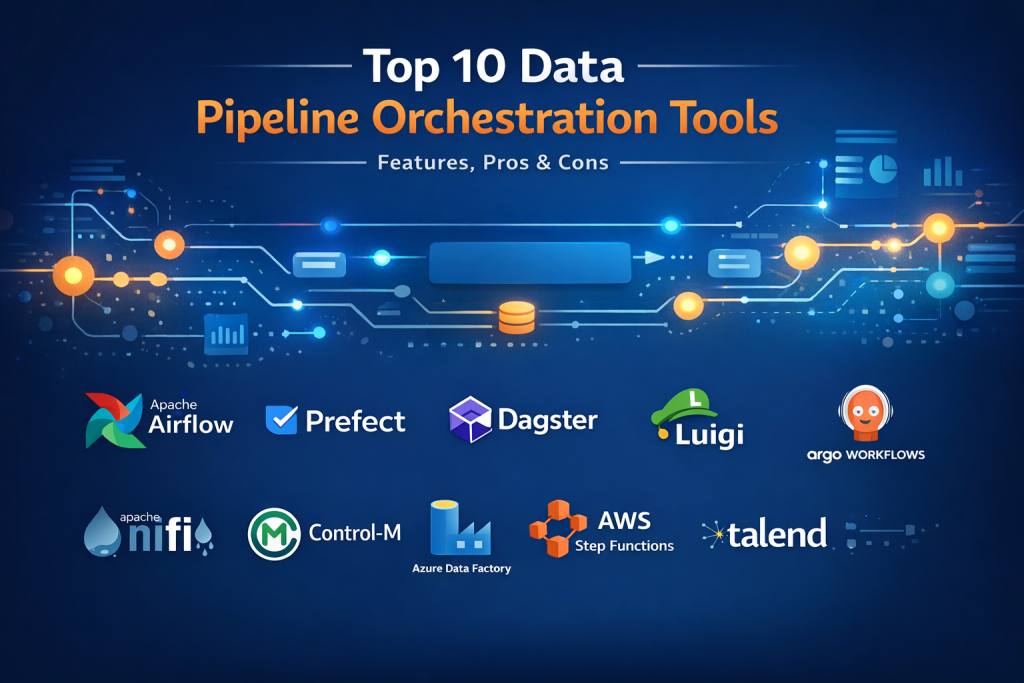
Top 10 Data Pipeline Orchestration Tools
1 — Apache Airflow
Short description:
Apache Airflow is one of the most widely adopted open-source orchestration platforms, designed for programmatic, scalable workflow management using Python.
Key features:
- Python-based DAG (Directed Acyclic Graph) definitions
- Rich scheduling and dependency management
- Extensive plugin and operator ecosystem
- Strong monitoring and retry mechanisms
- Cloud and on-prem deployment flexibility
- Large open-source community
Pros:
- Extremely flexible and extensible
- Industry-standard with broad adoption
Cons:
- Steep learning curve for beginners
- Operational overhead for self-managed deployments
Security & compliance:
Role-based access control, authentication integrations, encryption support (varies by deployment).
Support & community:
Large global community, extensive documentation, and enterprise support via vendors.
2 — Prefect
Short description:
Prefect focuses on developer experience, offering modern workflow orchestration with strong observability and flexible execution models.
Key features:
- Python-first workflow definitions
- Dynamic and reactive workflows
- Built-in retries and state handling
- Cloud-hosted and self-hosted options
- Strong observability and logging
Pros:
- Easier to learn than many alternatives
- Excellent monitoring and debugging
Cons:
- Smaller ecosystem compared to Airflow
- Some advanced features tied to paid plans
Security & compliance:
SSO, encryption, audit logs; compliance varies by plan.
Support & community:
Growing community, high-quality documentation, responsive support.
3 — Dagster
Short description:
Dagster emphasizes data assets, type safety, and observability, making it popular among modern analytics engineering teams.
Key features:
- Asset-centric orchestration model
- Strong type checking and validation
- Integrated testing capabilities
- Cloud and self-managed options
- Rich UI for pipeline introspection
Pros:
- Excellent data quality focus
- Strong developer tooling
Cons:
- Conceptual shift from task-based tools
- Smaller community than Airflow
Security & compliance:
SSO, RBAC, encryption; enterprise compliance options available.
Support & community:
Active community, strong documentation, enterprise support available.
4 — Luigi
Short description:
Luigi is a lightweight orchestration framework focused on batch processing and dependency resolution.
Key features:
- Python-based task definitions
- Simple dependency management
- Minimal infrastructure requirements
- Strong batch workflow support
Pros:
- Simple and lightweight
- Easy to get started
Cons:
- Limited UI and monitoring
- Not ideal for complex modern pipelines
Security & compliance:
Varies / N/A (depends on deployment).
Support & community:
Stable but smaller community, basic documentation.
5 — Argo Workflows
Short description:
Argo Workflows is designed for Kubernetes-native environments, offering scalable container-based workflows.
Key features:
- Kubernetes-native execution
- YAML-based workflow definitions
- Strong support for ML and batch jobs
- High scalability and fault tolerance
Pros:
- Excellent for containerized workloads
- Highly scalable
Cons:
- Kubernetes expertise required
- YAML-heavy configuration
Security & compliance:
Kubernetes-native security, RBAC, encryption support.
Support & community:
Active open-source community and strong CNCF backing.
6 — Apache NiFi
Short description:
Apache NiFi specializes in real-time data ingestion, routing, and transformation with a visual interface.
Key features:
- Drag-and-drop pipeline design
- Real-time data flow management
- Built-in data provenance
- Backpressure and prioritization
Pros:
- Excellent for streaming and ingestion
- Visual and user-friendly
Cons:
- Less suited for complex batch orchestration
- Can be resource-intensive
Security & compliance:
Strong security model, encryption, audit trails.
Support & community:
Mature community, solid documentation, enterprise support available.
7 — Control-M
Short description:
Control-M is an enterprise-grade workload automation platform supporting complex, mission-critical workflows.
Key features:
- Advanced scheduling and dependency handling
- Cross-platform workload automation
- SLA management and forecasting
- Strong governance and auditing
Pros:
- Enterprise reliability and scale
- Excellent compliance features
Cons:
- High cost
- Less developer-centric
Security & compliance:
SOC 2, ISO, GDPR, enterprise-grade security.
Support & community:
Professional enterprise support, limited open community.
8 — Azure Data Factory
Short description:
Azure Data Factory is a managed cloud service for building and orchestrating data pipelines within the Azure ecosystem.
Key features:
- Visual pipeline authoring
- Deep Azure integration
- Managed scaling and execution
- Hybrid data movement support
Pros:
- Fully managed service
- Strong enterprise integration
Cons:
- Azure-centric
- Limited flexibility outside ecosystem
Security & compliance:
Strong Azure security, compliance certifications.
Support & community:
Enterprise-grade support, extensive documentation.
9 — AWS Step Functions
Short description:
AWS Step Functions enables orchestration of distributed services using a serverless approach.
Key features:
- Serverless workflow management
- Visual state machine design
- Deep AWS service integration
- High availability and scalability
Pros:
- No infrastructure management
- Reliable and scalable
Cons:
- AWS lock-in
- Less data-specific features
Security & compliance:
IAM-based security, encryption, compliance certifications.
Support & community:
Strong AWS support ecosystem.
10 — Talend Data Fabric
Short description:
Talend Data Fabric combines orchestration, integration, and governance into a unified enterprise solution.
Key features:
- End-to-end data integration
- Visual pipeline development
- Built-in data quality tools
- Enterprise governance features
Pros:
- Comprehensive enterprise platform
- Strong data governance
Cons:
- Expensive
- Less flexible for custom workflows
Security & compliance:
SOC, GDPR, enterprise-grade compliance.
Support & community:
Professional enterprise support, smaller open community.
Comparison Table
| Tool Name | Best For | Platform(s) Supported | Standout Feature | Rating |
|---|---|---|---|---|
| Apache Airflow | Complex, custom workflows | Cloud, On-prem | Python DAG flexibility | N/A |
| Prefect | Developer-friendly orchestration | Cloud, On-prem | Observability & ease of use | N/A |
| Dagster | Analytics engineering teams | Cloud, On-prem | Asset-based model | N/A |
| Luigi | Simple batch pipelines | On-prem, Cloud | Lightweight simplicity | N/A |
| Argo Workflows | Kubernetes-native pipelines | Kubernetes | Container-native scale | N/A |
| Apache NiFi | Real-time ingestion | Cloud, On-prem | Visual data flows | N/A |
| Control-M | Enterprise workloads | Multi-platform | SLA management | N/A |
| Azure Data Factory | Azure-centric pipelines | Cloud | Managed orchestration | N/A |
| AWS Step Functions | Serverless workflows | Cloud | Event-driven orchestration | N/A |
| Talend Data Fabric | Enterprise data ops | Cloud, On-prem | Governance & quality | N/A |
Evaluation & Scoring of Data Pipeline Orchestration Tools
| Criteria | Weight | Notes |
|---|---|---|
| Core features | 25% | Workflow depth and flexibility |
| Ease of use | 15% | Learning curve and UI |
| Integrations & ecosystem | 15% | Data stack compatibility |
| Security & compliance | 10% | Governance and controls |
| Performance & reliability | 10% | Stability at scale |
| Support & community | 10% | Docs and help |
| Price / value | 15% | ROI vs cost |
Which Data Pipeline Orchestration Tool Is Right for You?
- Solo users & small teams: Prefect, Luigi
- SMBs: Dagster, Apache Airflow (managed)
- Mid-market: Airflow, Argo Workflows, NiFi
- Enterprise: Control-M, Talend, Azure Data Factory
Budget-conscious: Open-source tools like Airflow, Dagster
Premium solutions: Control-M, Talend
Feature depth vs ease of use: Airflow (depth) vs Prefect (simplicity)
Scalability: Argo, AWS Step Functions
Compliance-heavy environments: Control-M, Talend
Frequently Asked Questions (FAQs)
- What is data pipeline orchestration?
It is the coordination of tasks, dependencies, and schedules in data workflows. - Is orchestration different from ETL tools?
Yes, orchestration manages workflows, while ETL focuses on data movement. - Do I need coding skills?
Most tools require some coding, though visual tools exist. - Which tool is best for beginners?
Prefect and NiFi are generally easier to start with. - Are open-source tools reliable?
Yes, many power production systems worldwide. - How important is monitoring?
Critical for detecting failures and ensuring data freshness. - Can these tools handle streaming data?
Some, like NiFi, are better suited for streaming use cases. - Are these tools secure?
Most offer enterprise-grade security when configured properly. - What are common mistakes?
Underestimating complexity and ignoring monitoring. - Can I switch tools later?
Yes, but migration can be costly—choose carefully.
Conclusion
Data pipeline orchestration tools are foundational to reliable, scalable data operations. The right choice depends on your team size, technical expertise, budget, and compliance needs. While there is no universal winner, understanding your requirements and trade-offs will help you select a tool that delivers long-term value and operational confidence.

Find Trusted Cardiac Hospitals
Compare heart hospitals by city and services — all in one place.
Explore Hospitals