
Introduction
Demand Planning Tools are specialized software solutions designed to help businesses forecast customer demand accurately, balance supply with demand, and make data-driven decisions across procurement, production, inventory, and distribution. These tools combine historical sales data, market trends, seasonality, promotions, and advanced analytics to predict future demand with higher confidence.
In today’s volatile markets—shaped by fluctuating customer behavior, global disruptions, and shorter product lifecycles—manual forecasting using spreadsheets is no longer enough. Demand planning tools enable organizations to reduce stockouts, avoid overstocking, improve service levels, and optimize working capital. They are widely used across industries such as retail, manufacturing, consumer goods, pharmaceuticals, food & beverage, logistics, and e-commerce.
Key real-world use cases include:
- Forecasting seasonal and promotional demand
- Aligning sales, operations, and finance (S&OP / IBP)
- Optimizing inventory levels across multiple locations
- Improving production and capacity planning
- Responding faster to market changes
When choosing a demand planning tool, users should evaluate forecast accuracy, usability, scalability, integration capabilities, analytics depth, collaboration features, and security standards.
Best for:
Demand Planning Tools are ideal for demand planners, supply chain managers, operations leaders, procurement teams, and finance executives in SMBs to large enterprises across retail, manufacturing, CPG, healthcare, and distribution-driven industries.
Not ideal for:
Very small businesses with limited data, highly stable demand, or simple operations may find these tools overpowered. In such cases, lightweight forecasting or basic ERP modules may be sufficient.
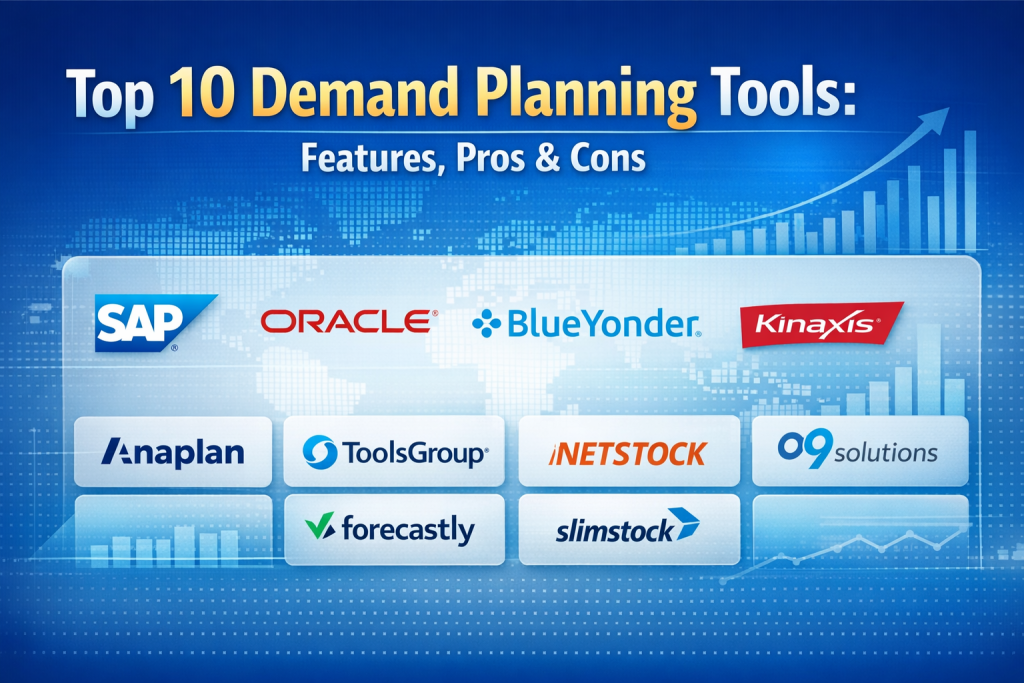
Top 10 Demand Planning Tools
1 — SAP Integrated Business Planning (SAP IBP)
Short description:
SAP IBP is an enterprise-grade demand planning and forecasting platform designed for large organizations with complex global supply chains and advanced planning needs.
Key features
- Advanced demand forecasting using statistical and AI models
- Integrated S&OP and IBP workflows
- Real-time scenario simulation and what-if analysis
- Tight integration with SAP ERP and supply modules
- Demand sensing using near-real-time data
- Collaboration across sales, operations, and finance
- Scalable cloud-based architecture
Pros
- Extremely powerful and comprehensive planning capabilities
- Best-in-class integration within SAP ecosystem
- Highly scalable for global enterprises
Cons
- High implementation and licensing cost
- Steep learning curve for new users
- Overkill for small or mid-sized companies
Security & compliance:
Enterprise-grade security, SSO, role-based access, encryption, audit logs, GDPR, ISO standards.
Support & community:
Strong enterprise support, extensive documentation, global SAP partner ecosystem, large user community.
2 — Oracle Demand Management Cloud
Short description:
Oracle Demand Management Cloud helps organizations forecast demand accurately and align it with supply planning and execution.
Key features
- Machine learning-based forecasting
- Multidimensional demand analysis
- Demand sensing and segmentation
- Scenario planning and simulations
- Native integration with Oracle SCM Cloud
- Automated forecast error tracking
Pros
- Strong forecasting accuracy with ML models
- Seamless integration with Oracle SCM suite
- Suitable for large, complex organizations
Cons
- Best value only within Oracle ecosystem
- UI can feel complex to new users
- Higher total cost of ownership
Security & compliance:
SOC 2, ISO, GDPR, encryption, role-based access, enterprise SSO.
Support & community:
Robust Oracle support, enterprise onboarding, large customer base, certified partners.
3 — Blue Yonder Demand Planning
Short description:
Blue Yonder provides AI-driven demand planning designed for retailers, manufacturers, and logistics-heavy enterprises.
Key features
- AI and ML-driven forecasting models
- Demand sensing with real-time signals
- Promotion and event-based forecasting
- End-to-end supply chain visibility
- Scenario modeling and risk analysis
- Cloud-native architecture
Pros
- Very strong AI capabilities
- Excellent for retail and omni-channel demand
- Scales well for large enterprises
Cons
- Complex configuration and setup
- Premium pricing
- Requires skilled planners to maximize value
Security & compliance:
Enterprise-grade security, GDPR, ISO certifications, encryption, access controls.
Support & community:
Dedicated enterprise support, training programs, strong retail-focused community.
4— Kinaxis RapidResponse
Short description:
Kinaxis RapidResponse focuses on concurrent planning, enabling fast decision-making across demand, supply, and inventory.
Key features
- Real-time demand and supply synchronization
- What-if scenario analysis
- Demand sensing and predictive analytics
- Integrated S&OP and supply planning
- In-memory processing for speed
- Collaboration across teams
Pros
- Extremely fast scenario analysis
- Excellent visibility across supply chain
- Ideal for volatile demand environments
Cons
- Higher cost for SMBs
- Requires training for full adoption
- Limited customization without consultants
Security & compliance:
SSO, encryption, audit trails, GDPR, SOC compliance.
Support & community:
Strong customer support, enterprise onboarding, active user forums.
5 — o9 Solutions Digital Brain
Short description:
o9 Solutions offers an AI-powered integrated planning platform combining demand planning, supply planning, and analytics.
Key features
- AI and graph-based forecasting
- End-to-end integrated business planning
- Scenario simulation and risk modeling
- Demand sensing and market signals
- Advanced analytics and dashboards
- Cloud-native, scalable platform
Pros
- Highly flexible and modern architecture
- Strong AI and analytics capabilities
- Supports complex, cross-functional planning
Cons
- Implementation can be resource-intensive
- Premium pricing
- Learning curve for advanced features
Security & compliance:
Enterprise security, SSO, encryption, GDPR, ISO standards.
Support & community:
Dedicated enterprise support, training, growing user ecosystem.
6 — Anaplan Supply Chain Planning
Short description:
Anaplan provides connected planning for demand, supply, finance, and operations through a unified modeling platform.
Key features
- Real-time collaborative planning
- Scenario modeling and forecasting
- Integrated financial and demand planning
- Cloud-based modeling engine
- Customizable dashboards
- Strong workflow automation
Pros
- Excellent collaboration and flexibility
- Strong finance and demand alignment
- Scales well across departments
Cons
- Modeling complexity for beginners
- Costs increase with scale
- Requires skilled model builders
Security & compliance:
SOC 2, GDPR, ISO, SSO, role-based permissions.
Support & community:
Strong documentation, active community, enterprise support options.
7 — ToolsGroup SO99+
Short description:
ToolsGroup specializes in probabilistic forecasting and inventory optimization for demand-driven organizations.
Key features
- Probabilistic demand forecasting
- Inventory optimization based on service levels
- Multi-echelon planning
- AI-driven replenishment
- Forecast accuracy monitoring
- ERP integration support
Pros
- Excellent forecast accuracy
- Strong inventory optimization focus
- Suitable for distribution-heavy businesses
Cons
- Less intuitive UI
- Limited visualization compared to newer tools
- Smaller ecosystem than big vendors
Security & compliance:
Standard enterprise security, GDPR, encryption, access controls.
Support & community:
Good customer support, industry-focused expertise, smaller user community.
8 — Netstock
Short description:
Netstock is a demand planning and inventory optimization tool tailored for SMBs and mid-market companies.
Key features
- Automated demand forecasting
- Inventory replenishment planning
- ERP integration
- Dashboards and alerts
- Scenario planning
- Multi-location inventory support
Pros
- Easy to use and fast to implement
- Affordable for SMBs
- Strong inventory focus
Cons
- Limited advanced analytics
- Not ideal for very large enterprises
- Customization options are moderate
Security & compliance:
Cloud security standards, encryption, role-based access, GDPR.
Support & community:
Responsive support team, onboarding assistance, smaller but helpful community.
9 — Forecastly
Short description:
Forecastly is a user-friendly demand forecasting tool focused on simplicity and quick adoption for growing businesses.
Key features
- Statistical and AI-based forecasting
- Sales and demand trend analysis
- Simple dashboards and reports
- Scenario planning
- CSV and ERP integrations
- Collaborative workflows
Pros
- Very easy to learn
- Cost-effective
- Quick deployment
Cons
- Limited enterprise scalability
- Fewer advanced features
- Basic customization
Security & compliance:
Standard cloud security, encryption, GDPR.
Support & community:
Good documentation, responsive support, limited community size.
10 — Slimstock Slim4
Short description:
Slim4 focuses on demand forecasting and inventory optimization with strong planning logic for retail and distribution.
Key features
- Demand forecasting with seasonality handling
- Inventory and replenishment optimization
- Exception-based planning
- Scenario simulations
- ERP integration
- Multi-echelon planning
Pros
- Strong balance of usability and depth
- Effective for retail and wholesale
- Good forecast transparency
Cons
- UI feels dated
- Limited AI compared to newer tools
- Custom reports may require support
Security & compliance:
Role-based access, encryption, GDPR compliance.
Support & community:
Solid customer support, training programs, regional user groups.
Comparison Table
| Tool Name | Best For | Platform(s) Supported | Standout Feature | Rating |
|---|---|---|---|---|
| SAP IBP | Large enterprises | Cloud | End-to-end IBP | N/A |
| Oracle Demand Mgmt | Oracle-centric orgs | Cloud | ML forecasting | N/A |
| Blue Yonder | Retail & CPG | Cloud | AI demand sensing | N/A |
| Kinaxis RapidResponse | Volatile demand | Cloud | Real-time scenarios | N/A |
| o9 Solutions | Integrated planning | Cloud | AI digital brain | N/A |
| Anaplan | Connected planning | Cloud | Collaborative modeling | N/A |
| ToolsGroup | Inventory-driven orgs | Cloud / Hybrid | Probabilistic forecasting | N/A |
| Netstock | SMBs | Cloud | Fast implementation | N/A |
| Forecastly | Growing teams | Cloud | Simplicity | N/A |
| Slimstock Slim4 | Retail & distribution | Cloud / On-prem | Inventory focus | N/A |
Evaluation & Scoring of Demand Planning Tools
| Criteria | Weight |
|---|---|
| Core features | 25% |
| Ease of use | 15% |
| Integrations & ecosystem | 15% |
| Security & compliance | 10% |
| Performance & reliability | 10% |
| Support & community | 10% |
| Price / value | 15% |
Insight:
Enterprise tools score highest on core features and scalability, while mid-market tools often win on ease of use and value.
Which Demand Planning Tool Is Right for You?
- Solo users & small teams: Lightweight tools like Forecastly or Netstock
- SMBs: Netstock, Slimstock, ToolsGroup
- Mid-market: Anaplan, ToolsGroup, Slimstock
- Enterprises: SAP IBP, Oracle, Blue Yonder, Kinaxis, o9
Budget-conscious users: SMB-focused tools with faster ROI
Premium solutions: Enterprise-grade IBP platforms
Feature depth vs simplicity: Advanced AI tools vs easy adoption
Integration needs: ERP-native tools for SAP or Oracle users
Security requirements: Enterprise tools for regulated industries
Frequently Asked Questions (FAQs)
1. What is a demand planning tool?
It is software that forecasts customer demand to optimize inventory, production, and supply decisions.
2. How accurate are demand planning tools?
Accuracy depends on data quality, model selection, and business complexity, but AI-based tools significantly outperform manual methods.
3. Are demand planning tools expensive?
Costs vary widely—from affordable SMB tools to premium enterprise platforms.
4. Can these tools integrate with ERP systems?
Yes, most support ERP integrations, especially SAP and Oracle ecosystems.
5. How long does implementation take?
SMB tools may take weeks, while enterprise platforms can take several months.
6. Do I need AI-based forecasting?
AI helps in volatile or complex environments but is not mandatory for stable demand.
7. Are these tools cloud-based?
Most modern tools are cloud-native, with some offering hybrid options.
8. Can they handle seasonal demand?
Yes, seasonality is a core feature of demand planning systems.
9. What are common mistakes when choosing a tool?
Overbuying features, ignoring usability, and underestimating change management.
10. Can demand planning tools replace planners?
No, they support planners by improving insights and decision-making.
Conclusion
Demand Planning Tools play a critical role in helping organizations forecast accurately, reduce costs, and respond quickly to market changes. From enterprise-grade platforms like SAP IBP and Oracle to SMB-friendly tools like Netstock and Forecastly, the market offers solutions for every business size and complexity.
The most important takeaway is that there is no single “best” demand planning tool for everyone. The right choice depends on your organization’s size, industry, data maturity, integration needs, budget, and planning sophistication. By focusing on real business requirements rather than hype, companies can select a tool that delivers measurable, long-term value.

Find Trusted Cardiac Hospitals
Compare heart hospitals by city and services — all in one place.
Explore Hospitals
This is a very insightful comparison of demand planning tools! The article neatly outlines the key features, advantages, and limitations of each solution, making it easier for supply chain and operations professionals to evaluate which platform best fits their forecasting, inventory optimization, and planning needs. A practical and well‑organized resource for anyone looking to improve accuracy, streamline workflows, and make better data‑driven decisions in demand planning.