
Introduction
Digital Banking Platforms are comprehensive technology solutions that enable banks, fintech companies, and financial institutions to deliver end-to-end banking services digitally. These platforms support everything from account onboarding and payments to lending, analytics, and customer engagement—without relying on traditional branch-centric infrastructure.
Their importance has grown rapidly as customer expectations shift toward 24/7 access, mobile-first experiences, real-time transactions, and personalized financial services. For banks, digital platforms reduce operational costs, improve scalability, and accelerate time-to-market for new products. For customers, they enable faster onboarding, seamless payments, instant insights, and better overall banking experiences.
Real-world use cases include launching neobanks, modernizing legacy core banking systems, enabling embedded finance for non-banks, supporting SME digital banking, and powering mobile-only financial services.
When evaluating Digital Banking Platforms, buyers should look at core functionality, scalability, integration capabilities, security and compliance, ease of customization, performance, and long-term vendor support. Choosing the right platform is less about popularity and more about alignment with business goals, regulatory environment, and customer expectations.
Best for:
Digital Banking Platforms are ideal for traditional banks, neobanks, fintech startups, credit unions, NBFCs, payment institutions, and enterprises offering embedded financial services. They benefit CIOs, CTOs, digital transformation leaders, and product teams focused on modern banking delivery.
Not ideal for:
These platforms may be excessive for very small financial cooperatives, businesses needing only basic payment processing, or organizations without regulatory obligations. In such cases, lightweight financial software or payment gateways may be more suitable.
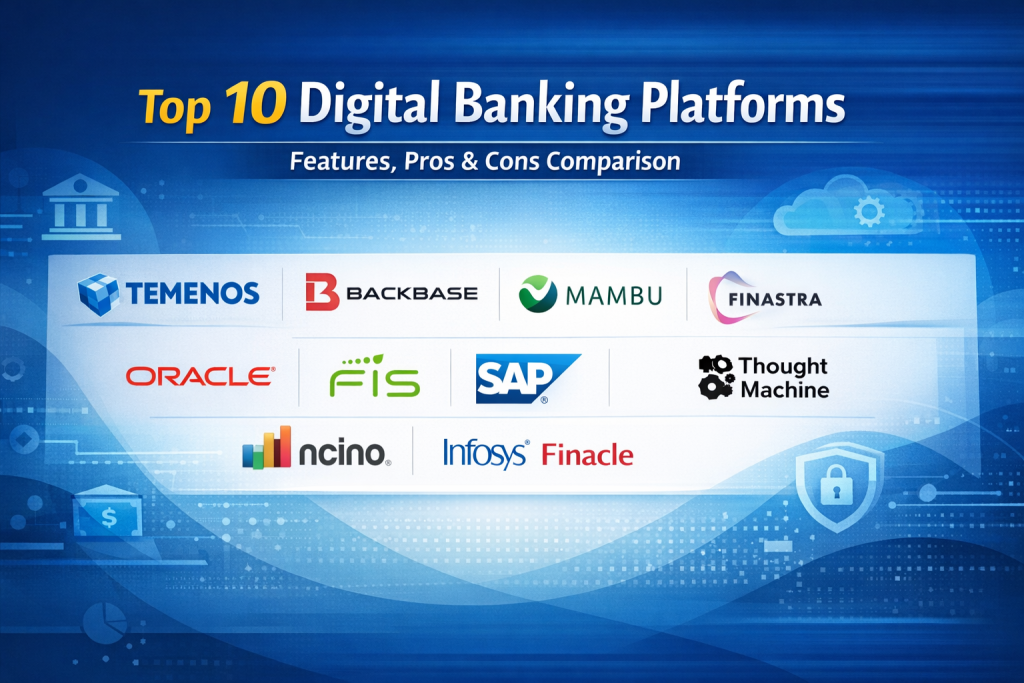
Top 10 Digital Banking Platforms Tools
1 — Temenos Infinity
Short description:
A full-stack digital banking platform designed for retail, corporate, and wealth banking with strong omnichannel capabilities.
Key features:
- Omnichannel customer journeys
- Modular microservices architecture
- AI-driven personalization
- Digital onboarding and KYC
- Payments and transaction management
- Open banking APIs
- Advanced analytics dashboard
Pros:
- Enterprise-grade scalability
- Strong global banking presence
- Highly customizable workflows
Cons:
- Complex implementation
- Higher total cost of ownership
Security & compliance:
SSO, encryption, audit logs, GDPR, ISO standards (varies by deployment)
Support & community:
Enterprise support, detailed documentation, global partner ecosystem
2 — Backbase
Short description:
A customer-experience-focused digital banking platform for banks aiming to modernize frontend and engagement layers.
Key features:
- Engagement banking framework
- Journey orchestration tools
- Digital onboarding
- Mobile and web banking SDKs
- Open API layer
- Personal finance management
- Real-time insights
Pros:
- Excellent UX capabilities
- Strong frontend customization
- Rapid innovation cycles
Cons:
- Relies on external core systems
- Advanced features require expertise
Security & compliance:
Encryption, SSO, GDPR, SOC 2 (varies by region)
Support & community:
Strong enterprise onboarding, active banking community
3 — Mambu
Short description:
A cloud-native core banking platform popular with fintechs and digital-first banks.
Key features:
- SaaS-based core banking
- Product configuration engine
- Real-time transaction processing
- Open APIs
- Multi-currency support
- Rapid product launches
- Cloud scalability
Pros:
- Fast time-to-market
- Modern API-first approach
- High reliability
Cons:
- Limited legacy banking depth
- Custom reporting may need add-ons
Security & compliance:
ISO standards, encryption, GDPR, audit controls
Support & community:
Strong documentation, partner-driven ecosystem
4 — Finastra Digital Banking
Short description:
A comprehensive platform serving retail, SME, and corporate digital banking needs.
Key features:
- Digital onboarding
- Payments and lending modules
- Omnichannel banking
- Open banking APIs
- Risk and compliance tools
- Data analytics
- Modular deployment options
Pros:
- Broad functional coverage
- Trusted by established banks
- Flexible integration options
Cons:
- UI modernization can be complex
- Licensing costs vary widely
Security & compliance:
SOC, GDPR, encryption, regulatory compliance tools
Support & community:
Global support network, enterprise documentation
5 — Thought Machine Vault
Short description:
A next-generation core banking platform built on cloud-native and smart contract principles.
Key features:
- Smart contract-based products
- Real-time ledger processing
- Cloud-agnostic deployment
- API-driven architecture
- Multi-currency and multi-entity support
- High availability design
Pros:
- Extremely flexible product design
- Modern core architecture
- High performance
Cons:
- Requires technical expertise
- Smaller ecosystem compared to legacy vendors
Security & compliance:
Encryption, audit trails, compliance-ready architecture
Support & community:
Dedicated enterprise support, growing developer community
6 — Oracle Digital Banking
Short description:
An enterprise-grade digital banking solution integrated with Oracle’s financial ecosystem.
Key features:
- Retail and corporate banking modules
- Digital lending
- AI-driven insights
- Omnichannel delivery
- Integration with Oracle core systems
- Advanced analytics
- Workflow automation
Pros:
- Strong enterprise integration
- Robust analytics capabilities
- High scalability
Cons:
- Best suited for Oracle environments
- Higher implementation effort
Security & compliance:
Enterprise-level security, encryption, regulatory compliance
Support & community:
Global enterprise support, extensive documentation
7 — FIS Digital One
Short description:
A unified digital banking platform designed for financial institutions seeking end-to-end digital services.
Key features:
- Unified customer experience
- Payments and transfers
- Digital account opening
- Alerts and notifications
- Analytics and insights
- API integrations
- Mobile and web banking
Pros:
- Comprehensive banking coverage
- Trusted industry reputation
- Scalable architecture
Cons:
- Customization may require vendor support
- UI flexibility varies by module
Security & compliance:
SOC, encryption, audit logging, regulatory compliance
Support & community:
Enterprise support, strong banking client base
8 — SAP Digital Banking
Short description:
A banking solution integrated into SAP’s enterprise finance and analytics ecosystem.
Key features:
- Digital payments
- Customer engagement tools
- Integration with SAP ERP
- Advanced analytics
- Lending and account services
- Workflow automation
- Multi-channel support
Pros:
- Deep enterprise integration
- Strong analytics
- Suitable for large banks
Cons:
- Complex deployment
- Best for SAP-centric organizations
Security & compliance:
Enterprise-grade security, GDPR, ISO standards
Support & community:
Extensive enterprise support, SAP partner network
9 — nCino Banking Platform
Short description:
A cloud-based banking platform focused on digital transformation of lending and client engagement.
Key features:
- Digital loan origination
- Customer relationship management
- Workflow automation
- Analytics and reporting
- Cloud-native deployment
- Integration capabilities
Pros:
- Strong lending workflows
- Cloud-first design
- Improves operational efficiency
Cons:
- Lending-centric focus
- Limited retail banking depth
Security & compliance:
Encryption, audit logs, regulatory standards
Support & community:
Strong customer success programs, documentation
10 — Infosys Finacle
Short description:
A comprehensive digital banking suite supporting retail, corporate, and universal banking.
Key features:
- Core and digital banking modules
- Payments and lending
- Omnichannel delivery
- Analytics and insights
- Open API framework
- Global deployment support
Pros:
- Proven global deployments
- Broad functional coverage
- Strong scalability
Cons:
- Implementation complexity
- UI customization may require effort
Security & compliance:
ISO standards, encryption, regulatory compliance
Support & community:
Global enterprise support, extensive partner ecosystem
Comparison Table
| Tool Name | Best For | Platform(s) Supported | Standout Feature | Rating |
|---|---|---|---|---|
| Temenos Infinity | Large banks | Web, Mobile | Omnichannel journeys | N/A |
| Backbase | CX-focused banks | Web, Mobile | Engagement framework | N/A |
| Mambu | Fintechs | Cloud | API-first core | N/A |
| Finastra | Universal banks | Web, Mobile | Modular banking | N/A |
| Thought Machine | Digital-first banks | Cloud | Smart contracts | N/A |
| Oracle Digital Banking | Enterprises | Web, Mobile | Enterprise analytics | N/A |
| FIS Digital One | Mid-large banks | Web, Mobile | Unified banking | N/A |
| SAP Digital Banking | SAP customers | Web, Mobile | ERP integration | N/A |
| nCino | Lending-focused banks | Cloud | Digital lending | N/A |
| Infosys Finacle | Global banks | Web, Mobile | End-to-end suite | N/A |
Evaluation & Scoring of Digital Banking Platforms
| Criteria | Weight | Description |
|---|---|---|
| Core features | 25% | Breadth and depth of banking capabilities |
| Ease of use | 15% | UI, configuration, learning curve |
| Integrations & ecosystem | 15% | APIs, third-party compatibility |
| Security & compliance | 10% | Regulatory readiness |
| Performance & reliability | 10% | Stability and scalability |
| Support & community | 10% | Documentation and vendor support |
| Price / value | 15% | ROI and long-term cost efficiency |
Which Digital Banking Platforms Tool Is Right for You?
- Solo or startup fintechs: Cloud-native platforms with fast deployment and API flexibility
- SMBs and mid-market banks: Modular platforms balancing features and cost
- Large enterprises: Enterprise-grade platforms with compliance depth
- Budget-conscious teams: SaaS platforms with predictable pricing
- Feature-driven organizations: Platforms with rich lending, analytics, and customization
- Highly regulated environments: Vendors with proven compliance and audit readiness
Frequently Asked Questions (FAQs)
1. What is a Digital Banking Platform?
It is software that enables banks to deliver digital banking services across channels.
2. Are these platforms only for banks?
No, fintechs and enterprises offering financial services also use them.
3. How long does implementation take?
It varies from weeks for SaaS platforms to months for enterprise deployments.
4. Do these platforms replace core banking systems?
Some do; others sit on top of existing cores.
5. Are Digital Banking Platforms secure?
Most include strong encryption and compliance controls.
6. Can they scale globally?
Enterprise platforms are designed for multi-region scalability.
7. What is the biggest cost factor?
Customization, integration, and long-term licensing.
8. Are cloud platforms better than on-premise?
Cloud platforms offer faster scaling and lower infrastructure overhead.
9. Do they support mobile banking?
Yes, mobile support is a core capability.
10. What is the most common mistake when choosing a platform?
Ignoring long-term scalability and regulatory needs.
Conclusion
Digital Banking Platforms have become foundational to modern financial services, enabling innovation, efficiency, and superior customer experiences. The right platform depends on business size, regulatory environment, technical maturity, and strategic goals. Rather than searching for a single “best” option, organizations should focus on fit, flexibility, and future readiness. A well-chosen platform becomes not just a system—but a long-term growth enabler.

Find Trusted Cardiac Hospitals
Compare heart hospitals by city and services — all in one place.
Explore Hospitals
