
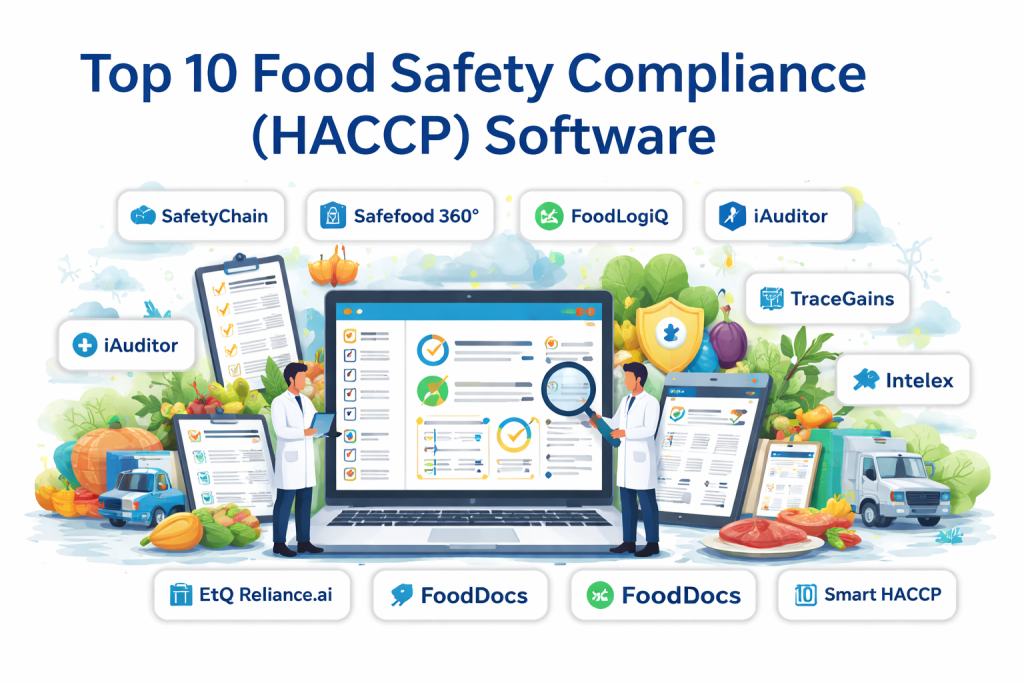
Introduction
Food Safety Compliance (HACCP) Software is a specialized digital solution designed to help food businesses implement, monitor, document, and maintain Hazard Analysis and Critical Control Points (HACCP) systems. These tools replace manual paperwork with structured, auditable, and real-time processes that ensure food safety standards are consistently met across operations.
In today’s food industry, compliance is no longer optional. Regulatory requirements are stricter, audits are more frequent, and consumer expectations around food safety and transparency are higher than ever. HACCP software helps organizations reduce risks such as contamination, spoilage, and non-compliance by standardizing processes, improving visibility, and creating reliable audit trails.
Common real-world use cases include monitoring critical control points (CCPs), tracking temperature logs, managing corrective actions, preparing for audits, training staff, and ensuring supplier compliance. When choosing a HACCP software solution, users should evaluate ease of use, regulatory coverage, reporting depth, scalability, integrations, offline access, and overall value.
Best for:
Food manufacturers, processors, restaurants, cloud kitchens, catering companies, food distributors, cold storage operators, quality assurance teams, and compliance managers across small, mid-sized, and enterprise food businesses.
Not ideal for:
Very small food operations with minimal regulatory exposure, businesses already operating under simple local compliance rules without formal audits, or companies looking only for basic checklist tools without full HACCP workflows.
Top 10 Food Safety Compliance (HACCP) Software Tools
1 — SafetyChain
Short description:
SafetyChain is an enterprise-grade food safety and quality management platform designed for manufacturers and processors managing complex compliance requirements.
Key features
- End-to-end HACCP and food safety management
- Real-time data collection and monitoring
- Advanced audit and inspection workflows
- Supplier quality and compliance management
- Corrective and preventive action (CAPA) tracking
- Custom reporting and dashboards
- Integration with ERP and operational systems
Pros
- Very strong enterprise-level capabilities
- Highly configurable for complex operations
- Excellent audit readiness and traceability
Cons
- Steeper learning curve for small teams
- Higher cost compared to SMB-focused tools
Security & compliance
Enterprise-grade encryption, role-based access, audit logs, GDPR-aligned practices; certifications vary by deployment.
Support & community
Strong onboarding, dedicated customer success managers, enterprise support, extensive documentation.
2 — Safefood 360°
Short description:
Safefood 360° is a comprehensive food safety and quality compliance solution focused on HACCP, ISO, and GFSI standards.
Key features
- HACCP plan creation and management
- Digital audits and inspections
- Supplier approval and monitoring
- Incident and corrective action management
- Training and competency tracking
- Customizable workflows and reports
Pros
- Deep regulatory and standards coverage
- Flexible configuration options
- Strong audit preparation tools
Cons
- Interface may feel complex for new users
- Setup requires careful planning
Security & compliance
Supports ISO-aligned controls, access management, audit trails, and data encryption.
Support & community
Professional onboarding, responsive support team, detailed knowledge base.
3 — FoodLogiQ
Short description:
FoodLogiQ focuses on food safety, traceability, and supplier transparency for brands and retailers.
Key features
- HACCP and food safety documentation
- Supplier compliance and verification
- Traceability and recall readiness
- Digital audits and assessments
- Centralized document management
- Data-driven compliance insights
Pros
- Strong supplier collaboration features
- Excellent traceability capabilities
- Trusted by large food brands
Cons
- Less suitable for very small operators
- Customization may require support involvement
Security & compliance
Robust data protection, audit logs, role-based permissions, GDPR-aligned practices.
Support & community
Structured onboarding, customer support, educational resources.
4 — iAuditor (SafetyCulture)
Short description:
iAuditor is a flexible inspection and compliance platform widely used for HACCP checklists and food safety audits.
Key features
- Customizable HACCP checklists
- Mobile inspections with offline access
- Issue tracking and corrective actions
- Photo and evidence capture
- Real-time reporting and dashboards
- Team collaboration features
Pros
- Very easy to use
- Strong mobile experience
- Quick deployment
Cons
- Not a full HACCP system out of the box
- Limited advanced food safety analytics
Security & compliance
Encryption in transit and at rest, audit logs, SSO options available on higher plans.
Support & community
Large user community, extensive documentation, responsive support.
5 — TraceGains
Short description:
TraceGains is a supplier compliance and food safety documentation platform focused on ingredient and supplier management.
Key features
- HACCP and food safety document control
- Supplier compliance automation
- Ingredient specification management
- Audit readiness and reporting
- Regulatory compliance tracking
- Recall preparedness tools
Pros
- Excellent supplier compliance automation
- Reduces manual document chasing
- Scales well for growing brands
Cons
- Limited operational HACCP monitoring
- Best value when supplier network is large
Security & compliance
Secure data storage, access controls, compliance-focused architecture.
Support & community
Dedicated onboarding, customer support, training resources.
6 — EtQ Reliance
Short description:
EtQ Reliance is a quality management system with strong food safety and HACCP modules for regulated industries.
Key features
- HACCP planning and monitoring
- Quality event and CAPA management
- Audit and inspection workflows
- Training management
- Risk assessment tools
- Enterprise reporting and analytics
Pros
- Very robust quality management features
- Highly configurable
- Suitable for large enterprises
Cons
- Complex implementation
- Higher cost and resource requirements
Security & compliance
Enterprise security controls, audit logs, configurable access, compliance-aligned frameworks.
Support & community
Enterprise-level support, onboarding services, extensive documentation.
7 — Intelex Food Safety
Short description:
Intelex provides a configurable EHS and food safety compliance platform with HACCP capabilities.
Key features
- HACCP program management
- Inspection and audit tools
- Incident and corrective action tracking
- Workflow automation
- Advanced reporting
- Integration with enterprise systems
Pros
- Highly customizable workflows
- Strong reporting capabilities
- Scales well for large organizations
Cons
- User interface may feel heavy
- Requires configuration effort
Security & compliance
Role-based access, encryption, audit logs, compliance-aligned data handling.
Support & community
Enterprise support options, onboarding assistance, training materials.
8 — Safefood.ai
Short description:
Safefood.ai is a modern, cloud-based HACCP and food safety platform focused on simplicity and automation.
Key features
- Digital HACCP plans
- Automated monitoring and alerts
- Mobile data capture
- Audit-ready reports
- Corrective action workflows
- Cloud-based document storage
Pros
- Clean, modern interface
- Faster adoption for teams
- Good balance of features and usability
Cons
- Fewer advanced enterprise integrations
- Smaller ecosystem
Security & compliance
Standard cloud security, access controls, data encryption; certifications vary.
Support & community
Responsive support, onboarding assistance, growing user community.
9 — FoodDocs
Short description:
FoodDocs is an SMB-focused HACCP and food safety software designed for restaurants and food service businesses.
Key features
- Automated HACCP plan creation
- Daily monitoring tasks and reminders
- Digital logs and records
- Audit preparation support
- Staff training materials
- Compliance dashboards
Pros
- Very easy to use
- Affordable for small businesses
- Minimal setup effort
Cons
- Limited customization for complex operations
- Not ideal for large manufacturers
Security & compliance
Cloud-based security, basic access controls, compliance-focused design.
Support & community
Strong onboarding, helpful support, educational resources.
10 — Smart HACCP
Short description:
Smart HACCP is a practical compliance tool focused on simplifying HACCP documentation and audits.
Key features
- Digital HACCP forms and logs
- Temperature and CCP monitoring
- Audit-ready reports
- Corrective action tracking
- Mobile-friendly interface
Pros
- Straightforward and practical
- Good for small to mid-sized operations
- Reduces paperwork significantly
Cons
- Limited advanced analytics
- Fewer integrations
Security & compliance
Basic security controls, cloud storage protections, audit logs vary.
Support & community
Email support, documentation, smaller user community.
Comparison Table
| Tool Name | Best For | Platform(s) Supported | Standout Feature | Rating |
|---|---|---|---|---|
| SafetyChain | Large manufacturers | Web, Cloud | Enterprise-grade food safety management | N/A |
| Safefood 360° | Regulated food producers | Web, Cloud | Deep standards compliance | N/A |
| FoodLogiQ | Brands & retailers | Web, Cloud | Supplier transparency | N/A |
| iAuditor | Audits & inspections | Web, Mobile | Ease of use | N/A |
| TraceGains | Supplier-heavy businesses | Web, Cloud | Supplier compliance automation | N/A |
| EtQ Reliance | Large enterprises | Web, Cloud | Quality management depth | N/A |
| Intelex | Enterprise food operations | Web, Cloud | Configurable workflows | N/A |
| Safefood.ai | Modern food teams | Web, Mobile | Automation and usability | N/A |
| FoodDocs | SMB restaurants | Web, Cloud | Simplicity and affordability | N/A |
| Smart HACCP | Small to mid-sized food firms | Web, Mobile | Practical HACCP documentation | N/A |
Evaluation & Scoring of Food Safety Compliance (HACCP) Software
| Criteria | Weight | Description |
|---|---|---|
| Core features | 25% | HACCP coverage, monitoring, reporting |
| Ease of use | 15% | User experience and adoption speed |
| Integrations & ecosystem | 15% | ERP, suppliers, sensors, APIs |
| Security & compliance | 10% | Data protection and audit readiness |
| Performance & reliability | 10% | Stability and uptime |
| Support & community | 10% | Onboarding, help resources |
| Price / value | 15% | Cost vs feature depth |
Which Food Safety Compliance (HACCP) Software Tool Is Right for You?
- Solo users and small teams: Tools like FoodDocs and Smart HACCP offer simplicity and affordability.
- SMBs: Safefood.ai and iAuditor provide a balance between usability and compliance depth.
- Mid-market organizations: TraceGains and FoodLogiQ excel in supplier-heavy environments.
- Enterprises: SafetyChain, Safefood 360°, EtQ Reliance, and Intelex offer scalability and advanced controls.
- Budget-conscious buyers: SMB-focused tools with predefined workflows.
- Compliance-heavy operations: Enterprise platforms with strong audit and reporting features.
- Integration-focused teams: Look for tools that support ERP and supplier data flows.
- High-security environments: Prioritize platforms with strong access controls and audit logs.
Frequently Asked Questions (FAQs)
1. What is HACCP software used for?
It helps manage food safety risks by digitizing HACCP plans, monitoring CCPs, and preparing audit-ready documentation.
2. Is HACCP software mandatory?
Not always, but it greatly simplifies compliance and reduces audit risks.
3. Can small restaurants use HACCP software?
Yes, many tools are designed specifically for small food businesses.
4. How long does implementation take?
It can range from a few days for simple tools to several months for enterprise platforms.
5. Does HACCP software replace audits?
No, but it makes audits faster and more accurate.
6. Is training required?
Basic training is recommended to ensure correct usage.
7. Can these tools work offline?
Some mobile-focused platforms support offline data capture.
8. Are integrations necessary?
Not always, but integrations improve efficiency for larger operations.
9. How secure is HACCP software?
Most reputable tools use encryption and access controls.
10. What is the biggest mistake buyers make?
Choosing overly complex software for simple operations or underpowered tools for complex needs.
Conclusion
Food Safety Compliance (HACCP) Software plays a critical role in protecting consumers, ensuring regulatory compliance, and maintaining operational efficiency in the food industry. The right solution helps teams move beyond manual paperwork to proactive, data-driven food safety management.
There is no single “best” HACCP software for everyone. The ideal choice depends on company size, regulatory exposure, operational complexity, budget, and long-term growth plans. By carefully evaluating features, usability, compliance depth, and support, organizations can select a tool that truly fits their needs and strengthens their food safety culture.

Find Trusted Cardiac Hospitals
Compare heart hospitals by city and services — all in one place.
Explore Hospitals
