
Introduction
Food Supply Chain Traceability Tools are specialized digital platforms designed to track, record, and verify the movement of food products from farm to fork. These tools create end-to-end visibility across suppliers, processors, distributors, retailers, and regulators, ensuring that every ingredient, batch, and process step can be traced accurately and quickly.
In today’s globalized food ecosystem, traceability is no longer optional. Food safety regulations, consumer transparency demands, recall preparedness, sustainability reporting, and brand protection all depend on reliable traceability systems. When contamination, fraud, or labeling errors occur, organizations without proper traceability face delayed recalls, regulatory penalties, reputational damage, and financial losses.
Real-world use cases include rapid recall management, allergen tracking, cold-chain compliance, organic and sustainability certification, supplier audits, and proof of origin for premium products. Modern traceability tools combine cloud platforms, IoT data, QR codes, blockchain, and analytics to deliver trustworthy records across complex supply networks.
When evaluating Food Supply Chain Traceability Tools, buyers should focus on data accuracy, interoperability, scalability, regulatory compliance, ease of adoption, and total cost of ownership—not just flashy technology.
Best for:
Food manufacturers, processors, importers/exporters, distributors, retailers, agribusinesses, compliance teams, quality managers, sustainability leaders, and regulators across small, mid-market, and enterprise organizations.
Not ideal for:
Very small producers with ultra-simple supply chains, businesses without regulatory traceability requirements, or organizations seeking only basic inventory tracking rather than full farm-to-fork visibility.
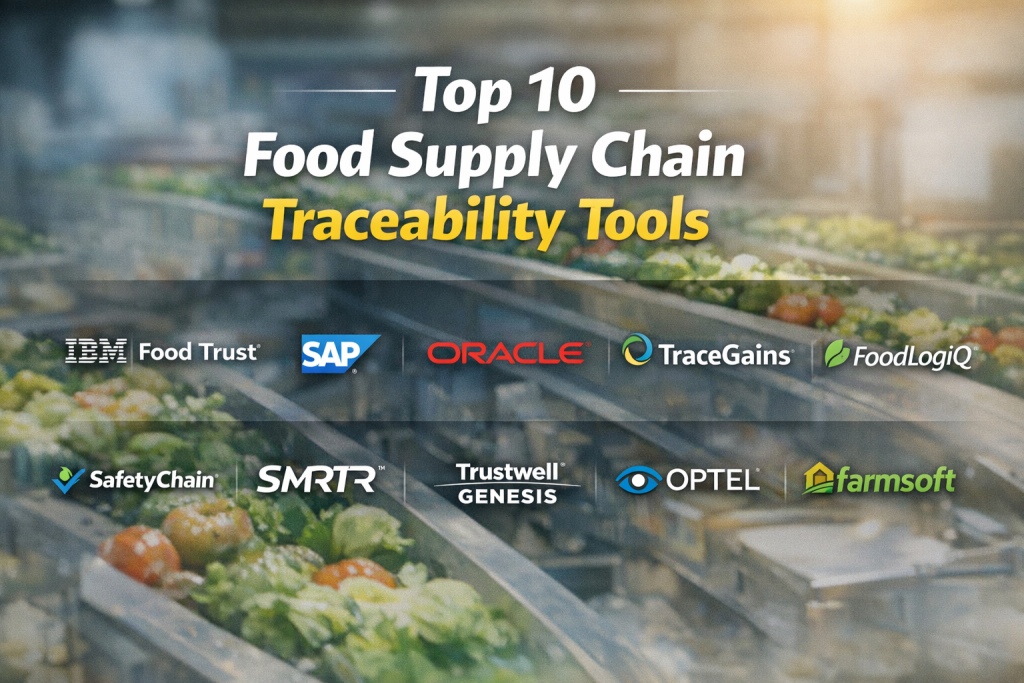
Top 10 Food Supply Chain Traceability Tools
1 — IBM Food Trust
Short description:
A blockchain-based food traceability network designed for large, complex supply chains requiring high trust, transparency, and auditability.
Key features:
- End-to-end blockchain traceability
- Immutable audit trails
- Batch and lot-level tracking
- Supplier onboarding workflows
- Recall and contamination analysis
- Data standardization across partners
Pros:
- Extremely high data integrity
- Strong enterprise adoption
- Excellent recall response speed
Cons:
- Higher implementation cost
- Requires partner participation
- Less suitable for very small suppliers
Security & compliance:
Enterprise-grade encryption, role-based access, audit logs, GDPR support
Support & community:
Enterprise support, extensive documentation, strong partner ecosystem
2 — SAP Supply Chain Traceability
Short description:
An enterprise-grade traceability solution tightly integrated with ERP, manufacturing, and quality management workflows.
Key features:
- End-to-end batch genealogy
- ERP-native traceability
- Regulatory compliance reporting
- Supplier and plant-level tracking
- Recall execution workflows
- Advanced analytics integration
Pros:
- Deep ERP integration
- Highly scalable
- Strong compliance capabilities
Cons:
- Complex configuration
- High licensing cost
- Longer deployment cycles
Security & compliance:
ISO-aligned controls, encryption, role-based access, audit trails
Support & community:
Global enterprise support, certified partners, large user community
3 — Oracle Food Traceability
Short description:
A cloud-based traceability platform focused on compliance, supplier visibility, and food safety analytics.
Key features:
- Ingredient-to-product traceability
- Supplier risk monitoring
- Recall simulation and execution
- Compliance dashboards
- Integration with ERP and WMS
- Predictive analytics
Pros:
- Strong analytics
- Cloud-native scalability
- Robust compliance reporting
Cons:
- Costly for smaller firms
- Customization complexity
- Requires Oracle ecosystem alignment
Security & compliance:
Enterprise cloud security, encryption, audit logs, GDPR compliance
Support & community:
Enterprise-level support, detailed documentation
4— TraceGains
Short description:
A food-specific traceability and compliance platform built for ingredient transparency and supplier documentation management.
Key features:
- Supplier documentation management
- Ingredient traceability
- Allergen and nutrition data tracking
- Recall readiness tools
- Regulatory compliance workflows
- Food safety data exchange
Pros:
- Food-industry specialization
- Faster onboarding than ERP tools
- Strong supplier collaboration
Cons:
- Limited non-food use cases
- Less customizable analytics
- Mid-range pricing
Security & compliance:
Encryption, audit trails, food regulatory compliance support
Support & community:
Dedicated food industry support, onboarding assistance
5— FoodLogiQ
Short description:
A cloud traceability platform focused on food safety, supplier compliance, and recall preparedness.
Key features:
- Lot-level traceability
- Supplier compliance tracking
- Recall management
- Audit readiness tools
- Quality incident tracking
- Dashboard reporting
Pros:
- User-friendly interface
- Strong recall tools
- Designed for food safety teams
Cons:
- Limited advanced analytics
- Fewer ERP-level controls
- Best for mid-market firms
Security & compliance:
Standard encryption, access controls, audit logs
Support & community:
Responsive customer support, solid documentation
6— SafetyChain
Short description:
An integrated food safety and traceability platform designed for compliance-driven organizations.
Key features:
- End-to-end traceability
- Quality and safety workflows
- Audit and inspection management
- Recall management
- Supplier approval processes
- Compliance reporting
Pros:
- Strong compliance focus
- Integrated quality workflows
- Scales well for manufacturers
Cons:
- Interface learning curve
- Higher setup effort
- Less flexible for non-compliance use
Security & compliance:
Role-based access, audit logs, regulatory compliance support
Support & community:
Enterprise support, implementation consulting available
7 — SMRTR Traceability
Short description:
A modular traceability solution emphasizing automation, labeling, and backhaul tracking.
Key features:
- Barcode and label traceability
- Automated compliance workflows
- Supplier data management
- ERP integration
- Recall reporting
- Real-time tracking
Pros:
- Flexible modular design
- Strong automation capabilities
- Good integration options
Cons:
- Less brand recognition
- Smaller ecosystem
- Requires configuration effort
Security & compliance:
Encryption, access controls, audit logs
Support & community:
Direct vendor support, technical onboarding
8 — Trustwell Genesis
Short description:
A food traceability and labeling platform designed for transparency, nutrition accuracy, and regulatory compliance.
Key features:
- Ingredient and allergen traceability
- Nutrition labeling accuracy
- Supplier data validation
- Recall readiness
- Compliance documentation
- Audit reporting
Pros:
- Excellent for labeling accuracy
- Food-specific workflows
- Clear compliance focus
Cons:
- Narrow industry focus
- Less supply chain analytics
- Limited logistics features
Security & compliance:
Data encryption, audit trails, food compliance support
Support & community:
Strong documentation, food industry expertise
9 — Optel Group
Short description:
An advanced traceability solution combining hardware, software, and serialization for regulated food environments.
Key features:
- Serialization and aggregation
- Vision system integration
- Batch-level traceability
- Compliance reporting
- Recall execution tools
- Hardware-software integration
Pros:
- High precision traceability
- Suitable for regulated products
- Strong serialization capabilities
Cons:
- Higher cost
- Hardware dependency
- Complex implementation
Security & compliance:
Enterprise security, audit logs, regulatory alignment
Support & community:
Global enterprise support, professional services
10 — FarmSoft Traceability
Short description:
A farm-to-processor traceability tool focused on agricultural operations and primary producers.
Key features:
- Farm-level traceability
- Crop and harvest tracking
- Supplier transparency
- Sustainability reporting
- Batch and lot tracking
- Compliance documentation
Pros:
- Strong agricultural focus
- Affordable for producers
- Simple deployment
Cons:
- Limited enterprise features
- Fewer integrations
- Less suitable for global supply chains
Security & compliance:
Basic security controls, compliance support varies
Support & community:
Standard support, agriculture-focused resources
Comparison Table
| Tool Name | Best For | Platform(s) Supported | Standout Feature | Rating |
|---|---|---|---|---|
| IBM Food Trust | Global enterprises | Cloud | Blockchain traceability | N/A |
| SAP Supply Chain Traceability | Large manufacturers | Cloud / On-prem | ERP-native genealogy | N/A |
| Oracle Food Traceability | Compliance-driven firms | Cloud | Predictive analytics | N/A |
| TraceGains | Ingredient transparency | Cloud | Supplier compliance | N/A |
| FoodLogiQ | Food safety teams | Cloud | Recall readiness | N/A |
| SafetyChain | Compliance-heavy ops | Cloud | Integrated quality workflows | N/A |
| SMRTR | Automated traceability | Cloud / Hybrid | Modular automation | N/A |
| Trustwell Genesis | Labeling accuracy | Cloud | Nutrition compliance | N/A |
| Optel Group | Regulated products | Hybrid | Serialization precision | N/A |
| FarmSoft Traceability | Producers & farms | Cloud | Farm-to-processor visibility | N/A |
Evaluation & Scoring of Food Supply Chain Traceability Tools
| Criteria | Weight | Score Explanation |
|---|---|---|
| Core features | 25% | Depth of traceability, recall, analytics |
| Ease of use | 15% | User experience and onboarding |
| Integrations & ecosystem | 15% | ERP, WMS, supplier connectivity |
| Security & compliance | 10% | Audit logs, encryption, standards |
| Performance & reliability | 10% | Scalability and uptime |
| Support & community | 10% | Training, vendor support |
| Price / value | 15% | Cost vs functionality |
Which Food Supply Chain Traceability Tool Is Right for You?
- Solo users & small producers: Farm-focused, lightweight tools with lower cost and simple setup
- SMBs: Food-specific SaaS platforms offering recall readiness and supplier compliance
- Mid-market: Integrated traceability with analytics and automation
- Enterprise: ERP-integrated or blockchain-based platforms for global scale
Budget-conscious teams should prioritize usability and compliance coverage, while premium buyers benefit from deep analytics, partner ecosystems, and scalability. Integration and regulatory complexity often matter more than feature count.
Frequently Asked Questions (FAQs)
1. What is food supply chain traceability?
It is the ability to track food products and ingredients across every supply chain stage.
2. Why is traceability important for food safety?
It enables faster recalls, contamination control, and regulatory compliance.
3. Do small food businesses need traceability tools?
Yes, especially when regulations or buyer requirements apply.
4. Are blockchain tools necessary?
Only for high-trust, multi-partner environments needing immutable records.
5. How long does implementation take?
From weeks for SaaS tools to months for enterprise platforms.
6. Are these tools expensive?
Costs vary widely based on scale, integrations, and compliance needs.
7. Do traceability tools replace ERP systems?
No, they typically integrate with ERP platforms.
8. What data should be tracked?
Ingredients, batches, suppliers, locations, dates, and compliance records.
9. Can traceability improve sustainability reporting?
Yes, by validating sourcing and production practices.
10. What is the biggest mistake buyers make?
Choosing tools without considering supplier adoption and data quality.
Conclusion
Food Supply Chain Traceability Tools play a critical role in food safety, compliance, transparency, and brand protection. The right platform helps organizations respond quickly to risks, meet regulatory demands, and build consumer trust.
There is no universal best solution. The optimal choice depends on company size, supply chain complexity, regulatory exposure, budget, and integration needs. By focusing on real-world usability, compliance strength, and scalability, organizations can select a traceability tool that delivers long-term value rather than short-term convenience.

Find Trusted Cardiac Hospitals
Compare heart hospitals by city and services — all in one place.
Explore Hospitals
This article offers a clear and practical overview of the leading food supply chain traceability tools, comparing their key features, benefits, and limitations. It’s helpful to see how different platforms handle product tracking, quality control, regulatory compliance, and integration with existing systems — all critical factors for improving transparency and safety in food production and distribution. By outlining strengths and drawbacks side by side, the post makes it easier for businesses to evaluate which solution aligns best with their traceability goals and operational needs. Overall, this is a valuable guide for anyone looking to enhance supply chain visibility and ensure food safety from farm to table.