
Introduction
Hospital Bed Management Systems (HBMS) are specialized digital platforms designed to track, allocate, and optimize hospital bed usage in real time. In modern healthcare environments—where patient flow, emergency admissions, elective surgeries, and infection control must be balanced continuously—manual or spreadsheet-based bed tracking is no longer sufficient.
These systems provide live visibility into bed availability, patient status (occupied, vacant, cleaning, isolation), and discharge readiness. By connecting admissions, nursing units, housekeeping, and operations teams on a single platform, bed management software reduces delays, improves patient experience, and increases overall hospital efficiency.
In real-world settings, Hospital Bed Management Systems are critical for:
- Emergency departments managing unpredictable patient inflow
- ICU and specialty wards requiring strict capacity control
- Large hospitals and multi-site networks optimizing resources across facilities
- Pandemic and surge scenarios where bed availability can become life-critical
When choosing a Hospital Bed Management System, buyers should evaluate:
- Real-time visibility and automation
- Integration with EHR, ADT, and clinical systems
- Ease of use for clinical and non-clinical staff
- Scalability across departments and facilities
- Security, compliance, and reliability
Best for:
Hospital Bed Management Systems are best suited for medium to large hospitals, multi-specialty healthcare facilities, academic medical centers, hospital operations teams, nursing supervisors, and bed coordinators who need accurate, real-time operational control.
Not ideal for:
Very small clinics, outpatient-only facilities, or practices without inpatient beds may not require a dedicated bed management system and can rely on simpler scheduling or EHR-native tools.
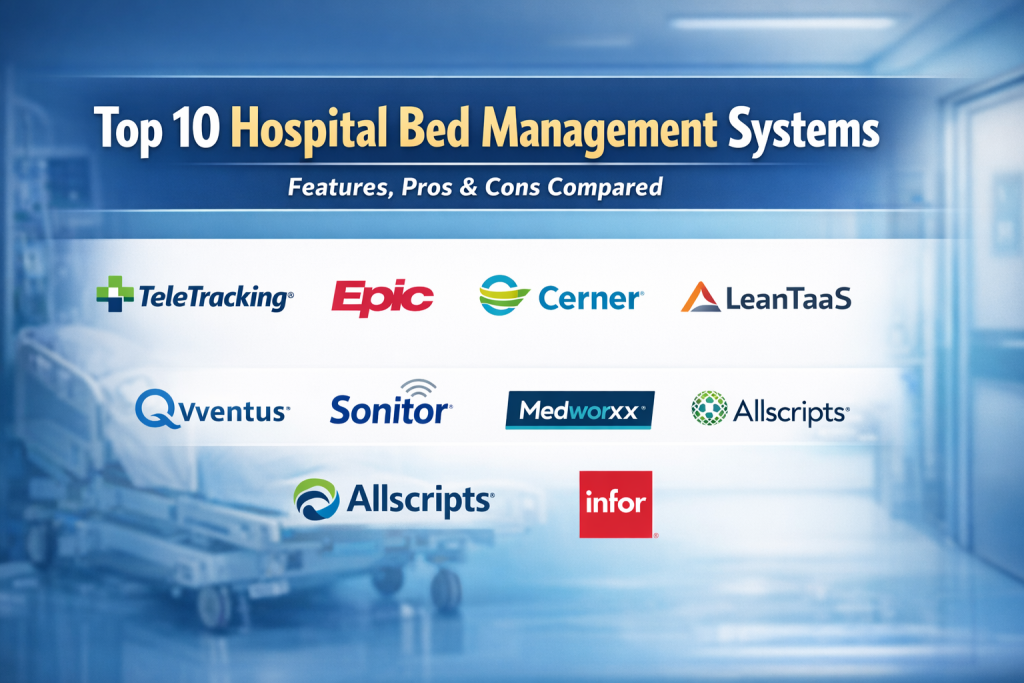
Top 10 Hospital Bed Management Systems Tools
1 — TeleTracking
Short description:
A market-leading hospital capacity and patient flow management platform designed for large hospitals and health systems.
Key features:
- Real-time bed availability dashboards
- Patient flow and transfer automation
- Predictive analytics for capacity planning
- Environmental services (EVS) coordination
- Surge and disaster management tools
- Integration with ADT and EHR systems
Pros:
- Extremely robust and enterprise-ready
- Strong analytics and forecasting capabilities
Cons:
- Higher cost compared to smaller tools
- Requires structured implementation
Security & compliance:
HIPAA-compliant, encryption in transit and at rest, audit logs
Support & community:
Enterprise onboarding, dedicated support teams, extensive documentation
2 — Epic Systems (Bed Management Module)
Short description:
An integrated bed and capacity management module built directly into the Epic EHR ecosystem.
Key features:
- Native ADT-driven bed tracking
- Unit-level and hospital-wide visibility
- Automated bed assignment workflows
- Integration with clinical documentation
- Discharge and transfer coordination
Pros:
- Seamless integration with Epic EHR
- Familiar interface for clinical staff
Cons:
- Limited customization outside Epic
- Not available as a standalone solution
Security & compliance:
HIPAA, SOC-aligned controls, role-based access
Support & community:
Strong enterprise support, large user community
3 — Cerner (Capacity Management)
Short description:
A bed and capacity management solution tailored for hospitals using Cerner Millennium.
Key features:
- Real-time bed status updates
- Automated patient placement rules
- Capacity and throughput dashboards
- Care team coordination tools
- Integration with Cerner clinical workflows
Pros:
- Tight integration with Cerner EHR
- Strong clinical alignment
Cons:
- Best suited only for Cerner users
- Configuration complexity
Security & compliance:
HIPAA-compliant, audit trails, enterprise security controls
Support & community:
Vendor-led onboarding, enterprise-level support
4 — LeanTaaS (iQueue for Beds)
Short description:
An AI-driven bed and capacity optimization platform focused on predictive and prescriptive analytics.
Key features:
- AI-based demand forecasting
- Bottleneck identification
- Predictive bed availability
- Operational decision support
- Scenario modeling
Pros:
- Strong data-driven insights
- Excellent for operational optimization
Cons:
- Less intuitive for non-technical users
- Analytics-heavy approach
Security & compliance:
HIPAA-compliant, secure data handling
Support & community:
High-touch onboarding, analytics-focused support
5 — Central Logic
Short description:
A patient placement and transfer management platform emphasizing bed coordination and access management.
Key features:
- Centralized bed request management
- Transfer and referral workflows
- Real-time availability views
- Rule-based patient placement
- Care coordination dashboards
Pros:
- Strong transfer and access workflows
- Improves admission turnaround time
Cons:
- UI can feel dated
- Limited advanced analytics
Security & compliance:
HIPAA-compliant, role-based access
Support & community:
Dedicated customer success teams
6 — Qventus
Short description:
An AI-powered hospital operations platform with bed management as part of a broader capacity solution.
Key features:
- AI-driven patient flow optimization
- Discharge prediction
- Bed turnover acceleration
- Operational alerts
- Performance analytics
Pros:
- Strong AI-driven automation
- Focus on operational efficiency
Cons:
- Premium pricing
- Requires high-quality data
Security & compliance:
HIPAA-compliant, enterprise-grade security
Support & community:
Guided onboarding, analytics consulting
7 — Sonitor
Short description:
A real-time location and bed tracking solution using RTLS technology.
Key features:
- Real-time bed and asset tracking
- Automated status updates
- Integration with nurse call systems
- EVS workflow optimization
- Location-based analytics
Pros:
- Highly accurate real-time tracking
- Reduces manual status updates
Cons:
- Requires hardware deployment
- Higher infrastructure cost
Security & compliance:
HIPAA-compliant, secure RTLS architecture
Support & community:
Implementation support, technical documentation
8 — Medworxx
Short description:
A configurable hospital bed and patient flow management platform focused on operational transparency.
Key features:
- Visual bed management dashboards
- Patient flow tracking
- Transfer coordination
- Configurable workflows
- Reporting and analytics
Pros:
- Flexible configuration
- Strong visual dashboards
Cons:
- Smaller ecosystem
- Limited AI features
Security & compliance:
HIPAA-compliant, access controls
Support & community:
Responsive support, onboarding assistance
9 — Allscripts (Care Management)
Short description:
A care and capacity management solution integrated into the Allscripts ecosystem.
Key features:
- Bed and care coordination
- Patient flow monitoring
- Integration with clinical records
- Discharge planning tools
- Reporting dashboards
Pros:
- Integrated care management
- Familiar workflow for Allscripts users
Cons:
- Limited standalone use
- UI modernization needed
Security & compliance:
HIPAA-compliant, enterprise security standards
Support & community:
Vendor-supported onboarding and training
10 — Infor (Healthcare Capacity Management)
Short description:
An enterprise-grade healthcare capacity and bed management solution designed for large systems.
Key features:
- Capacity planning dashboards
- Real-time bed status
- Staffing and resource alignment
- Integration with ERP and EHR
- Predictive reporting
Pros:
- Strong enterprise scalability
- Integrated operational planning
Cons:
- Complex setup
- Best for large organizations
Security & compliance:
HIPAA, ISO-aligned controls, audit logging
Support & community:
Enterprise support model, extensive documentation
Comparison Table
| Tool Name | Best For | Platform(s) Supported | Standout Feature | Rating |
|---|---|---|---|---|
| TeleTracking | Large hospitals | Web, enterprise | Predictive capacity analytics | N/A |
| Epic Bed Management | Epic hospitals | Web (EHR-integrated) | Native EHR integration | N/A |
| Cerner Capacity Mgmt | Cerner users | Web | ADT-driven workflows | N/A |
| LeanTaaS iQueue | Data-driven ops teams | Web | AI forecasting | N/A |
| Central Logic | Transfer-heavy hospitals | Web | Centralized placement | N/A |
| Qventus | AI-focused hospitals | Web | Discharge prediction | N/A |
| Sonitor | Real-time tracking needs | RTLS + Web | Live location data | N/A |
| Medworxx | Mid-size hospitals | Web | Configurable dashboards | N/A |
| Allscripts Care Mgmt | Allscripts users | Web | Care coordination | N/A |
| Infor Healthcare | Enterprise networks | Web | Capacity + ERP alignment | N/A |
Evaluation & Scoring of Hospital Bed Management Systems
| Evaluation Criteria | Weight | Key Considerations |
|---|---|---|
| Core features | 25% | Bed tracking, automation, dashboards |
| Ease of use | 15% | Adoption by nurses and coordinators |
| Integrations & ecosystem | 15% | EHR, ADT, EVS, RTLS |
| Security & compliance | 10% | HIPAA, access control |
| Performance & reliability | 10% | Real-time accuracy |
| Support & community | 10% | Training, response time |
| Price / value | 15% | ROI and scalability |
Which Hospital Bed Management Systems Tool Is Right for You?
- Solo or small hospitals: Lightweight, EHR-native modules may be sufficient
- Mid-market hospitals: Configurable platforms like Medworxx or Central Logic
- Large enterprises: TeleTracking, Infor, or AI-driven platforms
- Budget-conscious buyers: Native EHR modules reduce integration cost
- Premium solutions: AI-powered tools deliver long-term efficiency gains
- Security-focused organizations: Choose enterprise-grade compliance and auditability
Frequently Asked Questions (FAQs)
- What is a Hospital Bed Management System?
A software platform that tracks and optimizes inpatient bed availability in real time. - Do these systems integrate with EHRs?
Most enterprise tools integrate directly with major EHR platforms. - Are they suitable for emergency departments?
Yes, especially for managing surge capacity and patient flow. - Is AI necessary for bed management?
AI is helpful but not mandatory; it improves prediction and optimization. - How long does implementation take?
Anywhere from a few weeks to several months depending on complexity. - Are these systems secure?
Most are HIPAA-compliant with strong access controls. - Can small hospitals use them?
Yes, but simpler tools or EHR modules may be more cost-effective. - Do they support housekeeping workflows?
Many systems include EVS coordination features. - What is the biggest benefit?
Reduced wait times and improved patient throughput. - What is a common mistake when selecting a tool?
Underestimating integration and change management needs.
Conclusion
Hospital Bed Management Systems are no longer optional for modern hospitals. They play a critical role in patient flow, operational efficiency, and quality of care. While enterprise platforms offer deep analytics and scalability, smaller hospitals may benefit from simpler, integrated solutions.
There is no universal “best” tool. The right choice depends on hospital size, workflow complexity, integration needs, budget, and long-term strategy. By focusing on real-world usability, interoperability, and scalability, healthcare organizations can select a solution that delivers measurable clinical and operational impact.

Find Trusted Cardiac Hospitals
Compare heart hospitals by city and services — all in one place.
Explore Hospitals
Great article! The way you explained the pros and cons of each system makes it much easier to choose the right one for hospital use. 😊