
Introduction
Influencer Affiliate Platforms sit at the intersection of creator marketing and performance-based growth. These platforms enable brands to partner with influencers, creators, publishers, and ambassadors, allowing them to earn commissions for driving sales, sign-ups, or conversions. Unlike traditional influencer campaigns that rely on flat fees, affiliate-driven influencer programs focus on measurable outcomes, making them highly attractive in today’s ROI-driven marketing landscape.
The importance of Influencer Affiliate Platforms has grown rapidly as brands seek scalable, cost-efficient alternatives to paid ads. They provide tracking links, promo codes, attribution models, automated payouts, and performance analytics, ensuring transparency for both brands and creators. Real-world use cases include ecommerce brands onboarding thousands of micro-influencers, SaaS companies rewarding creators for subscriptions, and D2C startups building ambassador-led growth engines.
When choosing a platform in this category, users should evaluate tracking accuracy, ease of onboarding influencers, payout automation, integrations with ecommerce or CRM tools, fraud prevention, and reporting depth. Scalability, compliance readiness, and long-term cost structure are also critical factors that often differentiate entry-level tools from enterprise-grade solutions.
Best for:
Influencer Affiliate Platforms are best suited for D2C brands, ecommerce businesses, SaaS companies, marketing teams, agencies, creators, and influencer managers looking to scale partnerships while paying strictly for performance.
Not ideal for:
They may not be ideal for one-off influencer campaigns, brands seeking only flat-fee sponsorships, or teams without the operational capacity to manage ongoing affiliate relationships.
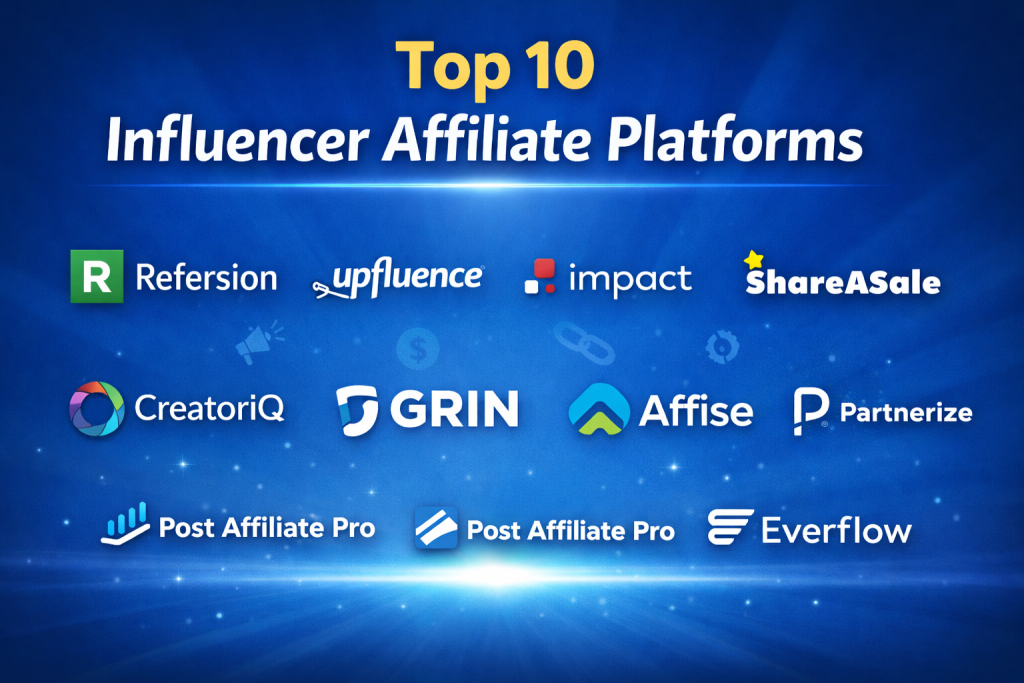
Top 10 Influencer Affiliate Platforms Tools
1 — Refersion
Short description:
A well-established affiliate and influencer tracking platform designed primarily for ecommerce brands using performance-based partnerships.
Key features:
- Affiliate and influencer link tracking
- Coupon and promo code attribution
- Real-time performance dashboards
- Automated commission calculations
- Ecommerce platform integrations
- Fraud detection and monitoring
- Flexible commission rules
Pros:
- Strong ecommerce-focused tracking accuracy
- Easy onboarding for influencers
Cons:
- Interface can feel dated for advanced users
- Limited customization for complex workflows
Security & compliance:
GDPR-aligned data handling, encrypted tracking data, role-based access.
Support & community:
Solid documentation, email support, onboarding assistance for paid plans.
2 — Upfluence
Short description:
A full-stack influencer platform combining discovery, relationship management, and affiliate-style performance tracking.
Key features:
- Influencer discovery with audience analytics
- Affiliate link and code tracking
- CRM for influencer relationships
- Campaign performance reporting
- Ecommerce and CRM integrations
- Automated influencer payouts
Pros:
- Strong discovery and analytics capabilities
- Suitable for large influencer programs
Cons:
- Higher cost compared to pure affiliate tools
- Learning curve for new users
Security & compliance:
GDPR-ready infrastructure, access controls, secure data storage.
Support & community:
Dedicated account managers, onboarding sessions, enterprise support.
3 — Impact
Short description:
An enterprise-grade partnership automation platform supporting influencers, affiliates, and strategic partners.
Key features:
- Advanced attribution models
- Influencer and partner lifecycle management
- Automated contracts and payouts
- Cross-channel tracking
- Enterprise-level reporting
- API-first architecture
Pros:
- Extremely powerful and scalable
- Deep analytics and attribution
Cons:
- Complex setup
- Premium pricing
Security & compliance:
SOC 2, GDPR, audit logs, enterprise SSO support.
Support & community:
Enterprise onboarding, priority support, extensive documentation.
4 — ShareASale
Short description:
A long-standing affiliate network with strong influencer participation across ecommerce categories.
Key features:
- Large influencer and affiliate marketplace
- Reliable tracking infrastructure
- Promo code attribution
- Automated payouts
- Merchant reporting tools
Pros:
- Trusted and widely adopted
- Large creator ecosystem
Cons:
- UI feels dated
- Limited customization
Security & compliance:
Standard encryption, GDPR-aligned processes.
Support & community:
Knowledge base, ticket-based support, active affiliate community.
5 — CreatorIQ
Short description:
An enterprise influencer intelligence platform with affiliate-style performance measurement.
Key features:
- Influencer discovery and vetting
- Performance and ROI tracking
- Affiliate and promo code attribution
- Fraud detection
- Advanced analytics
Pros:
- Enterprise-ready data depth
- Strong brand safety controls
Cons:
- High cost
- Overkill for small teams
Security & compliance:
SOC 2, GDPR, role-based permissions.
Support & community:
Dedicated enterprise support and strategic consulting.
6 — Grin
Short description:
A creator management platform focused on long-term influencer relationships and affiliate monetization.
Key features:
- Influencer CRM
- Affiliate link and code tracking
- Ecommerce integrations
- Automated product seeding
- Revenue attribution dashboards
Pros:
- Excellent for D2C brands
- Relationship-first approach
Cons:
- Limited outside ecommerce use cases
- Premium pricing tiers
Security & compliance:
GDPR-compliant data handling, secure integrations.
Support & community:
Strong onboarding, account management, training resources.
7 — Affise
Short description:
A performance marketing platform adaptable for influencer affiliate programs.
Key features:
- Real-time tracking and analytics
- Custom attribution logic
- API integrations
- Automated payouts
- Fraud prevention tools
Pros:
- Highly customizable
- Strong analytics engine
Cons:
- Not influencer-specific by default
- Requires technical setup
Security & compliance:
Encrypted data flows, GDPR readiness.
Support & community:
Developer documentation, technical support, onboarding assistance.
8 — Partnerize
Short description:
An enterprise partnership platform supporting influencer, affiliate, and brand collaborations.
Key features:
- Partner lifecycle management
- Attribution modeling
- Automated payments
- Global scalability
- Custom reporting
Pros:
- Enterprise-friendly scalability
- Strong compliance posture
Cons:
- Complex UI
- Costly for SMBs
Security & compliance:
SOC 2, GDPR, audit trails, SSO.
Support & community:
Enterprise support teams and onboarding specialists.
9 — Post Affiliate Pro
Short description:
A flexible affiliate software solution that can be adapted for influencer programs.
Key features:
- Affiliate tracking and management
- Promo codes and links
- Commission automation
- Custom branding
- Multi-currency payouts
Pros:
- Affordable compared to enterprise tools
- Customizable workflows
Cons:
- UI not modern
- Limited influencer discovery
Security & compliance:
Standard encryption, GDPR alignment.
Support & community:
Documentation, ticket support, community forums.
10 — Everflow
Short description:
A modern performance marketing platform increasingly used for influencer affiliate tracking.
Key features:
- Advanced attribution
- Real-time analytics
- Influencer-friendly tracking links
- API integrations
- Fraud detection
Pros:
- Clean, modern interface
- Strong analytics
Cons:
- Influencer discovery not included
- Setup complexity
Security & compliance:
Encrypted data, GDPR-ready infrastructure.
Support & community:
Good documentation, responsive support, onboarding help.
Comparison Table
| Tool Name | Best For | Platform(s) Supported | Standout Feature | Rating |
|---|---|---|---|---|
| Refersion | Ecommerce influencer programs | Web | Simple influencer tracking | N/A |
| Upfluence | Influencer-led commerce | Web | Discovery + affiliate tracking | N/A |
| Impact | Enterprise partnerships | Web | Advanced attribution | N/A |
| ShareASale | Large affiliate networks | Web | Trusted marketplace | N/A |
| CreatorIQ | Enterprise brands | Web | Influencer intelligence | N/A |
| Grin | D2C brands | Web | Creator relationship focus | N/A |
| Affise | Performance marketers | Web | Custom analytics | N/A |
| Partnerize | Global enterprises | Web | Partner lifecycle control | N/A |
| Post Affiliate Pro | SMBs | Web | Flexible pricing | N/A |
| Everflow | Modern performance teams | Web | Real-time analytics | N/A |
Evaluation & Scoring of Influencer Affiliate Platforms
| Criteria | Weight | Evaluation Focus |
|---|---|---|
| Core features | 25% | Tracking, payouts, attribution |
| Ease of use | 15% | Onboarding, UI clarity |
| Integrations & ecosystem | 15% | Ecommerce, CRM, APIs |
| Security & compliance | 10% | Data protection, standards |
| Performance & reliability | 10% | Tracking accuracy, uptime |
| Support & community | 10% | Documentation, responsiveness |
| Price / value | 15% | ROI, scalability |
Which Influencer Affiliate Platforms Tool Is Right for You?
- Solo creators & small teams: Simpler tools like Refersion or Post Affiliate Pro offer affordability and ease.
- SMBs & D2C brands: Grin and Upfluence balance relationship management with affiliate performance.
- Mid-market & enterprise: Impact, Partnerize, and CreatorIQ deliver scale, compliance, and deep analytics.
- Budget-conscious users: Look for predictable pricing and minimal setup complexity.
- Security-focused organizations: Enterprise platforms with SOC 2, SSO, and audit logs are essential.
Frequently Asked Questions (FAQs)
- What is an influencer affiliate platform?
A system that tracks influencer-driven sales and automates commission payments. - How is this different from influencer marketing tools?
Affiliate platforms focus on performance-based payouts rather than flat fees. - Do creators need technical skills?
Most platforms are creator-friendly and require minimal setup. - Are payouts automated?
Yes, most tools support automated commission payments. - Can these tools prevent fraud?
Many include fraud detection and suspicious activity monitoring. - Are they suitable for SaaS companies?
Yes, especially platforms with subscription tracking. - Do they support promo codes?
Most platforms offer code-based attribution. - Is enterprise security available?
Enterprise tools support advanced security and compliance standards. - How long does setup take?
From a few hours to several weeks depending on complexity. - Can they scale globally?
Enterprise platforms are designed for global influencer programs.
Conclusion
Influencer Affiliate Platforms have become a core growth engine for brands seeking measurable, scalable, and creator-friendly marketing. The right platform depends on company size, budget, technical maturity, and partnership strategy. Rather than chasing a universal “best” tool, teams should focus on alignment with their tracking needs, influencer workflows, and long-term growth goals. When chosen wisely, these platforms can turn influencers into consistent, performance-driven revenue partners.

Find Trusted Cardiac Hospitals
Compare heart hospitals by city and services — all in one place.
Explore Hospitals