
Introduction
Intellectual Property (IP) Management Software is designed to help organizations track, manage, protect, and optimize patents, trademarks, copyrights, and other IP assets throughout their entire lifecycle. From idea disclosure and filing to renewals, enforcement, and portfolio analysis, these tools act as a centralized system of record for some of a company’s most valuable assets.
In today’s innovation-driven economy, IP is no longer just a legal concern—it is a strategic business asset. Companies that fail to manage their IP effectively risk missed renewal deadlines, compliance issues, lost rights, duplication of work, and poor visibility into portfolio value. IP management software reduces these risks by automating workflows, maintaining accurate records, and enabling collaboration between legal, R&D, finance, and leadership teams.
Common real-world use cases include tracking global patent filings, managing trademark renewals across jurisdictions, monitoring deadlines, collaborating with outside counsel, analyzing portfolio strength, and ensuring regulatory compliance. When evaluating IP management tools, buyers should look at coverage (patents, trademarks, designs), automation, usability, reporting depth, integrations, security, scalability, and long-term value.
Best for:
IP attorneys, in-house legal teams, law firms, R&D-driven enterprises, universities, technology companies, pharmaceutical firms, manufacturing companies, and innovation-focused startups managing growing IP portfolios.
Not ideal for:
Individuals or very small businesses with only one or two IP assets, organizations outsourcing all IP work without internal oversight, or teams that only need basic document storage rather than full lifecycle management.
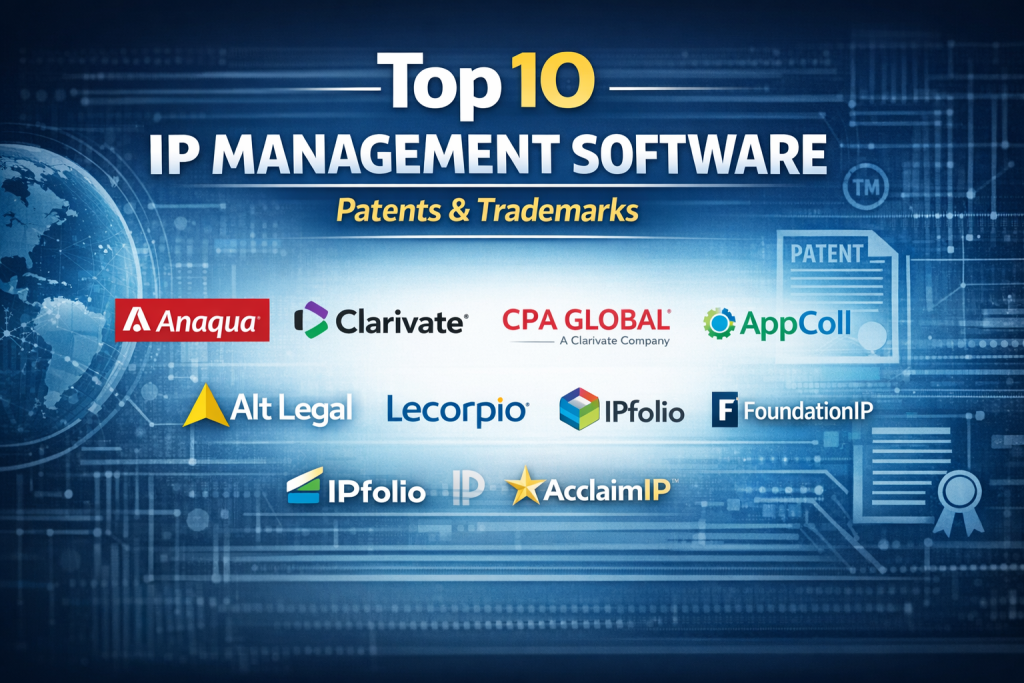
Top 10 IP Management (Patents/Trademarks) Software Tools
1 — Anaqua
Short description:
Anaqua is a comprehensive enterprise-grade IP management platform designed for large corporations and law firms managing complex global IP portfolios.
Key features:
- End-to-end patent and trademark lifecycle management
- Advanced docketing and deadline automation
- Integrated financial management and cost tracking
- Portfolio analytics and strategic reporting
- Collaboration with external counsel
- Custom workflows and dashboards
Pros:
- Extremely powerful and scalable for large portfolios
- Strong analytics and reporting capabilities
- Highly configurable to enterprise needs
Cons:
- Steep learning curve for new users
- Premium pricing not suitable for small teams
- Implementation can be time-intensive
Security & compliance:
SSO, role-based access, encryption, audit trails, GDPR compliance, enterprise-grade security controls.
Support & community:
Dedicated enterprise support, structured onboarding, detailed documentation, strong professional services.
2 — Clarivate IP Management (Derwent / IPfolio)
Short description:
Clarivate offers a robust IP management ecosystem combining portfolio management with industry-leading patent intelligence and analytics.
Key features:
- Patent and trademark docketing
- Integrated global patent data and analytics
- Renewal and annuity management
- Workflow automation and alerts
- Competitive intelligence tools
Pros:
- Best-in-class patent data integration
- Strong analytics for strategic decision-making
- Trusted by global enterprises
Cons:
- Interface can feel complex
- High cost for full-feature access
- Customization may require vendor support
Security & compliance:
Enterprise-grade encryption, SSO, GDPR compliance, access controls, audit logs.
Support & community:
Professional onboarding, global support teams, extensive knowledge base.
3 — CPA Global (now part of Clarivate)
Short description:
CPA Global is a long-standing IP management solution known for its strong docketing, renewals, and portfolio oversight capabilities.
Key features:
- Patent and trademark portfolio management
- Automated docketing and renewals
- Global jurisdiction coverage
- Cost forecasting and budgeting tools
- Integration with IP service providers
Pros:
- Proven reliability and global reach
- Strong renewals and annuity handling
- Suitable for large-scale operations
Cons:
- Less modern user experience
- Custom reporting can be limited
- Enterprise pricing structure
Security & compliance:
Robust access controls, encryption, GDPR-ready infrastructure.
Support & community:
Dedicated account managers, enterprise onboarding, global support coverage.
4 — AppColl
Short description:
AppColl is a flexible IP management system popular with law firms and in-house teams seeking customizable workflows.
Key features:
- Patent and trademark management
- Customizable workflows and fields
- Docketing and deadline tracking
- Integration with document management systems
- Cost tracking and reporting
Pros:
- High flexibility and configurability
- Strong fit for law firms
- Good balance of features and usability
Cons:
- Interface may feel dated to some users
- Reporting requires setup effort
- Less built-in analytics than premium tools
Security & compliance:
Role-based access, encryption, audit trails, GDPR support.
Support & community:
Responsive customer support, training resources, implementation assistance.
5 — PatSnap IP Management
Short description:
PatSnap combines IP management with innovation intelligence, helping companies align IP strategy with R&D and business goals.
Key features:
- Patent portfolio management
- Innovation and technology analytics
- Competitive benchmarking
- Visualization dashboards
- Collaboration tools
Pros:
- Excellent analytics and visualization
- Strong R&D and strategy alignment
- Intuitive interface
Cons:
- Less focus on trademark management
- Advanced features increase cost
- Not ideal for purely legal-focused teams
Security & compliance:
Encryption, access controls, GDPR compliance.
Support & community:
Good documentation, onboarding support, responsive helpdesk.
6 — Alt Legal
Short description:
Alt Legal is a modern, cloud-based IP management platform known for simplicity and automation, especially for trademarks.
Key features:
- Automated trademark docketing
- USPTO and global office data sync
- Deadline alerts and task automation
- Clean, intuitive interface
- Team collaboration tools
Pros:
- Very easy to use
- Excellent automation for trademarks
- Fast setup and onboarding
Cons:
- Limited patent management depth
- Fewer advanced analytics
- Not ideal for very large portfolios
Security & compliance:
Cloud security best practices, encryption, GDPR compliance.
Support & community:
Highly rated customer support, modern onboarding, helpful documentation.
7 — Lecorpio IP Management
Short description:
Lecorpio provides a cloud-based enterprise IP management platform with strong reporting and portfolio visibility.
Key features:
- Patent and trademark lifecycle management
- Portfolio analytics and dashboards
- Integration with ERP and finance systems
- Global docketing support
- Custom reporting tools
Pros:
- Strong reporting and visibility
- Good balance of power and usability
- Designed for in-house teams
Cons:
- UI may require training
- Configuration takes time
- Less brand recognition than top-tier vendors
Security & compliance:
SSO, encryption, access controls, GDPR compliance.
Support & community:
Dedicated customer success teams, structured onboarding, enterprise support.
8 — IPfolio
Short description:
IPfolio is a cloud-based IP management tool tailored for startups and mid-sized companies seeking simplicity and affordability.
Key features:
- Patent and trademark tracking
- Automated reminders and docketing
- Cost tracking
- Simple reporting
- Cloud-based collaboration
Pros:
- Easy to implement and use
- Affordable for growing companies
- Clean interface
Cons:
- Limited advanced analytics
- Not ideal for large enterprises
- Fewer customization options
Security & compliance:
Cloud encryption, role-based access, GDPR compliance.
Support & community:
Helpful customer support, online resources, guided onboarding.
9 — FoundationIP
Short description:
FoundationIP is a mature IP management platform focusing on reliability, renewals, and structured docketing.
Key features:
- Patent and trademark docketing
- Renewal and annuity management
- Portfolio reporting
- Multi-jurisdiction support
- Workflow automation
Pros:
- Stable and reliable platform
- Strong renewals handling
- Suitable for traditional IP teams
Cons:
- Less modern interface
- Limited analytics compared to newer tools
- Customization can be constrained
Security & compliance:
Standard enterprise security, access controls, GDPR-ready.
Support & community:
Professional support, documentation, onboarding services.
10 — AcclaimIP
Short description:
AcclaimIP focuses on patent analytics and portfolio intelligence, supporting strategic IP decision-making.
Key features:
- Patent analytics and valuation
- Portfolio visualization
- Competitive benchmarking
- Technology trend analysis
- Data-driven insights
Pros:
- Excellent analytics depth
- Strong strategic insights
- Ideal for portfolio evaluation
Cons:
- Limited docketing functionality
- Not a full lifecycle IP management system
- Best used alongside another tool
Security & compliance:
Data security controls, access management, GDPR compliance.
Support & community:
Knowledgeable support team, training resources, expert-led onboarding.
Comparison Table
| Tool Name | Best For | Platform(s) Supported | Standout Feature | Rating |
|---|---|---|---|---|
| Anaqua | Large enterprises | Web-based | Enterprise IP lifecycle management | N/A |
| Clarivate IP | Global corporations | Web-based | Patent intelligence integration | N/A |
| CPA Global | Large IP portfolios | Web-based | Global renewals expertise | N/A |
| AppColl | Law firms | Web-based | Customizable workflows | N/A |
| PatSnap | Innovation-driven firms | Web-based | IP analytics & insights | N/A |
| Alt Legal | Trademark-focused teams | Cloud | Automated docketing | N/A |
| Lecorpio | In-house legal teams | Cloud | Portfolio reporting | N/A |
| IPfolio | SMBs & startups | Cloud | Ease of use | N/A |
| FoundationIP | Traditional IP teams | Web-based | Reliable docketing | N/A |
| AcclaimIP | Strategy & analytics teams | Web-based | Patent intelligence | N/A |
Evaluation & Scoring of IP Management (Patents/Trademarks) Software
| Criteria | Weight | Description |
|---|---|---|
| Core features | 25% | Coverage of patents, trademarks, workflows |
| Ease of use | 15% | User experience and learning curve |
| Integrations & ecosystem | 15% | Compatibility with other tools |
| Security & compliance | 10% | Data protection and standards |
| Performance & reliability | 10% | Stability and uptime |
| Support & community | 10% | Vendor responsiveness |
| Price / value | 15% | Cost relative to features |
Which IP Management (Patents/Trademarks) Software Tool Is Right for You?
Choosing the right IP management software depends heavily on scale, complexity, and strategic goals.
- Solo users or startups benefit from simple, affordable tools like IPfolio or Alt Legal.
- SMBs and mid-market companies often need balanced solutions such as AppColl or Lecorpio.
- Large enterprises should consider Anaqua, Clarivate, or CPA Global for deep functionality and scalability.
- Budget-conscious teams should prioritize usability and automation over advanced analytics.
- Strategy-focused organizations may value analytics-heavy tools like PatSnap or AcclaimIP.
- Highly regulated industries should prioritize security, audit trails, and compliance readiness.
Frequently Asked Questions (FAQs)
1. What is IP management software?
It is software that helps track, manage, and protect patents, trademarks, and other intellectual property assets.
2. Do startups need IP management tools?
Yes, especially once they begin filing multiple patents or trademarks.
3. Can these tools manage global IP portfolios?
Most enterprise-grade tools support multi-jurisdiction management.
4. Are these tools cloud-based?
Many modern solutions are cloud-based, while some offer hybrid options.
5. How secure is IP management software?
Most reputable vendors offer encryption, access controls, and compliance features.
6. Do these tools replace IP attorneys?
No, they support legal teams but do not replace legal expertise.
7. What is docketing in IP management?
It refers to tracking deadlines, renewals, and legal actions.
8. Are analytics important in IP management?
Yes, especially for portfolio strategy and valuation.
9. How long does implementation take?
It ranges from days for simple tools to months for enterprise platforms.
10. What are common mistakes when choosing IP software?
Overpaying for unused features or underestimating future scalability needs.
Conclusion
IP Management (Patents/Trademarks) Software plays a crucial role in protecting innovation, ensuring compliance, and enabling strategic decision-making. The right tool can reduce risk, improve efficiency, and unlock hidden value within an IP portfolio.
There is no single “best” solution for everyone. The ideal choice depends on portfolio size, budget, industry, and long-term goals. By focusing on usability, coverage, security, and scalability, organizations can select a platform that supports both today’s needs and tomorrow’s growth.

Find Trusted Cardiac Hospitals
Compare heart hospitals by city and services — all in one place.
Explore Hospitals
Fantastic comparison of IP management tools! This article clearly explains how modern software can help legal teams and businesses track, protect, and optimize their patent and trademark portfolios — from automated docketing and deadline reminders to deep portfolio analytics and collaboration features. It makes choosing the right solution easier by outlining key strengths and limitations, helping professionals make informed decisions that match their scale, budget, and strategic goals in protecting intellectual property.