
Introduction
Kubernetes has become the backbone of modern cloud-native infrastructure. While it delivers unmatched scalability and flexibility, it also introduces significant governance and security challenges. With dozens or even thousands of workloads being deployed continuously, enforcing consistent rules across clusters is no longer optional—it’s essential. This is where Kubernetes Policy Enforcement Tools play a critical role.
These tools help organizations define, enforce, audit, and continuously monitor policies related to security, compliance, configuration standards, and operational best practices. They act as guardrails, ensuring that workloads adhere to organizational rules before deployment and throughout their lifecycle.
Common real-world use cases include preventing insecure container images, enforcing resource limits, restricting privileged access, ensuring compliance with regulatory frameworks, and standardizing configurations across teams.
When choosing a Kubernetes policy enforcement tool, buyers should evaluate policy language flexibility, ease of authoring policies, integration with CI/CD pipelines, runtime enforcement, scalability, compliance reporting, and community or vendor support.
Best for:
Platform engineers, DevOps teams, SREs, security engineers, and compliance teams working in cloud-native environments—especially mid-market to enterprise organizations operating multiple clusters.
Not ideal for:
Very small teams running single-node clusters or organizations without formal governance or compliance requirements, where basic Kubernetes defaults may be sufficient.
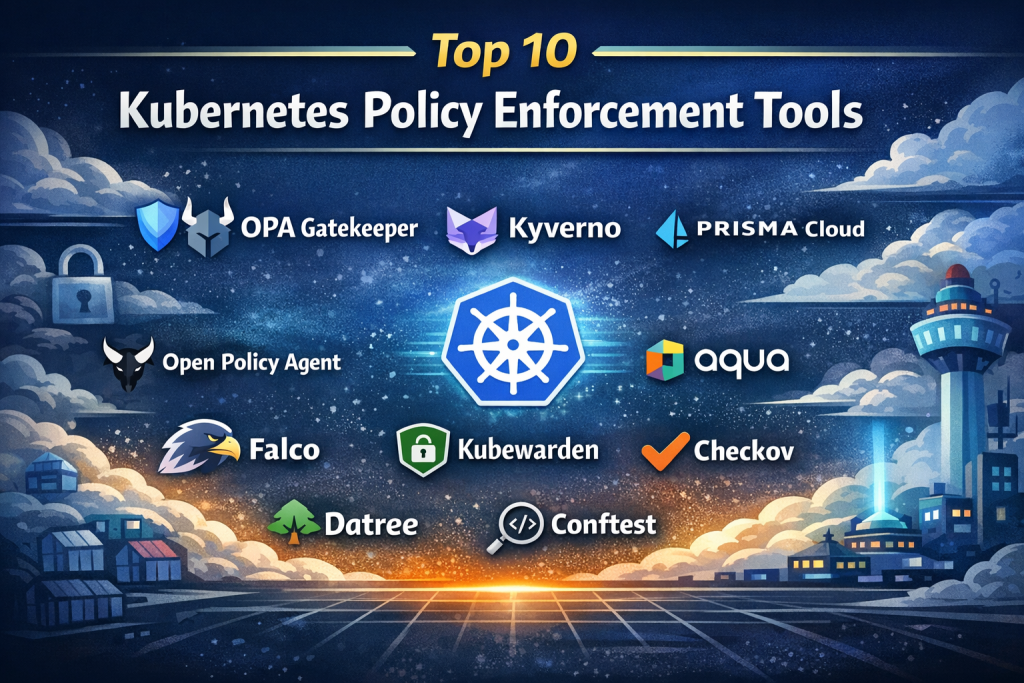
Top 10 Kubernetes Policy Enforcement Tools
1 — OPA Gatekeeper
Short description:
A policy enforcement solution built on Open Policy Agent, designed to enforce governance using Kubernetes admission controls.
Key features:
- Rego-based policy language
- Admission webhook enforcement
- Constraint templates for reuse
- Native Kubernetes integration
- Audit mode for existing clusters
- Declarative policy management
Pros:
- Industry-standard policy engine
- Strong flexibility for complex rules
- Active open-source community
Cons:
- Steep learning curve with Rego
- Policy debugging can be complex
Security & compliance:
Supports audit logging and compliance reporting; certifications vary by deployment.
Support & community:
Extensive documentation, strong CNCF backing, large community.
2 — Kyverno
Short description:
A Kubernetes-native policy engine that uses YAML instead of custom languages, ideal for DevOps teams.
Key features:
- YAML-based policy definitions
- Admission control and mutation
- Policy generation and validation
- Background scanning
- Native RBAC alignment
Pros:
- Easy to learn and adopt
- Kubernetes-friendly approach
- Excellent policy readability
Cons:
- Less expressive than Rego for advanced logic
- Performance tuning needed at scale
Security & compliance:
Audit support and policy reporting; compliance frameworks vary.
Support & community:
Fast-growing community, strong documentation, enterprise support available.
3 — Open Policy Agent
Short description:
A general-purpose policy engine used across cloud-native platforms, not limited to Kubernetes.
Key features:
- Rego policy language
- Works across APIs and microservices
- Decoupled policy decisions
- Kubernetes, CI/CD, and service mesh integration
- High performance decision engine
Pros:
- Extremely flexible
- Vendor-neutral
- Large ecosystem
Cons:
- Requires strong policy expertise
- Not Kubernetes-specific out of the box
Security & compliance:
Supports auditing, logging, and compliance use cases.
Support & community:
Very strong open-source community and ecosystem.
4 — Kubewarden
Short description:
A modern Kubernetes policy framework using WebAssembly for high performance and security.
Key features:
- WebAssembly-based policies
- Multiple policy languages
- Secure sandboxed execution
- Kubernetes admission integration
- Policy reuse and distribution
Pros:
- Strong isolation model
- Language flexibility
- Enterprise-grade design
Cons:
- Smaller community
- Newer ecosystem compared to OPA
Security & compliance:
Strong sandboxing, audit support; compliance depends on implementation.
Support & community:
Enterprise support available, growing community.
5— Falco
Short description:
A runtime security and policy enforcement tool focused on detecting abnormal behavior in Kubernetes.
Key features:
- Runtime threat detection
- Behavioral rules engine
- Kernel-level visibility
- Kubernetes audit integration
- Real-time alerts
Pros:
- Excellent runtime visibility
- Strong security focus
- CNCF-backed project
Cons:
- Not a full admission controller
- Alert tuning required
Security & compliance:
Audit logs, runtime security controls; compliance varies.
Support & community:
Strong open-source and enterprise backing.
6 — Prisma Cloud
Short description:
An enterprise cloud security platform offering Kubernetes policy enforcement and compliance.
Key features:
- Pre-built compliance policies
- CI/CD integration
- Runtime and admission enforcement
- Risk-based dashboards
- Multi-cloud support
Pros:
- Enterprise-ready
- Rich compliance coverage
- Unified security platform
Cons:
- High cost
- Complex setup
Security & compliance:
SOC 2, ISO, GDPR, HIPAA support.
Support & community:
Enterprise-grade support and documentation.
7 — Aqua Security
Short description:
A comprehensive container security solution with strong Kubernetes policy enforcement.
Key features:
- Image and runtime policy enforcement
- Admission controls
- Compliance benchmarking
- Vulnerability scanning
- Policy-as-code
Pros:
- End-to-end container security
- Mature enterprise features
- Strong compliance mapping
Cons:
- Premium pricing
- Learning curve for full platform
Security & compliance:
SOC 2, ISO, GDPR, HIPAA.
Support & community:
Strong enterprise support, training available.
8 — Checkov
Short description:
A policy enforcement tool focused on Infrastructure-as-Code, including Kubernetes manifests.
Key features:
- Policy-as-code scanning
- Pre-deployment checks
- Kubernetes YAML analysis
- CI/CD integration
- Compliance reports
Pros:
- Shift-left security
- Easy CI/CD integration
- Broad IaC coverage
Cons:
- No runtime enforcement
- Limited admission control
Security & compliance:
Supports common compliance frameworks.
Support & community:
Good documentation, active community.
9 — Conftest
Short description:
A lightweight tool for testing Kubernetes configurations using OPA policies.
Key features:
- Policy testing for manifests
- Rego-based rules
- CI/CD integration
- Fast feedback loops
- Multi-format support
Pros:
- Simple and fast
- Ideal for developers
- Open-source friendly
Cons:
- No runtime enforcement
- CLI-focused experience
Security & compliance:
Policy-dependent; no built-in certifications.
Support & community:
Active open-source community.
10 — Datree
Short description:
A developer-friendly Kubernetes policy and configuration validation platform.
Key features:
- Predefined policy rules
- Misconfiguration detection
- CI/CD validation
- User-friendly UI
- Policy analytics
Pros:
- Easy onboarding
- Developer-centric design
- Clear insights
Cons:
- Limited runtime controls
- Advanced features require paid plans
Security & compliance:
Supports security best practices; certifications vary.
Support & community:
Good documentation and responsive support.
Comparison Table
| Tool Name | Best For | Platform(s) Supported | Standout Feature | Rating |
|---|---|---|---|---|
| OPA Gatekeeper | Advanced governance | Kubernetes | Rego-based admission control | N/A |
| Kyverno | DevOps teams | Kubernetes | YAML-native policies | N/A |
| Open Policy Agent | Multi-platform policy | Kubernetes, APIs | Universal policy engine | N/A |
| Kubewarden | Secure policy execution | Kubernetes | WebAssembly policies | N/A |
| Falco | Runtime security | Kubernetes, Linux | Behavioral detection | N/A |
| Prisma Cloud | Large enterprises | Multi-cloud | Compliance automation | N/A |
| Aqua Security | Regulated industries | Kubernetes, containers | Full-stack security | N/A |
| Checkov | Shift-left security | CI/CD, IaC | Pre-deployment scanning | N/A |
| Conftest | Developers | CI/CD | Policy testing | N/A |
| Datree | Dev teams | Kubernetes | Misconfiguration insights | N/A |
Evaluation & Scoring of Kubernetes Policy Enforcement Tools
| Tool | Core Features (25%) | Ease of Use (15%) | Integrations (15%) | Security (10%) | Performance (10%) | Support (10%) | Price/Value (15%) | Total |
|---|---|---|---|---|---|---|---|---|
| OPA Gatekeeper | 23 | 10 | 14 | 8 | 9 | 8 | 12 | 84 |
| Kyverno | 21 | 14 | 13 | 8 | 8 | 8 | 13 | 85 |
| Open Policy Agent | 24 | 9 | 15 | 8 | 9 | 9 | 12 | 86 |
| Kubewarden | 20 | 11 | 12 | 9 | 9 | 7 | 12 | 80 |
| Falco | 18 | 10 | 12 | 9 | 9 | 8 | 12 | 78 |
Which Kubernetes Policy Enforcement Tool Is Right for You?
- Solo users / small teams: Kyverno, Datree, Conftest
- SMBs: Kyverno, OPA Gatekeeper, Checkov
- Mid-market: OPA Gatekeeper, Kubewarden, Falco
- Enterprise: Prisma Cloud, Aqua Security
Budget-conscious teams should favor open-source tools, while regulated industries benefit from enterprise platforms with built-in compliance. Choose feature depth for complex governance and ease of use for fast adoption.
Frequently Asked Questions (FAQs)
- What is Kubernetes policy enforcement?
It ensures workloads follow predefined rules before and during execution. - Do I need policy enforcement for small clusters?
Only if security or compliance is critical. - Is YAML-based policy better than Rego?
YAML is easier; Rego is more powerful. - Can these tools block deployments?
Yes, via admission controllers. - Are runtime policies necessary?
For security-sensitive environments, yes. - Do these tools slow down clusters?
Minimal impact if properly configured. - Can policies be version-controlled?
Yes, most support Git-based workflows. - Are open-source tools safe for enterprises?
Yes, with proper governance and support. - What’s the biggest mistake teams make?
Over-restricting policies too early. - Can I use multiple tools together?
Yes, many teams combine admission and runtime tools.
Conclusion
Kubernetes Policy Enforcement Tools are essential for maintaining security, compliance, and operational consistency in modern cloud-native environments. While no single tool is perfect for everyone, the right choice depends on team size, compliance needs, budget, and operational maturity. By carefully evaluating your requirements and understanding the strengths of each solution, you can implement governance that enables innovation—without sacrificing control.

Find Trusted Cardiac Hospitals
Compare heart hospitals by city and services — all in one place.
Explore Hospitals
