
Introduction
Logistics Visibility Platforms are modern digital solutions designed to provide real-time transparency across the entire supply chain—from raw material pickup to final delivery. These platforms aggregate data from carriers, IoT devices, GPS trackers, TMS, ERP systems, and external partners to give logistics teams a single, reliable source of truth for shipment status, delays, risks, and performance metrics.
In today’s highly interconnected and disruption-prone logistics environment, visibility is no longer a luxury—it is a business-critical capability. Delays, port congestion, weather events, geopolitical risks, and capacity shortages can quickly cascade into lost revenue, dissatisfied customers, and operational chaos. Logistics Visibility Platforms help organizations anticipate problems, respond faster, and optimize decisions instead of reacting blindly.
Key real-world use cases include:
- Real-time shipment tracking across ocean, air, rail, and road
- Proactive delay detection and exception management
- Carrier performance monitoring and benchmarking
- Inventory-in-transit optimization
- Customer-facing tracking and ETA notifications
When choosing a Logistics Visibility Platform, buyers should evaluate data accuracy, multi-modal coverage, ease of integration, analytics depth, scalability, security, and total cost of ownership.
Best for:
Logistics Visibility Platforms are ideal for manufacturers, retailers, e-commerce companies, 3PLs, freight forwarders, distributors, and enterprises managing complex, multi-carrier, multi-region supply chains. Roles that benefit most include supply chain managers, logistics planners, operations leaders, and customer experience teams.
Not ideal for:
These platforms may be excessive for very small businesses with simple shipping needs, low shipment volumes, or single-carrier operations where basic carrier tracking tools or ERP-native features are sufficient.
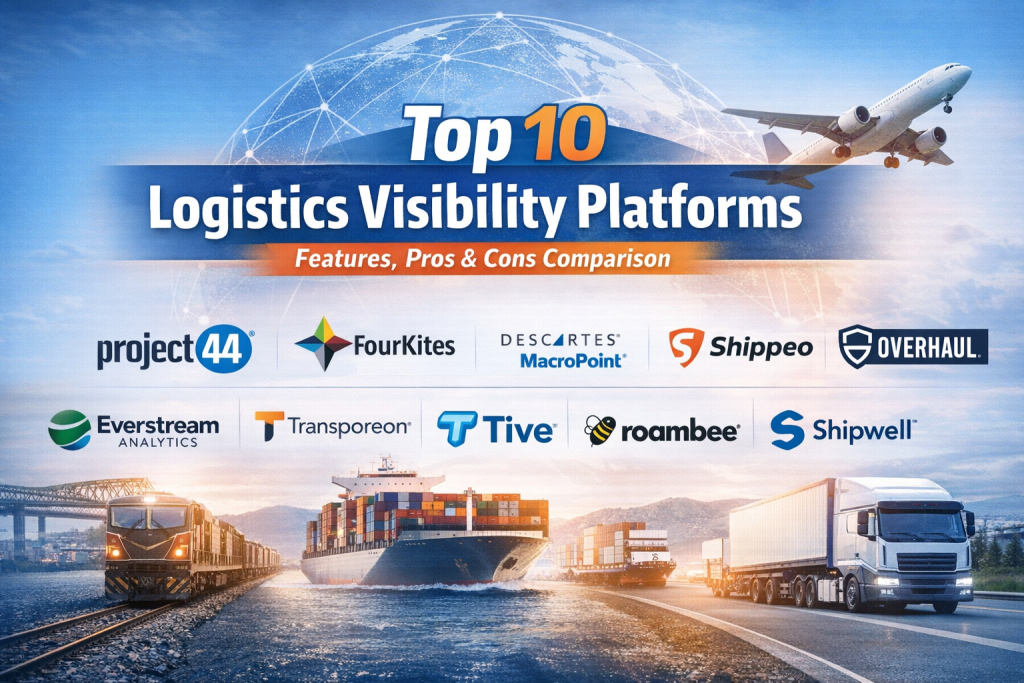
Top 10 Logistics Visibility Platforms Tools
1 — project44
Short description:
project44 is a leading real-time transportation visibility platform designed for large-scale, global supply chains with complex, multi-modal operations.
Key features:
- Real-time tracking across road, ocean, rail, and air
- Predictive ETAs powered by machine learning
- Exception management and proactive alerts
- Carrier network with thousands of integrations
- Advanced analytics and performance dashboards
- Customer-facing visibility tools
Pros:
- Extremely strong global carrier connectivity
- High data accuracy and predictive insights
- Enterprise-grade scalability
Cons:
- Premium pricing model
- Implementation can be resource-intensive
Security & compliance:
SOC 2, GDPR-aligned practices, SSO, encryption at rest and in transit.
Support & community:
Enterprise onboarding, dedicated account managers, extensive documentation.
2— FourKites
Short description:
FourKites focuses on end-to-end supply chain visibility with strong predictive analytics and collaboration features for enterprises.
Key features:
- Real-time multi-modal shipment tracking
- AI-driven predictive ETAs
- Yard, appointment, and dock visibility
- Exception management workflows
- Sustainability and emissions tracking
- Carrier performance analytics
Pros:
- Deep analytics and AI-driven insights
- Strong collaboration features
- Robust enterprise adoption
Cons:
- Learning curve for advanced features
- Higher cost for full feature set
Security & compliance:
SOC 2 Type II, GDPR compliance, encryption, role-based access.
Support & community:
Strong enterprise support, onboarding programs, active customer community.
3 — Descartes MacroPoint
Short description:
Descartes MacroPoint provides real-time freight visibility with a strong emphasis on carrier connectivity and compliance.
Key features:
- Real-time GPS-based shipment tracking
- Large carrier network connectivity
- Automated load status updates
- Compliance and audit-ready reporting
- Integration with TMS and ERP systems
Pros:
- Massive carrier network
- Reliable tracking accuracy
- Strong compliance capabilities
Cons:
- User interface feels dated
- Limited advanced analytics compared to newer platforms
Security & compliance:
SOC 2, ISO-aligned controls, data encryption.
Support & community:
Global support, structured onboarding, strong documentation.
4 — Shippeo
Short description:
Shippeo is a European-focused real-time visibility platform with strong sustainability and predictive analytics capabilities.
Key features:
- Real-time tracking across multiple transport modes
- Predictive ETAs with AI models
- Carbon emissions monitoring
- Exception alerts and risk management
- Customer visibility portals
Pros:
- Strong sustainability features
- High ETA accuracy
- Clean, intuitive interface
Cons:
- Smaller carrier network outside Europe
- Less suitable for highly fragmented markets
Security & compliance:
GDPR-compliant, encryption, enterprise access controls.
Support & community:
Responsive support, structured onboarding, growing partner ecosystem.
5 — Overhaul
Short description:
Overhaul combines logistics visibility with advanced risk management and cargo security features.
Key features:
- Real-time shipment visibility
- Theft and risk monitoring
- Incident detection and alerts
- Route risk analysis
- Compliance reporting
Pros:
- Excellent security-focused capabilities
- Strong risk intelligence
- Ideal for high-value cargo
Cons:
- Less emphasis on deep analytics
- Not ideal for low-risk shipments
Security & compliance:
SOC 2, encryption, audit logs, role-based access.
Support & community:
Dedicated customer success teams, specialized onboarding.
6 — Everstream Analytics
Short description:
Everstream Analytics focuses on predictive risk intelligence and supply chain resilience alongside visibility.
Key features:
- Real-time shipment tracking
- Predictive disruption alerts
- Weather, geopolitical, and port risk insights
- Scenario modeling
- Performance analytics
Pros:
- Strong risk and resilience focus
- Predictive analytics excellence
- Useful for strategic planning
Cons:
- Less operational UI polish
- Best suited for advanced users
Security & compliance:
Enterprise-grade security, GDPR-aligned controls.
Support & community:
Consultative onboarding, analyst-driven support.
7 — Transporeon Visibility
Short description:
Transporeon Visibility is part of a broader logistics ecosystem, offering visibility tightly integrated with freight procurement and execution.
Key features:
- Real-time shipment tracking
- Carrier collaboration tools
- Dock and yard visibility
- Performance benchmarking
- Seamless integration with procurement modules
Pros:
- Strong carrier collaboration
- End-to-end logistics ecosystem
- Reliable European coverage
Cons:
- Less flexible as a standalone tool
- UI complexity for new users
Security & compliance:
ISO-aligned controls, encryption, GDPR compliance.
Support & community:
Strong regional support, onboarding assistance.
8 — Tive
Short description:
Tive provides real-time shipment tracking using IoT sensors for high-value and sensitive goods.
Key features:
- IoT-powered real-time tracking
- Temperature, shock, and humidity monitoring
- Real-time alerts and geofencing
- Analytics dashboards
- Chain-of-custody reporting
Pros:
- Excellent for sensitive and regulated goods
- High data granularity
- Easy deployment
Cons:
- Hardware dependency
- Higher costs for large-scale deployments
Security & compliance:
Encryption, role-based access, compliance-ready reporting.
Support & community:
Strong onboarding, responsive support.
9 — Roambee
Short description:
Roambee specializes in logistics visibility using IoT and sensor-based intelligence across global supply chains.
Key features:
- Multi-sensor shipment tracking
- Real-time condition monitoring
- Predictive analytics
- Integration with enterprise systems
- Global roaming connectivity
Pros:
- Excellent sensor accuracy
- Strong global coverage
- Suitable for regulated industries
Cons:
- Hardware management overhead
- Less intuitive UI
Security & compliance:
SOC 2, encryption, compliance-ready architecture.
Support & community:
Enterprise support, technical onboarding.
10 — Shipwell Visibility
Short description:
Shipwell Visibility integrates logistics execution and visibility into a single platform focused on operational efficiency.
Key features:
- Real-time shipment tracking
- Integrated TMS capabilities
- Automated alerts and workflows
- Carrier performance analytics
- Centralized dashboards
Pros:
- Unified execution and visibility
- User-friendly interface
- Good value for mid-market users
Cons:
- Less advanced predictive analytics
- Smaller carrier network
Security & compliance:
Standard enterprise security, encryption, SSO support.
Support & community:
Strong customer support, growing user community.
Comparison Table
| Tool Name | Best For | Platform(s) Supported | Standout Feature | Rating |
|---|---|---|---|---|
| project44 | Global enterprises | Web, Cloud | Multi-modal global visibility | N/A |
| FourKites | Data-driven enterprises | Web, Cloud | Predictive ETAs | N/A |
| Descartes MacroPoint | Carrier-heavy networks | Web, Cloud | Massive carrier network | N/A |
| Shippeo | Sustainability-focused firms | Web, Cloud | Carbon tracking | N/A |
| Overhaul | High-value cargo | Web, Cloud | Risk & theft prevention | N/A |
| Everstream Analytics | Resilient supply chains | Web, Cloud | Disruption intelligence | N/A |
| Transporeon Visibility | European shippers | Web, Cloud | Carrier collaboration | N/A |
| Tive | Sensitive goods | Web, IoT | Sensor-based monitoring | N/A |
| Roambee | Regulated industries | Web, IoT | Multi-sensor intelligence | N/A |
| Shipwell Visibility | Mid-market logistics | Web, Cloud | Unified execution & visibility | N/A |
Evaluation & Scoring of Logistics Visibility Platforms
| Criteria | Weight | Description |
|---|---|---|
| Core features | 25% | Tracking, ETAs, alerts, analytics |
| Ease of use | 15% | UI clarity, onboarding |
| Integrations & ecosystem | 15% | ERP, TMS, carrier networks |
| Security & compliance | 10% | Data protection, standards |
| Performance & reliability | 10% | Accuracy, uptime |
| Support & community | 10% | Documentation, help |
| Price / value | 15% | ROI and scalability |
Which Logistics Visibility Platforms Tool Is Right for You?
- Solo users & SMBs: Look for simple platforms with fast setup and lower cost, such as Shipwell Visibility.
- Mid-market companies: Prioritize ease of use, integration flexibility, and cost efficiency.
- Enterprises: Choose platforms like project44 or FourKites for scale, analytics, and global coverage.
- Budget-conscious teams: Avoid sensor-heavy solutions unless necessary.
- Premium needs: Invest in predictive analytics and risk intelligence.
- Security-driven industries: Select platforms with strong compliance and audit features.
Frequently Asked Questions (FAQs)
1. What is a Logistics Visibility Platform?
It is a system that provides real-time tracking and insights into shipments across the supply chain.
2. Do these platforms replace a TMS?
No, they usually complement a TMS by adding real-time visibility and analytics.
3. Are they suitable for small businesses?
Some are, but many are designed for mid-market and enterprise operations.
4. How long does implementation take?
Anywhere from a few weeks to several months depending on complexity.
5. Do they support multi-modal transport?
Most leading platforms support road, rail, ocean, and air.
6. Are IoT sensors mandatory?
No, but they enhance visibility for sensitive or high-value goods.
7. How accurate are predictive ETAs?
Accuracy improves with historical data and carrier integration depth.
8. What security standards do they follow?
Most enterprise platforms follow SOC 2, GDPR, and encryption best practices.
9. Can customers access shipment tracking?
Yes, many platforms offer customer-facing portals.
10. What is the biggest mistake buyers make?
Choosing based on features alone without considering integration and usability.
Conclusion
Logistics Visibility Platforms have become essential tools for modern, resilient, and customer-centric supply chains. They enable organizations to move from reactive problem-solving to proactive, data-driven decision-making.
When choosing the right platform, focus on data accuracy, scalability, integration capabilities, security, and real operational value rather than hype. There is no single “best” solution for everyone—the ideal platform depends on your shipment complexity, industry, budget, and strategic goals.
The right visibility platform will not just show where your shipments are—it will help you run a smarter, faster, and more resilient supply chain.

Find Trusted Cardiac Hospitals
Compare heart hospitals by city and services — all in one place.
Explore Hospitals
Excellent breakdown of leading logistics visibility platforms! This article provides clear, side‑by‑side insights into key features, strengths, and limitations, making it much easier for supply chain professionals and logistics managers to evaluate which solution matches their needs — whether it’s real‑time tracking, predictive analytics, or seamless integration with existing systems. A highly practical and well‑organized resource for anyone looking to boost operational transparency and efficiency.