
Introduction
Manufacturing Execution Systems (MES) are software platforms designed to bridge the gap between enterprise planning systems and the shop floor. While ERP systems focus on planning and business processes, MES focuses on real-time execution, monitoring, and control of manufacturing operations. It helps manufacturers understand exactly what is happening on the factory floor—right now.
In today’s highly competitive and data-driven manufacturing environment, MES plays a critical role in improving productivity, quality, traceability, and compliance. By collecting real-time data from machines, operators, and production lines, MES enables manufacturers to reduce downtime, minimize waste, improve yield, and ensure consistent product quality.
Common real-world use cases include production tracking, quality management, work order execution, performance analysis (OEE), regulatory compliance, and genealogy tracking. Industries such as automotive, pharmaceuticals, electronics, food & beverage, and aerospace rely heavily on MES for operational excellence.
When choosing an MES, organizations should evaluate real-time capabilities, scalability, ease of use, integration with ERP and automation systems, security, compliance support, and total cost of ownership.
Best for:
Manufacturing Execution Systems (MES) tools are best suited for manufacturing managers, operations leaders, plant supervisors, quality engineers, IT teams, and executives working in discrete, process, batch, and hybrid manufacturing environments—from mid-sized factories to global enterprises.
Not ideal for:
MES may be overkill for very small workshops, manual production environments, or businesses with extremely simple workflows, where lightweight production tracking tools or spreadsheets may be sufficient.
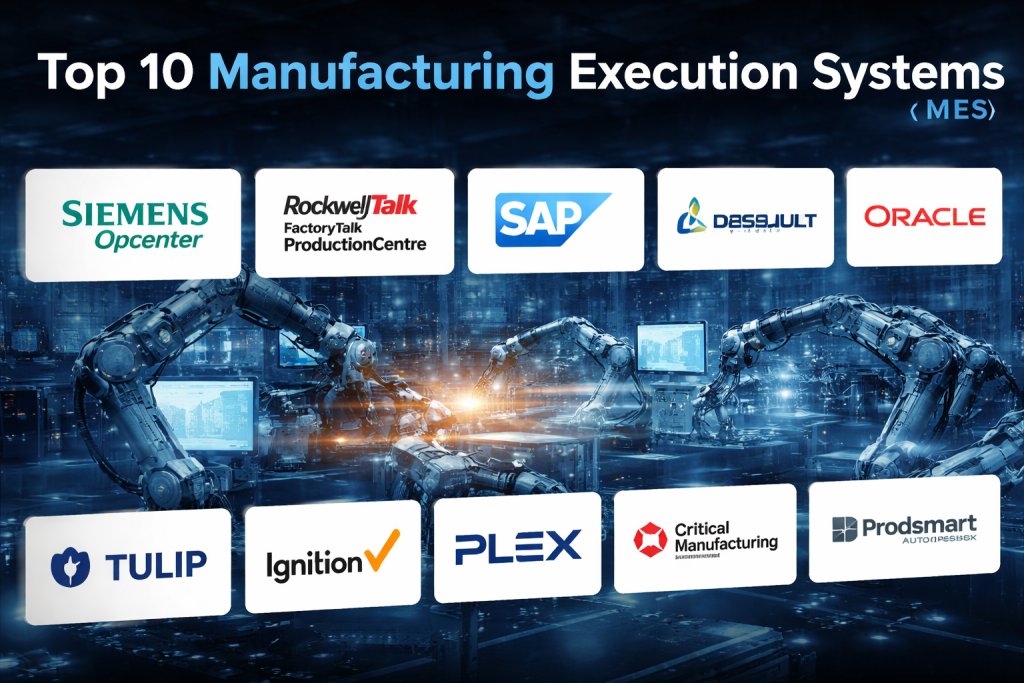
Top 10 Manufacturing Execution Systems (MES) Tools
1 — Siemens Opcenter
Short description:
Siemens Opcenter is a comprehensive, enterprise-grade MES designed for complex manufacturing environments requiring deep automation and digitalization.
Key features:
- Real-time production execution and monitoring
- Advanced quality management and SPC
- Manufacturing genealogy and traceability
- Integration with automation and PLM systems
- Support for discrete, batch, and hybrid manufacturing
- Advanced analytics and reporting
- Modular and scalable architecture
Pros:
- Extremely powerful and scalable
- Strong integration with industrial automation
Cons:
- High implementation complexity
- Premium pricing
Security & compliance:
Role-based access, encryption, audit trails, ISO-aligned controls, GDPR support
Support & community:
Enterprise-grade documentation, global support network, strong partner ecosystem
2 — Rockwell Automation FactoryTalk ProductionCentre
Short description:
FactoryTalk ProductionCentre focuses on production management, genealogy, and quality in highly automated manufacturing environments.
Key features:
- Production and work order execution
- Electronic batch records
- Quality and non-conformance management
- Full traceability and genealogy
- Tight integration with Rockwell PLCs
- Real-time dashboards
- Compliance-ready workflows
Pros:
- Excellent for regulated industries
- Deep automation integration
Cons:
- Best suited to Rockwell ecosystems
- Steeper learning curve
Security & compliance:
SSO, audit logs, encryption, regulatory compliance support (FDA, GMP)
Support & community:
Strong vendor support, extensive documentation, certified integrators
3 — SAP Manufacturing Execution (SAP ME/MII)
Short description:
SAP ME/MII is designed for organizations already invested in SAP ERP, providing seamless shop-floor execution and visibility.
Key features:
- Real-time production monitoring
- Tight SAP ERP integration
- Quality management and inspections
- Manufacturing genealogy
- KPI and performance dashboards
- Workflow orchestration
- Scalable enterprise deployment
Pros:
- Seamless ERP-to-shop-floor integration
- Strong data consistency
Cons:
- Requires SAP expertise
- Higher total cost of ownership
Security & compliance:
Enterprise-grade security, SSO, GDPR, audit logging
Support & community:
Large global community, extensive documentation, enterprise support
4 — Dassault DELMIA Apriso
Short description:
DELMIA Apriso offers a unified MES solution focused on global manufacturing operations and process standardization.
Key features:
- Global production visibility
- Quality and compliance management
- Work order and labor management
- Manufacturing intelligence dashboards
- Multi-site deployment support
- Process standardization tools
Pros:
- Strong multi-site coordination
- Robust analytics
Cons:
- Complex initial setup
- Customization may require specialists
Security & compliance:
Role-based security, encryption, audit logs, ISO/GDPR readiness
Support & community:
Enterprise support, consulting partners, professional training
5 — Oracle Manufacturing Execution
Short description:
Oracle MES provides cloud-connected execution and visibility, particularly for manufacturers using Oracle ERP systems.
Key features:
- Real-time shop-floor data capture
- Integrated quality inspections
- Production scheduling execution
- Traceability and genealogy
- Cloud and on-premise deployment
- Analytics and KPIs
Pros:
- Strong ERP alignment
- Cloud scalability options
Cons:
- Limited flexibility outside Oracle stack
- Licensing complexity
Security & compliance:
Enterprise-grade cloud security, encryption, compliance frameworks
Support & community:
Robust documentation, enterprise support, global Oracle ecosystem
6 — Tulip
Short description:
Tulip is a modern, low-code MES platform designed for rapid digitization of frontline manufacturing processes.
Key features:
- Low-code application builder
- Real-time operator guidance
- Machine data integration
- Quality checks and workflows
- Cloud-native dashboards
- Fast deployment
- IoT-ready architecture
Pros:
- Easy to use and fast to deploy
- Flexible for custom workflows
Cons:
- Less suited for very large enterprises
- Advanced features require configuration
Security & compliance:
Encryption, SSO, audit logs, GDPR support
Support & community:
Strong onboarding, active user community, responsive support
7 — Ignition by Inductive Automation
Short description:
Ignition is a flexible industrial platform combining MES, SCADA, and IIoT capabilities in a single solution.
Key features:
- Real-time production monitoring
- Modular MES components
- Unlimited licensing model
- Cross-platform support
- Strong SCADA integration
- Custom dashboards and reporting
Pros:
- Highly flexible and cost-effective
- Strong developer control
Cons:
- Requires technical expertise
- UI customization effort
Security & compliance:
Role-based access, encryption, audit logs
Support & community:
Extensive documentation, active community forum, training programs
8 — Plex Smart Manufacturing Platform
Short description:
Plex is a cloud-native MES and ERP platform designed specifically for manufacturers.
Key features:
- Real-time production execution
- Built-in quality management
- Inventory and traceability
- Cloud-native architecture
- Supplier and compliance management
- Analytics and dashboards
Pros:
- True cloud-first MES
- Strong visibility across operations
Cons:
- Limited deep customization
- Internet dependency
Security & compliance:
SOC-aligned controls, encryption, audit logs, compliance-ready
Support & community:
Good documentation, enterprise support, user groups
9 — Critical Manufacturing MES
Short description:
Critical Manufacturing MES is optimized for complex and high-tech manufacturing environments.
Key features:
- Advanced process control
- Semiconductor-ready workflows
- Full traceability and genealogy
- Real-time analytics
- Equipment integration
- Scalable architecture
Pros:
- Excellent for high-tech industries
- Strong process control
Cons:
- Niche focus
- Requires skilled implementation
Security & compliance:
Enterprise-grade security, audit trails, GDPR-ready
Support & community:
Dedicated enterprise support, specialized expertise
10 — Prodsmart (by Autodesk)
Short description:
Prodsmart is a lightweight, cloud-based MES focused on simplicity and rapid adoption.
Key features:
- Real-time production tracking
- OEE and performance analytics
- Quality checks
- Cloud dashboards
- Easy ERP integration
- Mobile-friendly interface
Pros:
- Easy to deploy
- Cost-effective for SMBs
Cons:
- Limited advanced functionality
- Less suited for highly regulated industries
Security & compliance:
Cloud security controls, encryption, GDPR support
Support & community:
Good onboarding, responsive support, growing community
Comparison Table
| Tool Name | Best For | Platform(s) Supported | Standout Feature | Rating |
|---|---|---|---|---|
| Siemens Opcenter | Large enterprises | Windows, Cloud | Deep automation integration | N/A |
| FactoryTalk ProductionCentre | Regulated industries | Windows | Electronic batch records | N/A |
| SAP ME/MII | SAP-centric orgs | Windows, Cloud | ERP integration | N/A |
| DELMIA Apriso | Global manufacturers | Windows | Multi-site control | N/A |
| Oracle MES | Oracle ERP users | Cloud, On-prem | Cloud scalability | N/A |
| Tulip | Agile manufacturers | Cloud | Low-code MES | N/A |
| Ignition | Custom MES builds | Cross-platform | Unlimited licensing | N/A |
| Plex | Cloud-first plants | Cloud | Built-in ERP + MES | N/A |
| Critical Manufacturing | High-tech fabs | Windows | Advanced process control | N/A |
| Prodsmart | SMBs | Cloud | Simple OEE tracking | N/A |
Evaluation & Scoring of Manufacturing Execution Systems (MES)
| Criteria | Weight | Score (Avg) |
|---|---|---|
| Core features | 25% | High |
| Ease of use | 15% | Medium–High |
| Integrations & ecosystem | 15% | High |
| Security & compliance | 10% | High |
| Performance & reliability | 10% | High |
| Support & community | 10% | Medium–High |
| Price / value | 15% | Medium |
Which Manufacturing Execution Systems (MES) Tool Is Right for You?
- Solo users / small shops: Lightweight cloud MES like Prodsmart or Tulip
- SMBs: Tulip, Ignition, Plex
- Mid-market: Plex, SAP ME, Oracle MES
- Enterprise: Siemens Opcenter, DELMIA Apriso, FactoryTalk
Budget-conscious: Ignition, Prodsmart
Premium solutions: Siemens, SAP, Oracle
Ease of use: Tulip, Prodsmart
Feature depth: Siemens, Rockwell, SAP
Integration needs: SAP ME, Oracle MES, Ignition
Security & compliance: FactoryTalk, Siemens, Critical Manufacturing
Frequently Asked Questions (FAQs)
1. What is an MES system?
An MES manages, monitors, and controls manufacturing operations in real time on the shop floor.
2. How is MES different from ERP?
ERP plans production; MES executes and tracks it in real time.
3. Is MES only for large factories?
No, modern cloud MES solutions also serve SMBs effectively.
4. How long does MES implementation take?
From weeks (lightweight MES) to several months (enterprise MES).
5. Does MES support Industry 4.0?
Yes, MES is a core pillar of Industry 4.0 and smart manufacturing.
6. Can MES integrate with machines and PLCs?
Most enterprise MES platforms support machine and automation integration.
7. Is MES secure?
Yes, most offer encryption, access control, and audit logging.
8. Is cloud MES reliable?
Modern cloud MES platforms offer high availability and scalability.
9. What industries use MES most?
Automotive, pharma, electronics, food & beverage, aerospace.
10. What is the biggest mistake when choosing MES?
Overbuying complexity without aligning to actual operational needs.
Conclusion
Manufacturing Execution Systems (MES) are no longer optional—they are essential tools for modern, competitive manufacturing operations. They provide real-time visibility, improve quality, ensure compliance, and enable data-driven decision-making on the shop floor.
The most important factors when choosing an MES include fit with your manufacturing processes, integration capabilities, scalability, ease of use, and total cost of ownership. There is no single “best” MES for everyone—the right choice depends on your company size, industry, budget, and digital maturity.

Find Trusted Cardiac Hospitals
Compare heart hospitals by city and services — all in one place.
Explore Hospitals