
Introduction
Materials Informatics Platforms sit at the intersection of materials science, data science, and artificial intelligence. These platforms help researchers and organizations discover, design, and optimize new materials faster by using machine learning models, structured databases, simulations, and experimental data analysis. Instead of relying only on trial-and-error experimentation—which can take years—materials informatics enables data-driven decision-making that dramatically reduces time, cost, and risk.
These platforms are becoming critical across industries such as advanced manufacturing, semiconductors, energy storage, chemicals, aerospace, pharmaceuticals, and sustainability-driven R&D. Common real-world use cases include battery material optimization, alloy design, polymer discovery, catalyst development, and performance prediction under extreme conditions.
When evaluating materials informatics tools, users should look for:
- Strong data modeling and ML capabilities
- Integration with experimental and simulation workflows
- Scalability for growing datasets
- Ease of use for scientists (not just data engineers)
- Security, compliance, and enterprise readiness
Best for:
Materials Informatics Platforms are best suited for materials scientists, R&D engineers, computational chemists, data scientists, and innovation teams in mid-market to large enterprises, research labs, and high-tech startups working on advanced materials or formulations.
Not ideal for:
These tools may be unnecessary for small teams doing limited lab work, organizations without structured materials data, or teams seeking general-purpose data analytics rather than materials-specific modeling.
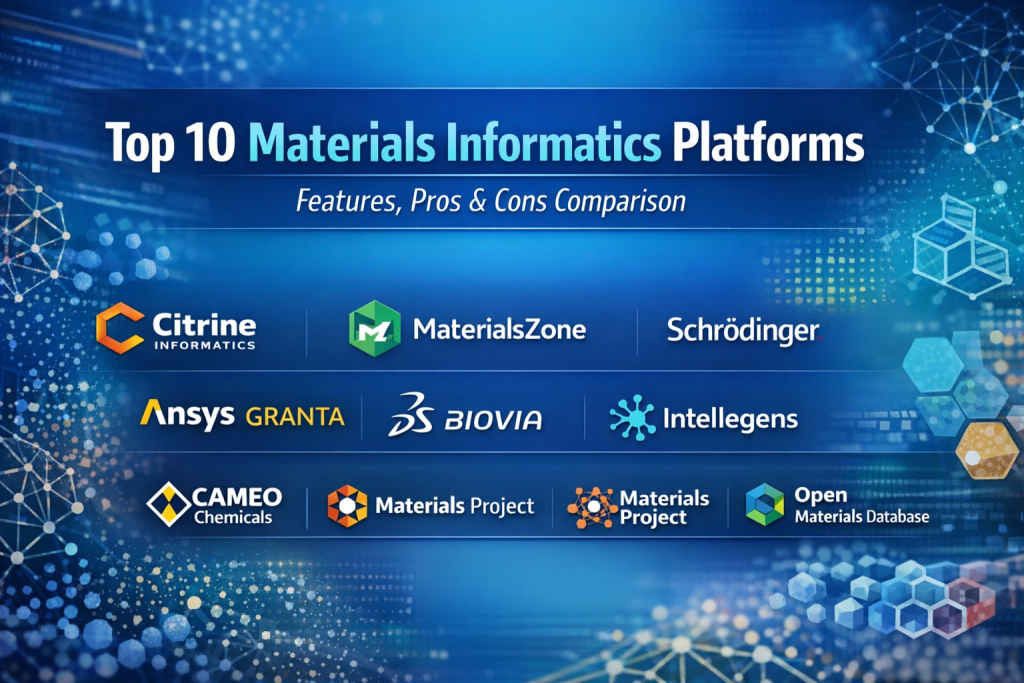
Top 10 Materials Informatics Platforms Tools
1 — Citrine Informatics
Short description:
A leading AI-driven platform focused on accelerating materials and chemical product development through machine learning and data analytics.
Key features
- Materials data management and normalization
- Predictive ML models for material properties
- Experiment planning and optimization
- Natural-language-inspired query tools
- Integration with lab and simulation data
- Visualization for property-performance tradeoffs
Pros
- Designed specifically for materials scientists
- Strong explainability in ML predictions
Cons
- Premium pricing for enterprise deployments
- Requires quality historical data to shine
Security & compliance:
Enterprise-grade encryption, role-based access, SSO support, GDPR-aligned controls
Support & community:
Strong documentation, onboarding support, enterprise customer success teams
2 — MaterialsZone
Short description:
A collaborative materials informatics platform focused on centralizing experimental data and enabling AI-driven insights.
Key features
- Unified materials data lake
- AI-powered analytics and modeling
- Experiment tracking and metadata management
- Workflow automation for R&D teams
- Collaboration and version control
- Visualization dashboards
Pros
- Excellent collaboration capabilities
- Good balance between usability and depth
Cons
- Customization can require vendor involvement
- Smaller ecosystem than older platforms
Security & compliance:
Encryption in transit and at rest, GDPR-compliant architecture
Support & community:
Hands-on onboarding, responsive support, growing user community
3 — Schrödinger
Short description:
A well-established computational modeling and simulation platform widely used in materials science and chemistry.
Key features
- Physics-based materials simulations
- ML-augmented property prediction
- Molecular and materials modeling
- High-performance computing support
- Visualization and analysis tools
Pros
- Scientifically rigorous models
- Trusted by academia and industry
Cons
- Steep learning curve
- Requires significant compute resources
Security & compliance:
Enterprise security controls, controlled-access deployments
Support & community:
Extensive documentation, training programs, strong academic community
4 — Dassault Systèmes BIOVIA
Short description:
An enterprise-grade platform for materials modeling, simulation, and lifecycle data management.
Key features
- Materials modeling and simulation tools
- Centralized materials data management
- Integration with PLM systems
- Collaboration across R&D and manufacturing
- Compliance and traceability features
Pros
- Deep enterprise integration
- Strong governance and compliance support
Cons
- Complex implementation
- Higher total cost of ownership
Security & compliance:
ISO-aligned controls, audit logs, enterprise access management
Support & community:
Global enterprise support, formal training programs
5 — Ansys Granta
Short description:
A materials information management platform focused on linking materials data with engineering simulations.
Key features
- Curated materials databases
- Integration with simulation tools
- Materials selection and comparison
- Compliance tracking
- Engineering-focused analytics
Pros
- Strong integration with engineering workflows
- Trusted materials datasets
Cons
- Less emphasis on AI-driven discovery
- UI can feel traditional
Security & compliance:
Enterprise-grade security, ISO compliance support
Support & community:
Comprehensive documentation, enterprise customer support
6 — Exabyte.io
Short description:
A cloud-native materials informatics platform enabling scalable simulations and data-driven discovery.
Key features
- Cloud-based materials simulations
- Workflow automation
- Integration with open-source tools
- Scalable compute resources
- Collaboration features
Pros
- Flexible and cloud-first
- Good for research teams and startups
Cons
- Smaller enterprise footprint
- Requires technical expertise
Security & compliance:
Cloud security best practices, access controls, encryption
Support & community:
Active documentation, responsive support, research-oriented community
7 — Intellegens
Short description:
An AI-driven materials informatics platform specializing in sparse and noisy experimental data.
Key features
- Advanced ML for small datasets
- Predictive modeling of materials properties
- Experiment prioritization
- Explainable AI outputs
- Cross-industry applicability
Pros
- Works well with limited data
- Strong interpretability
Cons
- Narrower workflow coverage
- Less focus on data management
Security & compliance:
Enterprise security controls, GDPR-ready deployments
Support & community:
Hands-on customer support, smaller but expert user base
8 — CAMEO Chemicals
Short description:
A materials and chemical information platform emphasizing safety, properties, and regulatory data.
Key features
- Chemical property databases
- Safety and hazard modeling
- Regulatory information
- Scenario analysis tools
- Educational resources
Pros
- Strong safety focus
- Easy to access structured data
Cons
- Limited AI-driven discovery
- Not a full R&D platform
Security & compliance:
Varies / N/A
Support & community:
Documentation-based support, educational user base
9 — Materials Project
Short description:
An open materials database providing computed properties for thousands of materials.
Key features
- Large open-access materials datasets
- Computational property predictions
- API access for integration
- Visualization tools
- Community-driven research
Pros
- Excellent for early-stage research
- No licensing barriers
Cons
- Limited enterprise features
- Requires technical expertise
Security & compliance:
Varies / N/A
Support & community:
Strong academic community, open documentation
10 — Open Materials Database
Short description:
A community-driven platform offering open datasets for materials science research.
Key features
- Open-access materials datasets
- Data sharing and collaboration
- Research-oriented structure
- Integration-friendly formats
- Transparency-focused approach
Pros
- Free and open
- Encourages collaboration
Cons
- No enterprise workflow support
- Limited advanced analytics
Security & compliance:
Varies / N/A
Support & community:
Community-led support, academic contributors
Comparison Table
| Tool Name | Best For | Platform(s) Supported | Standout Feature | Rating |
|---|---|---|---|---|
| Citrine Informatics | Enterprise R&D | Web, Cloud | Explainable AI models | N/A |
| MaterialsZone | Collaborative teams | Web, Cloud | Unified materials data lake | N/A |
| Schrödinger | Advanced simulations | Desktop, HPC, Cloud | Physics-based accuracy | N/A |
| BIOVIA | Large enterprises | Web, On-prem | PLM integration | N/A |
| Ansys Granta | Engineering teams | Desktop, Enterprise | Materials selection | N/A |
| Exabyte.io | Cloud-first research | Cloud | Scalable simulations | N/A |
| Intellegens | Sparse data modeling | Web, Cloud | ML with limited data | N/A |
| CAMEO Chemicals | Safety analysis | Web | Hazard modeling | N/A |
| Materials Project | Academic research | Web, API | Open materials data | N/A |
| Open Materials Database | Open science | Web | Free datasets | N/A |
Evaluation & Scoring of Materials Informatics Platforms
| Evaluation Criteria | Weight | Description |
|---|---|---|
| Core features | 25% | Modeling, data management, discovery capabilities |
| Ease of use | 15% | UI, learning curve, scientist-friendly design |
| Integrations & ecosystem | 15% | Lab, simulation, and enterprise system integration |
| Security & compliance | 10% | Access control, encryption, governance |
| Performance & reliability | 10% | Scalability and compute efficiency |
| Support & community | 10% | Documentation, training, vendor support |
| Price / value | 15% | ROI relative to cost |
Which Materials Informatics Platforms Tool Is Right for You?
- Solo researchers & academics: Open platforms like Materials Project
- SMBs & startups: Exabyte.io or Intellegens for flexibility
- Mid-market R&D teams: MaterialsZone or Citrine Informatics
- Large enterprises: BIOVIA, Ansys Granta, or Schrödinger
- Budget-conscious users: Open databases and community tools
- Compliance-heavy industries: BIOVIA or Ansys Granta
- Deep AI discovery needs: Citrine Informatics or Intellegens
The right choice depends on data maturity, team size, budget, and regulatory needs.
Frequently Asked Questions (FAQs)
1. What is materials informatics?
It is the application of data science and AI to materials science for faster discovery and optimization.
2. Do these platforms replace lab experiments?
No, they complement experiments by guiding and prioritizing them.
3. Are materials informatics tools only for large companies?
No, startups and research labs can also benefit, especially from cloud and open platforms.
4. How much data is required to start?
Some tools work well even with small or noisy datasets.
5. Are these platforms difficult to learn?
Complexity varies; many are designed for scientists rather than programmers.
6. Can they integrate with lab instruments?
Many support data import from LIMS and experimental systems.
7. Are open platforms reliable?
They are excellent for research but lack enterprise governance features.
8. How secure are these tools?
Enterprise platforms offer strong security; open tools vary.
9. What is the biggest mistake buyers make?
Choosing tools without considering data readiness and workflow fit.
10. Can materials informatics improve sustainability goals?
Yes, by accelerating low-impact and high-performance material discovery.
Conclusion
Materials Informatics Platforms are transforming how new materials are discovered, tested, and deployed. The most important factors when choosing a platform are workflow alignment, data readiness, scalability, and long-term value. There is no single “best” solution—only the best fit for your scientific, operational, and business needs. By carefully evaluating your goals and constraints, you can select a platform that accelerates innovation while reducing cost and risk.

Find Trusted Cardiac Hospitals
Compare heart hospitals by city and services — all in one place.
Explore Hospitals