
Introduction
Merchandise Storefront Platforms are digital tools that allow individuals and businesses to design, sell, manage, and scale branded merchandise through online storefronts. These platforms typically handle essential commerce functions such as product catalogs, payments, inventory, order fulfillment, taxes, and customer management—all in one place.
In today’s creator-driven and brand-first economy, merchandise has become more than just products. It is a direct revenue stream, a community-building channel, and a brand extension. From YouTubers and musicians selling apparel to startups launching branded products and enterprises running global D2C stores, merchandise storefronts play a central role.
Real-world use cases include:
- Creators monetizing audiences through branded apparel and accessories
- Startups launching MVP products without heavy infrastructure
- SMBs expanding from offline to online retail
- Enterprises running multi-region, multi-brand commerce operations
When choosing a Merchandise Storefront Platform, buyers should evaluate:
- Product and order management depth
- Ease of setup and daily operations
- Design flexibility and branding control
- Payment, tax, and fulfillment options
- Integration with marketing, analytics, and logistics tools
- Security, compliance, and scalability
Best for:
Content creators, D2C brands, SMB retailers, marketing teams, and enterprises looking to monetize physical products, validate ideas quickly, or scale merchandise globally.
Not ideal for:
Businesses selling only digital goods, teams requiring highly custom-built commerce engines from scratch, or organizations with no need for storefront-based selling.
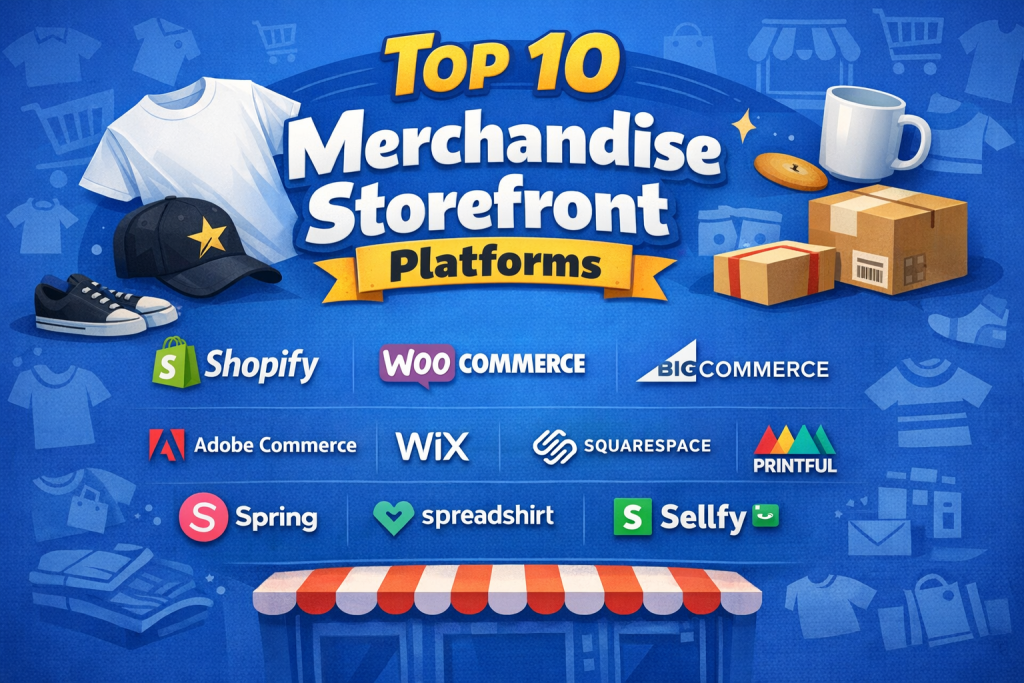
Top 10 Merchandise Storefront Platforms Tools
1 — Shopify
Short description:
A leading all-in-one commerce platform designed for businesses of all sizes to create, manage, and scale online merchandise stores globally.
Key features:
- Customizable storefront themes and branding
- Built-in checkout and payment processing
- Inventory, order, and tax management
- App ecosystem for marketing, shipping, and analytics
- Multi-channel selling (online, social, POS)
- Global currencies and localization
Pros:
- Extremely scalable from solo sellers to enterprises
- Large app and partner ecosystem
- Reliable performance and uptime
Cons:
- Monthly fees add up with apps
- Advanced customization may require developers
Security & compliance:
PCI-DSS compliant, GDPR support, encrypted transactions, role-based access controls.
Support & community:
Extensive documentation, 24/7 support plans, large global user and developer community.
2 — WooCommerce
Short description:
An open-source merchandise storefront solution built as a plugin for WordPress, offering full control and flexibility.
Key features:
- Deep WordPress integration
- Unlimited products and categories
- Extensive plugin and theme ecosystem
- Custom checkout and tax rules
- Self-hosted data ownership
Pros:
- Highly customizable and developer-friendly
- No platform transaction fees
- Strong SEO control
Cons:
- Requires hosting and maintenance
- Performance depends on setup quality
Security & compliance:
Varies by hosting and plugins; supports GDPR and encryption with proper configuration.
Support & community:
Large open-source community, documentation, paid expert support available.
3 — BigCommerce
Short description:
A robust SaaS merchandise platform focused on fast-growing brands and mid-market businesses.
Key features:
- Built-in multi-storefront support
- Advanced product and catalog management
- Headless commerce capabilities
- Native integrations with marketplaces
- Strong API-first architecture
Pros:
- Enterprise-grade features without heavy plugins
- Strong performance and reliability
- Good B2B and B2C support
Cons:
- Annual revenue limits by plan
- Smaller theme marketplace
Security & compliance:
PCI compliant, SOC 2 certified, GDPR support, enterprise security controls.
Support & community:
Dedicated onboarding, knowledge base, enterprise support options.
4 — Adobe Commerce
Short description:
A powerful enterprise commerce solution designed for complex, high-volume merchandise operations.
Key features:
- Advanced product and inventory management
- Multi-store and multi-language support
- Highly customizable checkout flows
- Enterprise-grade APIs and integrations
- AI-driven personalization tools
Pros:
- Unmatched flexibility for large operations
- Suitable for global commerce at scale
- Deep customization capabilities
Cons:
- High implementation and maintenance cost
- Requires experienced development teams
Security & compliance:
SOC 2, ISO standards support, advanced encryption, audit logs.
Support & community:
Enterprise support plans, certified partners, strong developer community.
5 — Wix
Short description:
A beginner-friendly website and merchandise storefront builder focused on ease of use and speed.
Key features:
- Drag-and-drop storefront design
- Built-in product and order management
- Integrated payments and taxes
- Mobile-optimized themes
- Marketing and email tools
Pros:
- Very easy to set up
- No technical skills required
- Affordable entry-level pricing
Cons:
- Limited scalability for large catalogs
- Less control over backend logic
Security & compliance:
PCI compliant, SSL encryption, GDPR tools available.
Support & community:
Guided onboarding, help center, community forums.
6 — Squarespace
Short description:
A design-focused commerce platform ideal for visually driven merchandise brands.
Key features:
- High-quality design templates
- Integrated inventory and checkout
- Subscription and product variants
- Built-in analytics
- Mobile-optimized storefronts
Pros:
- Excellent visual presentation
- Simple product management
- Reliable hosting included
Cons:
- Limited advanced commerce features
- Fewer integrations than competitors
Security & compliance:
SSL encryption, GDPR tools, standard payment compliance.
Support & community:
Knowledge base, email support, creator-focused community.
7 — Printful
Short description:
A print-on-demand merchandise platform that handles production and fulfillment automatically.
Key features:
- On-demand printing and shipping
- White-label branding options
- Product mockup generator
- Global fulfillment centers
- Seamless storefront integrations
Pros:
- No inventory risk
- Ideal for creators and artists
- Easy automation
Cons:
- Lower margins compared to bulk production
- Limited customization beyond catalog
Security & compliance:
GDPR compliant, secure payment handling.
Support & community:
Good documentation, creator resources, responsive support.
8 — Spring
Short description:
A creator-first merchandise platform focused on audience monetization.
Key features:
- Built-in storefront hosting
- Integrated audience tools
- On-demand production
- Global shipping
- Campaign-based selling
Pros:
- No upfront costs
- Simple setup for creators
- Handles fulfillment end-to-end
Cons:
- Limited branding flexibility
- Less control over customer data
Security & compliance:
Standard data protection practices; varies by region.
Support & community:
Creator guides, email support, community resources.
9 — Spreadshirt
Short description:
A marketplace and storefront solution for custom apparel and merchandise.
Key features:
- Marketplace exposure
- Custom storefronts
- On-demand printing
- Product design tools
- International fulfillment
Pros:
- Access to built-in audience
- No inventory management
- Easy product creation
Cons:
- Lower brand control
- Revenue share model
Security & compliance:
GDPR compliant, secure payment processing.
Support & community:
Help center, seller resources, community forums.
10 — Sellfy
Short description:
A simple commerce platform for selling physical merchandise alongside digital products.
Key features:
- Built-in storefront hosting
- Subscription and upsell tools
- Marketing automation
- Secure checkout
- Analytics dashboard
Pros:
- Fast setup
- Good for mixed product catalogs
- Affordable pricing
Cons:
- Limited design customization
- Not ideal for large-scale operations
Security & compliance:
SSL encryption, GDPR-ready tools.
Support & community:
Documentation, email support, creator-focused help content.
Comparison Table
| Tool Name | Best For | Platform(s) Supported | Standout Feature | Rating |
|---|---|---|---|---|
| Shopify | Scalable D2C brands | Web, POS | App ecosystem | N/A |
| WooCommerce | Custom WordPress stores | Web | Full control | N/A |
| BigCommerce | Mid-market brands | Web, Headless | Built-in enterprise tools | N/A |
| Adobe Commerce | Large enterprises | Web | Deep customization | N/A |
| Wix | Beginners | Web | Ease of use | N/A |
| Squarespace | Design-first brands | Web | Visual quality | N/A |
| Printful | Print-on-demand sellers | Web integrations | Fulfillment automation | N/A |
| Spring | Creators | Web | Audience monetization | N/A |
| Spreadshirt | Apparel sellers | Web | Marketplace reach | N/A |
| Sellfy | Small sellers | Web | Simple selling | N/A |
Evaluation & Scoring of Merchandise Storefront Platforms
| Criteria | Weight | Avg Score (1–5) |
|---|---|---|
| Core features | 25% | 4.5 |
| Ease of use | 15% | 4.3 |
| Integrations & ecosystem | 15% | 4.4 |
| Security & compliance | 10% | 4.2 |
| Performance & reliability | 10% | 4.4 |
| Support & community | 10% | 4.3 |
| Price / value | 15% | 4.1 |
Which Merchandise Storefront Platforms Tool Is Right for You?
- Solo creators: Look for ease of setup and fulfillment automation
- SMBs: Balance customization with operational simplicity
- Mid-market: Prioritize integrations, analytics, and scalability
- Enterprises: Focus on security, performance, and global operations
Budget-conscious users may prefer simpler SaaS or print-on-demand tools, while premium buyers benefit from enterprise-grade platforms. The right choice depends on how deeply merchandise is tied to your business strategy.
Frequently Asked Questions (FAQs)
1. Do I need technical skills to run a merchandise storefront?
Many platforms require no coding, while others allow advanced customization for developers.
2. Can I sell globally?
Most leading platforms support international payments and shipping.
3. Are print-on-demand platforms profitable?
Yes, but margins are usually lower than bulk manufacturing.
4. How important is design flexibility?
Critical for brand-focused businesses; less so for marketplace-based selling.
5. Can these platforms scale with my business?
Some scale easily, others require migration as volume grows.
6. What about taxes and compliance?
Most platforms offer automated tax tools or integrations.
7. Are these platforms secure?
Reputable providers follow industry-standard security practices.
8. Can I integrate marketing tools?
Yes, most offer built-in or third-party marketing integrations.
9. What is the biggest mistake buyers make?
Choosing based only on price, ignoring scalability and support.
10. Can I switch platforms later?
Yes, but migration can be complex depending on data volume.
Conclusion
Merchandise Storefront Platforms have become essential tools for monetizing brands, audiences, and products in the digital economy. The best platforms combine reliable commerce features, strong security, flexible integrations, and ease of use.
There is no single “best” solution for everyone. Solo creators, growing brands, and global enterprises each have different priorities. By aligning platform capabilities with your business size, budget, and long-term goals, you can choose a solution that not only sells merchandise—but strengthens your brand for the future.

Find Trusted Cardiac Hospitals
Compare heart hospitals by city and services — all in one place.
Explore Hospitals