
Introduction
Nurse Scheduling Systems are specialized workforce management tools designed to plan, assign, and optimize nursing shifts across hospitals, clinics, and healthcare organizations. Unlike generic scheduling software, these systems are built around the unique clinical, regulatory, and human realities of nursing, such as shift rotations, skill-based assignments, overtime rules, fatigue management, and last-minute coverage needs.
Effective nurse scheduling is critical because staffing directly impacts patient safety, nurse wellbeing, operational efficiency, and regulatory compliance. Poor schedules lead to burnout, absenteeism, staffing shortages, and increased medical errors. Modern Nurse Scheduling Systems help healthcare organizations move away from spreadsheets and manual planning toward automation, fairness, and real-time visibility.
Common real-world use cases include:
- Creating balanced rosters for large nursing teams
- Managing shift swaps and leave requests
- Ensuring compliance with labor laws and hospital policies
- Handling emergency coverage and float pools
- Reducing overtime and agency staffing costs
When choosing a Nurse Scheduling System, buyers should evaluate automation depth, ease of use, mobile access, integration with HR/payroll systems, compliance features, scalability, and data security.
Best for:
Hospitals, multi-specialty clinics, long-term care facilities, staffing coordinators, nurse managers, HR teams, and healthcare enterprises managing complex shift patterns.
Not ideal for:
Very small practices with fewer than 5 staff, non-clinical businesses, or organizations that only need basic calendar scheduling without compliance or workforce rules.
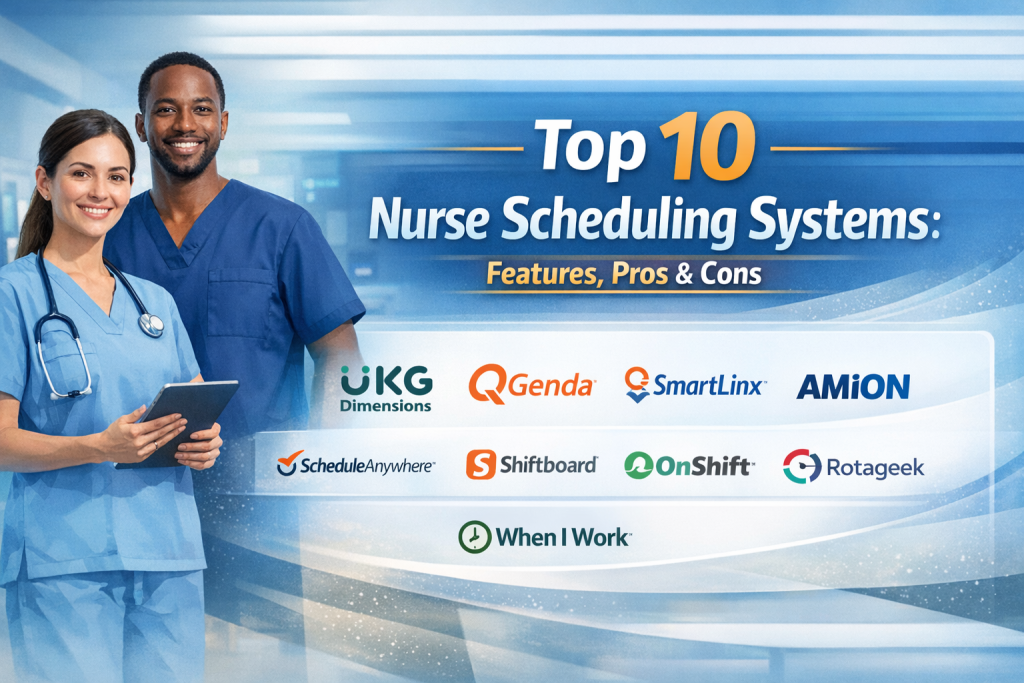
Top 10 Nurse Scheduling Systems Tools
1 — UKG Dimensions
Short description:
An enterprise-grade workforce management platform widely used by large hospitals to manage nurse scheduling, timekeeping, and labor compliance at scale.
Key features:
- Advanced nurse scheduling and shift optimization
- Labor rule enforcement and compliance automation
- Demand forecasting and staffing analytics
- Time & attendance integration
- Self-service shift swaps and requests
- Real-time dashboards and reporting
Pros:
- Extremely powerful for complex hospital environments
- Strong analytics and forecasting capabilities
Cons:
- Steep learning curve
- Higher cost compared to mid-market tools
Security & compliance:
HIPAA-aligned controls, SOC 2, role-based access, encryption, audit logs
Support & community:
Enterprise onboarding, dedicated account managers, extensive documentation
2 — QGenda
Short description:
A healthcare-focused scheduling platform designed for nurses, physicians, and clinical teams needing fair, rules-based schedules.
Key features:
- Automated nurse scheduling with fairness rules
- Credential and skill-based assignments
- Shift swaps and approvals
- Mobile access for staff
- Reporting and staffing insights
Pros:
- Designed specifically for healthcare workflows
- Easy adoption for clinical teams
Cons:
- Limited non-healthcare use cases
- Customization can require setup time
Security & compliance:
HIPAA-compliant infrastructure, SSO, encryption, audit trails
Support & community:
Strong onboarding, healthcare-focused support team
3 — SmartLinx
Short description:
A workforce management system tailored for healthcare organizations with strong nurse scheduling and compliance tracking.
Key features:
- Nurse scheduling and staffing optimization
- Credential and license tracking
- Time and attendance integration
- Overtime monitoring
- Payroll system integration
Pros:
- Strong compliance and credential management
- Good fit for regulated environments
Cons:
- Interface feels dated for some users
- Reporting customization is limited
Security & compliance:
HIPAA-ready, role-based access, audit logging
Support & community:
Dedicated healthcare support, structured onboarding
4 — AMiON
Short description:
A long-standing scheduling solution popular in hospitals for managing on-call rotations and nurse assignments.
Key features:
- On-call and shift scheduling
- Mobile access and alerts
- Coverage tracking
- Schedule publishing and updates
- Simple reporting tools
Pros:
- Reliable and proven in hospitals
- Straightforward scheduling workflows
Cons:
- Limited modern analytics
- UI feels basic compared to newer tools
Security & compliance:
Encryption, access controls, healthcare-ready deployment
Support & community:
Responsive support, clear documentation
5 — NurseGrid
Short description:
A mobile-first nurse scheduling app focused on communication, visibility, and shift coordination.
Key features:
- Mobile shift schedules
- Shift swap requests
- Group messaging for teams
- Calendar syncing
- Notifications and reminders
Pros:
- Excellent mobile experience for nurses
- Easy peer-to-peer coordination
Cons:
- Limited enterprise scheduling rules
- Not ideal for very large organizations
Security & compliance:
Basic encryption, access controls (compliance varies)
Support & community:
App-based support, strong nurse user community
6 — ScheduleAnywhere
Short description:
A flexible scheduling tool that supports healthcare teams needing quick deployment and easy shift management.
Key features:
- Drag-and-drop nurse scheduling
- Shift bidding and swaps
- Availability tracking
- Payroll exports
- Role-based scheduling rules
Pros:
- Simple to set up and use
- Cost-effective for mid-sized teams
Cons:
- Limited advanced analytics
- Fewer healthcare-specific automations
Security & compliance:
Standard encryption, access permissions
Support & community:
Email and phone support, onboarding resources
7 — Shiftboard
Short description:
A workforce scheduling platform used in healthcare for managing complex, high-volume shift operations.
Key features:
- Rule-based scheduling
- Real-time shift coverage updates
- Mobile staff access
- Compliance tracking
- Reporting and insights
Pros:
- Handles complex staffing models
- Good real-time visibility
Cons:
- Configuration can be complex
- Pricing varies by scale
Security & compliance:
SOC 2, encryption, audit logs
Support & community:
Dedicated support, enterprise onboarding options
8 — OnShift
Short description:
A workforce platform focused on nurse scheduling, engagement, and retention in healthcare environments.
Key features:
- Nurse scheduling and shift management
- Employee engagement tools
- Open shift bidding
- Mobile notifications
- Workforce analytics
Pros:
- Strong focus on retention and engagement
- User-friendly interface
Cons:
- Advanced reporting is limited
- Best suited for hourly workforce models
Security & compliance:
Encryption, access controls, healthcare-ready
Support & community:
Good onboarding, responsive support team
9 — Rotageek
Short description:
An AI-driven scheduling platform that optimizes nurse rosters based on demand, skills, and labor rules.
Key features:
- AI-powered scheduling optimization
- Skills and compliance matching
- Forecasting and demand planning
- Real-time adjustments
- Analytics dashboards
Pros:
- Advanced automation reduces manual effort
- Strong optimization capabilities
Cons:
- Higher cost for AI features
- Requires clean data for best results
Security & compliance:
GDPR-ready, encryption, access controls
Support & community:
Dedicated implementation support, training resources
10 — When I Work
Short description:
A lightweight scheduling solution used by smaller healthcare teams for simple nurse shift planning.
Key features:
- Shift scheduling and reminders
- Availability tracking
- Mobile app access
- Team messaging
- Basic reporting
Pros:
- Very easy to use
- Affordable entry-level option
Cons:
- Limited healthcare-specific rules
- Not ideal for complex hospitals
Security & compliance:
Standard security controls, compliance varies
Support & community:
Online help center, community resources
Comparison Table
| Tool Name | Best For | Platform(s) Supported | Standout Feature | Rating |
|---|---|---|---|---|
| UKG Dimensions | Large hospitals & enterprises | Web, Mobile | Advanced labor compliance | N/A |
| QGenda | Clinical teams & hospitals | Web, Mobile | Fairness-based scheduling | N/A |
| SmartLinx | Regulated healthcare orgs | Web | Credential tracking | N/A |
| AMiON | On-call nurse scheduling | Web, Mobile | Reliability | N/A |
| NurseGrid | Mobile-first nursing teams | Mobile | Nurse communication | N/A |
| ScheduleAnywhere | Mid-sized healthcare teams | Web | Ease of use | N/A |
| Shiftboard | High-volume staffing | Web, Mobile | Rule-based scheduling | N/A |
| OnShift | Nurse engagement & retention | Web, Mobile | Open shift bidding | N/A |
| Rotageek | Data-driven hospitals | Web | AI optimization | N/A |
| When I Work | Small healthcare teams | Web, Mobile | Simplicity | N/A |
Evaluation & Scoring of Nurse Scheduling Systems
| Criteria | Weight | Description |
|---|---|---|
| Core features | 25% | Scheduling depth, automation, rules |
| Ease of use | 15% | UI, learning curve, adoption |
| Integrations & ecosystem | 15% | HR, payroll, clinical systems |
| Security & compliance | 10% | Data protection, audits |
| Performance & reliability | 10% | Scalability and uptime |
| Support & community | 10% | Onboarding and help |
| Price / value | 15% | Cost vs benefits |
Which Nurse Scheduling Systems Tool Is Right for You?
- Solo users & small clinics: Simple tools like When I Work or NurseGrid
- SMBs & mid-market hospitals: ScheduleAnywhere, OnShift, QGenda
- Large enterprises: UKG Dimensions, SmartLinx, Rotageek
- Budget-conscious teams: Mobile-first or lightweight schedulers
- Compliance-heavy environments: UKG Dimensions, SmartLinx, QGenda
The right choice balances feature depth, usability, cost, and compliance needs.
Frequently Asked Questions (FAQs)
1. What is a Nurse Scheduling System?
It is software designed to manage nurse shifts, coverage, compliance, and staffing efficiency.
2. Why is nurse scheduling so complex?
Because it involves skills, fatigue rules, labor laws, patient demand, and fairness.
3. Do these tools support mobile access?
Most modern platforms offer mobile apps or mobile-friendly interfaces.
4. Can nurse scheduling systems reduce burnout?
Yes, fair schedules and self-service tools improve work-life balance.
5. Are these systems HIPAA compliant?
Many are designed for healthcare compliance, but levels vary by vendor.
6. How long does implementation take?
Anywhere from days for small teams to several months for enterprises.
7. Do they integrate with payroll systems?
Most mid-market and enterprise tools do.
8. Are AI-based schedulers better?
They can optimize schedules but require clean data and higher budgets.
9. What is the biggest mistake buyers make?
Choosing complexity over usability or ignoring nurse feedback.
10. Can these systems handle last-minute changes?
Yes, real-time updates and shift bidding are common features.
Conclusion
Nurse Scheduling Systems play a critical role in modern healthcare operations, directly affecting patient care quality, nurse satisfaction, and organizational efficiency. The best solutions automate complexity, enforce fairness, support compliance, and empower nurses through transparency and flexibility.
There is no single “best” tool for everyone. Small clinics may prioritize simplicity, while large hospitals need deep automation and analytics. The right choice depends on team size, budget, regulatory requirements, and operational complexity.
By focusing on real needs rather than feature checklists, healthcare organizations can select a Nurse Scheduling System that truly supports both caregivers and patients.

Find Trusted Cardiac Hospitals
Compare heart hospitals by city and services — all in one place.
Explore Hospitals
This blog is a practical comparison because nurse scheduling is not just “making a roster”—it directly impacts patient safety, staff burnout, overtime costs, and compliance. The best nurse scheduling systems typically combine demand-based staffing, skill/credential matching, shift swapping with approvals, automated overtime and fatigue rules, and real-time alerts for gaps or conflicts. When comparing tools, it’s important to check integration with payroll/HRIS and time & attendance, mobile usability for nurses, support for union and policy rules, float pool management, and reporting on coverage, overtime, and staffing efficiency. A strong scheduling platform helps hospitals maintain safe ratios, reduce last-minute chaos, and improve nurse satisfaction while keeping budgets under control.