
Introduction
Policy as Code (PaC) tools have become a foundational part of modern cloud-native, DevOps, and security-first organizations. At their core, these tools allow teams to define, manage, test, and enforce policies using code, rather than relying on manual reviews or static documentation. By turning governance rules into version-controlled, testable artifacts, Policy as Code enables consistency, automation, and auditability across infrastructure, applications, and deployment pipelines.
The importance of Policy as Code has grown alongside cloud adoption, Infrastructure as Code (IaC), Kubernetes, and CI/CD pipelines. As systems scale, manual governance simply does not scale with them. Policy as Code tools help organizations prevent misconfigurations, enforce security standards, ensure regulatory compliance, and reduce operational risk—all without slowing down development teams.
Real-world use cases include blocking insecure cloud resources before deployment, enforcing Kubernetes admission rules, validating Terraform plans, ensuring least-privilege access policies, and meeting compliance requirements such as SOC 2 or ISO standards.
When choosing a Policy as Code tool, users should evaluate:
- Policy language and flexibility
- Integration with CI/CD, IaC, and cloud platforms
- Ease of authoring, testing, and debugging policies
- Performance and scalability
- Security, auditability, and compliance support
Best for:
Platform engineers, DevOps teams, cloud security engineers, SREs, and compliance-driven organizations—from fast-growing startups to large enterprises—who need automated governance without sacrificing delivery speed.
Not ideal for:
Very small teams with minimal infrastructure, organizations with purely manual deployments, or teams unwilling to invest in learning declarative policy languages.
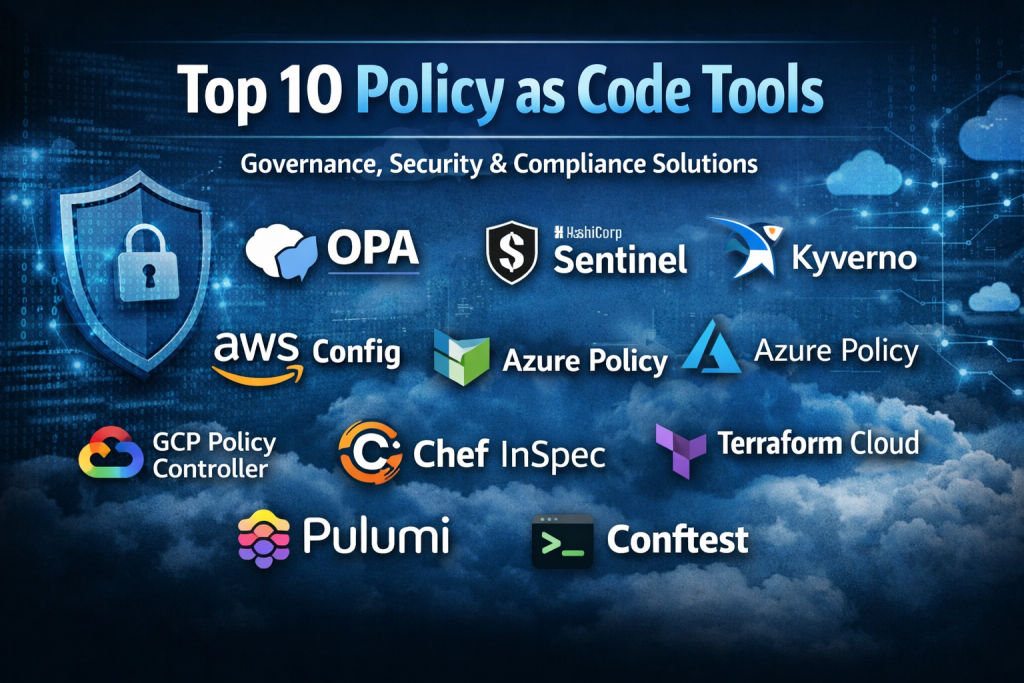
Top 10 Policy as Code Tools
1 — Open Policy Agent (OPA)
Short description:
Open Policy Agent is a general-purpose, open-source policy engine designed to enforce fine-grained policies across cloud-native systems, APIs, and microservices.
Key features:
- Declarative Rego policy language
- Works with Kubernetes, APIs, CI/CD, and microservices
- Decouples policy decisions from application logic
- High-performance evaluation engine
- JSON/YAML-based input and output
- Broad ecosystem and integrations
Pros:
- Extremely flexible and powerful
- Strong community and industry adoption
- Cloud-native and vendor-neutral
Cons:
- Steep learning curve with Rego
- Requires careful policy design for maintainability
Security & compliance:
Supports audit logging, RBAC integration, and compliance frameworks (implementation-dependent).
Support & community:
Excellent documentation, large open-source community, enterprise support via vendors.
2 — HashiCorp Sentinel
Short description:
HashiCorp Sentinel is a policy framework tightly integrated with HashiCorp’s ecosystem for enforcing governance across infrastructure workflows.
Key features:
- Integrated with Terraform, Vault, and Consul
- Fine-grained policy enforcement
- Policy checks at plan and apply stages
- Versioned and testable policies
- Enterprise-grade governance controls
Pros:
- Deep integration with HashiCorp tools
- Strong compliance and audit capabilities
- Designed for regulated environments
Cons:
- Proprietary and enterprise-focused
- Limited usefulness outside HashiCorp stack
Security & compliance:
SOC 2, audit trails, enterprise access controls.
Support & community:
Commercial support, detailed documentation, smaller community than OPA.
3 — Kyverno
Short description:
Kyverno is a Kubernetes-native Policy as Code engine that uses YAML-based rules for admission control and configuration enforcement.
Key features:
- Kubernetes-native design
- YAML-based policy definitions
- Mutating and validating admission controls
- Policy reporting and auditing
- No new DSL required
- Works directly with kubectl workflows
Pros:
- Easy to adopt for Kubernetes users
- No complex policy language
- Strong Kubernetes alignment
Cons:
- Kubernetes-only focus
- Less flexible for non-cluster policies
Security & compliance:
Supports audit policies and compliance reporting.
Support & community:
Active open-source community and growing enterprise adoption.
4 — Conftest
Short description:
Conftest is a lightweight testing tool that uses OPA policies to validate configuration files before deployment.
Key features:
- Policy testing for IaC files
- Works with Terraform, Kubernetes, Docker
- CLI-friendly and CI/CD-ready
- Rego-based policies
- Fast feedback loops
Pros:
- Simple and lightweight
- Prevents misconfigurations early
- CI/CD friendly
Cons:
- Not a runtime enforcement engine
- Depends on OPA knowledge
Security & compliance:
Policy-driven validation; compliance varies by implementation.
Support & community:
Good documentation, open-source community support.
5 — AWS Config Rules
Short description:
AWS Config Rules enable policy enforcement and continuous compliance monitoring within AWS environments.
Key features:
- Managed and custom rules
- Continuous resource evaluation
- Native AWS integration
- Automated remediation
- Compliance reporting
Pros:
- Fully managed by AWS
- Strong compliance visibility
- Easy AWS-native setup
Cons:
- AWS-only
- Limited customization compared to open tools
Security & compliance:
Supports SOC, ISO, GDPR-aligned compliance reporting.
Support & community:
Enterprise-grade AWS support and documentation.
6 — Azure Policy
Short description:
Azure Policy provides native Policy as Code enforcement across Microsoft Azure resources.
Key features:
- Declarative policy definitions
- Built-in compliance dashboards
- Automatic remediation
- Integration with Azure DevOps
- Policy initiatives and blueprints
Pros:
- Deep Azure integration
- Strong governance reporting
- Easy to scale across subscriptions
Cons:
- Azure-only
- Less portable across clouds
Security & compliance:
ISO, SOC, GDPR-aligned compliance capabilities.
Support & community:
Microsoft enterprise support and extensive documentation.
7 — Google Cloud Policy Controller
Short description:
Google Cloud Policy Controller enforces Kubernetes and cloud policies using constraint templates and declarative rules.
Key features:
- Built on OPA Gatekeeper
- Kubernetes admission control
- GCP-native integrations
- Policy auditing and reporting
- Centralized governance
Pros:
- Strong Kubernetes alignment
- Managed GCP service
- Scales well for large clusters
Cons:
- Primarily GCP-focused
- Less flexible outside Kubernetes
Security & compliance:
Supports audit logs and compliance reporting.
Support & community:
Google enterprise support and documentation.
8— Chef InSpec
Short description:
Chef InSpec is a Compliance as Code framework for defining infrastructure and security compliance rules.
Key features:
- Human-readable compliance language
- Infrastructure and security testing
- Supports multiple platforms
- Compliance profiles
- CI/CD integration
Pros:
- Strong compliance focus
- Mature ecosystem
- Widely adopted in regulated industries
Cons:
- More testing-focused than enforcement
- Learning curve for DSL
Security & compliance:
Designed for regulatory compliance (SOC, ISO, HIPAA).
Support & community:
Enterprise support and established community.
9 — Terraform Cloud Policy Sets
Short description:
Terraform Cloud Policy Sets enforce governance across Terraform workflows using Sentinel or OPA.
Key features:
- Policy enforcement at plan/apply
- Centralized governance
- Policy versioning
- Integration with Terraform runs
- Enterprise controls
Pros:
- Seamless Terraform integration
- Strong governance model
- Enterprise-ready
Cons:
- Terraform-centric
- Requires paid tiers
Security & compliance:
Audit logs, access controls, enterprise compliance.
Support & community:
Commercial support and strong documentation.
10 — Pulumi Policy as Code
Short description:
Pulumi Policy as Code allows teams to write policies using familiar programming languages.
Key features:
- Policies in TypeScript, Python, Go
- Tight IaC integration
- Preview-time enforcement
- Cross-cloud support
- Developer-friendly workflows
Pros:
- Uses general-purpose languages
- Strong developer experience
- Multi-cloud flexibility
Cons:
- Best suited for Pulumi users
- Smaller ecosystem than Terraform
Security & compliance:
Supports policy validation and audit logging.
Support & community:
Active community and enterprise support options.
Comparison Table
| Tool Name | Best For | Platform(s) Supported | Standout Feature | Rating |
|---|---|---|---|---|
| Open Policy Agent | Cloud-native governance | Multi-platform | Rego flexibility | N/A |
| HashiCorp Sentinel | HashiCorp users | Terraform ecosystem | Enterprise governance | N/A |
| Kyverno | Kubernetes teams | Kubernetes | YAML-native policies | N/A |
| Conftest | CI/CD validation | Multi-platform | Fast config testing | N/A |
| AWS Config Rules | AWS compliance | AWS | Managed compliance | N/A |
| Azure Policy | Azure governance | Azure | Native policy engine | N/A |
| GCP Policy Controller | GKE governance | GCP/Kubernetes | Gatekeeper-based | N/A |
| Chef InSpec | Compliance testing | Multi-platform | Compliance as Code | N/A |
| Terraform Cloud Policy Sets | Terraform governance | Terraform Cloud | Centralized enforcement | N/A |
| Pulumi Policy as Code | Developer-first IaC | Multi-cloud | Language flexibility | N/A |
Evaluation & Scoring of Policy as Code Tools
| Tool | Core Features (25%) | Ease of Use (15%) | Integrations (15%) | Security (10%) | Performance (10%) | Support (10%) | Price/Value (15%) | Total |
|---|---|---|---|---|---|---|---|---|
| Open Policy Agent | High | Medium | High | High | High | High | High | Very Strong |
| HashiCorp Sentinel | High | Medium | High | High | High | Medium | Medium | Strong |
| Kyverno | Medium | High | Medium | Medium | High | Medium | High | Strong |
| Conftest | Medium | High | Medium | Medium | High | Medium | High | Strong |
| AWS Config Rules | Medium | High | High | High | High | High | Medium | Strong |
| Azure Policy | Medium | High | High | High | High | High | Medium | Strong |
| GCP Policy Controller | Medium | Medium | Medium | Medium | High | Medium | Medium | Moderate |
| Chef InSpec | High | Medium | Medium | High | Medium | High | Medium | Strong |
| Terraform Cloud Policy Sets | High | Medium | High | High | High | Medium | Medium | Strong |
| Pulumi Policy as Code | High | High | Medium | Medium | High | Medium | Medium | Strong |
Which Policy as Code Tool Is Right for You?
- Solo users: Lightweight tools like Conftest or Pulumi Policy as Code
- SMBs: Kyverno, OPA, or Pulumi for flexibility and cost efficiency
- Mid-market: OPA with CI/CD integration or Terraform Cloud Policy Sets
- Enterprise: HashiCorp Sentinel, AWS Config, Azure Policy for governance
Budget-conscious: Open-source tools like OPA, Kyverno, Conftest
Premium solutions: Sentinel, Terraform Cloud, managed cloud-native tools
Feature depth: OPA, Sentinel
Ease of use: Kyverno, cloud-native policies
Compliance-heavy: Chef InSpec, AWS/Azure policies
Frequently Asked Questions (FAQs)
- What is Policy as Code?
It is the practice of defining and enforcing governance rules using code. - Why is Policy as Code important?
It ensures consistent, automated, and auditable governance at scale. - Is Policy as Code only for security?
No, it also covers cost control, reliability, and operational standards. - Can Policy as Code slow down developers?
When implemented well, it actually accelerates safe deployments. - Do I need Kubernetes to use Policy as Code?
No, many tools work with IaC, APIs, and cloud services. - Is OPA hard to learn?
It has a learning curve, but offers unmatched flexibility. - Are managed cloud policies enough?
They work well within a single cloud but lack portability. - Can I test policies before deployment?
Yes, tools like Conftest and Sentinel support pre-deployment checks. - How does Policy as Code help compliance?
It provides repeatable, auditable enforcement of standards. - Is there one best tool?
No—choice depends on your stack, scale, and governance needs.
Conclusion
Policy as Code tools are no longer optional for organizations operating at cloud scale. They bring automation, consistency, and confidence to governance by embedding policies directly into engineering workflows. While tools like Open Policy Agent offer unmatched flexibility, managed cloud-native solutions simplify compliance, and developer-first platforms focus on usability.
What matters most is alignment with your infrastructure, team skills, and compliance requirements. There is no universal winner—only the right tool for your specific context. By evaluating needs carefully, teams can adopt Policy as Code in a way that strengthens security and governance without slowing innovation.

Find Trusted Cardiac Hospitals
Compare heart hospitals by city and services — all in one place.
Explore Hospitals
Nice write‑up! I like how you laid out the pros and cons for each tool — makes it easier to see which one fits best for different needs. 😊