
Introduction
Predictive Maintenance Platforms are advanced software solutions designed to anticipate equipment failures before they happen. Instead of relying on fixed schedules or reacting after breakdowns occur, these platforms use sensor data, machine learning, statistical models, and historical patterns to predict when maintenance should be performed. The goal is simple but powerful: reduce downtime, lower maintenance costs, and extend asset life.
In today’s industrial environment—where factories, utilities, transportation networks, and energy systems operate at massive scale—even a few minutes of unplanned downtime can lead to significant financial and safety risks. Predictive maintenance has therefore become a strategic capability rather than just an operational improvement.
Why Predictive Maintenance Is Important
- Prevents costly unplanned downtime
- Reduces unnecessary preventive maintenance
- Improves asset reliability and lifespan
- Enhances worker safety
- Supports data-driven maintenance decisions
Common Real-World Use Cases
- Manufacturing equipment health monitoring
- Energy and utilities asset reliability
- Fleet and transportation maintenance
- Oil & gas rotating equipment monitoring
- Smart factories and Industry 4.0 initiatives
What to Look for When Choosing a Platform (Evaluation Criteria)
- Data ingestion (IoT sensors, SCADA, historians)
- AI/ML capabilities for anomaly detection and forecasting
- Ease of use for maintenance and reliability teams
- Integration with CMMS, ERP, and OT systems
- Scalability across plants and geographies
- Security and compliance for enterprise environments
Best for:
Maintenance engineers, reliability managers, operations leaders, plant managers, and data teams in manufacturing, energy, utilities, transportation, chemicals, and heavy industries—from mid-sized plants to global enterprises.
Not ideal for:
Very small teams with minimal equipment, organizations without sensor data, or businesses where assets are low-cost and easily replaceable—where traditional preventive maintenance may be sufficient.
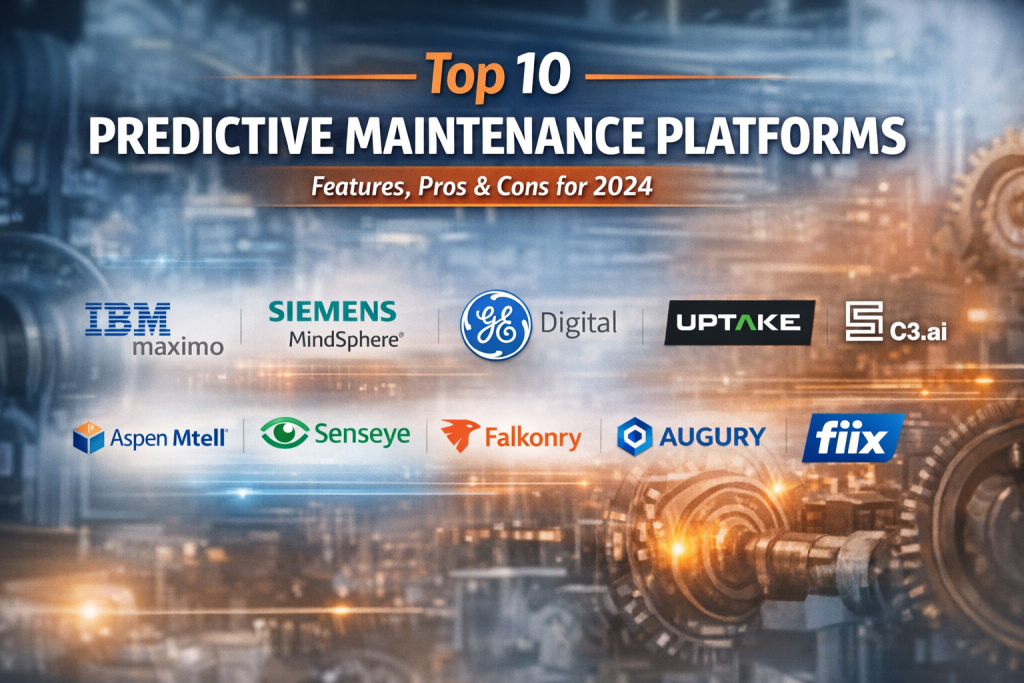
Top 10 Predictive Maintenance Platforms Tools
1 — IBM Maximo Application Suite
Short description:
An enterprise-grade asset management and predictive maintenance platform combining AI, IoT, and reliability engineering. Designed for large, asset-intensive organizations.
Key features:
- AI-driven predictive maintenance and anomaly detection
- Integration with IoT sensors and historians
- Asset lifecycle management
- Condition-based maintenance workflows
- Digital twin capabilities
- Work order automation
- Advanced analytics and dashboards
Pros:
- Extremely robust and scalable
- Deep asset management capabilities
Cons:
- Complex implementation
- Higher cost and learning curve
Security & compliance:
Enterprise-grade security, SSO, encryption, audit logs, SOC 2, ISO, GDPR support.
Support & community:
Strong enterprise support, extensive documentation, global partner ecosystem.
2 — Siemens MindSphere
Short description:
An industrial IoT and predictive maintenance platform focused on manufacturing, energy, and automation-heavy environments.
Key features:
- Real-time sensor data ingestion
- Predictive analytics and condition monitoring
- Digital twin integration
- Edge and cloud deployment options
- Strong OT system connectivity
- Advanced visualization tools
Pros:
- Excellent for Siemens-based environments
- Strong industrial-grade analytics
Cons:
- Best value when deeply integrated with Siemens stack
- Customization can require expertise
Security & compliance:
Enterprise security, encryption, role-based access, ISO, GDPR.
Support & community:
Professional enterprise support, strong industrial user base.
3 — GE Digital APM
Short description:
A mature asset performance management platform with strong predictive and reliability modeling capabilities.
Key features:
- Predictive analytics and failure forecasting
- Asset health indexing
- Risk-based maintenance planning
- Integration with historians and CMMS
- Reliability-centered maintenance (RCM) tools
Pros:
- Proven in heavy industries
- Strong reliability engineering focus
Cons:
- Interface can feel dated
- Configuration complexity
Security & compliance:
Enterprise-grade security, encryption, audit logging, ISO compliance.
Support & community:
Dedicated enterprise support and industry expertise.
4 — Uptake
Short description:
A data-driven predictive maintenance platform emphasizing AI models and industrial analytics.
Key features:
- Machine learning–based failure prediction
- Asset health scoring
- Fleet and equipment analytics
- Cloud-native architecture
- Cross-industry templates
Pros:
- Strong AI modeling capabilities
- Modern cloud-based approach
Cons:
- Less asset management depth than EAM tools
- Pricing can be premium
Security & compliance:
SSO, encryption, SOC 2, GDPR alignment.
Support & community:
Good onboarding and customer success focus.
5 — C3 AI Reliability
Short description:
An AI-first reliability and predictive maintenance solution built for large-scale industrial data environments.
Key features:
- Advanced AI and ML models
- Large-scale data processing
- Predictive failure analysis
- Asset health dashboards
- Custom model development
Pros:
- Extremely powerful analytics
- Handles massive data volumes
Cons:
- Requires data science expertise
- Enterprise-focused pricing
Security & compliance:
Enterprise security, SSO, encryption, audit trails, GDPR.
Support & community:
Strong enterprise support, limited community for smaller teams.
6 — Aspen Mtell
Short description:
A specialized predictive maintenance platform using advanced pattern recognition for early fault detection.
Key features:
- Early anomaly detection
- Physics-based and AI models
- Minimal training data requirements
- Integration with process historians
- Root cause insights
Pros:
- Excellent early fault detection
- Strong in process industries
Cons:
- Narrower scope beyond maintenance
- Less intuitive UI
Security & compliance:
Enterprise-grade security, encryption, compliance-ready.
Support & community:
Expert-led support, strong industrial reputation.
7 — Senseye PdM
Short description:
An accessible predictive maintenance platform focused on rapid deployment and ease of use.
Key features:
- Automated anomaly detection
- Maintenance decision support
- CMMS integration
- Asset health scoring
- Cloud and hybrid deployment
Pros:
- Easy to use for maintenance teams
- Faster time to value
Cons:
- Less customizable for advanced data science
- Limited deep AI tuning
Security & compliance:
SSO, encryption, GDPR, enterprise-ready controls.
Support & community:
Strong onboarding, practical documentation.
8 — Falkonry
Short description:
An AI platform for time-series data analysis and predictive maintenance in industrial environments.
Key features:
- No-code/low-code AI models
- Time-series anomaly detection
- Real-time alerts
- Edge and cloud support
- OT-friendly integrations
Pros:
- Faster deployment without heavy data science
- Flexible architecture
Cons:
- Limited EAM functionality
- Smaller ecosystem
Security & compliance:
Encryption, access controls, GDPR-aligned.
Support & community:
Good documentation and responsive support.
9 — Augury
Short description:
A machine health platform combining hardware sensors with AI-driven predictive maintenance.
Key features:
- Vibration and acoustic monitoring
- AI-based fault diagnosis
- Asset health reports
- Maintenance recommendations
- Rapid sensor deployment
Pros:
- Strong machine-level insights
- Turnkey solution with hardware
Cons:
- Hardware dependency
- Less flexible for custom analytics
Security & compliance:
Secure data transmission, encryption, enterprise-grade controls.
Support & community:
Strong customer success and guided onboarding.
10 — Fiix Predict
Short description:
A predictive maintenance extension focused on CMMS-driven maintenance optimization.
Key features:
- Maintenance trend analysis
- Failure prediction insights
- CMMS-native workflows
- Asset performance dashboards
- Maintenance prioritization
Pros:
- Easy for CMMS users
- Lower barrier to entry
Cons:
- Less advanced AI models
- Limited beyond maintenance analytics
Security & compliance:
Standard SaaS security, role-based access, GDPR.
Support & community:
Strong CMMS user community and documentation.
Comparison Table
| Tool Name | Best For | Platform(s) Supported | Standout Feature | Rating |
|---|---|---|---|---|
| IBM Maximo Application Suite | Large enterprises | Cloud, hybrid | Full EAM + AI PdM | N/A |
| Siemens MindSphere | Industrial IoT users | Cloud, edge | OT-native IoT integration | N/A |
| GE Digital APM | Heavy industry | Cloud, on-prem | Reliability-centered maintenance | N/A |
| Uptake | Data-driven operations | Cloud | AI-driven insights | N/A |
| C3 AI Reliability | Large-scale AI projects | Cloud | Advanced AI modeling | N/A |
| Aspen Mtell | Process industries | Cloud, on-prem | Early fault detection | N/A |
| Senseye PdM | Maintenance teams | Cloud, hybrid | Ease of use | N/A |
| Falkonry | OT analytics teams | Cloud, edge | No-code AI | N/A |
| Augury | Machine-level monitoring | Cloud + hardware | Sensor-driven diagnostics | N/A |
| Fiix Predict | CMMS users | Cloud | Maintenance-native PdM | N/A |
Evaluation & Scoring of Predictive Maintenance Platforms
| Criteria | Weight | Score Description |
|---|---|---|
| Core features | 25% | Predictive models, analytics depth |
| Ease of use | 15% | UI, onboarding, usability |
| Integrations & ecosystem | 15% | CMMS, ERP, IoT, OT systems |
| Security & compliance | 10% | Enterprise security readiness |
| Performance & reliability | 10% | Scalability and uptime |
| Support & community | 10% | Documentation, support quality |
| Price / value | 15% | ROI and cost justification |
Which Predictive Maintenance Platforms Tool Is Right for You?
- Solo users or small teams: CMMS-integrated or simpler platforms like Fiix Predict
- SMBs: Senseye PdM, Falkonry for faster deployment
- Mid-market: Uptake or Augury for strong analytics without full EAM complexity
- Enterprise: IBM Maximo, Siemens MindSphere, C3 AI
Budget-conscious: CMMS-native or focused PdM tools
Premium solutions: Enterprise AI-driven platforms
Ease of use: Senseye, Augury
Deep analytics: C3 AI, Aspen Mtell
Strict compliance needs: IBM, Siemens, GE Digital
Frequently Asked Questions (FAQs)
1. What is predictive maintenance?
It uses data and analytics to predict failures before they occur.
2. How is it different from preventive maintenance?
Preventive is schedule-based; predictive is condition-based.
3. Do I need IoT sensors?
Most platforms benefit significantly from sensor data.
4. Is AI mandatory for predictive maintenance?
AI enhances accuracy but simpler statistical models can also work.
5. How long does implementation take?
Anywhere from weeks to several months depending on scale.
6. Is predictive maintenance expensive?
Costs vary, but ROI often justifies the investment.
7. Can small companies use these platforms?
Yes, especially lighter and CMMS-integrated solutions.
8. Are these platforms secure?
Most enterprise platforms offer strong security controls.
9. Do they integrate with CMMS?
Yes, integration is a core feature for most tools.
10. What is the biggest implementation mistake?
Poor data quality and unclear maintenance objectives.
Conclusion
Predictive Maintenance Platforms are transforming how organizations manage assets, shifting maintenance from reactive and preventive approaches to data-driven, proactive strategies. The right platform can significantly reduce downtime, optimize costs, and improve operational reliability.
There is no single “best” tool for everyone. The best choice depends on your asset complexity, data maturity, team skills, budget, and industry requirements. By carefully evaluating features, integrations, usability, and long-term scalability, organizations can select a platform that delivers real and sustainable value.

Find Trusted Cardiac Hospitals
Compare heart hospitals by city and services — all in one place.
Explore Hospitals