
Introduction
Print-on-Demand (POD) platforms enable creators and businesses to design, sell, and fulfill custom-printed products—such as apparel, accessories, home décor, books, and stationery—without holding inventory. Orders are produced only after a sale is made, drastically reducing upfront risk and operational complexity. In today’s creator economy and eCommerce-first landscape, POD has become a core growth engine for entrepreneurs who want speed, flexibility, and global reach.
Why does POD matter? It lowers barriers to entry, shortens time-to-market, and allows rapid experimentation with designs and niches. Brands can test ideas, creators can monetize audiences, and enterprises can offer personalized merchandise without overstock or waste. Common use cases include influencer merch, brand swag, event merchandise, dropshipping stores, internal corporate kits, and personalized gifts.
When choosing a POD platform, users should evaluate product range, print quality, fulfillment speed, global coverage, integrations (storefronts and marketplaces), branding options, pricing transparency, quality control, and customer support. Reliability and scalability matter just as much as creative freedom.
Best for:
Creators, influencers, designers, artists, small brands, DTC startups, marketing teams, and eCommerce businesses seeking low-risk merchandising with scalable fulfillment.
Not ideal for:
Businesses needing ultra-low unit costs at massive volumes, highly specialized manufacturing processes, or strict on-prem compliance requirements where POD’s variable production model may be limiting.
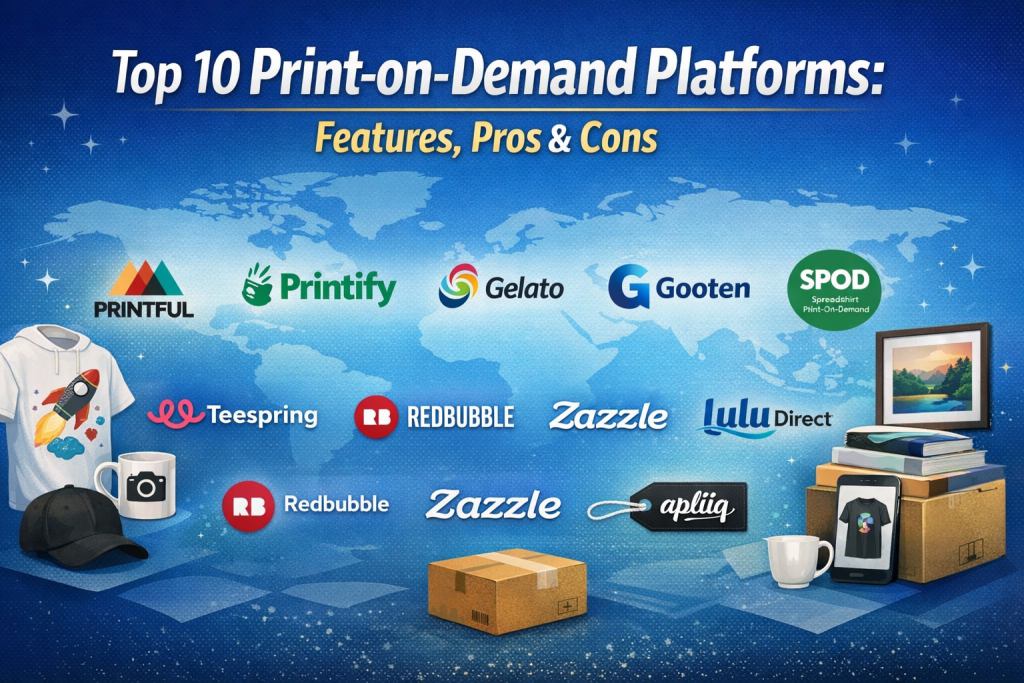
Top 10 Print-on-Demand Platforms Tools
1 — Printful
Short description: A premium POD platform focused on quality, branding, and global fulfillment for growing eCommerce brands.
Key features
- Large catalog (apparel, accessories, home goods)
- In-house printing and quality control
- Global fulfillment centers
- White-label branding options
- Mockup generator and design tools
- Native integrations with major storefronts
- Warehousing & fulfillment add-ons
Pros
- Consistent print quality and reliability
- Strong branding and packaging options
Cons
- Higher base costs than budget platforms
- Some products have longer production times
Security & compliance: GDPR-aligned data handling; varies by integration.
Support & community: Strong documentation, responsive support, active creator community, enterprise assistance available.
2 — Printify
Short description: A marketplace-style POD platform connecting users to a global network of print providers.
Key features
- Wide network of third-party print partners
- Competitive pricing via provider choice
- Extensive product catalog
- Simple design and listing tools
- Storefront integrations
- Printify Premium discounts
- Flexible routing options
Pros
- Cost-effective for price-sensitive sellers
- High product and provider variety
Cons
- Quality can vary by provider
- Less centralized quality control
Security & compliance: GDPR; provider-dependent controls.
Support & community: Solid documentation, ticket-based support, large user base.
3 — Gelato
Short description: A globally distributed POD network optimized for local production and fast delivery.
Key features
- Local production in many countries
- Focus on sustainability and reduced shipping
- Apparel, wall art, stationery, photo products
- API and storefront integrations
- Automated order routing
- Branding options
- Subscription for discounts
Pros
- Faster delivery with local fulfillment
- Environmentally conscious approach
Cons
- Smaller apparel catalog than competitors
- Some advanced features behind subscription
Security & compliance: GDPR-compliant; varies by region.
Support & community: Good onboarding, knowledge base, business-tier support.
4— Gooten
Short description: A scalable POD solution built for brands that need automation and global operations.
Key features
- Intelligent order routing
- Global print partner network
- Extensive product categories
- API-first approach
- Quality assurance workflows
- Automated shipping selection
- White-label fulfillment
Pros
- Strong automation for scaling brands
- Suitable for complex catalogs
Cons
- Steeper learning curve
- Less beginner-friendly UI
Security & compliance: Varies / N/A (depends on integrations).
Support & community: Dedicated account management for larger clients; documentation available.
5 — SPOD
Short description: A fast-production POD platform backed by Spreadshirt, ideal for apparel-focused sellers.
Key features
- Extremely fast production times
- Apparel-centric catalog
- Simple mockup generator
- Storefront integrations
- Custom branding options
- EU and US fulfillment
- Competitive pricing
Pros
- Industry-leading production speed
- Reliable apparel quality
Cons
- Limited non-apparel products
- Fewer advanced automation features
Security & compliance: GDPR-aligned.
Support & community: Helpful documentation, email support, Spreadshirt ecosystem community.
6 — Teespring
Short description: A creator-first platform that combines POD with built-in storefronts and marketing tools.
Key features
- Integrated storefronts
- Apparel and lifestyle products
- Audience monetization tools
- Marketing and promotion features
- Global fulfillment
- No upfront costs
- Simple design workflow
Pros
- Easy for creators without a separate store
- Built-in marketing capabilities
Cons
- Less control over branding
- Lower margins compared to self-hosted stores
Security & compliance: Varies / N/A.
Support & community: Creator-focused resources, community forums, standard support.
7 — Redbubble
Short description: A marketplace-driven POD platform designed for independent artists to sell designs globally.
Key features
- Built-in global marketplace
- Wide range of art-focused products
- Automatic fulfillment and shipping
- Artist analytics dashboard
- No store setup required
- Tiered artist accounts
- Community discovery features
Pros
- Exposure to a large existing audience
- Zero operational overhead
Cons
- Lower control over customer relationships
- Margin pressure due to marketplace fees
Security & compliance: GDPR; platform-managed.
Support & community: Artist help center, forums, community engagement.
8 — Zazzle
Short description: A customization-heavy POD marketplace suitable for personalized products and designs.
Key features
- Advanced product customization
- Large product catalog
- Built-in marketplace traffic
- Design tools for personalization
- Royalty settings
- Global shipping
- Licensing opportunities
Pros
- Strong personalization capabilities
- Marketplace exposure
Cons
- Complex interface for beginners
- Less brand ownership
Security & compliance: Varies / N/A.
Support & community: Documentation, creator support, marketplace community.
9 — Lulu Direct
Short description: A POD platform specialized in books, manuals, and print publications.
Key features
- Book and booklet printing
- High-quality binding options
- Global distribution
- API integrations
- White-label fulfillment
- Short-run and single-copy printing
- Author-centric tools
Pros
- Excellent print quality for books
- Ideal for authors and educators
Cons
- Limited non-book products
- Not suited for apparel sellers
Security & compliance: Varies / N/A.
Support & community: Strong documentation, author resources, dedicated support.
10 — Apliiq
Short description: A fashion-forward POD platform focused on premium apparel customization.
Key features
- Cut-and-sew apparel options
- Private labeling and custom tags
- Premium fabrics and finishes
- Branding customization
- US-based fulfillment
- Designer-focused workflows
- Small-batch production
Pros
- High-end apparel differentiation
- Strong brand control
Cons
- Higher costs
- Narrower product range
Security & compliance: Varies / N/A.
Support & community: Personalized support, niche designer community.
Comparison Table
| Tool Name | Best For | Platform(s) Supported | Standout Feature | Rating |
|---|---|---|---|---|
| Printful | Scaling DTC brands | Web, Storefront integrations | In-house quality control | N/A |
| Printify | Cost-sensitive sellers | Web, Storefront integrations | Provider marketplace | N/A |
| Gelato | Global delivery speed | Web, API | Local production worldwide | N/A |
| Gooten | Automation at scale | Web, API | Intelligent order routing | N/A |
| SPOD | Fast apparel fulfillment | Web, Storefront integrations | Ultra-fast production | N/A |
| Teespring | Creators & influencers | Web | Built-in storefronts | N/A |
| Redbubble | Independent artists | Web | Marketplace discovery | N/A |
| Zazzle | Personalization-heavy products | Web | Advanced customization | N/A |
| Lulu Direct | Books & publications | Web, API | Professional book printing | N/A |
| Apliiq | Premium apparel brands | Web | Cut-and-sew customization | N/A |
Evaluation & Scoring of Print-on-Demand Platforms
| Criteria | Weight | Notes |
|---|---|---|
| Core features | 25% | Product range, print quality, fulfillment |
| Ease of use | 15% | UI, onboarding, workflows |
| Integrations & ecosystem | 15% | Storefronts, APIs, marketplaces |
| Security & compliance | 10% | Data handling, privacy standards |
| Performance & reliability | 10% | Fulfillment speed, uptime |
| Support & community | 10% | Docs, responsiveness, resources |
| Price / value | 15% | Margins, transparency, scalability |
Which Print-on-Demand Platforms Tool Is Right for You?
- Solo users & creators: Marketplace-driven tools or all-in-one storefront platforms reduce setup friction.
- SMBs: Integration-focused platforms balance cost, control, and scalability.
- Mid-market brands: Automation, branding, and global fulfillment become critical.
- Enterprise: API access, QA processes, and consistent global performance matter most.
Budget-conscious vs premium:
Lower-cost platforms trade some control for affordability, while premium tools offer reliability and branding at higher margins.
Feature depth vs ease of use:
Beginners benefit from simplicity; advanced sellers need customization and automation.
Integration & scalability:
High-volume sellers should prioritize APIs and multi-store support.
Security & compliance:
While POD is generally low-risk, data privacy and regional compliance still matter—especially at scale.
Frequently Asked Questions (FAQs)
- What is print-on-demand?
A fulfillment model where products are printed only after a customer places an order. - Do I need inventory to start?
No. POD eliminates inventory and warehousing needs. - Is POD profitable?
Yes, with the right niche, pricing, and marketing strategy. - Which POD platform is cheapest?
Marketplace-style providers often offer lower base costs but less control. - Can I use POD with my existing store?
Most leading platforms integrate with popular eCommerce systems. - How long does fulfillment take?
Typically 2–7 business days, depending on product and location. - Is print quality consistent?
Quality varies by provider; platforms with in-house production offer more consistency. - Can I customize branding?
Many platforms support white-label packaging and branding. - Are there minimum order quantities?
Most POD platforms have no minimums. - What are common mistakes in POD?
Poor design quality, underpricing, ignoring shipping times, and weak niche targeting.
Conclusion
Print-on-Demand platforms have transformed how creators and businesses bring physical products to market. The right tool can unlock fast experimentation, global reach, and scalable growth—without inventory risk. Key factors to consider include product quality, fulfillment reliability, integrations, branding control, and overall value.
There is no single “best” Print-on-Demand platform for everyone. The ideal choice depends on your goals, audience, budget, and operational needs. By aligning platform strengths with your specific use case, you can build a sustainable and profitable POD business.

Find Trusted Cardiac Hospitals
Compare heart hospitals by city and services — all in one place.
Explore Hospitals
Great breakdown! Print-on-demand has become such a popular way for creators and businesses to sell custom products without inventory, so this comparison is really timely. I like that the article highlights both strengths and limitations of each platform — that’s super helpful when you’re trying to match the right features to your business model. Curious to hear which platforms others prefer for quality vs pricing — does anyone lean more toward design freedom even if it costs a bit more? Overall, this guide gives a clear and practical overview for anyone exploring print-on-demand options!