
Introduction
Proposal & RFP (Request for Proposal) Management Tools are specialized software platforms designed to help organizations create, manage, collaborate on, and submit business proposals and RFP responses efficiently. In today’s competitive environment, winning new business often depends not just on pricing, but on how quickly, accurately, and professionally proposals are delivered. These tools replace scattered documents, emails, and spreadsheets with a structured, repeatable, and trackable process.
The importance of Proposal & RFP Management Tools has grown significantly as sales cycles become more complex and buyers demand highly customized, compliant, and data-driven responses. Real-world use cases include responding to large enterprise RFPs, managing government tenders, producing sales proposals at scale, ensuring brand and legal compliance, and reusing high-quality content across teams. Without such tools, organizations risk missed deadlines, inconsistent messaging, and lost revenue.
When choosing a Proposal & RFP Management Tool, buyers should evaluate factors such as ease of content reuse, collaboration workflows, automation capabilities, integration with CRM systems, security controls, analytics, scalability, and overall return on investment. The right tool should reduce manual effort while increasing win rates and response quality.
Best for:
Proposal & RFP Management Tools are best suited for sales teams, bid managers, proposal writers, pre-sales teams, marketing departments, and enterprises responding to frequent or complex RFPs. They are particularly valuable in industries such as IT services, consulting, healthcare, government contracting, construction, finance, and SaaS.
Not ideal for:
These tools may not be necessary for solo consultants or very small businesses that submit only occasional, simple proposals. In such cases, basic document templates or lightweight document collaboration tools may be sufficient.
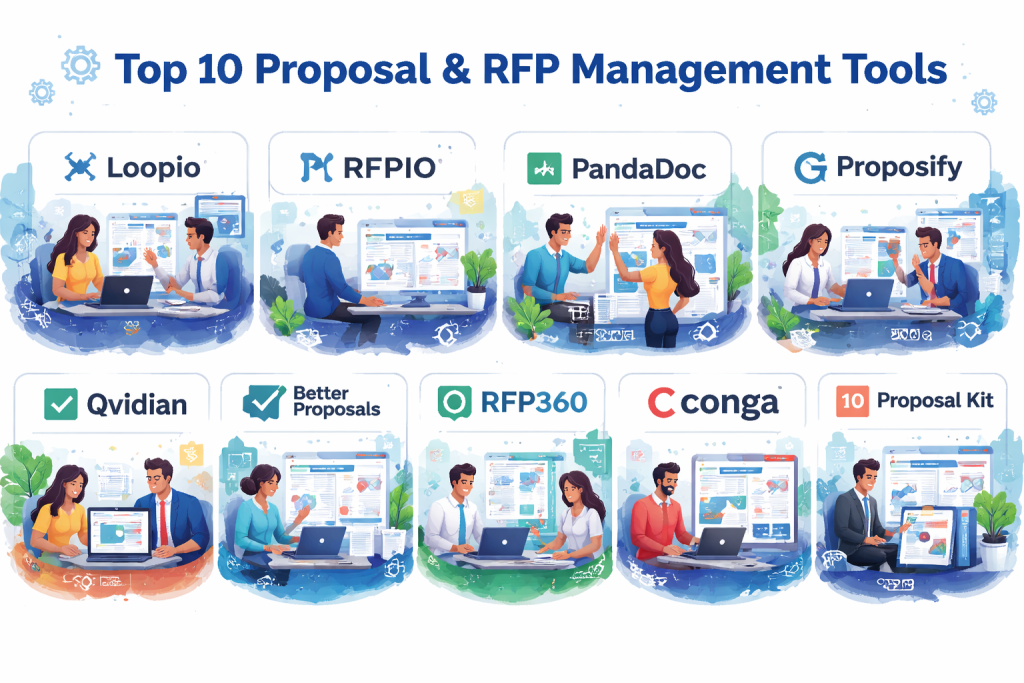
Top 10 Proposal & RFP Management Tools
1 — Loopio
Short description:
Loopio is a widely used RFP response management platform focused on content libraries, collaboration, and speed. It is designed for mid-market and enterprise teams responding to high volumes of RFPs.
Key features:
- Centralized content library with tagging and version control
- Automated answer suggestions using past responses
- Collaboration workflows with roles and permissions
- CRM integrations for data auto-fill
- Review and approval workflows
- Analytics on response usage and performance
Pros:
- Significant reduction in RFP response time
- Strong content reuse and governance
- Scales well for large teams
Cons:
- Can feel complex for smaller teams
- Initial setup requires planning and content cleanup
Security & compliance:
SSO, role-based access, encryption at rest and in transit, SOC 2, GDPR support.
Support & community:
Strong documentation, structured onboarding, responsive customer support, enterprise-grade assistance.
2 — RFPIO
Short description:
RFPIO is an AI-driven RFP and proposal automation tool designed to improve response accuracy and collaboration across sales, legal, and subject matter experts.
Key features:
- AI-powered answer recommendations
- Content library with smart search
- Workflow automation and task assignment
- CRM and document management integrations
- Real-time collaboration and commenting
- Reporting and analytics dashboards
Pros:
- AI improves answer relevance over time
- Excellent cross-functional collaboration
- Strong analytics for optimization
Cons:
- Higher learning curve for new users
- Premium pricing for advanced AI features
Security & compliance:
SOC 2, GDPR compliance, SSO, encryption, audit logs.
Support & community:
Dedicated onboarding, extensive knowledge base, customer success managers for enterprise users.
3 — PandaDoc
Short description:
PandaDoc is a document automation platform that includes strong proposal management features, ideal for sales teams focused on speed and e-signatures.
Key features:
- Proposal and document templates
- Drag-and-drop editor
- E-signatures and approvals
- Pricing tables and content blocks
- CRM integrations
- Document analytics and tracking
Pros:
- Very easy to use and quick to deploy
- Excellent for sales-driven proposals
- Built-in e-signatures reduce friction
Cons:
- Limited advanced RFP-specific workflows
- Less suitable for complex, long RFPs
Security & compliance:
SOC 2, GDPR, encryption, audit trails.
Support & community:
Good documentation, live chat support, active user community.
4 — Proposify
Short description:
Proposify focuses on proposal creation, branding, and analytics, making it popular among sales and marketing teams.
Key features:
- Branded proposal templates
- Content library and snippets
- Collaboration and commenting
- Proposal analytics and tracking
- CRM integrations
- Approval workflows
Pros:
- Strong visual and branding control
- Clear analytics on proposal engagement
- User-friendly interface
Cons:
- Limited RFP automation capabilities
- Not ideal for government or highly regulated bids
Security & compliance:
Encryption, role-based access, GDPR support.
Support & community:
Helpful onboarding resources, responsive support, moderate community activity.
5 — Qvidian
Short description:
Qvidian is an enterprise-grade proposal automation solution built for highly regulated and complex proposal environments.
Key features:
- Centralized content repository
- Workflow automation for large teams
- CRM and ERP integrations
- Advanced reporting and compliance controls
- Version control and audit trails
- Multi-language support
Pros:
- Excellent for large, regulated enterprises
- Strong compliance and governance
- Handles very complex proposals
Cons:
- Dated user interface
- Requires significant implementation effort
Security & compliance:
SOC 2, ISO standards support, encryption, audit logs.
Support & community:
Enterprise-level support, dedicated account teams, structured training.
6 — Better Proposals
Short description:
Better Proposals is a simple, sales-focused proposal tool aimed at freelancers and small to mid-sized businesses.
Key features:
- Ready-made proposal templates
- Interactive pricing tables
- Proposal tracking and analytics
- E-signatures
- Payment integrations
- Custom branding
Pros:
- Extremely easy to use
- Fast proposal creation
- Affordable pricing
Cons:
- Not designed for RFP workflows
- Limited collaboration features
Security & compliance:
Basic encryption, GDPR support.
Support & community:
Email support, guides, small but active user base.
7 — RFP360
Short description:
RFP360 is a robust RFP response platform designed for structured, repeatable, and compliant bid responses.
Key features:
- RFP and questionnaire automation
- Central answer repository
- Collaboration and task management
- CRM and content integrations
- Response analytics
- Deadline tracking
Pros:
- Strong focus on structured RFPs
- Improves response consistency
- Good for cross-department use
Cons:
- UI can feel rigid
- Setup requires upfront effort
Security & compliance:
SOC 2, GDPR, SSO, encryption.
Support & community:
Good onboarding, dedicated support, enterprise readiness.
8— Nusii
Short description:
Nusii is a proposal creation tool focused on simplicity and branding for creative agencies and consultants.
Key features:
- Clean proposal templates
- Client approval workflows
- Proposal tracking
- Custom branding
- Simple collaboration
- PDF export
Pros:
- Very intuitive
- Clean, professional proposals
- Minimal setup required
Cons:
- Limited automation
- Not suitable for complex RFPs
Security & compliance:
Standard encryption, GDPR support.
Support & community:
Email support, tutorials, small user community.
9 — Conga
Short description:
Conga provides enterprise document and proposal automation tightly integrated with CRM systems.
Key features:
- Advanced document generation
- CRM-native workflows
- Approval and compliance automation
- Contract and proposal management
- Reporting and analytics
- Scalable architecture
Pros:
- Powerful automation
- Deep CRM integration
- Suitable for enterprise scale
Cons:
- Complex configuration
- Requires admin expertise
Security & compliance:
SOC 2, GDPR, encryption, enterprise-grade controls.
Support & community:
Strong enterprise support, documentation, partner ecosystem.
10 — Proposal Kit
Short description:
Proposal Kit is a template-driven proposal solution ideal for organizations needing offline or customizable document control.
Key features:
- Extensive proposal templates
- Document assembly tools
- Customizable branding
- Offline usage support
- Industry-specific content
- One-time licensing option
Pros:
- Flexible document ownership
- No mandatory subscription
- Wide range of templates
Cons:
- Limited collaboration
- Not cloud-native
Security & compliance:
Varies / N/A depending on deployment.
Support & community:
Documentation and email support, limited community interaction.
Comparison Table
| Tool Name | Best For | Platform(s) Supported | Standout Feature | Rating |
|---|---|---|---|---|
| Loopio | High-volume RFP teams | Web | Content reuse automation | N/A |
| RFPIO | AI-driven RFP responses | Web | AI answer recommendations | N/A |
| PandaDoc | Sales proposals | Web | E-signatures & ease of use | N/A |
| Proposify | Branded sales proposals | Web | Proposal analytics | N/A |
| Qvidian | Regulated enterprises | Web | Compliance & governance | N/A |
| Better Proposals | SMB sales teams | Web | Speed and simplicity | N/A |
| RFP360 | Structured RFP workflows | Web | RFP automation | N/A |
| Nusii | Agencies & consultants | Web | Clean design | N/A |
| Conga | Enterprise CRM users | Web | CRM-native automation | N/A |
| Proposal Kit | Template-based users | Desktop / Hybrid | Offline flexibility | N/A |
Evaluation & Scoring of Proposal & RFP Management Tools
| Tool | Core Features (25%) | Ease of Use (15%) | Integrations (15%) | Security (10%) | Performance (10%) | Support (10%) | Price/Value (15%) | Total Score |
|---|---|---|---|---|---|---|---|---|
| Loopio | 23 | 12 | 13 | 9 | 9 | 9 | 12 | 87 |
| RFPIO | 24 | 11 | 13 | 9 | 9 | 9 | 11 | 85 |
| PandaDoc | 20 | 14 | 12 | 8 | 9 | 8 | 13 | 84 |
| Proposify | 19 | 14 | 11 | 8 | 8 | 8 | 13 | 81 |
| Qvidian | 24 | 9 | 13 | 10 | 9 | 9 | 10 | 84 |
| Better Proposals | 16 | 15 | 9 | 7 | 8 | 7 | 15 | 77 |
| RFP360 | 22 | 11 | 12 | 9 | 8 | 8 | 12 | 82 |
| Nusii | 15 | 15 | 8 | 7 | 8 | 7 | 14 | 74 |
| Conga | 24 | 9 | 15 | 10 | 9 | 9 | 10 | 86 |
| Proposal Kit | 17 | 10 | 6 | 6 | 7 | 6 | 14 | 66 |
Which Proposal & RFP Management Tool Is Right for You?
Choosing the right tool depends heavily on organizational size, complexity, and goals.
- Solo users: Simple tools like Better Proposals or Nusii are sufficient.
- SMBs: PandaDoc and Proposify balance ease of use with functionality.
- Mid-market: Loopio, RFPIO, and RFP360 provide structure and scalability.
- Enterprise: Conga and Qvidian excel in compliance, governance, and integrations.
Budget-conscious teams should prioritize usability and quick ROI, while premium buyers may focus on automation depth, analytics, and compliance. Organizations with strong CRM dependency should choose tools with deep integrations, while regulated industries must emphasize security and audit controls.
Frequently Asked Questions (FAQs)
1. What is an RFP management tool?
It is software that helps teams respond to RFPs efficiently using content libraries, workflows, and automation.
2. Do small businesses need these tools?
Only if they respond to frequent or complex proposals; otherwise, simpler tools may suffice.
3. How much do these tools cost?
Pricing varies widely, from affordable monthly plans to enterprise contracts.
4. Are these tools secure?
Most leading tools offer encryption, access control, and compliance certifications.
5. Can these tools integrate with CRM systems?
Yes, many integrate with popular CRM platforms for data automation.
6. How long does implementation take?
From a few hours for simple tools to several weeks for enterprise platforms.
7. Do they support collaboration?
Yes, collaboration is a core feature of most RFP tools.
8. Can content be reused across proposals?
Yes, centralized content libraries are a key benefit.
9. Are they suitable for government RFPs?
Enterprise-grade tools are better suited due to compliance requirements.
10. What is the biggest mistake buyers make?
Choosing overly complex tools without assessing actual needs.
Conclusion
Proposal & RFP Management Tools play a crucial role in modern sales and bid operations by improving speed, accuracy, and consistency. While some tools focus on simplicity and sales enablement, others specialize in complex, regulated RFP environments. Key considerations include collaboration, automation, integrations, security, and scalability.
There is no single “best” tool for everyone. The right choice depends on team size, proposal complexity, industry requirements, and budget. By aligning tool capabilities with real business needs, organizations can significantly improve win rates and proposal quality while reducing operational stress.

Find Trusted Cardiac Hospitals
Compare heart hospitals by city and services — all in one place.
Explore Hospitals
This post is useful because RFP and proposal work usually fails due to messy coordination, not lack of effort. I liked that the comparison focuses on real features like a central content library, reusable answers, version control, approval workflows, deadlines, and collaboration across sales, legal, finance, and technical teams. The pros and cons section is also practical because some tools are best for small teams that need simple templates, while others are built for large bid desks handling many proposals at once with strict compliance. One smart tip is to check how well the tool supports review trails and role-based access, because that helps prevent wrong claims, outdated pricing, and last-minute errors that can cost a deal.