
Introduction
Public Safety Dispatch (CAD) Systems—commonly known as Computer-Aided Dispatch systems—are mission-critical platforms used by emergency services to receive, prioritize, dispatch, and track incidents in real time. These systems sit at the heart of 911/112/100 control rooms and are relied upon by police departments, fire services, emergency medical services (EMS), and integrated public safety agencies.
In high-pressure environments where seconds can save lives, CAD systems provide dispatchers and responders with structured workflows, location intelligence, real-time unit status, and seamless communication. Modern CAD platforms go far beyond simple call handling—they integrate mapping, mobile data terminals, records management, analytics, and interoperability across agencies.
Key real-world use cases include:
- Emergency call intake and prioritization
- Police, fire, and EMS dispatch coordination
- Real-time vehicle and responder tracking
- Multi-agency incident response and disaster management
- Compliance reporting, auditing, and post-incident analysis
When choosing a CAD system, organizations should evaluate reliability, usability under stress, integration with existing systems, scalability, security, and vendor support. The right solution must work flawlessly 24/7, even during large-scale emergencies.
Best for:
Public Safety Dispatch (CAD) Systems are best suited for law enforcement agencies, fire departments, EMS providers, emergency communication centers, municipalities, transportation authorities, and large campuses requiring structured, reliable emergency response coordination.
Not ideal for:
These systems may not be suitable for small private security teams, non-emergency call centers, or organizations with minimal dispatch needs, where simpler ticketing or radio-based workflows may be sufficient.
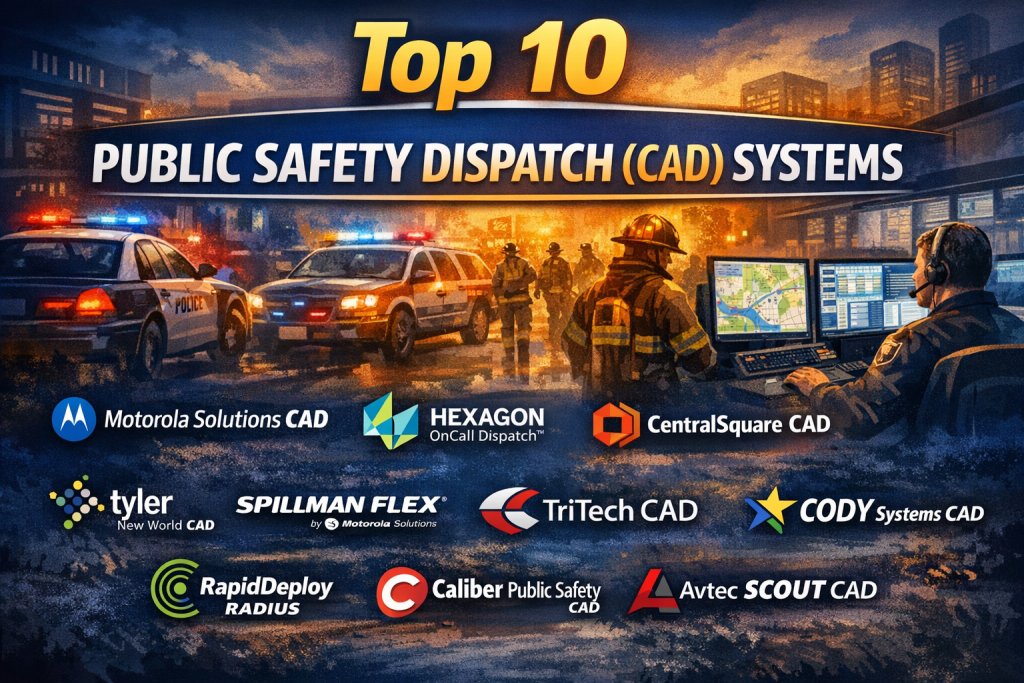
Top 10 Public Safety Dispatch (CAD) Systems Tools
1 — Motorola Solutions CAD
Short description:
A market-leading CAD platform used by large police, fire, and EMS agencies worldwide, known for reliability and deep public safety integration.
Key features:
- Real-time call handling and dispatch workflows
- Integrated GIS mapping and AVL tracking
- Seamless integration with radio and communication systems
- Mobile dispatch support for field units
- Incident analytics and reporting dashboards
- Multi-agency and regional interoperability
Pros:
- Extremely robust and field-tested at scale
- Strong ecosystem with public safety hardware and software
Cons:
- High cost of ownership
- Implementation can be complex and lengthy
Security & compliance:
Strong encryption, role-based access, audit logs; compliance varies by deployment.
Support & community:
Enterprise-grade support, extensive documentation, strong global user base.
2 — Hexagon OnCall Dispatch
Short description:
A modern, modular CAD system designed for police, fire, and EMS agencies seeking flexibility and advanced analytics.
Key features:
- Configurable dispatch workflows
- Advanced GIS and real-time mapping
- Integrated analytics and incident dashboards
- Mobile and web-based responder access
- Cross-agency data sharing
- Scalable architecture for regional deployments
Pros:
- Highly configurable for different agencies
- Strong analytics and situational awareness
Cons:
- Requires skilled configuration teams
- Higher learning curve for new users
Security & compliance:
Role-based security, encryption, detailed audit trails.
Support & community:
Professional onboarding, strong enterprise support, active public safety customer base.
3 — CentralSquare CAD
Short description:
A widely adopted CAD solution focused on North American public safety agencies, offering cloud and on-premise options.
Key features:
- Call intake and priority-based dispatch
- Integrated mapping and unit recommendations
- Mobile access for field responders
- Built-in reporting and compliance tools
- RMS and jail management integration
- Cloud-ready architecture
Pros:
- Comprehensive public safety suite
- Flexible deployment models
Cons:
- Interface can feel dated in some modules
- Customization may require vendor support
Security & compliance:
Encryption, access controls, CJIS-aligned deployments.
Support & community:
Strong documentation, dedicated support teams, large municipal user base.
4 — Tyler Technologies New World CAD
Short description:
A CAD solution tailored for local governments and municipalities, tightly integrated with civic and justice systems.
Key features:
- Emergency call processing and dispatch
- GIS-based unit tracking
- Integration with municipal ERP and records
- Mobile field reporting
- Automated alerts and notifications
- Compliance-focused reporting
Pros:
- Excellent for city and county governments
- Strong integration with other civic systems
Cons:
- Less suited for very large national agencies
- Custom workflows can increase setup time
Security & compliance:
Government-grade security controls, audit logging.
Support & community:
Reliable government support model, structured onboarding.
5 — Spillman Flex CAD
Short description:
A cloud-first CAD system designed for mid-sized public safety agencies prioritizing ease of use and mobility.
Key features:
- Browser-based dispatch interface
- Real-time unit status and mapping
- Mobile-friendly responder tools
- Integrated RMS options
- Rapid deployment and updates
- Disaster recovery support
Pros:
- Faster deployment than traditional CAD
- User-friendly interface
Cons:
- Limited deep customization
- Advanced analytics may require add-ons
Security & compliance:
Cloud security controls, encrypted data storage.
Support & community:
Responsive customer support, growing user community.
6 — TriTech CAD
Short description:
A long-standing CAD platform trusted by high-volume emergency communication centers.
Key features:
- High-availability dispatch workflows
- Advanced call prioritization
- Real-time GIS and AVL integration
- Multi-agency coordination tools
- Mobile unit support
- Performance monitoring dashboards
Pros:
- Proven reliability in large deployments
- Strong real-time performance
Cons:
- Legacy UI elements
- Higher infrastructure requirements
Security & compliance:
Role-based access, encryption, audit trails.
Support & community:
Enterprise-level support, experienced professional services.
7 — CODY Systems CAD
Short description:
A CAD solution focused primarily on law enforcement agencies with streamlined workflows.
Key features:
- Incident-based dispatch management
- Integrated records and reporting
- Mobile officer access
- Automated alerts and notifications
- Search and historical data tools
Pros:
- Simple and focused for police departments
- Easier adoption for small to mid-sized teams
Cons:
- Limited fire/EMS-specific features
- Smaller ecosystem
Security & compliance:
Standard access controls, audit logging.
Support & community:
Direct vendor support, concise documentation.
8 — Caliber Public Safety CAD
Short description:
An integrated CAD and records platform built for agencies wanting unified dispatch and data management.
Key features:
- Unified CAD and RMS
- Real-time dispatch and unit tracking
- Customizable workflows
- Mobile access for responders
- Data analytics and reporting
Pros:
- Single platform for dispatch and records
- Consistent user experience
Cons:
- Not ideal for very large enterprises
- Fewer third-party integrations
Security & compliance:
Encryption, role-based access, audit logs.
Support & community:
Vendor-led onboarding, responsive support teams.
9 — RapidDeploy Radius CAD
Short description:
A cloud-native CAD platform emphasizing modern UX and real-time data from emergency calls.
Key features:
- Real-time call location intelligence
- Cloud-based dispatch workflows
- Modern, intuitive UI
- Integration with next-gen 911 systems
- Fast deployment and scalability
Pros:
- Modern interface and real-time data
- Excellent for next-generation dispatch centers
Cons:
- Newer platform with evolving feature set
- Limited legacy system compatibility
Security & compliance:
Cloud security standards, encrypted communications.
Support & community:
Strong onboarding, growing public safety community.
10 — Avtec Scout CAD
Short description:
A CAD system designed for multi-jurisdictional emergency communications and radio interoperability.
Key features:
- Dispatch and call handling
- Radio and communication integration
- Real-time mapping and unit tracking
- Multi-jurisdiction support
- Event replay and analysis tools
Pros:
- Strong communication interoperability
- Reliable for regional dispatch centers
Cons:
- Less emphasis on advanced analytics
- UI may feel dated
Security & compliance:
Role-based access, audit logging.
Support & community:
Dedicated enterprise support, niche but loyal user base.
Comparison Table
| Tool Name | Best For | Platform(s) Supported | Standout Feature | Rating |
|---|---|---|---|---|
| Motorola Solutions CAD | Large enterprises | Web, On-prem, Mobile | End-to-end public safety ecosystem | N/A |
| Hexagon OnCall Dispatch | Multi-agency regions | Web, Mobile | Configurability & analytics | N/A |
| CentralSquare CAD | Municipal agencies | Cloud, On-prem | Comprehensive public safety suite | N/A |
| Tyler New World CAD | Local governments | Web, Mobile | Civic system integration | N/A |
| Spillman Flex CAD | Mid-sized agencies | Cloud | Rapid deployment | N/A |
| TriTech CAD | High-volume centers | On-prem, Hybrid | Real-time performance | N/A |
| CODY Systems CAD | Police departments | Web, Mobile | Simplicity for law enforcement | N/A |
| Caliber Public Safety CAD | Unified CAD/RMS users | Web, Mobile | Single-platform approach | N/A |
| RapidDeploy Radius | Next-gen dispatch | Cloud | Real-time location intelligence | N/A |
| Avtec Scout CAD | Regional dispatch | On-prem, Hybrid | Communication interoperability | N/A |
Evaluation & Scoring of Public Safety Dispatch (CAD) Systems
| Criteria | Weight | Evaluation Focus |
|---|---|---|
| Core features | 25% | Dispatch accuracy, mapping, workflows |
| Ease of use | 15% | Dispatcher efficiency under stress |
| Integrations & ecosystem | 15% | RMS, GIS, radio, mobile |
| Security & compliance | 10% | Access control, auditability |
| Performance & reliability | 10% | Uptime, latency, failover |
| Support & community | 10% | Vendor responsiveness |
| Price / value | 15% | Long-term ROI |
Which Public Safety Dispatch (CAD) Systems Tool Is Right for You?
- Solo or small agencies: Look for cloud-based, easy-to-deploy tools like Spillman Flex or CODY Systems.
- Mid-market agencies: CentralSquare or Hexagon offer balance between features and scalability.
- Enterprise or regional centers: Motorola Solutions or TriTech provide proven reliability at scale.
- Budget-conscious teams: Focus on usability and essential features over deep customization.
- Security-focused agencies: Prioritize strong access controls, audit logs, and proven vendors.
Frequently Asked Questions (FAQs)
- What is a CAD system in public safety?
A CAD system manages emergency calls, dispatches responders, and tracks incidents in real time. - Is CAD software only for police?
No, it is used by police, fire, EMS, and integrated emergency services. - Cloud vs on-premise CAD—what’s better?
Cloud offers faster deployment; on-premise provides greater control. - How long does CAD implementation take?
It can range from weeks to several months depending on complexity. - Do CAD systems integrate with 911 systems?
Yes, most modern CAD platforms integrate with emergency call handling systems. - Are CAD systems secure?
Leading systems use encryption, role-based access, and audit logs. - Can CAD work during network outages?
Enterprise systems include redundancy and offline failover options. - Is mobile access important?
Yes, mobile CAD improves situational awareness for responders. - Are CAD systems customizable?
Most offer configurable workflows, though deep customization varies. - What is the biggest mistake when choosing CAD software?
Focusing only on cost instead of reliability and usability under pressure.
Conclusion
Public Safety Dispatch (CAD) Systems are mission-critical platforms that directly impact emergency response outcomes. The right system improves coordination, reduces response times, and enhances situational awareness during high-stress incidents.
There is no single best CAD solution for everyone. The ideal choice depends on agency size, operational complexity, budget, integration needs, and security requirements. By focusing on reliability, usability, and long-term support, organizations can select a CAD system that truly supports their mission to protect lives and communities.

Find Trusted Cardiac Hospitals
Compare heart hospitals by city and services — all in one place.
Explore Hospitals