
Introduction
Retrieval-Augmented Generation (RAG) tooling has become a cornerstone of modern AI applications that need accurate, up-to-date, and trustworthy responses. At its core, RAG combines two powerful ideas: information retrieval (fetching relevant data from knowledge sources such as documents, databases, or APIs) and text generation (using large language models to produce natural language answers). Instead of relying only on what a model was trained on, RAG systems ground responses in real data.
This approach is critical because it reduces hallucinations, improves factual accuracy, and enables AI systems to work with private or domain-specific knowledge. Today, RAG tooling is widely used in enterprise search, internal knowledge assistants, customer support bots, compliance workflows, research automation, and developer productivity tools.
When choosing RAG tooling, users should evaluate data ingestion options, vector search quality, orchestration flexibility, observability, scalability, security, and ease of integration. Some tools focus on developer flexibility, while others emphasize enterprise governance and low-code usability.
Best for:
RAG tooling is ideal for AI engineers, product teams, data scientists, enterprise architects, and organizations that want to build reliable AI assistants using proprietary or frequently changing data across industries such as healthcare, finance, legal, SaaS, education, and e-commerce.
Not ideal for:
These tools may be unnecessary for simple chatbot use cases, static FAQ sites, or teams without access to structured or unstructured knowledge sources. Lightweight prompt-only solutions or traditional search systems may be sufficient in such cases.
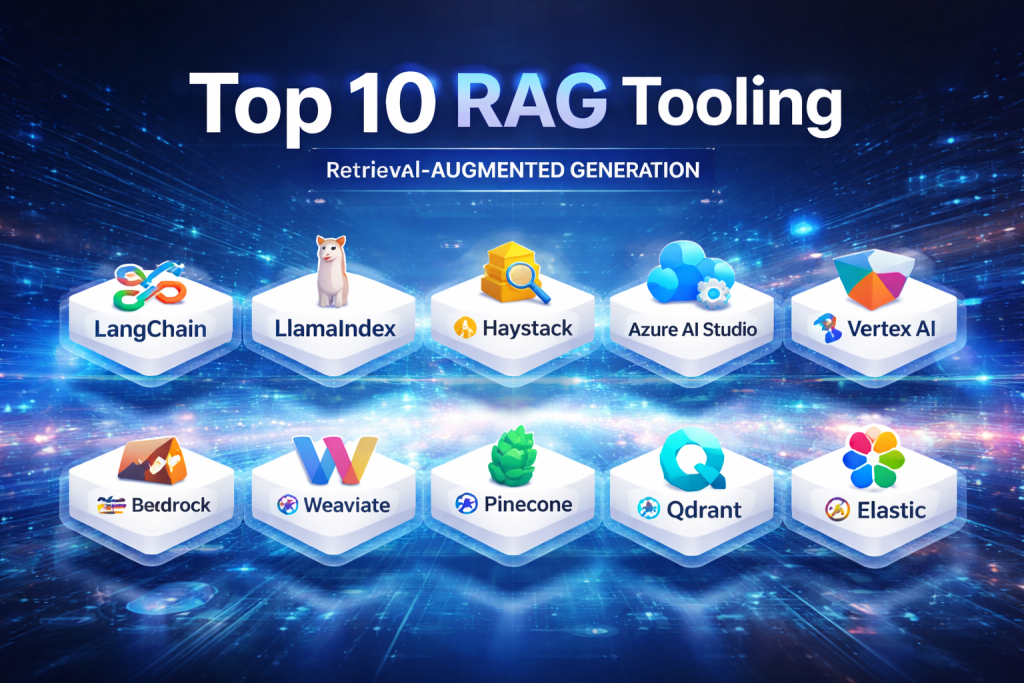
Top 10 RAG (Retrieval-Augmented Generation) Tooling Tools
1 — LangChain
Short description:
LangChain is a widely adopted open-source framework designed for developers building advanced RAG pipelines, AI agents, and LLM-powered applications.
Key features:
- Modular RAG pipeline components (retrievers, chains, memory)
- Support for multiple vector databases and LLMs
- Prompt templates and output parsers
- Agent and tool-calling capabilities
- Extensive integrations ecosystem
- Python and JavaScript support
Pros:
- Extremely flexible and extensible
- Large community and ecosystem
Cons:
- Steeper learning curve for beginners
- Requires engineering effort to productionize
Security & compliance:
Varies by deployment; depends on underlying infrastructure.
Support & community:
Excellent documentation, tutorials, and a very large open-source community.
2— LlamaIndex
Short description:
LlamaIndex focuses on making unstructured data easy to index, retrieve, and use in RAG workflows with minimal setup.
Key features:
- Document loaders for many data sources
- Indexing and chunking strategies
- Query engines and retrievers
- Metadata-aware retrieval
- RAG evaluation utilities
- Python-first developer experience
Pros:
- Easy to get started with RAG
- Strong data ingestion capabilities
Cons:
- Less agent orchestration than alternatives
- Advanced customization requires expertise
Security & compliance:
Varies / N/A (depends on deployment).
Support & community:
Strong documentation and growing developer community.
3 — Haystack
Short description:
Haystack is an open-source framework focused on production-ready RAG systems, search pipelines, and enterprise QA solutions.
Key features:
- End-to-end RAG pipelines
- Dense and sparse retrieval support
- Modular nodes for preprocessing and ranking
- REST API deployment options
- Evaluation and monitoring tools
- Enterprise extensions available
Pros:
- Mature and production-oriented
- Flexible pipeline design
Cons:
- More complex configuration
- Smaller community than LangChain
Security & compliance:
Enterprise editions support security and compliance needs.
Support & community:
Good documentation and professional enterprise support options.
4 — Azure AI Studio (RAG tooling)
Short description:
Azure AI Studio provides enterprise-grade RAG tooling tightly integrated with cloud infrastructure, governance, and security controls.
Key features:
- Managed vector search
- Secure data connectors
- Prompt flow orchestration
- Observability and evaluation tools
- Identity and access management
- Enterprise scalability
Pros:
- Strong security and compliance
- Fully managed infrastructure
Cons:
- Vendor lock-in
- Higher cost at scale
Security & compliance:
SOC 2, ISO, GDPR, HIPAA (varies by region and configuration).
Support & community:
Enterprise-grade support and extensive documentation.
5 — Google Vertex AI RAG
Short description:
Vertex AI RAG tools help enterprises build retrieval-augmented applications using managed AI services and scalable infrastructure.
Key features:
- Managed embeddings and vector search
- Integration with data warehouses
- Evaluation and monitoring
- Secure data governance
- Scalable cloud deployment
- Enterprise IAM integration
Pros:
- High performance and scalability
- Strong data integration ecosystem
Cons:
- Complex setup for small teams
- Cloud-specific tooling
Security & compliance:
Strong enterprise compliance and data governance features.
Support & community:
Robust documentation and enterprise support.
6 — Amazon Bedrock Knowledge Bases
Short description:
This tooling enables RAG workflows using managed embeddings, vector stores, and foundation models within a cloud ecosystem.
Key features:
- Managed data ingestion pipelines
- Vector search and retrieval
- Integration with enterprise storage
- Scalable infrastructure
- Access controls and monitoring
- Model-agnostic approach
Pros:
- Easy enterprise integration
- Reliable performance
Cons:
- Less flexibility than open-source frameworks
- Cloud dependency
Security & compliance:
SOC 2, ISO, GDPR, HIPAA support depending on configuration.
Support & community:
Enterprise-grade documentation and customer support.
7 — Weaviate RAG Toolkit
Short description:
Weaviate offers a vector-native database with built-in RAG patterns for semantic search and AI applications.
Key features:
- Hybrid search (vector + keyword)
- Schema-based data modeling
- Real-time indexing
- Modular retrieval pipelines
- Scalable distributed architecture
- RAG-optimized APIs
Pros:
- Strong search relevance
- High performance at scale
Cons:
- Requires schema design upfront
- Learning curve for optimization
Security & compliance:
Enterprise features include encryption and access control.
Support & community:
Active community and professional support tiers.
8 — Pinecone RAG Stack
Short description:
Pinecone provides a managed vector database optimized for high-performance RAG use cases.
Key features:
- Low-latency vector search
- Automatic scaling
- Namespace-based data isolation
- Metadata filtering
- High availability
- Developer-friendly APIs
Pros:
- Excellent performance and reliability
- Minimal operational overhead
Cons:
- Requires external orchestration tools
- Cost can grow with scale
Security & compliance:
Encryption, access controls, and enterprise compliance options.
Support & community:
Strong documentation and enterprise support.
9 — Qdrant RAG Framework
Short description:
Qdrant is an open-source vector database designed for flexible and scalable RAG systems.
Key features:
- High-performance similarity search
- Payload-based filtering
- On-prem or cloud deployment
- REST and gRPC APIs
- Distributed clustering
- Open-source transparency
Pros:
- Deployment flexibility
- Strong performance for real-time use cases
Cons:
- Requires more engineering effort
- Smaller ecosystem than managed services
Security & compliance:
Varies; enterprise options available.
Support & community:
Active open-source community and paid support.
10 — Elastic RAG Solutions
Short description:
Elastic combines search, vector retrieval, and analytics to support enterprise-scale RAG implementations.
Key features:
- Hybrid search capabilities
- Vector and keyword retrieval
- Scalable indexing
- Observability and logging
- Enterprise data governance
- Integration with analytics tools
Pros:
- Powerful hybrid search
- Mature enterprise tooling
Cons:
- Complex configuration
- Higher operational overhead
Security & compliance:
SOC 2, GDPR, ISO support in enterprise deployments.
Support & community:
Strong enterprise support and large user base.
Comparison Table
| Tool Name | Best For | Platform(s) Supported | Standout Feature | Rating |
|---|---|---|---|---|
| LangChain | Developers building custom RAG | Python, JavaScript | Modular RAG orchestration | N/A |
| LlamaIndex | Fast RAG prototyping | Python | Data ingestion simplicity | N/A |
| Haystack | Production RAG systems | Cloud, On-prem | Pipeline-based design | N/A |
| Azure AI Studio | Enterprise AI governance | Cloud | Security & compliance | N/A |
| Vertex AI RAG | Large-scale data integration | Cloud | Managed scalability | N/A |
| Bedrock Knowledge Bases | Enterprise RAG workflows | Cloud | Managed infrastructure | N/A |
| Weaviate | Semantic search & RAG | Cloud, On-prem | Hybrid retrieval | N/A |
| Pinecone | High-performance vector search | Cloud | Low-latency search | N/A |
| Qdrant | Flexible open-source RAG | Cloud, On-prem | Payload filtering | N/A |
| Elastic RAG | Enterprise hybrid search | Cloud, On-prem | Search + analytics | N/A |
Evaluation & Scoring of RAG (Retrieval-Augmented Generation) Tooling
| Tool | Core Features (25%) | Ease of Use (15%) | Integrations (15%) | Security (10%) | Performance (10%) | Support (10%) | Price/Value (15%) | Total |
|---|---|---|---|---|---|---|---|---|
| LangChain | 23 | 12 | 14 | 7 | 8 | 9 | 13 | 86 |
| LlamaIndex | 21 | 14 | 12 | 7 | 8 | 8 | 14 | 84 |
| Haystack | 22 | 11 | 13 | 8 | 8 | 8 | 12 | 82 |
| Azure AI Studio | 23 | 13 | 14 | 10 | 9 | 9 | 11 | 89 |
| Vertex AI RAG | 22 | 12 | 15 | 10 | 9 | 9 | 10 | 87 |
| Bedrock | 21 | 12 | 14 | 10 | 9 | 9 | 11 | 86 |
| Weaviate | 22 | 11 | 13 | 8 | 9 | 8 | 12 | 83 |
| Pinecone | 21 | 14 | 12 | 9 | 10 | 8 | 11 | 85 |
| Qdrant | 20 | 11 | 11 | 7 | 9 | 7 | 14 | 79 |
| Elastic | 23 | 10 | 14 | 10 | 9 | 9 | 10 | 85 |
Which RAG (Retrieval-Augmented Generation) Tooling Tool Is Right for You?
- Solo users & startups: Open-source frameworks like LlamaIndex or LangChain provide flexibility and cost control.
- SMBs: Managed vector databases combined with lightweight orchestration tools balance speed and reliability.
- Mid-market: Hybrid solutions with observability and governance offer scalability without excessive complexity.
- Enterprise: Fully managed platforms with strong security, compliance, and support are often the best choice.
Budget-conscious teams should favor open-source tools, while premium solutions deliver reliability and reduced operational overhead. If ease of use is critical, managed platforms excel. For deep customization, developer-centric frameworks are ideal.
Frequently Asked Questions (FAQs)
1. What problem does RAG solve?
It reduces hallucinations by grounding AI responses in real, retrievable data.
2. Is RAG better than fine-tuning?
Yes for dynamic data; fine-tuning suits static knowledge.
3. Do I need a vector database?
Most RAG systems rely on one for semantic search.
4. Can RAG work with private data?
Yes, it is one of its main strengths.
5. Is RAG expensive?
Costs vary based on scale, storage, and compute usage.
6. How hard is RAG to implement?
Depends on tooling; some frameworks simplify setup significantly.
7. Does RAG improve compliance?
Yes, by providing traceable, auditable sources.
8. What industries benefit most from RAG?
Healthcare, finance, legal, SaaS, and research.
9. Can RAG systems scale?
Yes, especially with managed infrastructure.
10. What is the biggest mistake in RAG?
Poor data quality and weak retrieval strategies.
Conclusion
RAG tooling has moved from experimental to mission-critical for reliable AI systems. The tools reviewed here show that there is no single “best” solution—only the best fit for your data, scale, security needs, and team expertise. By focusing on retrieval quality, integration, and governance, organizations can build AI systems that are accurate, trustworthy, and future-proof.

Find Trusted Cardiac Hospitals
Compare heart hospitals by city and services — all in one place.
Explore Hospitals
This article does an excellent job breaking down the landscape of RAG tooling — a mission‑critical layer for building high‑quality AI applications that combine large language models with reliable, up‑to‑date data retrieval. I appreciate how the comparison highlights not just basic capabilities like vector search, document indexing, and API integrations, but also real‑world considerations such as latency differences, scalability, support for multimodal data, and the maturity of client ecosystems. By clearly outlining pros and cons for each platform, the guide helps practitioners and architects understand where trade‑offs exist — whether prioritizing performance, cost‑efficiency, ease of integration, or deep customization of retrieval pipelines. For teams evaluating RAG solutions to power semantic search, chat interfaces, or knowledge‑centric AI apps, this structured, use‑case‑focused analysis makes the decision‑making process much more informed and practical.