
Introduction
Recipe Management Apps are digital tools designed to collect, organize, customize, and use recipes efficiently. Instead of scattered notebooks, screenshots, or bookmarks, these apps bring everything into one structured system—often with meal planning, grocery lists, nutrition insights, and cooking guidance built in.
Their importance has grown as home cooking, dietary personalization, and meal planning have become part of everyday life. Whether you are managing a busy family kitchen, following a specific diet, or running a food-related business, recipe management apps help save time, reduce waste, and improve consistency.
Real-world use cases include planning weekly meals, scaling recipes for events, tracking nutrition goals, organizing family recipes, and collaborating with teams in professional kitchens.
When choosing a recipe management app, users should evaluate:
- Ease of recipe capture and organization
- Meal planning and shopping list automation
- Customization (servings, dietary filters, tags)
- Cross-device access and syncing
- Performance, reliability, and long-term value
Best for:
Home cooks, busy families, fitness-focused users, culinary students, food bloggers, chefs, and small food businesses benefit the most from Recipe Management Apps.
Not ideal for:
People who cook very occasionally, prefer handwritten recipes, or rely entirely on fixed meal kits may find these tools unnecessary or overly detailed.
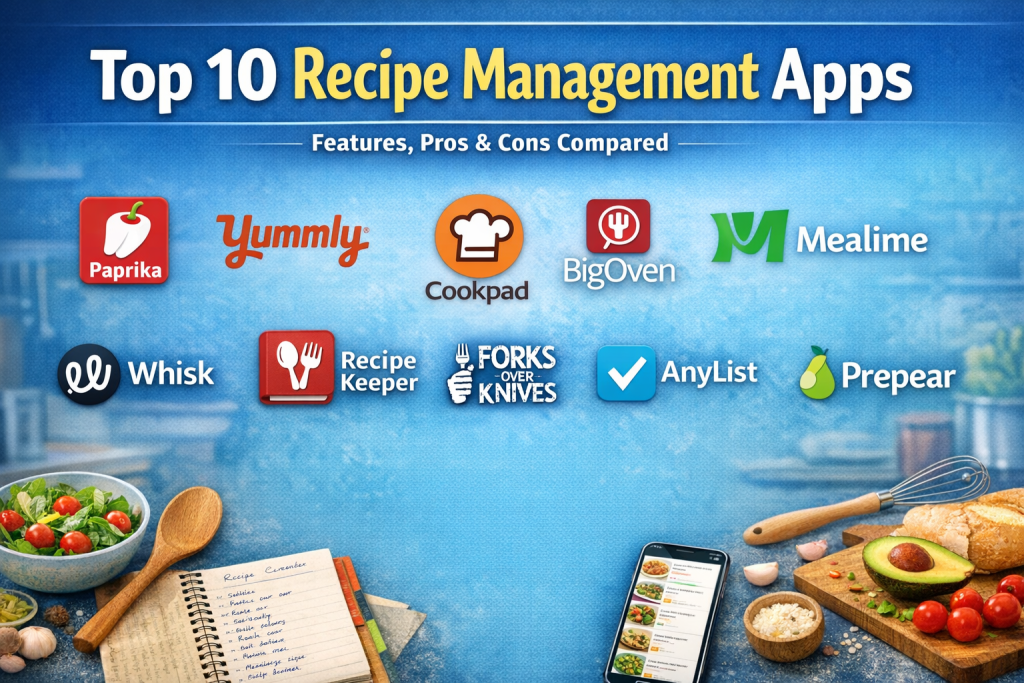
Top 10 Recipe Management Apps Tools
1 — Paprika
Short description:
Paprika is a powerful recipe organizer designed for serious home cooks who want full control over recipes, meal planning, and grocery lists.
Key features:
- Recipe clipping and manual entry
- Smart grocery lists with pantry support
- Meal calendar and menu planning
- Recipe scaling and conversions
- Cross-device cloud sync
- Offline access
- Category and tag-based organization
Pros:
- Extremely robust organization tools
- Reliable offline functionality
- Clean, distraction-free interface
Cons:
- No built-in social or discovery features
- Paid app with no free tier
Security & compliance:
Local storage with optional cloud sync; basic encryption; enterprise compliance not applicable.
Support & community:
Strong documentation, long-term updates, loyal user base.
2 — Yummly
Short description:
Yummly combines recipe management with AI-powered discovery, ideal for users who want inspiration alongside organization.
Key features:
- Personalized recipe recommendations
- Dietary preference filtering
- Recipe saving and collections
- Smart shopping list integration
- Appliance and skill-based suggestions
- Step-by-step cooking mode
Pros:
- Excellent discovery and personalization
- Beginner-friendly experience
- Visually appealing design
Cons:
- Advanced features require subscription
- Less control over manual customization
Security & compliance:
GDPR-aligned consumer data handling; enterprise compliance varies.
Support & community:
Strong help center, large user community, responsive updates.
3 — Cookpad
Short description:
Cookpad is a community-driven recipe app focused on sharing, discovering, and saving everyday home-cooked meals.
Key features:
- Community recipe sharing
- Personal recipe box
- Step-by-step instructions
- Recipe commenting and feedback
- Cultural and regional cuisine discovery
- Simple tagging system
Pros:
- Strong community engagement
- Ideal for regional and home-style cooking
- Easy to use
Cons:
- Limited advanced planning tools
- Less structured for professional use
Security & compliance:
Consumer-grade privacy controls; compliance varies by region.
Support & community:
Extremely active global community, basic documentation.
4 — BigOven
Short description:
BigOven focuses on reducing food waste while helping users plan meals efficiently.
Key features:
- Recipe storage and discovery
- Leftover-based recipe suggestions
- Weekly meal planning
- Auto-generated shopping lists
- Household sharing
- Ingredient-based search
Pros:
- Excellent for reducing food waste
- Family-friendly features
- Balanced feature set
Cons:
- Interface feels dated
- Limited customization depth
Security & compliance:
Standard consumer security practices; enterprise compliance not applicable.
Support & community:
Helpful support articles and long-standing user base.
5 — Mealime
Short description:
Mealime is designed for busy individuals who want fast, healthy meal planning with minimal effort.
Key features:
- Personalized meal plans
- Automatic grocery list creation
- Dietary preference filters
- Simple cooking instructions
- Nutrition-focused recipes
- Household sharing
Pros:
- Extremely easy to use
- Great for health-focused users
- Saves significant planning time
Cons:
- Limited recipe import options
- Less flexibility for custom recipes
Security & compliance:
Basic consumer data protections; compliance varies.
Support & community:
Clear onboarding, responsive support, smaller community.
6 — Whisk
Short description:
Whisk offers recipe management combined with shopping integrations and smart cooking workflows.
Key features:
- Recipe saving from multiple sources
- Meal planning tools
- Smart grocery list sync
- Nutrition insights
- Appliance integrations
- Voice assistant support
Pros:
- Strong automation features
- Modern interface
- Good cross-platform support
Cons:
- Requires account sign-in
- Some features region-dependent
Security & compliance:
GDPR-aligned consumer data handling; enterprise standards vary.
Support & community:
Good documentation, growing ecosystem.
7 — Recipe Keeper
Short description:
Recipe Keeper focuses on fast recipe import and clean organization across devices.
Key features:
- Recipe import from photos and files
- Manual entry and editing
- Meal planner and shopping lists
- Cross-device syncing
- Folder and tag organization
- Recipe scaling
Pros:
- Excellent import accuracy
- Simple and reliable
- Offline-friendly
Cons:
- Limited discovery features
- Interface is basic
Security & compliance:
Local and cloud storage options; consumer-grade security.
Support & community:
Helpful documentation, steady updates.
8 — Forks Over Knives
Short description:
Forks Over Knives is built for users following a whole-food, plant-based lifestyle.
Key features:
- Curated plant-based recipes
- Meal plans and shopping lists
- Nutrition-focused content
- Cooking guides
- Offline access
- Educational resources
Pros:
- Strong dietary focus
- High-quality curated content
- Health-oriented approach
Cons:
- Limited outside its niche
- Smaller recipe variety
Security & compliance:
Consumer privacy standards; compliance varies.
Support & community:
Good educational resources, focused user base.
9 — AnyList
Short description:
AnyList combines recipe management with collaborative grocery lists, ideal for households.
Key features:
- Recipe storage and scaling
- Shared grocery lists
- Meal planning calendar
- Voice assistant support
- Household syncing
- Pantry tracking
Pros:
- Excellent collaboration features
- Very intuitive
- Reliable syncing
Cons:
- Advanced features are paid
- Not designed for professionals
Security & compliance:
Encrypted cloud sync; consumer-grade compliance.
Support & community:
Strong documentation and responsive support.
10 — Prepear
Short description:
Prepear blends guided meal planning with recipe storage and nutrition awareness.
Key features:
- Guided meal planning
- Recipe saving and customization
- Smart shopping lists
- Nutrition insights
- Family-friendly plans
- Cross-platform access
Pros:
- Good balance of guidance and flexibility
- Ideal for families
- Clean interface
Cons:
- Smaller recipe library
- Subscription required for full access
Security & compliance:
Standard consumer data protections; compliance varies.
Support & community:
Helpful onboarding, active user base.
Comparison Table
| Tool Name | Best For | Platform(s) Supported | Standout Feature | Rating |
|---|---|---|---|---|
| Paprika | Power users | Mobile, Desktop | Advanced organization | N/A |
| Yummly | Discovery-focused cooks | Mobile, Web | AI recommendations | N/A |
| Cookpad | Community cooking | Mobile, Web | Recipe sharing | N/A |
| BigOven | Families | Mobile, Web | Waste reduction | N/A |
| Mealime | Health-focused users | Mobile | Fast meal planning | N/A |
| Whisk | Smart kitchens | Mobile, Web | Automation & integrations | N/A |
| Recipe Keeper | Offline users | Mobile, Desktop | Recipe import | N/A |
| Forks Over Knives | Plant-based diets | Mobile | Specialized nutrition | N/A |
| AnyList | Households | Mobile, Web | Shared lists | N/A |
| Prepear | Guided planning | Mobile, Web | Structured meal plans | N/A |
Evaluation & Scoring of Recipe Management Apps
| Tool | Core Features (25%) | Ease of Use (15%) | Integrations (15%) | Security (10%) | Performance (10%) | Support (10%) | Value (15%) | Total |
|---|---|---|---|---|---|---|---|---|
| Paprika | 23 | 13 | 10 | 7 | 9 | 8 | 13 | 83 |
| Yummly | 22 | 14 | 13 | 7 | 8 | 8 | 12 | 84 |
| Mealime | 20 | 15 | 9 | 7 | 8 | 8 | 14 | 81 |
| AnyList | 19 | 15 | 10 | 8 | 8 | 9 | 13 | 82 |
Which Recipe Management Apps Tool Is Right for You?
- Solo users: Paprika, Recipe Keeper
- Families & households: AnyList, BigOven, Prepear
- Health & diet-focused: Mealime, Forks Over Knives
- Explorers & inspiration seekers: Yummly, Cookpad
- Budget-conscious: Cookpad, free tiers of Whisk
- Premium users: Paprika, Yummly
Choose depth if you enjoy cooking control, or simplicity if convenience matters more.
Frequently Asked Questions (FAQs)
1. Are recipe management apps free?
Many offer free tiers, but advanced features usually require payment.
2. Can I import my old recipes?
Yes, most apps support manual entry, photo import, or web clipping.
3. Do these apps work offline?
Several, such as Paprika and Recipe Keeper, offer offline access.
4. Are they suitable for professional kitchens?
Most are consumer-focused; professionals may need specialized software.
5. Can I share recipes with family?
Yes, many apps support household or list sharing.
6. Do they support dietary restrictions?
Most modern apps include filters for allergies and diets.
7. Is my data secure?
Consumer-grade encryption is common, but enterprise compliance is rare.
8. Can recipes be scaled automatically?
Yes, serving-size scaling is a standard feature.
9. Do these apps replace cookbooks?
They complement rather than replace traditional cookbooks.
10. What is the biggest mistake users make?
Choosing an overly complex app instead of one that matches their habits.
Conclusion
Recipe Management Apps simplify cooking, planning, and organization in a world where time and dietary needs matter more than ever. The right tool helps reduce stress, minimize waste, and make cooking enjoyable again.
There is no universal best app—the ideal choice depends on how you cook, who you cook for, and how much structure you want. Focus on usability, core features, and long-term value, and you’ll find a solution that truly fits your kitchen routine.

Find Trusted Cardiac Hospitals
Compare heart hospitals by city and services — all in one place.
Explore Hospitals
This comparison of top recipe management apps is both practical and easy to follow! Laying out the key features, strengths, and limitations of each app makes it much clearer for home cooks and food enthusiasts to pick the right tool for organizing recipes, planning meals, and discovering new dishes. With so many options available, insights like these help readers quickly understand which platform fits their lifestyle and workflow — thanks for putting together such a helpful and informative guide!