
Introduction
Robotics Fleet Management Tools are software platforms designed to monitor, control, coordinate, and optimize multiple robots operating simultaneously across warehouses, factories, hospitals, campuses, and outdoor environments. Instead of managing robots one by one, these tools provide a centralized system to oversee an entire robotic fleet in real time.
As robotics adoption accelerates across logistics, manufacturing, healthcare, retail, agriculture, and smart cities, managing fleets manually becomes inefficient and risky. Fleet management tools solve this by enabling task allocation, traffic control, health monitoring, analytics, and remote updates, ensuring robots operate safely, efficiently, and at scale.
Common real-world use cases include:
- Coordinating autonomous mobile robots (AMRs) in warehouses
- Managing delivery robots across campuses or cities
- Orchestrating industrial robots in smart factories
- Monitoring cleaning, security, or inspection robots remotely
When choosing a robotics fleet management tool, users should evaluate:
- Scalability (from a few robots to thousands)
- Interoperability with different robot vendors
- Real-time visibility and control
- Integration with existing IT, ERP, WMS, or MES systems
- Security, reliability, and compliance readiness
Best for:
Robotics Fleet Management Tools are ideal for robotics engineers, operations managers, automation teams, system integrators, and enterprises running multi-robot deployments in logistics, manufacturing, healthcare, retail, agriculture, and smart infrastructure.
Not ideal for:
Solo robotics hobbyists, single-robot research projects, or early-stage prototypes may not need full fleet management platforms and can rely on basic robot control frameworks instead.
Top 10 Robotics Fleet Management Tools
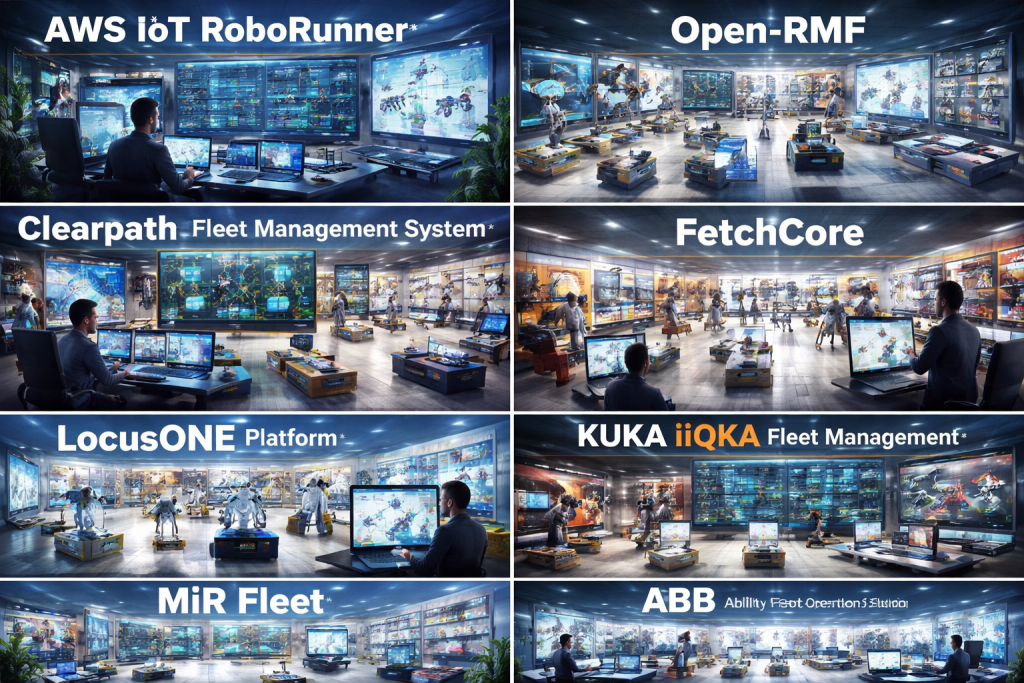
1 — AWS IoT RoboRunner
Short description:
A cloud-based service that helps enterprises orchestrate and manage heterogeneous robot fleets across facilities using a unified digital map.
Key features:
- Centralized fleet orchestration
- Digital twin mapping of facilities
- Integration with multiple robot vendors
- Task dispatching and coordination
- Real-time status monitoring
- Event-driven workflows
- Cloud scalability
Pros:
- Strong scalability for large enterprises
- Vendor-agnostic approach
- Deep cloud ecosystem integration
Cons:
- Requires cloud expertise
- Cost can grow with scale
- Limited offline capabilities
Security & compliance:
Enterprise-grade encryption, IAM-based access control, audit logging, GDPR readiness.
Support & community:
Extensive documentation, enterprise support plans, strong developer ecosystem.
2 — Open-RMF (Robotics Middleware Framework)
Short description:
An open-source framework focused on coordinating fleets of robots from different vendors in shared environments.
Key features:
- Vendor-agnostic fleet coordination
- Traffic scheduling and collision avoidance
- Interoperability across robot types
- ROS 2-based architecture
- Multi-facility support
- Customizable workflows
Pros:
- Open and extensible
- Strong community adoption
- Ideal for mixed robot fleets
Cons:
- Requires engineering expertise
- Limited out-of-the-box UI
- Support depends on integrators
Security & compliance:
Varies; depends on deployment architecture and integrations.
Support & community:
Active open-source community, strong documentation, integrator-led enterprise support.
3 — Clearpath Fleet Management System
Short description:
A fleet management solution optimized for Clearpath and OTTO autonomous mobile robots in industrial environments.
Key features:
- Centralized AMR coordination
- Traffic and task management
- Real-time diagnostics
- Map-based visualization
- Industrial safety features
- Predictive maintenance insights
Pros:
- Highly reliable in industrial settings
- Tight hardware-software integration
- Strong safety focus
Cons:
- Limited to specific robot ecosystems
- Less flexible for heterogeneous fleets
- Premium pricing
Security & compliance:
Role-based access, encrypted communication, industrial security standards.
Support & community:
Strong vendor support, professional onboarding, enterprise-grade SLAs.
4 — FetchCore (Zebra Robotics Automation)
Short description:
A fleet orchestration platform designed to manage and optimize Fetch and Zebra AMR deployments.
Key features:
- Centralized fleet orchestration
- Intelligent task assignment
- Warehouse system integrations
- Fleet analytics and reporting
- Health and uptime monitoring
- Scalable architecture
Pros:
- Proven in warehouse automation
- Strong analytics capabilities
- Reliable performance at scale
Cons:
- Best suited for Fetch/Zebra robots
- Limited customization outside ecosystem
- Enterprise pricing
Security & compliance:
Enterprise security practices, encrypted data, access controls.
Support & community:
Vendor-led support, onboarding assistance, enterprise customer success teams.
5 — LocusONE Platform
Short description:
A robotics orchestration platform focused on large-scale warehouse automation using collaborative robots.
Key features:
- Multi-robot fleet coordination
- Real-time task orchestration
- Workforce collaboration tools
- Performance analytics dashboards
- High-availability architecture
- Cloud-based deployment
Pros:
- Optimized for high-volume logistics
- Strong productivity gains
- Enterprise-ready reliability
Cons:
- Logistics-focused use cases
- Limited use outside warehousing
- Premium cost structure
Security & compliance:
Enterprise encryption, audit logs, GDPR compliance readiness.
Support & community:
Dedicated enterprise support, professional services, structured onboarding.
6 — Brain Corp BrainOS Fleet Manager
Short description:
A cloud-based fleet management system designed for autonomous cleaning and service robots.
Key features:
- Centralized robot monitoring
- AI-driven performance optimization
- Remote updates and diagnostics
- Fleet analytics and insights
- Multi-location management
- User-friendly dashboards
Pros:
- Easy to use
- Strong AI-powered optimization
- Proven in commercial environments
Cons:
- Focused on service robots
- Limited industrial flexibility
- Vendor-specific ecosystem
Security & compliance:
Encrypted communication, role-based access, cloud security best practices.
Support & community:
Strong vendor support, training resources, commercial customer focus.
7 — KUKA iiQKA Fleet Management
Short description:
A fleet management solution tailored for coordinating industrial robots and mobile platforms within smart factories.
Key features:
- Industrial robot fleet coordination
- Integration with manufacturing systems
- Real-time status monitoring
- Predictive maintenance
- Secure industrial networking
- High reliability architecture
Pros:
- Industrial-grade robustness
- Deep manufacturing integration
- Trusted robotics brand
Cons:
- Less flexible for non-KUKA robots
- Complex setup
- Higher learning curve
Security & compliance:
ISO-aligned security practices, role-based access, industrial network security.
Support & community:
Strong global enterprise support, professional services, certified partners.
8 — MiR Fleet (Mobile Industrial Robots)
Short description:
A centralized fleet management system designed for MiR autonomous mobile robots.
Key features:
- Centralized fleet control
- Intelligent task scheduling
- Map-based traffic control
- Fleet analytics
- Safety zone management
- Easy configuration
Pros:
- User-friendly interface
- Reliable indoor navigation
- Quick deployment
Cons:
- Vendor-specific
- Limited cross-brand interoperability
- Scaling costs
Security & compliance:
Encrypted communication, user authentication, industrial security standards.
Support & community:
Vendor documentation, training programs, global support network.
9 — Omron Fleet Operations Workspace
Short description:
A comprehensive platform for managing Omron mobile robot fleets in industrial automation environments.
Key features:
- Fleet orchestration and traffic control
- Integration with factory automation
- Real-time visualization
- Diagnostics and maintenance alerts
- High availability design
- Scalable deployment
Pros:
- Strong industrial automation integration
- High reliability
- Well-structured workflows
Cons:
- Limited to Omron ecosystems
- Less flexible for mixed fleets
- Enterprise pricing
Security & compliance:
Industrial security standards, role-based access, encrypted communications.
Support & community:
Professional vendor support, industrial training resources.
10 — ABB Ability RobotStudio Fleet Management
Short description:
A fleet management and simulation-driven platform for managing ABB robots across production environments.
Key features:
- Fleet-level monitoring
- Simulation-driven optimization
- Digital twin capabilities
- Predictive maintenance
- Production analytics
- Integration with ABB systems
Pros:
- Strong simulation capabilities
- High industrial reliability
- Advanced analytics
Cons:
- Best suited for ABB robots
- Complex configuration
- Higher cost
Security & compliance:
Enterprise security controls, ISO-aligned practices, audit readiness.
Support & community:
Strong global support, extensive documentation, professional services.
Comparison Table
| Tool Name | Best For | Platform(s) Supported | Standout Feature | Rating |
|---|---|---|---|---|
| AWS IoT RoboRunner | Large enterprises, mixed fleets | Cloud | Vendor-agnostic orchestration | N/A |
| Open-RMF | Multi-vendor environments | On-prem / Hybrid | Open interoperability | N/A |
| Clearpath FMS | Industrial AMRs | On-prem | Industrial reliability | N/A |
| FetchCore | Warehouse automation | Cloud / Hybrid | Advanced fleet analytics | N/A |
| LocusONE | High-volume logistics | Cloud | Workforce-robot orchestration | N/A |
| BrainOS Fleet | Service robots | Cloud | AI-driven optimization | N/A |
| KUKA iiQKA | Smart factories | On-prem | Industrial integration | N/A |
| MiR Fleet | Indoor AMRs | On-prem | Ease of use | N/A |
| Omron Fleet | Factory automation | On-prem | Automation ecosystem | N/A |
| ABB Ability Fleet | Industrial robotics | On-prem / Hybrid | Simulation-based management | N/A |
Evaluation & Scoring of Robotics Fleet Management Tools
| Criteria | Weight | Description |
|---|---|---|
| Core features | 25% | Task allocation, monitoring, coordination |
| Ease of use | 15% | UI, onboarding, configuration |
| Integrations & ecosystem | 15% | ERP, WMS, ROS, APIs |
| Security & compliance | 10% | Encryption, access control |
| Performance & reliability | 10% | Uptime, latency, scalability |
| Support & community | 10% | Docs, vendor support |
| Price / value | 15% | Cost vs features |
Overall insight:
Enterprise tools score highest on reliability and security, while open frameworks excel in flexibility and interoperability.
Which Robotics Fleet Management Tool Is Right for You?
- Solo users / research teams: Open frameworks with minimal overhead
- SMBs: Easy-to-deploy, vendor-supported platforms
- Mid-market: Scalable systems with analytics and integrations
- Enterprise: Highly secure, interoperable, and reliable platforms
Budget-conscious users may favor open or vendor-bundled tools, while premium solutions deliver advanced analytics and support.
Choose feature depth for complex environments, or ease of use for rapid deployment.
Security-critical industries should prioritize compliance and auditability.
Frequently Asked Questions (FAQs)
- What is robotics fleet management?
It is the centralized coordination and monitoring of multiple robots operating together. - Do I need fleet management for small deployments?
Not always; it becomes essential as fleet size and complexity grow. - Can these tools manage robots from different vendors?
Some tools support heterogeneous fleets, others are vendor-specific. - Are these platforms cloud-based?
They can be cloud, on-prem, or hybrid depending on the tool. - How important is traffic management?
Critical for safety, efficiency, and avoiding collisions. - Are these tools secure?
Most enterprise tools include encryption, access control, and audit logs. - Do they integrate with warehouse systems?
Many integrate with WMS, ERP, and MES platforms. - What industries benefit the most?
Logistics, manufacturing, healthcare, retail, and smart infrastructure. - How long does implementation take?
From weeks to months depending on scale and customization. - What is the biggest mistake buyers make?
Choosing tools that don’t scale or integrate with existing systems.
Conclusion
Robotics Fleet Management Tools are no longer optional for organizations deploying multiple robots at scale. They provide the visibility, control, safety, and efficiency needed to operate modern robotic fleets reliably.
When choosing a solution, focus on scalability, interoperability, security, and real-world operational needs rather than just brand popularity. There is no single “best” tool—only the best fit for your specific environment, budget, and long-term robotics strategy.

Find Trusted Cardiac Hospitals
Compare heart hospitals by city and services — all in one place.
Explore Hospitals
This is a very comprehensive comparison of robotics fleet management tools that clearly explains how these platforms act as the “air traffic control” for coordinating multiple robots across warehouses, factories, hospitals, and other environments, enabling centralized task allocation, traffic control, health monitoring, and real-time analytics. By breaking down tools like AWS IoT RoboRunner, Open-RMF, Clearpath FMS, BrainOS Fleet Manager, and others with their core features, pros, and cons, the post provides practical insights for evaluating scalability, interoperability, integration with existing systems (ERP/WMS/MES), and security readiness in real-world automation deployments. This kind of comparison is especially valuable for robotics engineers and operations managers who need to choose the right solution based on fleet size, vendor diversity, and operational complexity — something that becomes essential as robotic automation moves from pilot stages to large-scale production environments.