
Introduction
Smart Meter Data Management Systems (MDMS) are specialized software platforms designed to collect, validate, store, analyze, and distribute data generated by smart meters used for electricity, gas, and water utilities. With millions of meters producing high-frequency interval data, utilities need reliable systems to turn raw meter readings into accurate billing data, operational insights, and regulatory reports.
These systems play a critical role in modern utility operations, enabling real-time consumption visibility, outage detection, demand response, theft identification, and customer engagement. As utilities transition toward smart grids and digital infrastructure, MDMS platforms act as the backbone connecting meters, billing systems, analytics tools, and regulatory workflows.
Common real-world use cases include automated billing, load forecasting, time-of-use pricing, outage and tamper detection, grid optimization, and regulatory compliance reporting.
When choosing a Smart Meter Data Management System, organizations should evaluate scalability, data validation accuracy, integration with AMI and billing systems, analytics depth, security standards, and long-term vendor reliability.
Best for:
Utilities (electricity, gas, water), municipal authorities, energy retailers, grid operators, and large infrastructure providers managing high-volume meter data.
Not ideal for:
Small facilities with manual meters, organizations without AMI infrastructure, or teams seeking lightweight analytics rather than enterprise-grade meter data platforms.
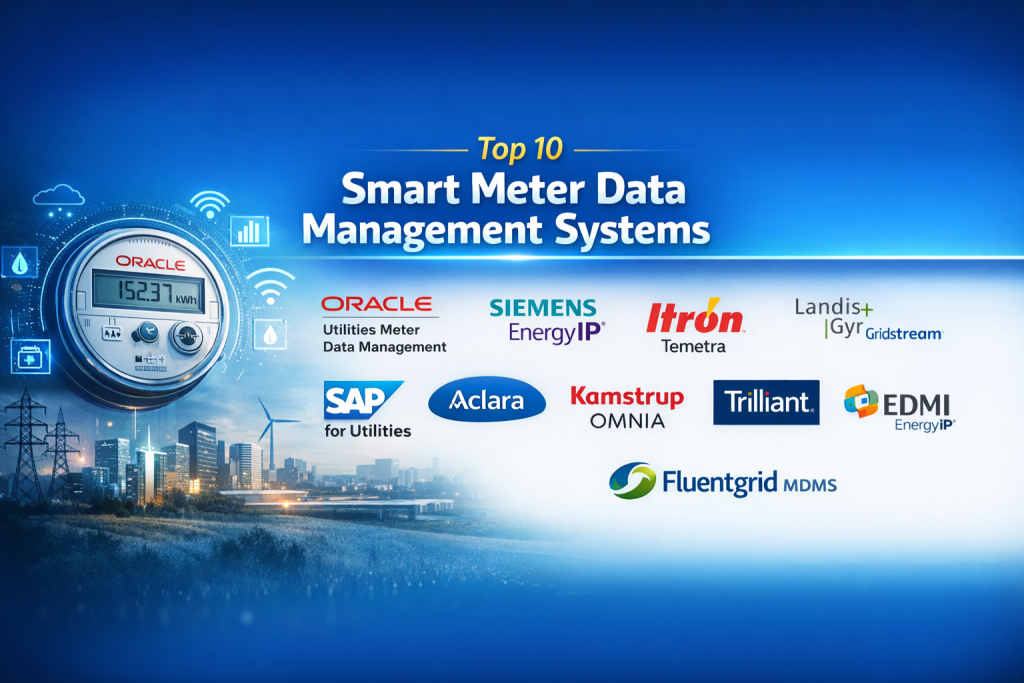
Top 10 Smart Meter Data Management Systems Tools
1 — Oracle Utilities Meter Data Management
Short description:
A highly scalable, enterprise-grade MDMS designed for large utilities managing millions of smart meters across electricity, gas, and water networks.
Key features:
- High-volume interval data ingestion
- Advanced VEE (Validation, Estimation, Editing)
- Seamless billing and CIS integration
- Time-of-use and dynamic tariff support
- Outage and tamper detection
- Regulatory and audit reporting
Pros:
- Proven scalability for national utilities
- Deep regulatory and billing alignment
Cons:
- Complex implementation cycles
- Premium enterprise pricing
Security & compliance:
Role-based access, encryption, audit logs, GDPR support, ISO-aligned controls.
Support & community:
Strong enterprise support, extensive documentation, global implementation partners.
2 — Siemens EnergyIP Meter Data Management
Short description:
A robust MDMS platform focused on grid intelligence, analytics, and utility-scale smart infrastructure.
Key features:
- Multi-utility meter data handling
- Advanced analytics and forecasting
- Grid event correlation
- Flexible VEE rules engine
- Cloud and on-premise deployment
Pros:
- Strong analytics capabilities
- Excellent grid integration
Cons:
- Requires skilled technical teams
- Higher operational complexity
Security & compliance:
Enterprise security controls, encryption, GDPR compliance, audit logging.
Support & community:
Strong enterprise support, professional services-led onboarding.
3 — Itron Temetra
Short description:
A cloud-based MDMS optimized for utilities adopting Itron AMI infrastructure and IoT-enabled meters.
Key features:
- Native Itron meter integration
- Cloud-native architecture
- Automated VEE processes
- Remote meter management
- Analytics dashboards
Pros:
- Fast deployment for Itron ecosystems
- Modern cloud scalability
Cons:
- Limited flexibility outside Itron stack
- Customization can be constrained
Security & compliance:
Cloud security standards, encryption, GDPR support.
Support & community:
Good vendor support, focused documentation, ecosystem-driven community.
4 — Landis+Gyr Gridstream MDMS
Short description:
A mature MDMS solution tightly integrated with Landis+Gyr smart metering and grid automation technologies.
Key features:
- Large-scale meter data processing
- Real-time event management
- Advanced estimation algorithms
- Billing system integration
- Grid performance analytics
Pros:
- Highly reliable for large deployments
- Strong global utility adoption
Cons:
- Less flexible for mixed vendor environments
- Implementation complexity
Security & compliance:
ISO-aligned security, encryption, audit trails, GDPR readiness.
Support & community:
Strong global support network, enterprise-focused onboarding.
5 — SAP for Utilities MDMS
Short description:
An integrated MDMS component within SAP’s utilities ecosystem, ideal for organizations already running SAP billing and ERP systems.
Key features:
- Tight SAP IS-U integration
- High-volume meter data handling
- Time-based billing support
- Data validation workflows
- Regulatory reporting
Pros:
- Seamless SAP ecosystem fit
- Enterprise-grade reliability
Cons:
- High cost of ownership
- Steep learning curve
Security & compliance:
SAP security framework, role-based access, GDPR and ISO alignment.
Support & community:
Extensive SAP documentation, large partner ecosystem, enterprise support.
6 — Aclara Meter Data Management
Short description:
A utility-focused MDMS optimized for advanced metering infrastructure and grid modernization initiatives.
Key features:
- Meter data aggregation
- VEE automation
- Outage and theft detection
- Integration with AMI networks
- Utility analytics dashboards
Pros:
- Strong operational reliability
- Utility-centric design
Cons:
- Limited advanced analytics
- Smaller ecosystem compared to giants
Security & compliance:
Encryption, access controls, audit logging.
Support & community:
Responsive vendor support, moderate documentation depth.
7 — Kamstrup OMNIA Suite
Short description:
A modular MDMS designed primarily for water and heat utilities with growing smart infrastructure needs.
Key features:
- Modular deployment model
- Interval data processing
- Leak and anomaly detection
- Visualization dashboards
- Billing export tools
Pros:
- Flexible modular architecture
- Strong water utility focus
Cons:
- Less suited for massive electric grids
- Limited third-party integrations
Security & compliance:
Standard enterprise security, GDPR support.
Support & community:
Good vendor support, smaller but active user base.
8 — Trilliant Smart Meter Data Platform
Short description:
A scalable MDMS platform supporting multi-utility deployments with strong communications and data management capabilities.
Key features:
- Multi-utility meter support
- High-frequency data ingestion
- Network performance monitoring
- Analytics and reporting
- API-driven integrations
Pros:
- Vendor-agnostic approach
- Scalable communications layer
Cons:
- UI can feel dated
- Advanced analytics require add-ons
Security & compliance:
Encryption, access control, audit capabilities.
Support & community:
Enterprise support available, documentation improving steadily.
9 — EDMI EnergyIP MDMS
Short description:
A global MDMS solution supporting complex metering environments and regional regulatory requirements.
Key features:
- Large-scale data validation
- Flexible tariff handling
- Meter event management
- Regional compliance tools
- Analytics and reporting
Pros:
- Strong international deployment record
- Flexible configuration
Cons:
- Customization increases cost
- Interface complexity
Security & compliance:
GDPR support, role-based access, audit logs.
Support & community:
Regional support teams, solid onboarding assistance.
10 — Fluentgrid MDMS
Short description:
A cost-effective MDMS platform designed for utilities in emerging and mid-scale markets.
Key features:
- Meter data acquisition
- VEE processing
- Billing and CIS integration
- Analytics dashboards
- Cloud and on-prem options
Pros:
- Competitive pricing
- Faster deployment cycles
Cons:
- Limited global brand recognition
- Smaller ecosystem
Security & compliance:
Standard enterprise security, encryption, compliance varies by deployment.
Support & community:
Good customer support, growing partner network.
Comparison Table
| Tool Name | Best For | Platform(s) Supported | Standout Feature | Rating |
|---|---|---|---|---|
| Oracle Utilities MDM | Large national utilities | Cloud / On-prem | Extreme scalability | N/A |
| Siemens EnergyIP | Grid-focused utilities | Cloud / On-prem | Advanced analytics | N/A |
| Itron Temetra | Itron AMI users | Cloud | Fast cloud deployment | N/A |
| Landis+Gyr Gridstream | Large AMI deployments | On-prem / Hybrid | Reliability at scale | N/A |
| SAP Utilities MDMS | SAP-centric utilities | On-prem / Cloud | ERP integration | N/A |
| Aclara MDMS | Operational reliability | On-prem / Hybrid | Grid event detection | N/A |
| Kamstrup OMNIA | Water & heat utilities | Cloud / On-prem | Modular design | N/A |
| Trilliant Platform | Multi-utility networks | Cloud / Hybrid | Vendor-agnostic | N/A |
| EDMI EnergyIP | International utilities | Cloud / On-prem | Regional compliance | N/A |
| Fluentgrid MDMS | Mid-scale utilities | Cloud / On-prem | Cost-effective | N/A |
Evaluation & Scoring of Smart Meter Data Management Systems
| Criteria | Weight | Evaluation Focus |
|---|---|---|
| Core features | 25% | Data ingestion, VEE, billing readiness |
| Ease of use | 15% | UI clarity, workflow simplicity |
| Integrations & ecosystem | 15% | AMI, billing, analytics tools |
| Security & compliance | 10% | Encryption, access control, audits |
| Performance & reliability | 10% | Data accuracy, uptime |
| Support & community | 10% | Documentation, vendor support |
| Price / value | 15% | ROI, scalability vs cost |
Which Smart Meter Data Management Systems Tool Is Right for You?
- Solo users: Rarely applicable; MDMS platforms are enterprise-oriented.
- SMBs / municipal utilities: Fluentgrid, Kamstrup OMNIA offer balance and affordability.
- Mid-market utilities: Itron Temetra, Trilliant, EDMI provide scalable yet flexible options.
- Enterprise utilities: Oracle, Siemens, SAP, Landis+Gyr deliver unmatched scale and compliance.
Budget-conscious teams should prioritize core VEE and billing readiness, while premium buyers benefit from advanced analytics, grid intelligence, and long-term vendor stability.
Frequently Asked Questions (FAQs)
1. What is a Smart Meter Data Management System?
It is software that processes, validates, and manages data generated by smart meters.
2. Is MDMS required for smart grids?
Yes, it acts as the backbone connecting meters, billing, and analytics systems.
3. Can MDMS handle multiple utilities?
Many platforms support electricity, gas, and water data simultaneously.
4. How secure is meter data?
Enterprise MDMS platforms use encryption, role-based access, and audit logging.
5. Is cloud deployment safe for utilities?
Yes, when backed by strong compliance and data residency controls.
6. How long does implementation take?
Anywhere from a few months to over a year, depending on scale.
7. Does MDMS replace billing systems?
No, it feeds validated data into billing platforms.
8. What are common mistakes when choosing MDMS?
Underestimating data volume and integration complexity.
9. Are these systems customizable?
Yes, but customization often increases cost and complexity.
10. Can small utilities benefit from MDMS?
Yes, especially with modular or cloud-based solutions.
Conclusion
Smart Meter Data Management Systems are critical infrastructure platforms for modern utilities, enabling accurate billing, operational intelligence, and regulatory compliance. While enterprise solutions dominate large deployments, newer and modular platforms make MDMS accessible to mid-scale and municipal utilities as well.
The most important takeaway is that there is no universal “best” MDMS. The right choice depends on data volume, utility type, regulatory environment, integration needs, and long-term digital strategy. Selecting a platform aligned with your operational reality ensures sustainable value and future-ready smart utility operations.

Find Trusted Cardiac Hospitals
Compare heart hospitals by city and services — all in one place.
Explore Hospitals
