
Introduction
Transportation Management Systems (TMS) are specialized software platforms designed to plan, execute, optimize, and analyze the movement of goods across supply chains. In today’s global, fast-moving logistics environment, transportation is no longer just about moving items from point A to point B—it’s about doing it faster, cheaper, more reliably, and with full visibility.
A modern TMS helps organizations manage carrier selection, route optimization, freight auditing, shipment tracking, compliance, and performance analytics—all from a centralized system. As transportation costs often represent one of the largest operational expenses, even small efficiency gains can result in significant savings.
Real-world use cases include optimizing last-mile delivery, managing multi-carrier freight networks, supporting omnichannel retail, handling international shipping compliance, and improving on-time delivery performance. Companies use TMS platforms to gain control over complex logistics operations, reduce manual work, and make data-driven transportation decisions.
When evaluating TMS tools, buyers should look at route optimization capabilities, carrier connectivity, real-time visibility, scalability, integrations with ERP/WMS systems, analytics depth, security standards, and total cost of ownership. Ease of use and implementation time also matter, especially for fast-growing organizations.
Best for:
Transportation Management Systems are ideal for manufacturers, retailers, wholesalers, 3PLs, logistics service providers, e-commerce companies, and enterprises that manage frequent shipments, multiple carriers, or complex delivery networks.
Not ideal for:
Very small businesses with minimal shipping volume or organizations that rely entirely on a single courier with simple shipping needs may find a full TMS excessive. In such cases, basic shipping software or carrier portals may be sufficient.
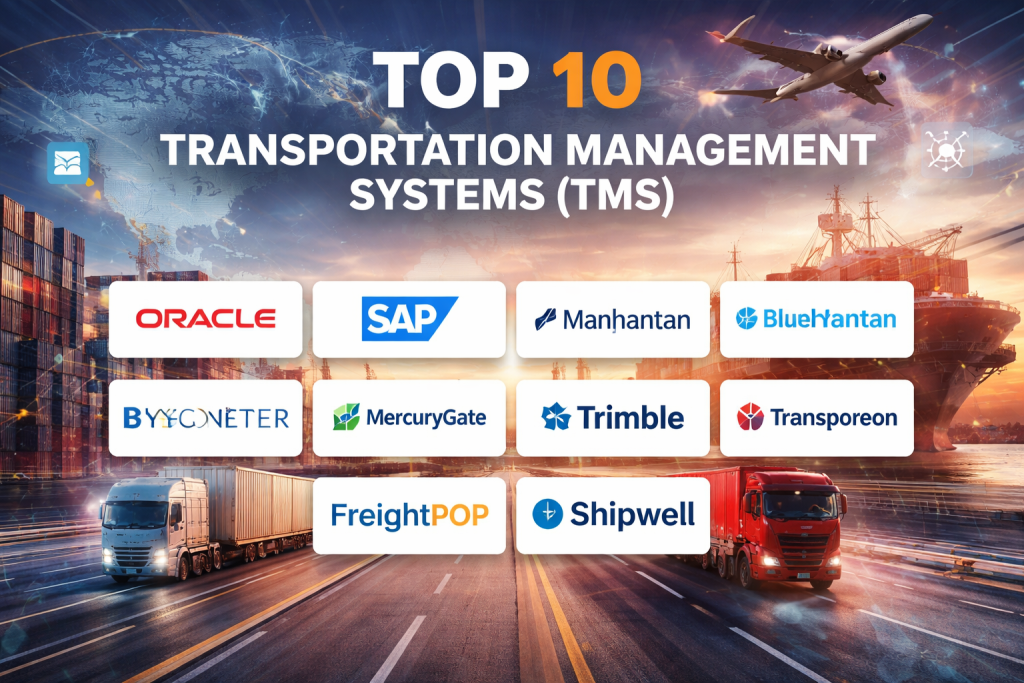
Top 10 Transportation Management Systems (TMS) Tools
1 — Oracle Transportation Management (OTM)
Short description:
Oracle Transportation Management is a powerful enterprise-grade TMS built for large, global organizations managing complex, multi-modal transportation networks.
Key features:
- Advanced route and load optimization
- Multi-modal transportation planning
- Global trade compliance and documentation
- Real-time shipment tracking and visibility
- Freight settlement and audit automation
- Deep analytics and KPI dashboards
Pros:
- Extremely robust and scalable for global operations
- Strong optimization and compliance capabilities
Cons:
- High implementation complexity
- Expensive for smaller organizations
Security & compliance:
Enterprise-grade security, encryption, role-based access, audit logs, GDPR support, ISO-aligned controls.
Support & community:
Extensive documentation, enterprise onboarding, dedicated Oracle support ecosystem.
2 — SAP Transportation Management
Short description:
SAP Transportation Management is a tightly integrated TMS solution designed for SAP-centric enterprises seeking end-to-end logistics control.
Key features:
- End-to-end transportation planning
- Carrier collaboration portals
- Freight cost management and settlement
- Real-time analytics within SAP ecosystem
- Multi-leg and multi-modal shipping support
- Tight ERP and supply chain integration
Pros:
- Seamless integration with SAP systems
- Strong analytics and process automation
Cons:
- Steep learning curve
- Best value only within SAP environments
Security & compliance:
Enterprise-grade SAP security framework, SSO, audit trails, GDPR compliance.
Support & community:
Strong global SAP partner network, enterprise-level support and training.
3 — Manhattan Transportation Management
Short description:
Manhattan TMS focuses on unified logistics execution, offering deep functionality for retailers and distributors.
Key features:
- Transportation planning and execution
- Omnichannel fulfillment support
- Carrier performance management
- Advanced freight rating and audit
- Real-time visibility dashboards
- Integration with WMS and OMS
Pros:
- Excellent for retail and distribution
- Strong execution and visibility features
Cons:
- Premium pricing
- Requires experienced implementation teams
Security & compliance:
Role-based access, encryption, audit logging, GDPR-ready.
Support & community:
Strong enterprise support, structured onboarding, dedicated account management.
4 — Blue Yonder Transportation Management
Short description:
Blue Yonder TMS combines transportation planning with AI-driven optimization for complex supply chains.
Key features:
- AI-based route optimization
- Dynamic carrier selection
- Predictive analytics and forecasting
- End-to-end shipment visibility
- Carbon footprint tracking
- Scenario modeling
Pros:
- Advanced AI and predictive capabilities
- Excellent for complex, volatile networks
Cons:
- Complex setup
- Higher cost of ownership
Security & compliance:
Enterprise security standards, data encryption, compliance frameworks vary by deployment.
Support & community:
Enterprise-focused support, strong consulting ecosystem.
5 — Descartes Transportation Management
Short description:
Descartes TMS offers modular, scalable transportation solutions suitable for mid-market to enterprise logistics teams.
Key features:
- Route planning and optimization
- Carrier connectivity network
- Customs and compliance management
- Real-time tracking and alerts
- Freight audit and payment
- Modular deployment options
Pros:
- Flexible and scalable modules
- Strong global logistics network
Cons:
- UI can feel dated in places
- Customization may require support
Security & compliance:
SOC-aligned controls, encryption, compliance varies by module.
Support & community:
Reliable support, strong documentation, global customer base.
6 — MercuryGate TMS
Short description:
MercuryGate is a cloud-native TMS designed for shippers and logistics providers managing multi-modal freight.
Key features:
- Multi-modal shipment management
- Rate management and freight audit
- Carrier network connectivity
- Visibility and exception management
- Analytics and reporting tools
- API-driven integrations
Pros:
- Flexible and highly configurable
- Strong multi-modal capabilities
Cons:
- Interface can feel complex
- Configuration requires expertise
Security & compliance:
Cloud security standards, encryption, role-based controls, SOC compliance.
Support & community:
Strong customer support, active logistics user community.
7 — Trimble Transportation Management
Short description:
Trimble TMS focuses on transportation execution, fleet connectivity, and real-time visibility.
Key features:
- Real-time tracking and telematics integration
- Carrier and fleet management
- Dispatch and execution tools
- Freight payment automation
- Analytics and reporting
- Mobile access for drivers
Pros:
- Excellent real-time visibility
- Strong telematics integration
Cons:
- More execution-focused than planning
- Limited advanced optimization
Security & compliance:
Standard enterprise security, encryption, access controls.
Support & community:
Solid support services, strong transportation industry presence.
8 — Transporeon
Short description:
Transporeon is a collaborative TMS platform emphasizing shipper-carrier connectivity and transparency.
Key features:
- Digital freight tendering
- Carrier collaboration network
- Real-time shipment tracking
- Rate benchmarking and analytics
- Dock and yard management
- Sustainability tracking
Pros:
- Strong carrier collaboration
- High transparency and benchmarking
Cons:
- Best suited for European markets
- Less customizable for niche needs
Security & compliance:
GDPR-compliant, secure data exchange, audit controls.
Support & community:
Strong user community, responsive support teams.
9 — FreightPOP
Short description:
FreightPOP is a user-friendly TMS designed for SMBs needing powerful shipping without enterprise complexity.
Key features:
- Multi-carrier rate shopping
- Shipment booking and tracking
- Freight audit and invoicing
- Warehouse and ERP integrations
- Analytics dashboards
- Cloud-based deployment
Pros:
- Easy to use and quick to deploy
- Cost-effective for growing businesses
Cons:
- Limited advanced optimization
- Less suitable for very large enterprises
Security & compliance:
Standard cloud security, encryption, role-based access.
Support & community:
Good onboarding support, helpful documentation.
10 — Shipwell
Short description:
Shipwell is a modern, cloud-based TMS built for agile supply chains and fast-growing companies.
Key features:
- Real-time shipment visibility
- Automated carrier matching
- Predictive ETAs
- Analytics and performance tracking
- API-first integrations
- Exception management
Pros:
- Modern interface and usability
- Strong visibility and automation
Cons:
- Still evolving feature depth
- Smaller ecosystem than legacy vendors
Security & compliance:
Cloud-native security, encryption, SOC-aligned controls.
Support & community:
Responsive customer support, growing user base.
Comparison Table
| Tool Name | Best For | Platform(s) Supported | Standout Feature | Rating |
|---|---|---|---|---|
| Oracle TMS | Global enterprises | Web, Cloud | Advanced optimization | N/A |
| SAP TMS | SAP-centric enterprises | Web, Cloud | ERP-native integration | N/A |
| Manhattan TMS | Retail & distribution | Web, Cloud | Omnichannel execution | N/A |
| Blue Yonder TMS | Complex supply chains | Web, Cloud | AI-driven optimization | N/A |
| Descartes TMS | Global logistics teams | Web, Cloud | Modular scalability | N/A |
| MercuryGate | Multi-modal shippers | Web, Cloud | Configuration flexibility | N/A |
| Trimble TMS | Fleet-focused operations | Web, Mobile | Real-time telematics | N/A |
| Transporeon | Shipper-carrier networks | Web | Collaboration platform | N/A |
| FreightPOP | SMB logistics | Web, Cloud | Ease of use | N/A |
| Shipwell | Fast-growing companies | Web, Cloud | Predictive visibility | N/A |
Evaluation & Scoring of Transportation Management Systems (TMS)
| Criteria | Weight | Description |
|---|---|---|
| Core features | 25% | Planning, execution, audit, visibility |
| Ease of use | 15% | UI, learning curve, daily usability |
| Integrations & ecosystem | 15% | ERP, WMS, carrier connectivity |
| Security & compliance | 10% | Data protection and compliance |
| Performance & reliability | 10% | Scalability and uptime |
| Support & community | 10% | Vendor support quality |
| Price / value | 15% | ROI and total cost |
Which Transportation Management Systems (TMS) Tool Is Right for You?
Choosing the right TMS depends heavily on your business size, shipment complexity, budget, and technology ecosystem.
- Solo users & SMBs: Lightweight, easy-to-use tools with fast onboarding and lower costs work best.
- Mid-market companies: Look for configurable systems with strong integrations and scalability.
- Enterprises: Prioritize advanced optimization, compliance, analytics, and global scalability.
Budget-conscious organizations may favor cloud-native platforms, while premium solutions offer unmatched depth for complex networks. Consider how deeply the TMS must integrate with ERP, WMS, and analytics platforms. Security and compliance become critical in regulated or global operations.
Frequently Asked Questions (FAQs)
1. What does a TMS actually do?
A TMS manages transportation planning, execution, tracking, and freight cost control.
2. Is TMS only for large enterprises?
No. Many modern TMS platforms are designed specifically for SMBs and mid-market companies.
3. How long does TMS implementation take?
It can range from a few weeks for cloud tools to several months for enterprise platforms.
4. Can a TMS reduce transportation costs?
Yes. Route optimization and rate management often reduce costs significantly.
5. Does TMS replace carriers or freight brokers?
No. It coordinates and optimizes how you work with them.
6. Is real-time tracking standard in TMS?
Most modern systems offer real-time or near-real-time visibility.
7. What integrations are most important?
ERP, WMS, accounting, and carrier systems are critical.
8. How secure are TMS platforms?
Reputable vendors use encryption, access controls, and compliance frameworks.
9. Can TMS support international shipping?
Many enterprise-grade tools support global trade and compliance.
10. What is the biggest mistake when choosing a TMS?
Overbuying complexity or underestimating integration and change management.
Conclusion
Transportation Management Systems play a crucial role in modern supply chains by delivering cost savings, visibility, control, and operational efficiency. From lightweight tools for growing businesses to enterprise platforms powering global logistics networks, the TMS market offers solutions for every need.
What matters most is aligning the system with your shipment volume, complexity, budget, integration needs, and growth plans. There is no single “best” TMS for everyone—the right choice depends on your specific business goals and operational realities. By focusing on value, usability, and scalability, organizations can turn transportation from a cost center into a strategic advantage.

Find Trusted Cardiac Hospitals
Compare heart hospitals by city and services — all in one place.
Explore Hospitals