
Introduction
Treasury ALM (Asset Liability Management) software plays a critical role in how financial institutions and large enterprises manage balance-sheet risk, liquidity, interest rate exposure, and long-term financial stability. At its core, Treasury ALM software helps organizations measure, monitor, and optimize the relationship between assets and liabilities under both normal and stressed market conditions.
In today’s volatile environment—marked by interest-rate fluctuations, liquidity tightening, regulatory pressure, and complex financial products—manual models and spreadsheets are no longer sufficient. Treasury ALM platforms bring scenario modeling, forecasting, stress testing, and regulatory reporting into one governed system, enabling treasury and risk teams to make confident, data-driven decisions.
Why Treasury ALM software is important
- Protects net interest margin and economic value of equity
- Strengthens liquidity and funding planning
- Supports regulatory and internal stress testing
- Improves strategic balance-sheet optimization
- Enhances governance, transparency, and auditability
Key real-world use cases
- Interest rate risk (IRRBB) modeling and sensitivity analysis
- Liquidity risk and cash-flow gap management
- Balance-sheet forecasting and funding strategy
- Regulatory reporting and supervisory stress tests
- Strategic capital allocation decisions
What to look for when choosing a Treasury ALM tool
- Accuracy and depth of ALM models
- Scenario and stress-testing flexibility
- Integration with treasury, risk, and core systems
- Transparency, explainability, and audit controls
- Scalability and regulatory readiness
Best for:
Treasury ALM software is best suited for banks, NBFCs, insurance firms, asset managers, fintech lenders, and large corporates with complex balance sheets. Primary users include treasury teams, ALM committees, CFO offices, risk managers, and regulatory reporting teams.
Not ideal for:
Very small businesses, startups with simple cash-flow needs, or organizations seeking basic treasury tracking may find full-scale ALM tools excessive. In such cases, lightweight treasury or cash-management platforms may be more appropriate.
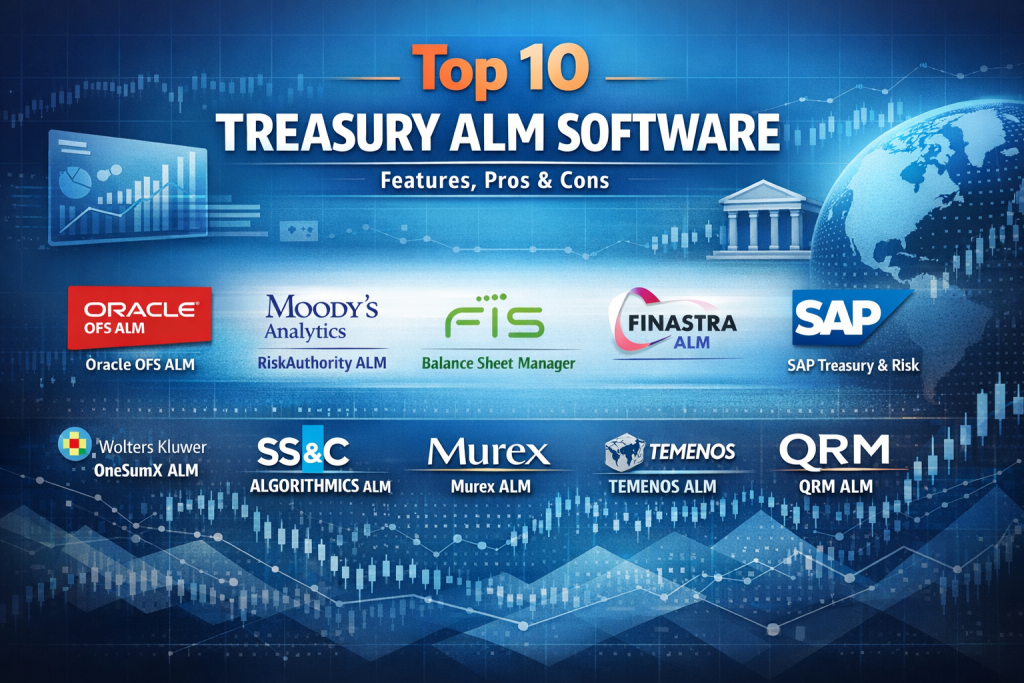
Top 10 Treasury ALM (Asset Liability Mgmt) Software Tools
1 — Oracle OFS Asset Liability Management
Short description:
A comprehensive enterprise-grade ALM solution designed for large financial institutions requiring advanced modeling, stress testing, and regulatory alignment.
Key features
- Advanced interest rate and liquidity risk modeling
- Scenario analysis and stress-testing frameworks
- Behavioral modeling for non-maturing deposits
- Regulatory reporting and audit trails
- Integration with enterprise finance and risk systems
Pros
- Extremely powerful and scalable
- Trusted by global tier-1 institutions
Cons
- High implementation complexity
- Premium cost structure
Security & compliance
Enterprise encryption, role-based access, audit logs, regulatory compliance support (varies by deployment)
Support & community
Strong enterprise support, formal onboarding, extensive documentation, global partner ecosystem
2 — Moody’s Analytics RiskAuthority ALM
Short description:
A data-driven ALM platform focused on balance-sheet risk, stress testing, and regulatory compliance for banks and insurers.
Key features
- Interest rate risk and liquidity modeling
- Scenario-based balance-sheet forecasting
- Integrated stress testing and sensitivity analysis
- Regulatory and supervisory reporting
- Analytics powered by Moody’s data expertise
Pros
- Strong analytical depth
- Excellent regulatory credibility
Cons
- Steeper learning curve
- Less flexibility for non-financial enterprises
Security & compliance
Enterprise-grade security, audit controls, regulatory compliance frameworks
Support & community
Professional services-led onboarding, strong documentation, dedicated customer support
3 — FIS Balance Sheet Manager
Short description:
A robust ALM and balance-sheet management solution tailored for banks and financial institutions with complex funding structures.
Key features
- Interest rate risk and liquidity risk modeling
- Cash-flow gap and repricing analysis
- Scenario simulation and forecasting
- Regulatory reporting support
- Integration with treasury and core banking systems
Pros
- Deep financial-services expertise
- Strong integration ecosystem
Cons
- UI can feel dated
- Customization may require vendor support
Security & compliance
SSO, encryption, audit logging, compliance-ready architecture
Support & community
Global enterprise support, structured onboarding, strong user base in banking sector
4 — Finastra ALM
Short description:
A flexible ALM solution designed for banks seeking integrated treasury, risk, and balance-sheet management.
Key features
- Interest rate and liquidity risk analytics
- Behavioral modeling and forecasting
- Scenario-based stress testing
- Regulatory compliance reporting
- Modular integration with Finastra ecosystem
Pros
- Modular and scalable design
- Strong treasury-risk integration
Cons
- Best value when used within Finastra stack
- Implementation effort can be significant
Security & compliance
Enterprise security controls, role-based access, compliance reporting
Support & community
Formal onboarding, enterprise SLAs, extensive product documentation
5 — SAP Treasury and Risk Management (ALM)
Short description:
A treasury-centric ALM capability embedded within SAP’s broader finance and risk ecosystem.
Key features
- Cash-flow and liquidity forecasting
- Interest rate exposure analysis
- Integrated accounting and risk data
- Scenario simulation
- Tight ERP integration
Pros
- Seamless SAP ERP integration
- Strong data consistency
Cons
- ALM depth lighter than specialist tools
- Requires SAP expertise
Security & compliance
Enterprise SAP security, role-based controls, audit logging
Support & community
Large global user community, extensive documentation, partner-led support
6 — Wolters Kluwer OneSumX ALM
Short description:
A regulatory-focused ALM platform combining balance-sheet risk management with compliance and reporting strength.
Key features
- Interest rate and liquidity risk modeling
- Regulatory reporting alignment
- Scenario and sensitivity analysis
- Governance and auditability features
- Modular deployment options
Pros
- Strong regulatory credibility
- Transparent reporting workflows
Cons
- UI less modern
- Best suited for regulated institutions
Security & compliance
Compliance-driven security, audit trails, regulatory reporting controls
Support & community
Professional services onboarding, strong regulatory documentation
7 — SS&C Algorithmics ALM
Short description:
An advanced quantitative ALM solution designed for institutions with complex portfolios and risk profiles.
Key features
- Sophisticated interest rate and liquidity modeling
- Scenario-based stress testing
- Economic value and earnings-at-risk analysis
- Portfolio-level risk aggregation
- Advanced analytics
Pros
- Very strong quantitative modeling
- Highly configurable
Cons
- Requires skilled users
- Higher operational complexity
Security & compliance
Enterprise-grade security, audit logging, compliance frameworks
Support & community
Dedicated enterprise support, professional services-led deployment
8 — Murex ALM
Short description:
A real-time ALM and treasury solution tightly integrated with trading, risk, and finance operations.
Key features
- Real-time balance-sheet visibility
- Interest rate and liquidity risk management
- Scenario simulation and stress testing
- Integrated treasury and risk data
- Strong analytics engine
Pros
- Real-time processing capabilities
- Strong front-to-back integration
Cons
- Complex implementation
- Premium pricing
Security & compliance
High-grade security, audit trails, enterprise compliance standards
Support & community
Global enterprise support, structured training programs
9 — Temenos ALM
Short description:
An ALM module within the Temenos banking platform, optimized for core banking integration.
Key features
- Interest rate and liquidity risk analysis
- Balance-sheet forecasting
- Scenario-based stress testing
- Core banking data integration
- Regulatory reporting support
Pros
- Strong core banking alignment
- Good for Temenos users
Cons
- Less flexible outside Temenos ecosystem
- Customization limits
Security & compliance
Enterprise banking security, role-based access, audit logs
Support & community
Strong vendor support, global banking user base
10 — QRM (Quantitative Risk Management) ALM
Short description:
A specialized ALM platform focused on risk-driven balance-sheet management and behavioral modeling.
Key features
- Interest rate risk and liquidity modeling
- Behavioral assumptions and forecasting
- Scenario and stress-testing engines
- Economic value analysis
- Governance and reporting tools
Pros
- Strong behavioral modeling
- Clear risk transparency
Cons
- Narrower scope than all-in-one platforms
- Smaller ecosystem
Security & compliance
Enterprise security controls, audit trails, compliance support
Support & community
Focused customer support, strong domain expertise
Comparison Table
| Tool Name | Best For | Platforms Supported | Standout Feature | Rating |
|---|---|---|---|---|
| Oracle OFS ALM | Tier-1 banks | Cloud / On-prem | Enterprise-grade ALM depth | N/A |
| Moody’s RiskAuthority | Regulated institutions | Cloud / On-prem | Regulatory analytics | N/A |
| FIS Balance Sheet Manager | Banks & lenders | Cloud / On-prem | Balance-sheet optimization | N/A |
| Finastra ALM | Treasury-risk integration | Cloud / On-prem | Modular design | N/A |
| SAP Treasury ALM | SAP-centric enterprises | Cloud / On-prem | ERP integration | N/A |
| OneSumX ALM | Compliance-driven banks | Cloud / On-prem | Regulatory reporting | N/A |
| SS&C Algorithmics | Quant-heavy institutions | Cloud / On-prem | Advanced analytics | N/A |
| Murex ALM | Real-time treasury | Cloud / On-prem | Front-to-back integration | N/A |
| Temenos ALM | Core banking users | Cloud / On-prem | Core data alignment | N/A |
| QRM ALM | Risk-focused ALM teams | Cloud / On-prem | Behavioral modeling | N/A |
Evaluation & Scoring of Treasury ALM Software
| Evaluation Criteria | Weight | Description |
|---|---|---|
| Core features | 25% | Depth of ALM modeling, forecasting, stress testing |
| Ease of use | 15% | Usability, dashboards, learning curve |
| Integrations & ecosystem | 15% | ERP, core banking, treasury, data feeds |
| Security & compliance | 10% | Encryption, audit logs, regulatory readiness |
| Performance & reliability | 10% | Scalability, calculation speed, uptime |
| Support & community | 10% | Onboarding, documentation, vendor support |
| Price / value | 15% | ROI, flexibility, long-term cost efficiency |
Which Treasury ALM Software Tool Is Right for You?
- Solo users & SMBs: Lightweight treasury tools or ERP-embedded ALM may be sufficient
- Mid-market institutions: Modular ALM platforms with strong reporting and forecasting
- Large enterprises & banks: Full-scale enterprise ALM with stress testing and regulatory depth
- Budget-conscious teams: ERP-integrated or limited-scope ALM solutions
- Premium needs: Best-of-breed platforms with advanced analytics and scalability
- Security-driven organizations: Choose vendors with strong governance and audit frameworks
The right choice depends on complexity, regulatory pressure, integration needs, and long-term strategy.
Frequently Asked Questions (FAQs)
1. What is Treasury ALM software used for?
It helps manage interest rate risk, liquidity risk, and balance-sheet stability through modeling and forecasting.
2. Is Treasury ALM only for banks?
No. Insurers, NBFCs, asset managers, and large corporates also benefit.
3. How long does implementation take?
From a few months to over a year, depending on complexity and data readiness.
4. Does ALM software support stress testing?
Yes. Stress testing is a core capability of most ALM platforms.
5. Is ALM software cloud-based?
Most vendors offer both cloud and on-premise deployment options.
6. How important are behavioral assumptions?
Very important, especially for deposits, prepayments, and early withdrawals.
7. Can ALM integrate with ERP systems?
Yes, especially platforms designed for enterprise finance integration.
8. What are common implementation mistakes?
Poor data quality, unrealistic assumptions, and lack of stakeholder buy-in.
9. Is ALM software expensive?
Enterprise ALM can be costly, but ROI is high for complex balance sheets.
10. How often should ALM models be updated?
Typically monthly or quarterly, with more frequent updates during volatility.
Conclusion
Treasury ALM software is no longer optional for organizations managing complex balance sheets and financial risk. The right platform provides clarity, control, and confidence in an increasingly uncertain financial environment.
Rather than searching for a universal “best” solution, organizations should focus on fit—matching modeling depth, usability, integration, and compliance needs to their specific context. When chosen thoughtfully, a Treasury ALM platform becomes a strategic asset that strengthens resilience, governance, and long-term financial performance.

Find Trusted Cardiac Hospitals
Compare heart hospitals by city and services — all in one place.
Explore Hospitals
Great breakdown of ALM platforms! The list makes it easier to see differences in modeling depth, stress-testing capabilities, and regulatory support — perfect for finance teams.