
Introduction
Unmanned Aerial Vehicles (UAVs), commonly known as drones, have evolved from single-purpose devices into large, mission-critical fleets used across industries. As organizations deploy dozens—or even hundreds—of drones, UAV Fleet Management Platforms have become essential. These platforms act as the central nervous system for drone operations, helping teams plan missions, monitor fleets, manage pilots, maintain compliance, and ensure safety at scale.
At their core, UAV fleet management platforms provide visibility, control, and automation. They replace spreadsheets and manual tracking with real-time dashboards, flight logs, maintenance schedules, and compliance reporting. For regulated industries such as energy, telecom, logistics, and public safety, these platforms are no longer optional—they are operational necessities.
When choosing a UAV fleet management platform, buyers should evaluate scalability, security, regulatory support, integrations, usability, and cost. The right solution should reduce operational risk while improving efficiency and decision-making.
Best for:
UAV fleet management platforms are ideal for commercial drone operators, enterprises managing multi-drone fleets, service providers, government agencies, infrastructure inspectors, and logistics teams that rely on repeatable, compliant drone operations.
Not ideal for:
They may be unnecessary for hobbyists, single-drone users, or short-term projects where manual planning and basic flight apps are sufficient.
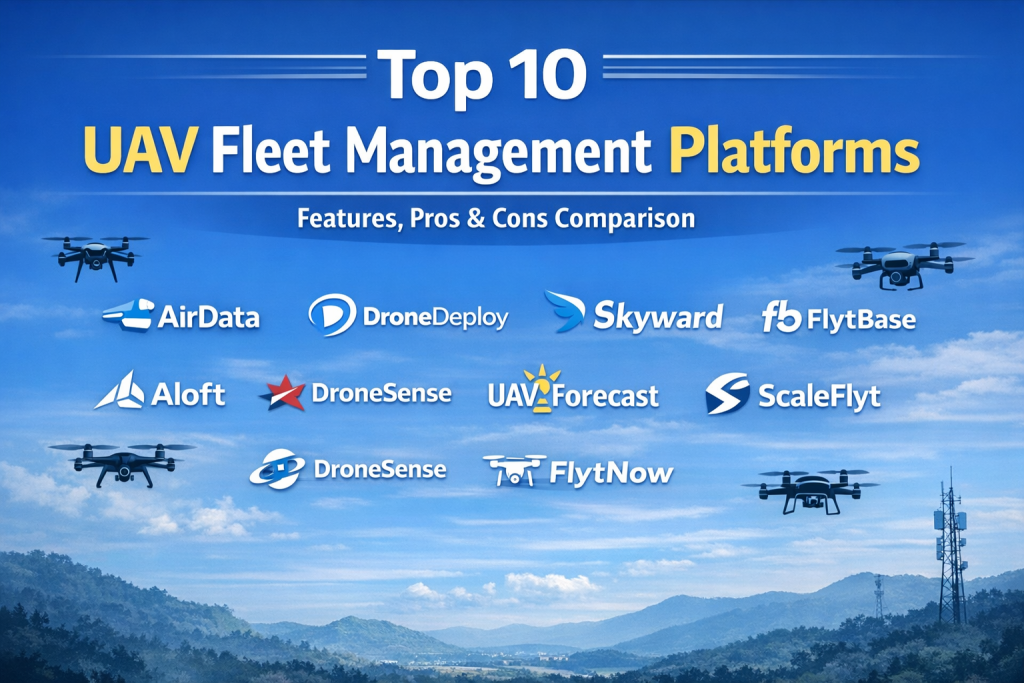
Top 10 UAV Fleet Management Platforms Tools
1 — AirData
Short description:
AirData focuses on deep analytics, flight logging, and compliance reporting. It is widely used by enterprises that need operational insights and safety tracking across large UAV fleets.
Key features
- Automated flight data capture and analytics
- Fleet health and maintenance tracking
- Pilot performance and safety scoring
- Compliance reporting and audit logs
- Real-time fleet dashboards
- Integrations with major drone manufacturers
Pros
- Excellent analytics depth
- Strong compliance and safety focus
Cons
- Interface can feel data-heavy for beginners
- Premium features can be costly
Security & compliance:
Encryption, role-based access, audit logs, GDPR-aligned data handling
Support & community:
Comprehensive documentation, enterprise onboarding, responsive support
2 — DroneDeploy
Short description:
DroneDeploy combines fleet management with mapping, inspection, and data visualization, making it popular for construction, agriculture, and infrastructure monitoring.
Key features
- Fleet and pilot management
- Mission planning and automation
- Cloud-based data processing
- Inspection and mapping workflows
- Role-based access control
- Analytics dashboards
Pros
- End-to-end operational coverage
- User-friendly interface
Cons
- Advanced features locked behind higher tiers
- Less customizable for niche workflows
Security & compliance:
Enterprise SSO, encryption, SOC-aligned controls, GDPR support
Support & community:
Strong training resources, active enterprise customer base
3 — Skyward
Short description:
Skyward emphasizes airspace intelligence and regulatory compliance, making it a strong choice for regulated and government-aligned drone operations.
Key features
- Airspace awareness and authorization workflows
- Fleet and pilot management
- Risk assessment tools
- Compliance documentation
- Mission planning
- Operational reporting
Pros
- Excellent regulatory support
- Strong risk management tools
Cons
- Interface feels enterprise-centric
- Less focus on analytics depth
Security & compliance:
Audit logs, secure data handling, regulatory compliance support
Support & community:
Professional onboarding, structured enterprise support
4 — FlytBase
Short description:
FlytBase is built for autonomous and dock-based drone operations, enabling remote monitoring and AI-driven missions.
Key features
- Autonomous mission execution
- Remote fleet monitoring
- Dock and charging station integration
- API-first architecture
- AI and automation workflows
Pros
- Strong autonomy focus
- Excellent for remote operations
Cons
- Requires higher technical expertise
- Less suitable for small teams
Security & compliance:
Encrypted communications, access controls, enterprise security standards
Support & community:
Developer-friendly documentation, enterprise support available
5 — Unifly
Short description:
Unifly specializes in UAS traffic management (UTM) and airspace coordination, often used by regulators and large infrastructure operators.
Key features
- UTM and airspace coordination
- Fleet monitoring
- Regulatory integration
- Real-time situational awareness
- Mission authorization workflows
Pros
- Best-in-class airspace management
- Strong government adoption
Cons
- Limited analytics features
- Not designed for small operators
Security & compliance:
Government-grade security, compliance-focused design
Support & community:
Enterprise and public-sector support model
6 — Aloft
Short description:
Aloft provides airspace intelligence combined with fleet management, widely used by commercial pilots and public safety agencies.
Key features
- Airspace awareness tools
- Fleet and pilot logs
- Mission planning
- Compliance reporting
- Operational dashboards
Pros
- Strong airspace intelligence
- Accessible pricing tiers
Cons
- Limited advanced analytics
- Fewer automation options
Security & compliance:
Encrypted data, role-based access, compliance-ready reporting
Support & community:
Active user community, solid documentation
7 — DroneSense
Short description:
DroneSense is designed specifically for public safety and emergency response drone operations.
Key features
- Real-time fleet visibility
- Live streaming and command tools
- Pilot coordination
- Incident logging
- Secure communications
Pros
- Purpose-built for first responders
- Real-time operational focus
Cons
- Limited commercial use cases
- Less emphasis on long-term analytics
Security & compliance:
High-security controls, encrypted communications
Support & community:
Dedicated public safety support teams
8 — UAV Forecast
Short description:
UAV Forecast focuses on weather-driven flight decision support rather than full fleet management.
Key features
- Hyper-local weather forecasting
- Flight risk indicators
- Wind and visibility modeling
- Environmental alerts
- Simple dashboards
Pros
- Excellent weather accuracy
- Lightweight and easy to use
Cons
- Not a full fleet management solution
- Limited integrations
Security & compliance:
Varies / N/A
Support & community:
Basic documentation, community-driven adoption
9 — ScaleFlyt
Short description:
ScaleFlyt targets enterprises that need to operationalize drone data across teams and systems.
Key features
- Fleet and asset tracking
- Data lifecycle management
- Enterprise integrations
- Workflow automation
- Analytics dashboards
Pros
- Strong enterprise data focus
- Good scalability
Cons
- Less beginner-friendly
- Smaller ecosystem
Security & compliance:
Enterprise encryption, access controls, GDPR-ready
Support & community:
Enterprise onboarding, professional support
10 — FlytNow
Short description:
FlytNow is designed for drone delivery operations, emphasizing fleet coordination and logistics workflows.
Key features
- Delivery mission orchestration
- Fleet tracking
- API-driven integrations
- Automation workflows
- Real-time monitoring
Pros
- Delivery-focused design
- Automation-ready
Cons
- Narrow use case
- Requires technical setup
Security & compliance:
Encrypted APIs, access controls, compliance varies by deployment
Support & community:
Technical documentation, enterprise support available
Comparison Table
| Tool Name | Best For | Platform(s) Supported | Standout Feature | Rating |
|---|---|---|---|---|
| AirData | Enterprise analytics & compliance | Web | Deep flight analytics | N/A |
| DroneDeploy | Inspection & mapping teams | Web, Mobile | End-to-end workflows | N/A |
| Skyward | Regulated operations | Web | Airspace intelligence | N/A |
| FlytBase | Autonomous fleets | Web, API | Dock-based autonomy | N/A |
| Unifly | UTM & regulators | Web | Airspace coordination | N/A |
| Aloft | Commercial pilots | Web, Mobile | Airspace awareness | N/A |
| DroneSense | Public safety | Web, Mobile | Real-time response | N/A |
| UAV Forecast | Weather planning | Mobile, Web | Weather accuracy | N/A |
| ScaleFlyt | Enterprise data ops | Web | Data orchestration | N/A |
| FlytNow | Drone delivery | Web, API | Logistics automation | N/A |
Evaluation & Scoring of UAV Fleet Management Platforms
| Criteria | Weight | Score (Avg) |
|---|---|---|
| Core features | 25% | High |
| Ease of use | 15% | Medium |
| Integrations & ecosystem | 15% | Medium |
| Security & compliance | 10% | High |
| Performance & reliability | 10% | High |
| Support & community | 10% | Medium |
| Price / value | 15% | Medium |
Which UAV Fleet Management Platforms Tool Is Right for You?
- Solo users: Lightweight tools or airspace planners are sufficient
- SMBs: Platforms with ease of use and moderate pricing work best
- Mid-market: Look for analytics, integrations, and scalability
- Enterprise: Prioritize compliance, security, automation, and APIs
Budget-conscious teams should focus on modular platforms, while premium users benefit from automation and deep analytics. If compliance is critical, regulatory-first platforms are the safest choice.
Frequently Asked Questions (FAQs)
- What is UAV fleet management software?
It centralizes drone operations, pilots, compliance, and data in one system. - Is fleet management required by law?
Not always, but it greatly simplifies compliance and audits. - Can small teams use these platforms?
Yes, many tools offer scaled-down plans. - Do these platforms support multiple drone brands?
Most enterprise tools do, but compatibility varies. - How secure is drone fleet data?
Security depends on encryption, access controls, and compliance standards. - Are these tools cloud-based?
The majority are cloud-native with web dashboards. - Can I automate drone missions?
Some platforms support advanced automation and autonomy. - What is UTM integration?
It manages airspace coordination and traffic awareness. - How long does implementation take?
From a few days to several weeks, depending on scale. - Is there a single best platform?
No—each excels in different operational scenarios.
Conclusion
UAV fleet management platforms are no longer optional for professional drone operations. They improve safety, efficiency, compliance, and scalability. The most important takeaway is that there is no universal best tool—the right platform depends on your fleet size, industry, budget, and regulatory needs. By aligning your operational goals with the strengths of each platform, you can build a future-ready UAV program with confidence.

Find Trusted Cardiac Hospitals
Compare heart hospitals by city and services — all in one place.
Explore Hospitals
This article offers a very practical and well‑structured comparison of UAV fleet management platforms — a space that’s becoming increasingly critical as drones are used for inspections, delivery, surveying, and public safety operations. I appreciate how it breaks down not just core features like mission planning, real‑time tracking, and regulatory compliance, but also real‑world considerations such as scalability, integration with existing systems, ease of use, and data analytics capabilities. The side‑by‑side pros and cons help readers match platform strengths to specific operational needs — whether that’s autonomous flight coordination, robust safety and geofencing support, or enterprise‑grade reporting and telemetry. For drone program managers and aviation teams evaluating management solutions, this comparison provides clear insights and decision‑support that goes beyond basic feature lists.