
Introduction
Wind Farm Monitoring Software plays a critical role in the modern renewable energy ecosystem. As wind farms grow in size, complexity, and geographic spread, operators can no longer rely on manual checks or fragmented systems to manage turbine performance, energy output, and asset health. These platforms act as the digital control center for wind assets—collecting real-time data from turbines, sensors, substations, and weather systems to provide actionable insights.
The importance of wind farm monitoring goes far beyond simple performance tracking. These tools help operators maximize energy production, reduce downtime, predict failures before they occur, and ensure compliance with regulatory and grid requirements. From offshore mega-projects to distributed onshore wind parks, monitoring software enables data-driven decision-making that directly impacts profitability and reliability.
Common real-world use cases include:
- Real-time turbine performance and availability monitoring
- Predictive maintenance and fault detection
- Power curve analysis and energy yield optimization
- Grid compliance and curtailment management
- Centralized monitoring of multi-site wind portfolios
When choosing a Wind Farm Monitoring Software, buyers should evaluate:
- Depth of analytics and forecasting accuracy
- SCADA and IoT integration capabilities
- Ease of use for operators and engineers
- Scalability across sites and regions
- Security, compliance, and reliability
Best for:
Wind Farm Monitoring Software is best suited for wind farm owners, independent power producers (IPPs), utilities, O&M service providers, asset managers, and energy analysts managing anything from a single wind park to large global portfolios.
Not ideal for:
These tools may be excessive for very small pilot projects, academic simulations, or single-turbine installations, where lightweight data loggers or basic SCADA systems may be sufficient.
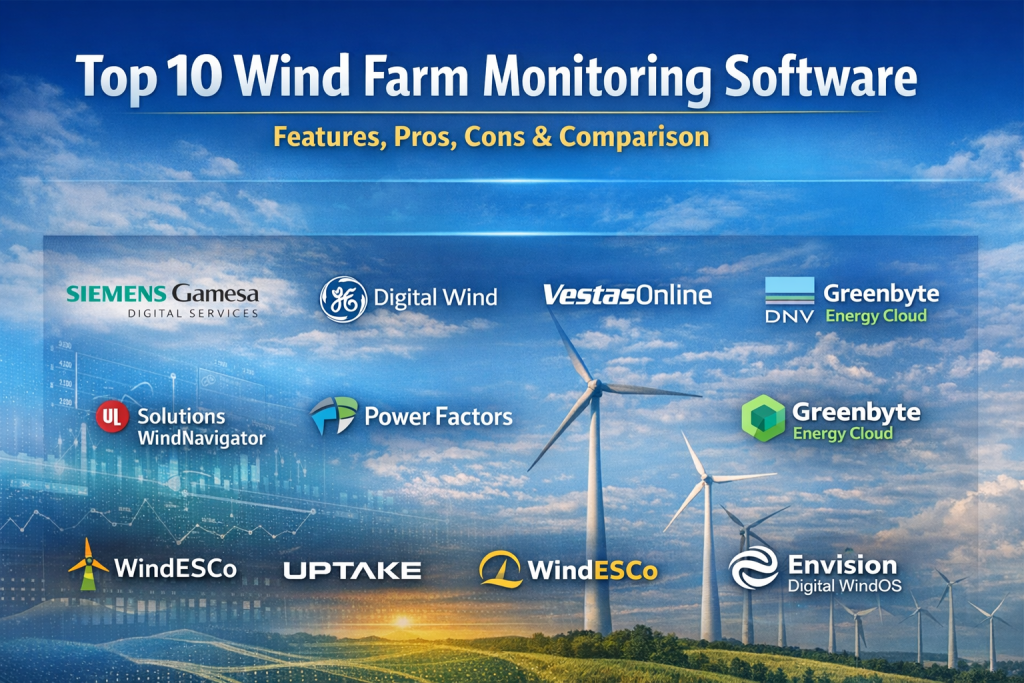
Top 10 Wind Farm Monitoring Software Tools
1 — Siemens Gamesa Digital Services
Short description:
A comprehensive digital platform designed for large-scale wind farm operators seeking deep turbine-level intelligence, predictive analytics, and lifecycle optimization.
Key features:
- Advanced SCADA-based turbine monitoring
- Predictive maintenance using AI models
- Power curve and performance deviation analysis
- Fleet-wide benchmarking and reporting
- Condition monitoring for critical components
- Grid compliance and operational analytics
Pros:
- Industry-leading turbine analytics depth
- Strong reliability and accuracy at scale
Cons:
- Best value for Siemens turbine fleets
- Enterprise-level complexity for smaller operators
Security & compliance:
Enterprise-grade security, encryption, role-based access, GDPR-aligned practices.
Support & community:
Strong enterprise support, structured onboarding, professional services available.
2 — GE Digital Wind
Short description:
A robust wind monitoring and analytics suite built for utility-scale operators focused on operational excellence and performance optimization.
Key features:
- Real-time turbine and plant monitoring
- AI-driven fault detection and alerts
- Performance and availability analytics
- Grid interaction and curtailment insights
- Integration with GE turbine ecosystems
- Historical trend analysis and reporting
Pros:
- Powerful analytics for large wind farms
- Proven reliability in utility environments
Cons:
- Less flexible for non-GE assets
- Requires trained operators for full value
Security & compliance:
Strong access controls, encryption, enterprise IT standards.
Support & community:
Dedicated enterprise support, detailed documentation, OEM expertise.
3 — VestasOnline Business
Short description:
A monitoring and performance management platform tailored for wind asset owners using Vestas turbines.
Key features:
- Live turbine status and alarms
- Energy production and availability reports
- Performance benchmarking across sites
- Power curve monitoring
- Maintenance planning insights
- Weather-adjusted performance analysis
Pros:
- Seamless integration with Vestas turbines
- Clear, operator-friendly dashboards
Cons:
- Limited flexibility for mixed fleets
- Analytics depth depends on service tier
Security & compliance:
Secure access, data encryption, GDPR-compliant operations.
Support & community:
OEM-backed support, structured training, global service reach.
4 — DNV WindGEMINI
Short description:
A performance monitoring and operational analytics platform focused on independent verification and performance assurance.
Key features:
- Independent SCADA data validation
- Performance and availability benchmarking
- Power curve verification
- Energy yield assessment
- KPI-based reporting
- Long-term degradation analysis
Pros:
- Vendor-neutral and highly trusted
- Excellent for contractual verification
Cons:
- Less real-time operational control
- More analytical than operational
Security & compliance:
Strong data governance, secure access, industry-standard compliance.
Support & community:
Expert consulting support, strong documentation, trusted industry reputation.
5 — Greenbyte Energy Cloud
Short description:
A widely used renewable monitoring platform offering portfolio-level visibility and performance analytics for wind and hybrid assets.
Key features:
- Centralized monitoring across sites
- Automated KPI tracking
- Power curve and loss analysis
- Alarm management and reporting
- Asset hierarchy and portfolio dashboards
- Integration with multiple SCADA systems
Pros:
- Strong multi-vendor support
- Clean, intuitive user interface
Cons:
- Advanced analytics may require configuration
- Premium pricing for large portfolios
Security & compliance:
Role-based access, encrypted data, GDPR-aligned processes.
Support & community:
Strong onboarding, active customer base, responsive support.
6 — UL Solutions WindNavigator
Short description:
An analytics-driven platform focused on performance assessment, benchmarking, and risk mitigation.
Key features:
- SCADA-based performance analytics
- Turbine availability tracking
- Independent loss analysis
- Operational benchmarking
- Long-term performance trend analysis
- Reporting for investors and stakeholders
Pros:
- Trusted independent analytics
- Excellent for financial and risk analysis
Cons:
- Less suited for real-time operations
- Limited visualization customization
Security & compliance:
Secure data handling, audit-ready reporting, compliance-focused.
Support & community:
Professional support, strong analytical documentation.
7 — Power Factors
Short description:
A comprehensive renewable energy monitoring and asset performance management platform designed for scaling portfolios.
Key features:
- Real-time SCADA data ingestion
- Predictive maintenance analytics
- Portfolio-wide KPI dashboards
- Alarm and event management
- Financial and operational reporting
- Cloud-based scalability
Pros:
- Strong balance of depth and usability
- Suitable for mixed renewable portfolios
Cons:
- Requires data normalization effort
- Advanced features may increase cost
Security & compliance:
Enterprise-grade security, encrypted storage, role-based controls.
Support & community:
Active customer support, structured onboarding, growing user ecosystem.
8 — Uptake Wind
Short description:
An AI-driven monitoring solution emphasizing predictive maintenance and operational intelligence.
Key features:
- Machine-learning-based fault prediction
- Turbine health scoring
- Maintenance optimization insights
- Historical performance analytics
- Integration with industrial IoT sources
- Reliability-focused dashboards
Pros:
- Strong AI-driven insights
- Reduces unplanned downtime
Cons:
- Less traditional SCADA visualization
- Requires quality historical data
Security & compliance:
Enterprise security standards, data encryption, controlled access.
Support & community:
High-touch enterprise support, technical onboarding.
9 — WindESCo
Short description:
A performance optimization platform focused on energy yield improvement and contractual performance assurance.
Key features:
- Energy performance analytics
- Contractual KPI tracking
- Turbine efficiency monitoring
- Performance improvement recommendations
- Reporting for asset managers
- Long-term trend analysis
Pros:
- Strong focus on yield improvement
- Clear ROI-oriented insights
Cons:
- Limited real-time control
- Narrower feature scope
Security & compliance:
Standard enterprise security practices, secure reporting.
Support & community:
Specialist support, focused documentation.
10 — Envision Digital WindOS
Short description:
A digital operating system for wind farms combining monitoring, analytics, and AI optimization.
Key features:
- Real-time operational monitoring
- AI-powered performance optimization
- Integrated asset and energy management
- Portfolio-level insights
- Grid interaction analytics
- Scalable cloud-native architecture
Pros:
- Strong AI and digital twin capabilities
- Designed for large, complex portfolios
Cons:
- Enterprise-oriented learning curve
- Overkill for small operators
Security & compliance:
Advanced security controls, encrypted cloud infrastructure.
Support & community:
Enterprise support, professional services, global deployments.
Comparison Table
| Tool Name | Best For | Platform(s) Supported | Standout Feature | Rating |
|---|---|---|---|---|
| Siemens Gamesa Digital Services | Large OEM-based fleets | Web, Cloud | Predictive turbine analytics | N/A |
| GE Digital Wind | Utility-scale operators | Web, Cloud | AI fault detection | N/A |
| VestasOnline Business | Vestas turbine owners | Web | Seamless OEM integration | N/A |
| DNV WindGEMINI | Independent verification | Web | Vendor-neutral benchmarking | N/A |
| Greenbyte Energy Cloud | Multi-vendor portfolios | Web, Cloud | Portfolio-level KPIs | N/A |
| UL WindNavigator | Risk & performance analysis | Web | Independent analytics | N/A |
| Power Factors | Scaling renewable portfolios | Web, Cloud | Unified asset management | N/A |
| Uptake Wind | Predictive maintenance | Cloud | AI-driven health scoring | N/A |
| WindESCo | Yield optimization | Web | Performance improvement focus | N/A |
| Envision Digital WindOS | Enterprise wind operators | Cloud | AI-powered optimization | N/A |
Evaluation & Scoring of Wind Farm Monitoring Software
| Criteria | Weight | Description |
|---|---|---|
| Core features | 25% | Depth of monitoring, analytics, and insights |
| Ease of use | 15% | Operator-friendly dashboards and workflows |
| Integrations & ecosystem | 15% | SCADA, OEM, and third-party compatibility |
| Security & compliance | 10% | Data protection and governance |
| Performance & reliability | 10% | System uptime and data accuracy |
| Support & community | 10% | Vendor support and documentation |
| Price / value | 15% | ROI relative to cost |
Which Wind Farm Monitoring Software Tool Is Right for You?
- Solo operators / small wind parks: Simple platforms with essential monitoring and reporting
- SMBs: Multi-vendor tools with strong dashboards and moderate analytics
- Mid-market operators: Platforms balancing predictive insights and usability
- Enterprise portfolios: AI-driven, scalable systems with deep analytics
Budget-conscious users should prioritize usability and essential KPIs, while premium buyers benefit most from predictive maintenance and AI optimization.
If integration and scalability are critical, vendor-neutral platforms are often the safest choice.
For regulated environments, prioritize strong security, audit trails, and compliance features.
Frequently Asked Questions (FAQs)
- What is Wind Farm Monitoring Software?
It is a digital platform that tracks turbine performance, energy output, and asset health in real time. - Does it replace SCADA systems?
No. Most tools complement SCADA by adding analytics and insights. - Is predictive maintenance really effective?
Yes, when supported by quality historical data and AI models. - Can these tools handle multi-vendor turbines?
Many platforms are vendor-neutral, but OEM tools are often limited. - Are cloud-based platforms secure?
Most enterprise tools use strong encryption and access controls. - How long does implementation take?
From a few weeks to several months, depending on complexity. - Do I need in-house data scientists?
Not usually; most platforms provide pre-built analytics. - Are these tools suitable for offshore wind farms?
Yes, especially those with predictive and reliability analytics. - How do they improve profitability?
By reducing downtime, optimizing output, and improving maintenance planning. - Is there a single best solution?
No. The best choice depends on fleet size, budget, and operational goals.
Conclusion
Wind Farm Monitoring Software has become an essential component of modern wind energy operations. The right platform enables operators to move from reactive maintenance to predictive, data-driven decision-making, improving reliability, efficiency, and financial performance.
When selecting a solution, focus on fit rather than hype. Consider your fleet size, turbine mix, analytics maturity, and compliance needs. The “best” tool is not universal—it is the one that aligns most closely with your operational realities and long-term strategy.

Find Trusted Cardiac Hospitals
Compare heart hospitals by city and services — all in one place.
Explore Hospitals
Fantastic comparative guide! This article clearly highlights the top wind farm monitoring software tools by walking through their key features, strengths, and potential drawbacks. For operations managers and renewable energy professionals, the side‑by‑side insights make it much easier to evaluate which solutions can best enhance performance tracking, predictive maintenance, and overall asset reliability. A very practical and well‑structured resource for anyone invested in optimizing wind energy operations.