
Software engineers usually find coding to be the most satisfying aspect of their job. This is easy to understand because programming is a challenging, creative activity requiring extensive technical skills. It can mean getting to “play” with state-of-the-art tools, and it provides almost instant gratification in the form of immediate feedback. Programming is the development task that most readily comes to mind when the profession of software engineering is mentioned.
To support these essential backend processes, many teams adopt modern practices such as DevOps Services.
That said, seasoned engineers and project managers realize that programmers are part of a larger team. All of the integral tasks, such as quality assurance and verification and validation, are behind-the-scenes activities necessary to turn standalone software into a useful and usable commodity. Software configuration management (SCM) falls into this category—it can’t achieve star status, like the latest “killer app,” but it is essential to project success. The smart software project manager highly values the individuals and tools that provide this service.
This chapter will answer the following questions about software configuration management.
What Is Software Configuration Management (SCM)?
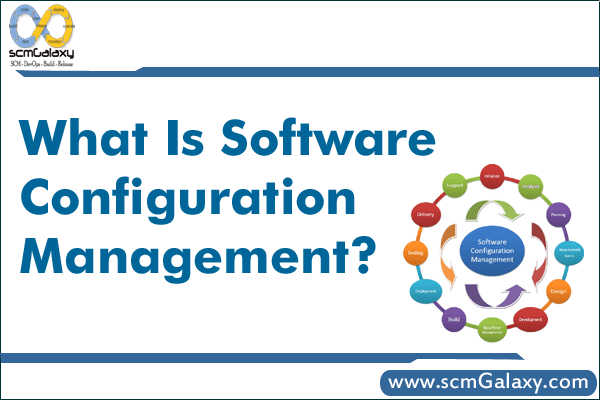
Software Configuration Management (SCM) is the discipline of organizing, tracking, and controlling every component within a software system so that all parts work together consistently—never falling out of sync. At its core, SCM ensures that the evolving elements of a software project remain stable, traceable, and well-coordinated.
Industry experts provide several perspectives that help clarify the true depth of SCM:
- Roger Pressman describes SCM as “a set of activities designed to control change by identifying the work products that are likely to change, establishing relationships among them, defining mechanisms for managing different versions of these work products, controlling the changes imposed, and auditing and reporting the changes made.”
This view aligns closely with how many organizations interpret SCM—as a structured approach to software change management. - Wayne Babich calls SCM “the art of identifying, organizing, and controlling modifications to the software being built by a programming team. It maximizes productivity by minimizing mistakes.”
This definition emphasizes SCM as both a technical and organizational discipline. - The Software Engineering Institute (SEI) states that SCM ensures the integrity of all project deliverables across the entire software lifecycle. It involves identifying configuration items, controlling change in a systematic manner, and maintaining traceability from creation to deployment.
- Military standards define configuration as the functional or physical characteristics of hardware or software documented throughout development. From this perspective, every artifact that can change is a configuration item—documents, models, prototypes, code, test results, tools, and more.
In practical terms, configuration items may include:
project proposals, estimates, project plans, risk plans, QA plans, configuration management plans, test plans, requirement specs, design documents, code modules, testing tools, reports, and any deliverable that evolves during the project. The number of relationships among these items often dictates the complexity of the SCM effort.
Why Is SCM Important?
Software project managers treat SCM as a core activity because it brings order, visibility, and stability to a constantly changing environment. Effective configuration management helps teams:
1. Track the state of every artifact
You always know:
- which document or code version is current,
- who modified it,
- what changed, and
- where to retrieve it.
2. Improve software quality
Stable, version-controlled, thoroughly tested components become reusable assets—saving time, cost, and effort in future projects.
3. Enable smooth software maintenance
Software changes for many reasons. The National Institute of Standards and Technology (NIST) notes that software evolves to adapt, perfect, or correct itself. Pressman adds that new business requirements, customer needs, reorganizations, or budget constraints often trigger revisions.
SCM ensures maintenance teams can:
- understand the original design,
- identify what changed,
- assess impact,
- and implement fixes safely.
4. Reduce chaos
Without SCM, projects quickly encounter:
- conflicting versions
- double maintenance
- lost work
- inconsistent updates
- and teamwide confusion
In short, SCM protects both the process and product, helping organizations deliver reliable, maintainable software.
Who Is Involved in SCM?
SCM affects everyone on a software project.
- Project managers use SCM for planning, tracking, and reporting.
- Developers use it to ensure they’re working with the correct versions of code and documents.
- Testers depend on it for reproducing builds and verifying fixes.
- Release engineers rely on it for packaging stable and traceable releases.
During early development, frequent and informal changes only require basic tracking—what changed, who changed it, and where it lives.
However, during deployment and baselining, changes become formal. They must be prioritized, assessed for impact, and approved before implementation.
This is typically managed by a Change Control Board (CCB)—a group responsible for reviewing, approving, or rejecting changes once the system enters implementation or production.
How Can SCM Be Implemented in Your Organization?
Earlier project management approaches insisted that:
- “Plans must never change,”
- “Requirements must be frozen,”
- “Stability comes from rigidity.”
Today, we know the opposite is true.
Project plans evolve as knowledge increases.
Requirements morph, merge, and expand as stakeholders clarify what they truly need.
As long as software artifacts can change—and they always do—organizations need a structured method for managing that change.
SCM provides that structure.
Implementing SCM successfully requires understanding:
- SCM Principles
- The Four Basic Requirements of an SCM System
- Planning and Organizing for SCM
- SCM Tools
- Benefits of SCM
- A Path to SCM Implementation
This framework ensures consistency, traceability, and quality across all software projects. Mastering SCM is a critical success factor for any team aiming to reduce risk, avoid chaos, and deliver high-quality software reliably and repeatedly.

I’m a DevOps/SRE/DevSecOps/Cloud Expert passionate about sharing knowledge and experiences. I have worked at Cotocus. I share tech blog at DevOps School, travel stories at Holiday Landmark, stock market tips at Stocks Mantra, health and fitness guidance at My Medic Plus, product reviews at TrueReviewNow , and SEO strategies at Wizbrand.
Do you want to learn Quantum Computing?
Please find my social handles as below;
Rajesh Kumar Personal Website
Rajesh Kumar at YOUTUBE
Rajesh Kumar at INSTAGRAM
Rajesh Kumar at X
Rajesh Kumar at FACEBOOK
Rajesh Kumar at LINKEDIN
Rajesh Kumar at WIZBRAND
Find Trusted Cardiac Hospitals
Compare heart hospitals by city and services — all in one place.
Explore Hospitals
This blog gives a clear and helpful explanation of software configuration management and why it matters in software development. SCM helps teams track and control changes in code, settings, and documents so projects stay organized and consistent. By managing versions and changes systematically, teams can avoid errors, work together more easily, and deliver updates more reliably. Learning these SCM concepts is valuable for developers, DevOps engineers, and anyone involved in building and maintaining software systems.
This blog post on Software Configuration Management (SCM) is a great resource for anyone looking to understand the importance of configuration management in software development. It effectively explains how SCM plays a critical role in ensuring that software artifacts like code, documentation, and dependencies are tracked, controlled, and maintained consistently throughout the development lifecycle. The article covers key SCM processes such as version control, change management, and build automation, and highlights how these practices help prevent configuration drift and ensure stability in deployments. For teams working in DevOps or continuous integration/continuous deployment (CI/CD) environments, this blog offers valuable insights into how proper SCM practices can streamline development, reduce errors, and improve overall software quality. It’s a must-read for anyone aiming to improve their software delivery process and maintain consistency across environments.