
Introduction
Agent Memory Stores are systems designed to manage the memory of AI agents, enabling them to retain, retrieve, and reason over knowledge across multiple interactions and tasks. These memory stores allow agents to maintain context, state, and long-term knowledge, supporting sophisticated multi-step reasoning, tool execution, and retrieval-augmented workflows.
They are increasingly essential in 2026+ for multi-agent coordination, RAG-based workflows, enterprise AI assistants, research agents, customer support automation, software development assistants, and financial or healthcare AI applications. Buyers should evaluate memory persistence, context management, multi-agent compatibility, RAG integration, access controls, latency, cost, observability, tool integrations, deployment flexibility, and evaluation/guardrail support.
Best for: AI engineers, enterprise AI teams, research institutions, and developers building long-term reasoning and multi-agent workflows.
Not ideal for: single-turn chatbots, stateless task automation, or simple prompt-based AI tasks.
What’s Changed in Agent Memory Stores
- Memory is now a core feature for multi-agent workflows.
- Long-term, short-term, and ephemeral memory types are supported.
- Integration with RAG and vector databases is standard.
- Observability tracks memory usage, retrieval latency, and token costs.
- Multi-agent compatibility allows shared or distributed memory.
- Model-agnostic memory stores support proprietary and open-source LLMs.
- Guardrails enforce privacy, policy compliance, and data safety.
- Low-code APIs and SDKs accelerate integration with agents.
- Memory versioning and state rollback improve reliability.
- Evaluation frameworks test retrieval accuracy and memory consistency.
- Tool and API integration allow agents to augment memory with external knowledge.
- Cost and latency optimizations are built into retrieval and storage pipelines.
Quick Buyer Checklist
- Memory persistence: short-term, long-term, ephemeral
- Multi-agent support and shared memory
- RAG and knowledge retrieval integration
- Human-in-the-loop for sensitive memory operations
- Guardrails and policy enforcement
- Observability: memory usage, latency, token metrics
- Security: encryption, RBAC, audit logs
- Deployment flexibility: cloud, hybrid, on-prem
- Model-agnostic support (BYO, multi-model)
- Integration with agent orchestration and workflow engines
- Cost and latency optimization
- Versioning, rollback, and state recovery
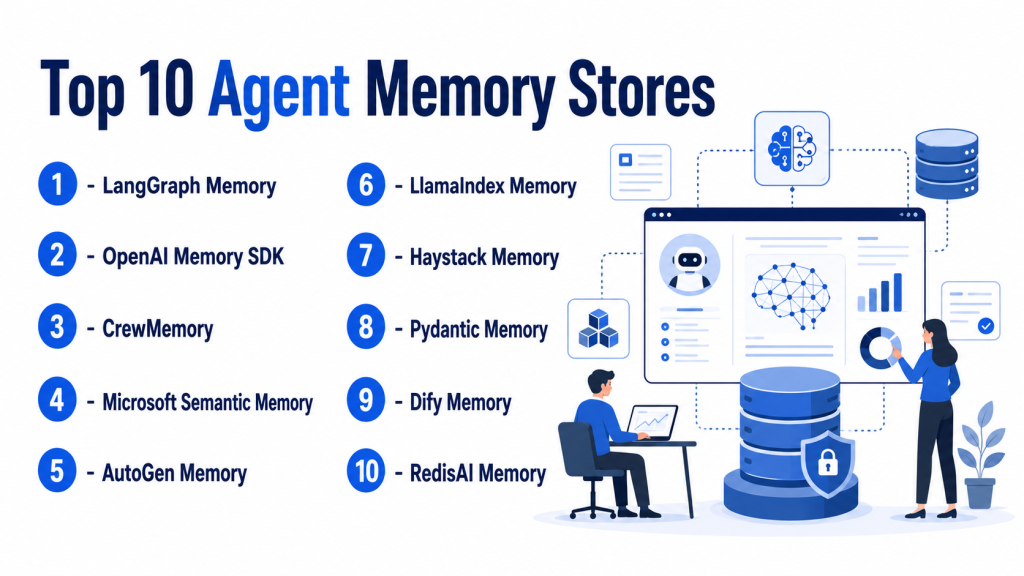
Top 10 Agent Memory Stores
1- LangGraph Memory
One-line verdict: Enterprise-grade memory store for multi-agent workflows with durable, context-rich persistence.
Short description:
LangGraph Memory provides graph-based persistent memory for agents, enabling long-term context, RAG integration, and human-in-the-loop management.
Standout Capabilities
- Graph-based memory structures
- Long-term and short-term memory support
- Multi-agent shared memory
- RAG integration with vector DBs
- Observability dashboards for memory metrics
- Tool and API integration
- Durable and versioned memory
AI-Specific Depth
- Model support: proprietary / BYO / multi-model
- RAG / knowledge integration: vector DB compatible
- Evaluation: regression tests, retrieval accuracy
- Guardrails: privacy, access policies
- Observability: token usage, latency, memory metrics
Pros
- High control over agent memory
- Enterprise-ready multi-agent persistence
- Supports RAG and tool integration
Cons
- Requires engineering expertise
- Learning curve for new teams
- Complex memory structures
Deployment & Platforms
Cloud / hybrid; Python-based
Integrations & Ecosystem
APIs, RAG connectors, LangChain ecosystem, enterprise workflows
Pricing Model
Open-source; enterprise support available
Best-Fit Scenarios
- Production multi-agent workflows
- Knowledge-driven RAG systems
- Human-in-the-loop memory management
2- OpenAI Memory SDK
One-line verdict: Memory store middleware for OpenAI agents with RAG and context management.
Short description:
OpenAI Memory SDK allows agents to store and retrieve context, supporting multi-step workflows, tool integrations, and knowledge retrieval.
Standout Capabilities
- Persistent memory management
- Multi-agent context sharing
- Tool and API integration
- RAG knowledge retrieval
- Human-in-the-loop memory updates
AI-Specific Depth
- Model support: OpenAI / BYO / multi-model
- RAG / knowledge integration: API connectors
- Evaluation: retrieval accuracy, workflow regression
- Guardrails: memory access policies
- Observability: token usage, latency metrics
Pros
- Developer-friendly
- Integrates with OpenAI models
- Supports multi-agent memory workflows
Cons
- Limited outside OpenAI models
- Enterprise governance requires extra setup
- Premium deployment required for full features
Deployment & Platforms
Cloud; Python-based
Integrations & Ecosystem
OpenAI APIs, RAG pipelines, enterprise tools
Pricing Model
Usage-based tiers
Best-Fit Scenarios
- Rapid prototyping
- Tool-driven memory workflows
- Multi-agent experimentation
3- CrewMemory
One-line verdict: Role-based memory store for multi-agent task and context coordination.
Short description:
CrewMemory structures memory per agent role, enabling shared or isolated context, multi-tool integration, and human oversight for enterprise workflows.
Standout Capabilities
- Role-based memory storage
- Shared and private memory support
- Multi-tool integration
- Observability for memory usage
- Human-in-the-loop updates
AI-Specific Depth
- Model support: BYO / multi-model
- RAG / knowledge integration: connectors
- Evaluation: memory consistency tests
- Guardrails: access control policies
- Observability: latency and token metrics
Pros
- Intuitive role-based memory
- Multi-agent workflow support
- Flexible memory structures
Cons
- Complexity grows with number of agents
- Less code-first control
- Learning curve for crews
Deployment & Platforms
Cloud / self-hosted; Python-based
Integrations & Ecosystem
APIs, RAG connectors, workflow tools
Pricing Model
Open-source with enterprise support
Best-Fit Scenarios
- Task-driven agent workflows
- Enterprise multi-agent coordination
- Knowledge-intensive processes
4- Microsoft Semantic Memory
One-line verdict: Enterprise memory store for agents with RAG and tool integration.
Short description:
Semantic Memory allows multi-agent workflows to retain structured and context-rich knowledge, integrated with Microsoft ecosystems and enterprise RAG pipelines.
Standout Capabilities
- Multi-agent shared memory
- RAG integration
- Tool API integration
- Human-in-the-loop memory updates
- Observability dashboards
AI-Specific Depth
- Model support: BYO / multi-model
- RAG / knowledge integration: connectors
- Evaluation: retrieval tests, regression
- Guardrails: policy enforcement
- Observability: memory metrics
Pros
- Enterprise-ready
- Multi-agent memory persistence
- Integrated with Microsoft tools
Cons
- Microsoft ecosystem required
- Low-code options limited
- Enterprise support may be premium
Deployment & Platforms
Windows, Linux, cloud / hybrid
Integrations & Ecosystem
Microsoft apps, RAG connectors, APIs
Pricing Model
Open-source SDK with enterprise support
Best-Fit Scenarios
- Enterprise AI workflows
- Microsoft-aligned agent memory
- Multi-agent tool integration
5- AutoGen Memory
One-line verdict: Open-source memory store for research and multi-agent experimentation.
Short description:
AutoGen Memory stores agent context and knowledge across sessions, suitable for experimentation, tool integration, and multi-agent research workflows.
Standout Capabilities
- Multi-agent memory persistence
- Tool integration support
- Human-in-the-loop updates
- Observability dashboards
- Workflow branching
AI-Specific Depth
- Model support: BYO / multi-model
- RAG / knowledge integration: connectors
- Evaluation: retrieval accuracy
- Guardrails: policy checks
- Observability: token and latency metrics
Pros
- Flexible for research
- Open-source
- Multi-agent memory support
Cons
- Production readiness limited
- Engineering skill required
- Minimal governance tools
Deployment & Platforms
Python, cloud / local
Integrations & Ecosystem
Tool connectors, APIs, RAG pipelines
Pricing Model
Open-source
Best-Fit Scenarios
- Research workflows
- Multi-agent prototyping
- Academic experiments
6- LlamaIndex Memory
One-line verdict: RAG-focused memory store for multi-agent, knowledge-driven AI workflows.
Short description:
LlamaIndex Memory enables agents to store, retrieve, and reason over long-term context and RAG knowledge, ideal for document-heavy AI workflows.
Standout Capabilities
- Long-term and short-term memory support
- RAG pipeline integration
- Multi-agent shared memory
- Observability dashboards
- Tool and API integration
AI-Specific Depth
- Model support: BYO / multi-model
- RAG / knowledge integration: vector DBs
- Evaluation: retrieval accuracy, regression tests
- Guardrails: access policies, privacy enforcement
- Observability: token usage, latency, memory metrics
Pros
- Knowledge-driven agent workflows
- Strong RAG integration
- Multi-agent memory coordination
Cons
- Requires technical expertise
- Less low-code support
- Governance outside RAG may need custom work
Deployment & Platforms
Python, cloud / hybrid
Integrations & Ecosystem
Vector DBs, APIs, RAG pipelines, workflow tools
Pricing Model
Open-source
Best-Fit Scenarios
- Knowledge assistants
- RAG-heavy multi-agent workflows
- Enterprise document workflows
7- Haystack Memory
One-line verdict: Modular memory store for RAG and multi-agent orchestration.
Short description:
Haystack Memory allows multi-agent workflows to persist context, integrate with tools, and manage retrieval-augmented knowledge efficiently.
Standout Capabilities
- Modular memory components
- Multi-agent orchestration
- RAG and knowledge integration
- Observability and logging
- Tool and API support
AI-Specific Depth
- Model support: BYO / multi-model
- RAG / knowledge integration: connectors
- Evaluation: retrieval and workflow testing
- Guardrails: policy enforcement
- Observability: token usage, latency
Pros
- Flexible and modular
- Supports RAG workflows
- Open-source
Cons
- Multi-agent collaboration limited
- Complex pipelines require engineering
- Guardrails may require custom setup
Deployment & Platforms
Python, cloud / hybrid
Integrations & Ecosystem
Vector DBs, APIs, RAG pipelines, workflow connectors
Pricing Model
Open-source
Best-Fit Scenarios
- Knowledge-based workflows
- Multi-agent RAG pipelines
- Enterprise document processing
8- Pydantic Memory
One-line verdict: Python-first memory store for structured multi-agent outputs.
Short description:
Pydantic Memory provides type-safe, validated memory for agents, enabling structured context storage across multi-step workflows.
Standout Capabilities
- Structured output validation
- Multi-agent memory coordination
- Tool and API integration
- Observability and logging
- Human-in-the-loop support
AI-Specific Depth
- Model support: BYO / multi-model
- RAG / knowledge integration: connectors
- Evaluation: regression and retrieval tests
- Guardrails: schema validation
- Observability: token usage, latency
Pros
- Type-safe memory outputs
- Python developer-friendly
- Production-ready multi-agent workflows
Cons
- Python expertise required
- Less visual or low-code support
- Multi-agent orchestration may need custom design
Deployment & Platforms
Python, cloud / hybrid
Integrations & Ecosystem
Python apps, RAG pipelines, APIs, enterprise tools
Pricing Model
Open-source
Best-Fit Scenarios
- Structured production workflows
- Python-first AI workflows
- Multi-agent coordination
9- Dify Memory
One-line verdict: Low-code memory store for multi-agent RAG and tool workflows.
Short description:
Dify Memory offers a visual, low-code approach to persist agent context, integrate RAG pipelines, and maintain multi-agent workflow state.
Standout Capabilities
- Visual workflow and memory management
- Multi-agent orchestration
- Tool integration and RAG support
- Observability dashboards
- Human-in-the-loop memory updates
AI-Specific Depth
- Model support: Hosted / BYO
- RAG / knowledge integration: connectors
- Evaluation: workflow testing
- Guardrails: policy enforcement
- Observability: memory usage, latency
Pros
- Low-code rapid deployment
- RAG and tool-ready
- Multi-agent memory orchestration
Cons
- Limited low-level control
- Governance depends on platform
- Complex workflows may need engineering
Deployment & Platforms
Web, cloud / self-hosted
Integrations & Ecosystem
LLMs, APIs, RAG pipelines, workflow tools
Pricing Model
Open-source / tiered
Best-Fit Scenarios
- Rapid prototyping
- RAG-based memory workflows
- Enterprise internal tools
10- RedisAI Memory
One-line verdict: High-performance in-memory store for AI agents with tool and RAG integration.
Short description:
RedisAI Memory provides ultra-fast in-memory storage for agent context, supports multi-agent RAG workflows, and ensures low-latency memory retrieval.
Standout Capabilities
- In-memory persistent storage
- Multi-agent coordination
- RAG integration
- Tool and API calls
- Observability dashboards
AI-Specific Depth
- Model support: BYO / multi-model
- RAG / knowledge integration: connectors
- Evaluation: retrieval accuracy and latency tests
- Guardrails: access control and policy checks
- Observability: memory usage, latency, token metrics
Pros
- Extremely fast memory retrieval
- Supports high-volume multi-agent workflows
- RAG and tool integration
Cons
- Requires infrastructure setup
- Limited low-code interfaces
- Enterprise governance may need custom layers
Deployment & Platforms
Cloud, on-prem; Python, Web
Integrations & Ecosystem
APIs, RAG pipelines, vector DBs, workflow connectors
Pricing Model
Open-source / enterprise support
Best-Fit Scenarios
- High-performance memory workloads
- Multi-agent RAG systems
- Latency-sensitive workflows
Comparison Table
| Tool | Best For | Deployment | Model Flexibility | Strength | Watch-Out | Public Rating |
|---|---|---|---|---|---|---|
| LangGraph Memory | Enterprise workflows | Cloud / Hybrid | Multi-model / BYO | Durable orchestration | Complexity | N/A |
| OpenAI Memory SDK | OpenAI agents | Cloud | OpenAI / BYO | RAG-enabled memory | Limited outside OpenAI | N/A |
| CrewMemory | Role-based memory | Cloud / Self-hosted | BYO / Multi-model | Task & context coordination | Workflow complexity | N/A |
| Microsoft Semantic Memory | Enterprise AI | Cloud / Hybrid | Multi-model / BYO | Enterprise memory SDK | Microsoft ecosystem | N/A |
| AutoGen Memory | Research workflows | Cloud / Local | BYO / Multi-model | Flexible experimentation | Production readiness limited | N/A |
| LlamaIndex Memory | Knowledge-heavy workflows | Cloud / Hybrid | BYO / Multi-model | RAG-focused memory | Engineering skill | N/A |
| Haystack Memory | Modular workflows | Cloud / Hybrid | BYO / Multi-model | Flexible pipelines | Multi-agent collaboration | N/A |
| Pydantic Memory | Structured outputs | Cloud / Hybrid | BYO / Multi-model | Type-safe memory | Python-dependent | N/A |
| Dify Memory | Low-code RAG workflows | Cloud / Self-hosted | Hosted / BYO | Rapid prototyping | Governance setup | N/A |
| RedisAI Memory | High-performance memory | Cloud / On-prem | BYO / Multi-model | Low-latency storage | Infrastructure setup | N/A |
Scoring & Evaluation
| Tool | Core | Reliability | Guardrails | Integrations | Ease | Perf/Cost | Security/Admin | Support | Weighted Total |
|---|---|---|---|---|---|---|---|---|---|
| LangGraph Memory | 9 | 8 | 7 | 9 | 7 | 8 | 7 | 8 | 8.0 |
| OpenAI Memory SDK | 8 | 7 | 7 | 8 | 8 | 7 | 7 | 8 | 7.5 |
| CrewMemory | 8 | 7 | 7 | 8 | 8 | 7 | 6 | 8 | 7.4 |
| Microsoft Semantic Memory | 8 | 7 | 7 | 8 | 7 | 7 | 8 | 8 | 7.5 |
| AutoGen Memory | 7 | 6 | 5 | 7 | 7 | 7 | 6 | 7 | 6.6 |
| LlamaIndex Memory | 8 | 7 | 6 | 9 | 7 | 7 | 7 | 8 | 7.5 |
| Haystack Memory | 8 | 7 | 6 | 8 | 7 | 7 | 7 | 8 | 7.3 |
| Pydantic Memory | 7 | 8 | 6 | 7 | 8 | 7 | 7 | 7 | 7.2 |
| Dify Memory | 7 | 6 | 6 | 8 | 9 | 7 | 7 | 7 | 7.1 |
| RedisAI Memory | 9 | 8 | 7 | 9 | 7 | 8 | 7 | 8 | 8.0 |
Top 3 for Enterprise: LangGraph Memory, Microsoft Semantic Memory, RedisAI Memory
Top 3 for SMB: Dify Memory, CrewMemory, OpenAI Memory SDK
Top 3 for Developers: LangGraph Memory, Pydantic Memory, LlamaIndex Memory
Which Agent Memory Store Is Right for You
Solo / Freelancer
Dify Memory or Pydantic Memory for prototyping and small-scale memory workflows.
SMB
CrewMemory, Dify Memory, OpenAI Memory SDK for team-based RAG workflows.
Mid-Market
LangGraph Memory, LlamaIndex Memory, Haystack Memory for enterprise RAG and multi-agent memory.
Enterprise
Microsoft Semantic Memory, LangGraph Memory, RedisAI Memory for production-grade persistence and multi-agent orchestration.
Regulated Industries
Memory with strict governance: Microsoft Semantic Memory, LangGraph Memory, RedisAI Memory.
Budget vs Premium
Budget: Dify Memory, Pydantic Memory, AutoGen Memory
Premium: LangGraph Memory, Microsoft Semantic Memory, RedisAI Memory
Build vs Buy
Build if requiring full control over memory persistence; buy for low-code, enterprise-grade memory and tool integrations.
Implementation Playbook 30 / 60 / 90 Days
30 Days: Pilot workflows, assign agent memory responsibilities, log usage, human-in-the-loop setup.
60 Days: Add evaluation metrics, guardrails, RAG integration, and observability dashboards.
90 Days: Optimize cost, latency, governance, scale production, enforce human-in-the-loop policies.
Common Mistakes
- Ignoring human-in-the-loop memory supervision
- Skipping retrieval evaluation and regression tests
- Weak guardrails on memory access
- Neglecting observability and logging
- Overcomplicating memory structures prematurely
- Underestimating cost and latency
- Assuming one memory store fits all workflows
- Poor RAG and tool access management
- No incident response plan
- Lack of deployment governance
FAQs
1. What is an agent memory store?
A system that allows AI agents to retain, retrieve, and reason over knowledge across multiple tasks and sessions.
2. How is it different from standard data storage?
It maintains contextual memory for agents, including long-term, short-term, and ephemeral knowledge.
3. Which memory store is best for production?
LangGraph Memory, Microsoft Semantic Memory, or RedisAI Memory for high-scale multi-agent workflows.
4. Which is beginner-friendly?
Dify Memory and Pydantic Memory provide low-code and Python-friendly memory management.
5. Can they integrate with RAG pipelines?
Yes, LlamaIndex Memory and Haystack Memory are optimized for RAG-enabled agent workflows.
6. Are guardrails included?
Most provide basic policy checks; enterprise deployments may require additional guardrails.
7. Are these secure?
Depends on deployment; RBAC, encryption, and logging are essential.
8. Can multiple models share memory?
Yes, multi-model memory orchestration is supported by most modern stores.
9. What is human-in-the-loop memory?
A human supervises, validates, or updates agent memory for compliance and accuracy.
10. How do I evaluate memory workflows?
Monitor retrieval accuracy, latency, token usage, and memory consistency across sessions.
Conclusion
Agent Memory Stores are essential for maintaining context, state, and knowledge in multi-agent AI workflows. LangGraph Memory, Microsoft Semantic Memory, and RedisAI Memory excel for enterprise deployments, while Dify Memory and Pydantic Memory are ideal for prototyping and small teams. The right choice depends on workflow complexity, governance needs, multi-agent coordination, budget, and human-in-the-loop requirements.

Find Trusted Cardiac Hospitals
Compare heart hospitals by city and services — all in one place.
Explore Hospitals
Helpful article! The comparison of agent memory stores is simple, clear, and useful for understanding long-term memory handling in AI agents.