
Introduction
Multi-Agent Coordination Platforms are software systems that allow multiple AI agents to work together seamlessly. These platforms orchestrate workflows, coordinate actions, manage dependencies, and ensure agents collaborate effectively to achieve complex tasks. Unlike single-agent systems, they can support multiple autonomous agents that interact, share context, and leverage tool integration while maintaining reliability, observability, and safety.
These platforms are crucial in modern AI because organizations are using collaborative AI agents for enterprise automation, research simulations, customer support workflows, sales and marketing pipelines, software development assistants, data analysis, and multi-step RAG processes. Buyers should evaluate workflow orchestration, agent communication, human-in-the-loop integration, tool calling, memory management, RAG compatibility, governance, observability, security, deployment flexibility, integration ecosystem, and cost/latency management.
Best for: AI engineers, platform teams, automation teams, enterprises, and research institutions implementing complex multi-agent workflows.
Not ideal for: teams only requiring single-agent AI, simple chatbots, or small-scale automation without collaborative agents.
What’s Changed in Multi-Agent Coordination Platforms
- Multi-agent collaboration is now central to AI automation workflows.
- Human-in-the-loop mechanisms ensure sensitive tasks are supervised.
- Tool-calling, API integration, and service orchestration are standard.
- RAG pipelines are integrated for knowledge-driven agent coordination.
- Observability and monitoring track latency, token usage, cost, and workflow steps.
- Model-agnostic frameworks now support OpenAI, Anthropic, Google, and open-source models.
- Evaluation tools test hallucinations, output correctness, and workflow reliability.
- Guardrails prevent prompt injection, unsafe tool execution, and policy violations.
- Visual and low-code orchestration interfaces complement code-first platforms.
- Structured memory supports short-term, long-term, and shared knowledge between agents.
- Deployment includes versioning, rollback, sandboxing, and admin auditing.
- Cost optimization and workflow routing help manage production-scale multi-agent AI.
Quick Buyer Checklist
- Workflow orchestration and task coordination
- Human-in-the-loop support for sensitive tasks
- Tool-calling and API integration
- Multi-agent memory management
- RAG integration and knowledge retrieval
- Guardrails for safety and policy enforcement
- Observability and monitoring dashboards
- Deployment flexibility (cloud, hybrid, on-prem)
- Security, RBAC, and audit logging
- Vendor lock-in and portability
- Model-agnostic support for multiple LLMs
- Cost and latency optimization
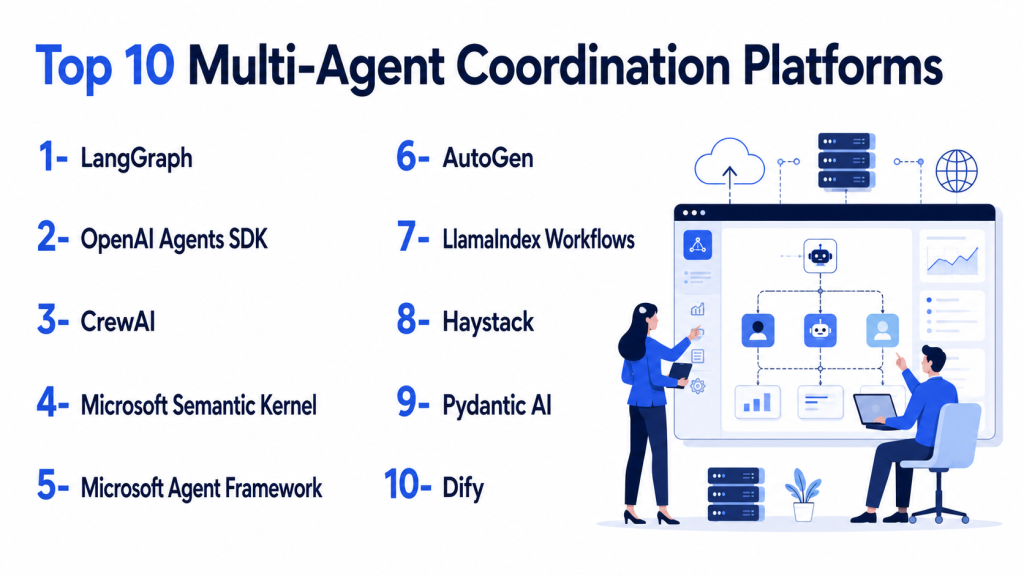
Top 10 Multi-Agent Coordination Platforms
1- LangGraph
One-line verdict: Best for enterprises needing stateful, production-grade multi-agent orchestration with durable execution.
Short description:
LangGraph provides graph-based coordination for multiple AI agents, supporting human-in-the-loop workflows, RAG pipelines, and tool integrations. It is ideal for organizations building complex multi-agent production workflows.
Standout Capabilities
- Graph-based multi-agent orchestration
- Stateful execution with branching workflows
- Human-in-the-loop approvals
- RAG integration for knowledge access
- Tool and API coordination
- Observability dashboards and error logging
- Durable execution patterns
AI-Specific Depth
- Model support: proprietary / BYO / multi-model routing
- RAG / knowledge integration: connectors, vector DB compatible
- Evaluation: prompt and workflow regression tests
- Guardrails: policy enforcement and prompt injection defense
- Observability: traces, latency, token/cost metrics
Pros
- High control for enterprise workflows
- Strong multi-agent support
- Integrates with RAG and tools
Cons
- Requires engineering expertise
- Complex workflows may be difficult to maintain
- Learning curve for new teams
Deployment & Platforms
Cloud, hybrid; Python-based
Integrations & Ecosystem
APIs, RAG connectors, LangChain ecosystem, and enterprise tools
Pricing Model
Open-source; enterprise support available
Best-Fit Scenarios
- Production multi-agent workflows
- Knowledge-driven RAG systems
- Human-in-the-loop coordination
2- OpenAI Agents SDK
One-line verdict: Best for developers building OpenAI-centric multi-agent workflows with tool orchestration.
Short description:
OpenAI Agents SDK allows agents to collaborate, plan, and execute tasks with structured workflows. It is suitable for organizations using OpenAI models and tools in complex automation pipelines.
Standout Capabilities
- Multi-agent orchestration and tool integration
- LLM-driven and code-driven workflows
- Human-in-the-loop support
- Observability for actions and token usage
- Workflow branching and task delegation
AI-Specific Depth
- Model support: OpenAI / BYO / multi-model
- RAG / knowledge integration: API connectors
- Evaluation: workflow and regression testing
- Guardrails: sandboxed tool calls and policy checks
- Observability: action logs, latency metrics
Pros
- Developer-friendly
- Strong OpenAI ecosystem integration
- Supports multi-agent collaboration
Cons
- Limited value outside OpenAI models
- Governance requires additional architecture
- Enterprise deployment may need extra configuration
Deployment & Platforms
Cloud, Python-based; Web, hybrid
Integrations & Ecosystem
OpenAI APIs, workflow connectors, tool integrations
Pricing Model
Usage-based tiers
Best-Fit Scenarios
- Rapid OpenAI prototype development
- Tool-driven agent workflows
- Multi-agent research experiments
3- CrewAI
One-line verdict: Best for role-based multi-agent coordination with task and crew management.
Short description:
CrewAI organizes agents into “crews” for collaborative workflows. Each agent has defined roles, goals, and tasks. Ideal for teams needing task-level coordination and branching workflows.
Standout Capabilities
- Role-based multi-agent orchestration
- Crew and task flow management
- Tool integration and memory support
- Human-in-the-loop workflow
- Observability and logging
AI-Specific Depth
- Model support: BYO / multi-model
- RAG / knowledge integration: connectors
- Evaluation: workflow testing
- Guardrails: policy checks
- Observability: execution logs and latency
Pros
- Intuitive multi-agent coordination
- Task-focused workflow management
- Flexible for enterprise automation
Cons
- Workflow complexity can increase rapidly
- Requires careful planning
- Less low-level control than code-first frameworks
Deployment & Platforms
Cloud / self-hosted; Python-based
Integrations & Ecosystem
Tool connectors, RAG pipelines, API integrations
Pricing Model
Open-source with enterprise support
Best-Fit Scenarios
- Task-driven agent automation
- Multi-agent enterprise workflows
- Internal collaborative AI applications
4- Microsoft Semantic Kernel
One-line verdict: Enterprise SDK for multi-agent orchestration across Microsoft application stacks.
Short description:
Semantic Kernel enables developers to orchestrate multi-agent workflows with plugin, tool, and API integration, suitable for enterprise AI projects.
Standout Capabilities
- Model-agnostic multi-agent orchestration
- Workflow branching
- Tool and plugin integration
- Enterprise application support
AI-Specific Depth
- Model support: open-source / BYO / multi-model
- RAG / knowledge integration: connectors
- Evaluation: workflow testing
- Guardrails: policy enforcement
- Observability: execution logging
Pros
- Enterprise-ready
- Flexible agent orchestration
- Strong Microsoft ecosystem integration
Cons
- Requires engineering skill
- Low-code options limited
- Some features are experimental
Deployment & Platforms
Windows, Linux, cloud / hybrid
Integrations & Ecosystem
Microsoft apps, APIs, RAG connectors, enterprise workflows
Pricing Model
Open-source SDK with enterprise support
Best-Fit Scenarios
- Enterprise AI apps
- Microsoft-aligned workflows
- Multi-agent orchestration
5- Microsoft Agent Framework
One-line verdict: Unified framework for enterprise multi-agent orchestration with monitoring and governance.
Short description:
Microsoft Agent Framework offers enterprise-grade tools for multi-agent orchestration, telemetry, and state management, suitable for regulated environments.
Standout Capabilities
- Multi-agent orchestration
- State management and monitoring
- Tool integration
- Human-in-the-loop support
AI-Specific Depth
- Model support: BYO / multi-model
- RAG / knowledge integration: connectors
- Evaluation: regression and workflow tests
- Guardrails: policy enforcement
- Observability: execution metrics
Pros
- Enterprise-ready
- Unified agent orchestration
- Workflow monitoring and telemetry
Cons
- Microsoft ecosystem required
- Complexity for small teams
- Limited open-source examples
Deployment & Platforms
Cloud / hybrid; Web, Windows, Linux
Integrations & Ecosystem
Microsoft apps, APIs, RAG, enterprise workflows
Pricing Model
Enterprise license
Best-Fit Scenarios
- Enterprise AI orchestration
- Regulated workflows
- Microsoft-aligned multi-agent systems
6- AutoGen
One-line verdict: Research-focused open-source framework for collaborative multi-agent workflows.
Short description:
AutoGen enables multiple AI agents to interact, collaborate, and execute tasks with human-in-the-loop testing and tool integration. Ideal for research or experimentation.
Standout Capabilities
- Multi-agent conversation
- Collaboration and task delegation
- Tool integration
- Human-in-the-loop workflows
AI-Specific Depth
- Model support: BYO / multi-model
- RAG / knowledge integration: connectors
- Evaluation: regression and prompt testing
- Guardrails: sandboxing
- Observability: execution logs
Pros
- Flexible for research
- Open-source
- Multi-agent experimentation
Cons
- Production readiness limited
- Engineering skill required
- Governance tools minimal
Deployment & Platforms
Python-based, cloud / local
Integrations & Ecosystem
Tool integration, APIs, RAG pipelines
Pricing Model
Open-source
Best-Fit Scenarios
- Research workflows
- Prototype multi-agent applications
- Academic experimentation
7- LlamaIndex Workflows
One-line verdict: RAG-focused multi-agent orchestration for knowledge-driven applications.
Short description:
LlamaIndex Workflows coordinates multi-step agents with retrieval-augmented generation, suitable for document-heavy AI workflows.
Standout Capabilities
- Multi-agent orchestration
- RAG integration
- Event-driven workflows
- Observability and logging
AI-Specific Depth
- Model support: BYO / multi-model
- RAG / knowledge integration: vector DB
- Evaluation: regression and prompt tests
- Guardrails: policy checks
- Observability: execution and latency
Pros
- Knowledge-focused
- Strong RAG integration
- Supports complex workflows
Cons
- Requires technical expertise
- Less low-code support
- Governance outside RAG may be limited
Deployment & Platforms
Cloud / hybrid; Python-based
Integrations & Ecosystem
Vector DBs, APIs, RAG pipelines
Pricing Model
Open-source
Best-Fit Scenarios
- Knowledge assistants
- Document-heavy workflows
- RAG multi-agent systems
8- Haystack
One-line verdict: Modular framework for RAG pipelines and multi-agent workflows.
Short description:
Haystack allows developers to orchestrate multi-agent workflows with modular pipelines and tool integration, ideal for document-driven AI.
Standout Capabilities
- Component-based pipelines
- Multi-agent orchestration
- RAG integration
- Tool calling
- Observability
AI-Specific Depth
- Model support: BYO / multi-model
- RAG / knowledge integration: connectors
- Evaluation: workflow testing
- Guardrails: custom policies
- Observability: latency and token metrics
Pros
- Modular design
- RAG-ready
- Open-source and flexible
Cons
- Multi-agent collaboration limited
- Complex pipelines require engineering
- Guardrails need custom setup
Deployment & Platforms
Python, cloud / hybrid
Integrations & Ecosystem
Vector DBs, APIs, RAG connectors, workflow tools
Pricing Model
Open-source
Best-Fit Scenarios
- Knowledge-driven AI
- Multi-agent RAG pipelines
- Enterprise document workflows
9- Pydantic AI
One-line verdict: Python-first framework for type-safe, structured multi-agent outputs.
Short description:
Pydantic AI ensures structured agent outputs, type safety, and multi-agent orchestration, suitable for production workflows with strict output requirements.
Standout Capabilities
- Structured and validated outputs
- Multi-agent orchestration
- Tool integration
- Observability
- Human-in-the-loop support
AI-Specific Depth
- Model support: BYO / multi-model
- RAG / knowledge integration: connectors
- Evaluation: regression and workflow testing
- Guardrails: schema validation
- Observability: logging and traces
Pros
- Type-safe outputs
- Python developer-friendly
- Production-ready workflows
Cons
- Python expertise required
- Less visual or low-code support
- Multi-agent orchestration needs design
Deployment & Platforms
Python, cloud / hybrid
Integrations & Ecosystem
Python apps, RAG pipelines, APIs
Pricing Model
Open-source
Best-Fit Scenarios
- Structured production AI
- Python-first workflows
- Multi-agent orchestration
10- Dify
One-line verdict: Visual platform for low-code multi-agent coordination and RAG workflows.
Short description:
Dify provides a visual interface to orchestrate multi-agent workflows, integrate tools, and deploy RAG-based AI applications quickly.
Standout Capabilities
- Low-code visual workflow builder
- Agent nodes for reasoning and tool use
- RAG integration
- Multi-agent orchestration
- Observability dashboard
AI-Specific Depth
- Model support: Hosted / BYO
- RAG / knowledge integration: connectors
- Evaluation: workflow regression testing
- Guardrails: policy enforcement
- Observability: logging and latency
Pros
- Low-code for rapid deployment
- RAG-ready workflows
- Multi-agent orchestration
Cons
- Less low-level control
- Governance depends on platform
- Complex enterprise workflows may need engineering
Deployment & Platforms
Web, cloud / self-hosted
Integrations & Ecosystem
LLM providers, APIs, RAG pipelines, workflow tools
Pricing Model
Open-source / tiered
Best-Fit Scenarios
- Rapid prototyping
- RAG-based AI workflows
- Internal enterprise tools
Comparison Table
| Tool | Best For | Deployment | Model Flexibility | Strength | Watch-Out | Public Rating |
|---|---|---|---|---|---|---|
| LangGraph | Stateful enterprise workflows | Cloud / Hybrid | Multi-model / BYO | Durable orchestration | Requires expertise | N/A |
| OpenAI Agents SDK | OpenAI developers | Cloud | OpenAI / BYO | Tool orchestration | Ecosystem limited | N/A |
| CrewAI | Role-based coordination | Cloud / Self-hosted | BYO / Multi-model | Crews and flows | Workflow complexity | N/A |
| Microsoft Semantic Kernel | Enterprise apps | Cloud / Hybrid | Multi-model / BYO | Enterprise SDK | Low-code limited | N/A |
| Microsoft Agent Framework | Enterprise orchestration | Cloud / Hybrid | Multi-model | Unified control | Microsoft-centric | N/A |
| AutoGen | Research workflows | Cloud / Local | BYO / Multi-model | Multi-agent collaboration | Production readiness limited | N/A |
| LlamaIndex Workflows | RAG-heavy workflows | Cloud / Hybrid | BYO / Multi-model | Knowledge orchestration | Engineering skill required | N/A |
| Haystack | Modular RAG pipelines | Cloud / Hybrid | BYO / Multi-model | Flexible pipelines | Less collaboration | N/A |
| Pydantic AI | Structured outputs | Cloud / Hybrid | BYO / Multi-model | Type-safe agents | Python dependent | N/A |
| Dify | Low-code visual orchestration | Cloud / Self-hosted | Hosted / BYO | Rapid prototyping | Governance depends on setup | N/A |
Scoring & Evaluation
| Tool | Core | Reliability | Guardrails | Integrations | Ease | Perf/Cost | Security/Admin | Support | Weighted Total |
|---|---|---|---|---|---|---|---|---|---|
| LangGraph | 9 | 8 | 7 | 9 | 7 | 8 | 7 | 8 | 8.0 |
| OpenAI Agents SDK | 8 | 7 | 7 | 8 | 8 | 7 | 7 | 8 | 7.5 |
| CrewAI | 8 | 7 | 7 | 8 | 8 | 7 | 6 | 8 | 7.4 |
| Microsoft Semantic Kernel | 8 | 7 | 7 | 8 | 7 | 7 | 8 | 8 | 7.5 |
| Microsoft Agent Framework | 8 | 7 | 7 | 8 | 7 | 7 | 8 | 8 | 7.5 |
| AutoGen | 7 | 6 | 5 | 7 | 7 | 7 | 6 | 7 | 6.6 |
| LlamaIndex Workflows | 8 | 7 | 6 | 9 | 7 | 7 | 7 | 8 | 7.5 |
| Haystack | 8 | 7 | 6 | 8 | 7 | 7 | 7 | 8 | 7.3 |
| Pydantic AI | 7 | 8 | 6 | 7 | 8 | 7 | 7 | 7 | 7.2 |
| Dify | 7 | 6 | 6 | 8 | 9 | 7 | 7 | 7 | 7.1 |
Top 3 for Enterprise: LangGraph, Microsoft Semantic Kernel, Microsoft Agent Framework
Top 3 for SMB: Dify, CrewAI, OpenAI Agents SDK
Top 3 for Developers: LangGraph, Pydantic AI, LlamaIndex Workflows
Which Multi-Agent Coordination Platform Is Right for You
Solo / Freelancer
Low-scale prototyping: Dify or Pydantic AI for small projects and simple workflows.
SMB
Affordable and flexible: CrewAI, Dify, OpenAI Agents SDK for team collaboration and workflow automation.
Mid-Market
Governance and RAG-heavy workflows: LangGraph, LlamaIndex, Haystack.
Enterprise
Production-grade orchestration with governance: Microsoft Semantic Kernel, Microsoft Agent Framework, LangGraph.
Regulated Industries
High compliance and human-in-the-loop workflows: Microsoft frameworks, LangGraph.
Budget vs Premium
Budget: Open-source or low-code (Dify, Pydantic AI, AutoGen).
Premium: Microsoft, LangGraph, Semantic Kernel.
Build vs Buy
Build for custom multi-agent workflows with full control; buy for rapid deployment, governance, and low-code workflows.
Implementation Playbook 30 / 60 / 90 Days
30 Days: Pilot workflows, define success metrics, assign agents, track logs.
60 Days: Implement evaluation, guardrails, RAG access, and dashboards.
90 Days: Optimize cost, latency, governance, scale production, and enforce human-in-the-loop policies.
Common Mistakes
- Ignoring human-in-the-loop
- Skipping evaluation and regression testing
- Weak guardrails or prompt injection defenses
- Neglecting observability
- Overestimating workflow simplicity
- Underestimating cost and latency
- Assuming one framework fits all
- Poor RAG and tool access management
- No incident response plan
- Weak deployment governance
FAQs
1. What is a multi-agent coordination platform?
A system to orchestrate multiple AI agents, manage workflows, and ensure task collaboration.
2. How is it different from single-agent frameworks?
It supports multiple agents collaborating, using tools, and maintaining state and memory.
3. Which is best for production workflows?
LangGraph or Microsoft frameworks offer stateful orchestration and monitoring.
4. Which is beginner-friendly?
Dify and Pydantic AI are easiest for small teams or solo developers.
5. Can they integrate RAG pipelines?
Yes; LlamaIndex Workflows and Haystack excel in knowledge-driven orchestration.
6. Are guardrails included?
Most frameworks include basic policies; enterprise-grade deployments need custom guardrails.
7. Are they secure?
Depends on deployment; RBAC, logging, and encryption must be configured at application level.
8. Can they support multiple LLMs?
Yes, many frameworks allow BYO or multi-model orchestration.
9. What is human-in-the-loop?
Human oversight integrated into workflows to ensure safety and compliance.
10. How do I evaluate workflows?
Use regression tests, monitor agent actions, latency, token usage, and output accuracy.
Conclusion
Multi-Agent Coordination Platforms enable enterprises and developers to orchestrate complex AI workflows, manage multi-step reasoning, and integrate RAG pipelines safely. LangGraph, Microsoft frameworks, and LlamaIndex offer production-grade orchestration, while Dify and Pydantic AI suit prototyping and smaller teams. Selecting the right framework depends on workflow complexity, team size, human-in-the-loop requirements, governance needs, and budget.

Find Trusted Cardiac Hospitals
Compare heart hospitals by city and services — all in one place.
Explore Hospitals
Useful article! The comparison of multi-agent coordination platforms is clear, simple, and helpful for understanding collaborative AI workflows and orchestration.