
Introduction
In the current landscape of cloud-native applications, the pressure to deliver features rapidly while maintaining bulletproof stability has never been higher. Engineering teams are constantly balancing the need for speed with the requirement for uptime. This shift has necessitated new operational models, bringing concepts like DevOps and SRE to the forefront of modern software development.
DevOps focuses on breaking down organizational silos to enable faster, more reliable software delivery. Conversely, Site Reliability Engineering (SRE) takes those same principles and applies them through the lens of a software engineer, focusing heavily on system reliability and scalability. For those looking to master these disciplines, DevOpsSchool provides comprehensive resources to navigate this complex field.
Whether you are a developer looking to understand operations or an engineer aiming to specialize in reliability, understanding the nuance of DevOps vs SRE is critical. These methodologies are not mutually exclusive; rather, they are complementary approaches that define how modern enterprises manage infrastructure, code, and, most importantly, the user experience.
What Is DevOps?
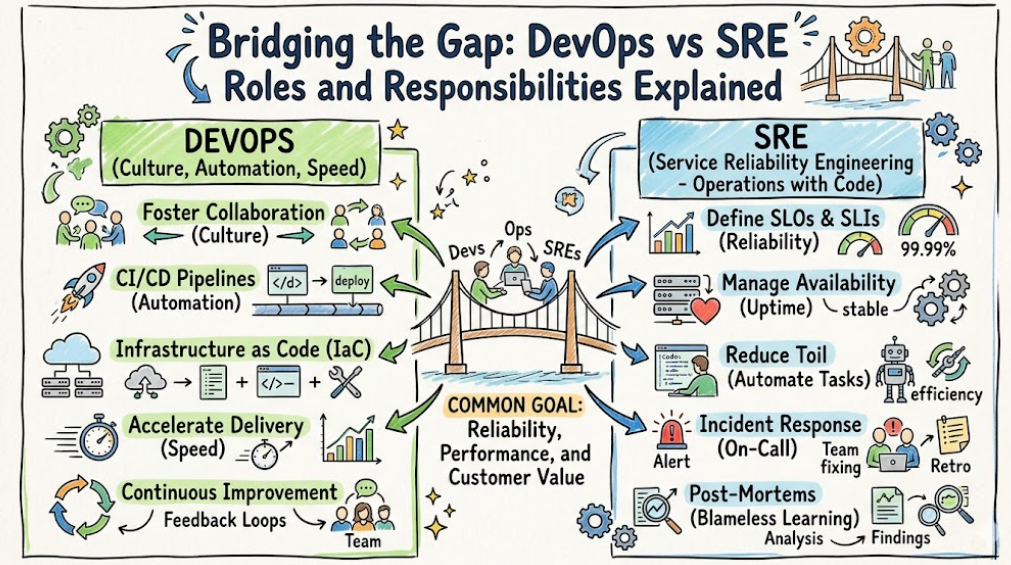
DevOps is a set of practices, philosophies, and tools that increases an organization’s ability to deliver applications and services at high velocity. At its core, DevOps is about changing the culture. It aims to bridge the gap between development teams (who want to ship code) and operations teams (who want to keep the system stable).
By using CI/CD automation, teams can test and deploy code changes more frequently and reliably. This shared ownership model ensures that developers are more involved in the deployment process, leading to fewer surprises when code hits production. It is essentially about continuous improvement, collaboration, and reducing the friction between the desk of the developer and the server in the data center.
What Is SRE?
Site Reliability Engineering, or SRE, is the practice of using software engineering approaches to solve operations problems. Coined by Google, the core tenet of SRE is that “hope is not a strategy.” SREs treat operations as a software problem.
SREs are responsible for the availability, latency, performance, efficiency, change management, monitoring, emergency response, and capacity planning of their services. They rely heavily on Service Level Objectives (SLOs) and error budgets to decide when to move fast and when to pause for stability. It is a proactive approach to keeping complex, distributed systems running smoothly.
Evolution of DevOps and SRE
Traditionally, development and operations were isolated silos. Developers would “throw code over the wall” to operations, leading to finger-pointing and delayed releases. DevOps emerged as a solution to this, emphasizing automation and cultural shift.
As systems grew in scale—moving from monolithic applications to complex microservices—the need for a more rigorous, data-driven approach to operations became apparent. This is where SRE entered the scene. SRE essentially provides the “how-to” for the “what” that DevOps defines. While DevOps sets the vision for faster delivery, SRE provides the engineering rigour to ensure that the delivery is reliable.
DevOps vs SRE: Core Differences
While they share the same goals, their execution differs.
| Feature | DevOps | SRE |
| Primary Focus | Velocity and cultural collaboration | System reliability and stability |
| Philosophy | A cultural mindset/approach | An engineering-centric discipline |
| Ownership | Shared responsibility for delivery | Responsibility for service health |
| Automation | Focus on CI/CD pipelines | Focus on toil reduction and reliability |
| Metrics | Throughput, deployment frequency | SLOs, SLIs, Error Budgets |
| Incident Management | Reactive collaboration | Proactive/Systematic engineering |
Similarities Between DevOps and SRE
Both disciplines are deeply rooted in the same fundamental values:
- Automation-First Mindset: Both avoid manual labor at all costs.
- Continuous Improvement: Both prioritize learning from failures.
- Collaboration Culture: Both emphasize breaking down communication silos.
- Infrastructure as Code: Both treat infrastructure as programmable software.
- Focus on Scalability: Both are designed to handle growth efficiently.
Core Principles of DevOps
- Collaboration: Removing barriers between teams.
- CI/CD Automation: Ensuring code is always in a deployable state.
- Infrastructure as Code (IaC): Defining servers and networks via configuration files.
- Continuous Feedback: Monitoring the results of deployments in real-time.
- Shared Ownership: Developers own the code in production.
Core Principles of SRE
- Embracing Risk: Using Error Budgets to balance feature speed with reliability.
- SLOs and SLIs: Setting clear, measurable service level objectives.
- Eliminating Toil: Automating repetitive, manual operational tasks.
- Observability: Understanding system health through deep monitoring.
- Incident Response: Structured, blameless post-mortems after outages.
DevOps Lifecycle Explained
The DevOps lifecycle is an iterative process:
- Plan: Defining features and requirements.
- Code: Developing the application.
- Build: Compiling and packaging.
- Test: Running automated quality checks.
- Release/Deploy: Pushing to production.
- Operate/Monitor: Maintaining and observing performance.
SRE Workflow Explained
SREs focus on the “Operate and Monitor” phase with a deep-dive approach:
- Monitoring: Implementing robust telemetry (metrics, logs, traces).
- Alerting: Setting thresholds based on SLOs.
- Incident Response: Managing outages through defined playbooks.
- Root Cause Analysis: Blameless analysis of why things failed.
- Capacity Planning: Ensuring the system can handle future load.
Monitoring and Observability
Monitoring is about asking “Is the system healthy?” (Metrics/Alerts). Observability is about asking “Why is the system behaving this way?” (Logs, Traces, Context).
DevOps often relies on monitoring to ensure deployments are successful. SREs dive into observability to debug complex microservices failures. Common tools include Prometheus for metrics, Grafana for visualization, the ELK Stack for log management, and Datadog for unified cloud monitoring.
Role of Automation in DevOps and SRE
Automation is the bedrock of both fields. In DevOps, automation focuses on the software delivery pipeline (Jenkins, GitLab CI). In SRE, automation focuses on “Toil reduction”—removing the manual, repetitive, tactical work that keeps engineers from working on strategic projects.
DevOps and SRE in Cloud-Native Environments
In the world of Kubernetes, containers, and microservices, the line between DevOps and SRE often blurs. Platform engineering has emerged as the intersection of these two, where teams build self-service internal developer platforms (IDPs). This allows developers to consume infrastructure as a service, while SREs ensure the underlying platform remains reliable and scalable.
Popular DevOps Tools
| Tool | Purpose | Enterprise Usage | Difficulty |
| Jenkins | CI/CD | High | Medium |
| Terraform | IaC | High | Medium |
| Docker | Containerization | High | Low |
| Ansible | Configuration | Medium | Low |
Popular SRE Tools
| Tool | Purpose | Enterprise Usage | Difficulty |
| Prometheus | Monitoring | High | High |
| PagerDuty | Incident Management | High | Low |
| Gremlin | Chaos Engineering | Medium | High |
| Grafana | Observability | High | Medium |
Benefits of DevOps
- Faster Time-to-Market: Features reach users in hours instead of weeks.
- Better Team Morale: Less manual work leads to higher job satisfaction.
- Higher Quality: Automated testing catches bugs early.
Benefits of SRE
- Reduced Downtime: Proactive reliability measures prevent outages.
- Data-Driven Decisions: SLOs provide a neutral language for product and engineering.
- Sustainable Pace: Preventing burnout through systematic toil reduction.
Challenges in DevOps and SRE
- Cultural Resistance: Moving from a traditional siloed model is difficult.
- Tool Fatigue: Adopting too many tools without a clear strategy.
- Skill Gaps: Both fields require deep knowledge across development and ops.
- Alert Fatigue: Too many false-positive alerts can lead to burnout.
DevOps vs SRE Career Paths
Both offer exceptional career growth.
- DevOps Engineer: Focuses on the pipeline, CI/CD, and infrastructure automation.
- Site Reliability Engineer: Focuses on system architecture, reliability, and incident response.
- Platform Engineer: Builds the infrastructure and tools that enable developers to work efficiently.
Certifications & Learning Paths
Hands-on learning is paramount. Mastering Linux, networking, and cloud platforms (AWS, Azure, GCP) is the baseline.
| Certification | Best For | Focus Area |
| CKA (Certified Kubernetes Administrator) | Cloud/SRE | Container Orchestration |
| AWS DevOps Engineer Professional | DevOps | Cloud-native CI/CD |
| Google Professional Cloud DevOps Engineer | Both | SRE Principles |
Explore the structured learning paths at DevOpsSchool to build these critical competencies.
Common Beginner Mistakes
- Tooling Over Principles: Learning a tool without understanding the underlying concept.
- Ignoring Fundamentals: Skipping Linux basics, networking, or database fundamentals.
- Ignoring Documentation: Assuming you can figure it out later.
- Lack of Automation: Doing things manually “just this once.”
Future of DevOps and SRE
The future points toward AIOps (using AI to predict failures), GitOps (managing infrastructure via Git workflows), and Platform Engineering. As systems become more distributed, the focus will shift from “monitoring systems” to “managing reliability at scale.”
FAQs
- What is the difference between DevOps and SRE? DevOps is the cultural framework, while SRE is the practical implementation of reliability engineering.
- Is SRE part of DevOps? SRE is often considered a specific implementation or “subset” of DevOps principles.
- Which is better: DevOps or SRE? Neither is better; they serve different operational goals.
- Does SRE require coding? Absolutely. SREs use software engineering to solve operations tasks.
- Is Kubernetes important for SRE? Yes, it is the standard for managing cloud-native infrastructure at scale.
- What are SLOs and SLIs? SLIs are the metrics you measure; SLOs are the targets you aim for.
- Is SRE stressful? It can be, but mature SRE teams use error budgets and automation to manage that stress.
- Which career has better growth? Both are high-demand roles with excellent compensation.
- Do I need to be a developer for DevOps? You need strong scripting and automation skills.
- How do I start? Start with Linux, Git, and a cloud provider.
- Can DevOps exist without SRE? Yes, but reliability might suffer at scale.
- Can SRE exist without DevOps? It is difficult, as SRE relies on the collaboration culture defined by DevOps.
- Are salaries high in these fields? Yes, because these roles are critical to modern business uptime.
- What is the most important skill? Problem-solving and the ability to learn new technologies.
- Is there a difference in incident response? SREs emphasize data-backed post-mortems and preventative automation.
Final Thoughts
Success in modern engineering isn’t about choosing between DevOps and SRE; it’s about integrating the best of both. DevOps provides the cultural agility, while SRE provides the engineering discipline needed to scale that agility without breaking the system. Focus on mastering the fundamentals, embrace automation, and always prioritize observability.

Find Trusted Cardiac Hospitals
Compare heart hospitals by city and services — all in one place.
Explore Hospitals