
Introduction
AI Fraud Detection for Payments Tools are advanced financial security platforms that use machine learning, behavioral analytics, and real-time transaction monitoring to detect and prevent fraudulent payment activities. These systems analyze payment behavior, device signals, transaction patterns, merchant history, and network-level data to identify suspicious activities before transactions are completed.
Unlike traditional rule-based fraud filters, AI-powered fraud detection systems continuously learn from new fraud patterns and adapt to evolving attack strategies such as synthetic identities, account takeover fraud, card-not-present fraud, and payment laundering.
Modern payment fraud prevention platforms operate in real time, scoring each transaction within milliseconds to decide whether to approve, block, or challenge the payment.
Why It Matters
Payment fraud is one of the fastest-growing risks in digital finance due to the rise of real-time payments, e-commerce, and AI-powered scam techniques.
Common challenges include:
- Card-not-present fraud
- Account takeover attacks
- Synthetic identity fraud
- Payment laundering schemes
- False declines of legitimate transactions
- Cross-channel fraud detection gaps
AI fraud detection systems solve these issues by:
- Scoring transactions in real time
- Detecting abnormal payment behavior
- Identifying device and identity inconsistencies
- Reducing fraud losses and chargebacks
- Minimizing false declines
- Improving payment approval rates
AI systems can process billions of signals across transactions, devices, and networks to detect fraud patterns that humans or rule-based systems cannot identify.
Real World Use Cases
- E-commerce payment fraud prevention
- Credit card transaction monitoring
- Digital wallet fraud detection
- Real-time payment authorization screening
- Buy now pay later (BNPL) fraud detection
- Account takeover detection in banking apps
- Cross-border payment risk scoring
- Merchant risk assessment
- Subscription fraud detection
- AML (anti-money laundering) screening for payments
Evaluation Criteria for Buyers
- Real-time fraud scoring speed
- Machine learning accuracy and adaptability
- Device fingerprinting capability
- Behavioral analytics strength
- False positive reduction rate
- Payment gateway integration depth
- Scalability across transaction volume
- Multi-channel fraud detection coverage
- API flexibility and deployment ease
- Compliance and security framework
What’s Changed in AI Payment Fraud Detection
Modern fraud prevention has evolved significantly:
- From static rules → adaptive machine learning models
- From batch checks → real-time decisioning
- From single-channel analysis → multi-channel risk intelligence
- From manual review → AI-driven automated scoring
- From isolated systems → network-wide fraud intelligence
AI systems now continuously retrain on new fraud patterns and detect evolving threats such as AI-generated scams and synthetic identities.
Quick Buyer Checklist
| Requirement | Why It Matters |
|---|---|
| Real-time fraud scoring | Prevents fraud instantly |
| AI behavioral analysis | Detects hidden fraud patterns |
| Device fingerprinting | Identifies suspicious devices |
| API integration | Enables payment gateway use |
| False positive control | Avoids blocking good users |
| Multi-channel monitoring | Covers all payment channels |
| Adaptive ML models | Improves detection over time |
| Risk scoring engine | Enables decision automation |
| Compliance readiness | Ensures regulatory alignment |
| Scalability | Handles high transaction volume |
Best For
- Banks and financial institutions
- Payment gateways and processors
- Fintech companies
- E-commerce platforms
- Digital wallet providers
- BNPL companies
- Subscription-based businesses
- Global payment networks
Not Ideal For
- Very small offline businesses
- Manual cash-based systems
- Organizations without digital payment infrastructure
- Low transaction volume environments
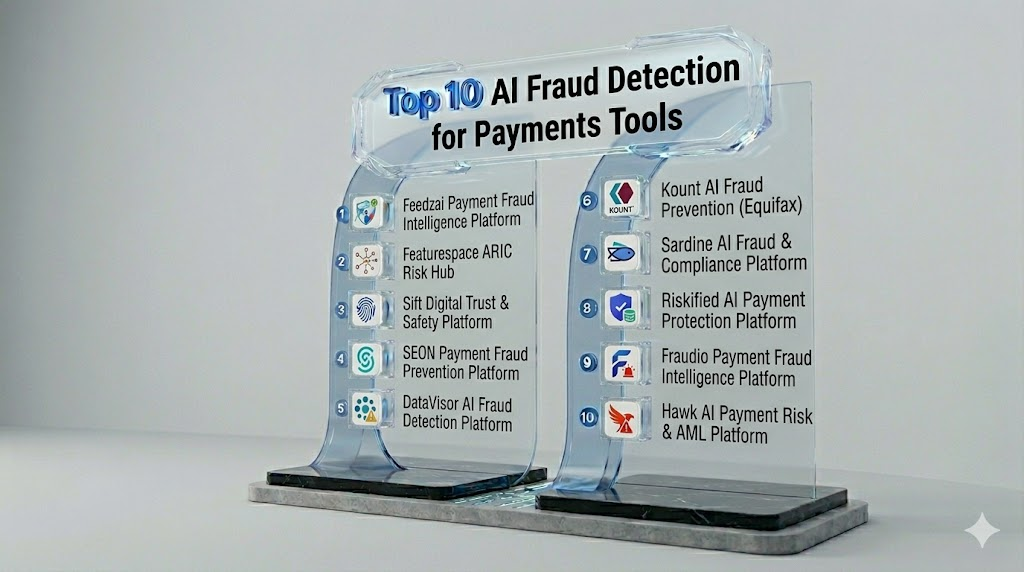
Top 10 AI Fraud Detection for Payments Tools
1- Feedzai Payment Fraud Intelligence Platform
2- Featurespace ARIC Risk Hub
3- Sift Digital Trust & Safety Platform
4- SEON Payment Fraud Prevention Platform
5- DataVisor AI Fraud Detection Platform
6- Kount AI Fraud Prevention (Equifax)
7- Sardine AI Fraud & Compliance Platform
8- Riskified AI Payment Protection Platform
9- Fraudio Payment Fraud Intelligence Platform
10- Hawk AI Payment Risk & AML Platform
1- Feedzai Payment Fraud Intelligence Platform
One-line Verdict
Best for enterprise real-time payment fraud detection at scale.
Short Description
Feedzai uses AI-powered risk engines to detect and prevent payment fraud across banking and digital commerce channels in real time.
Standout Capabilities
- Real-time transaction scoring
- Behavioral analytics engine
- Device and identity intelligence
- Cross-channel fraud detection
- Payment risk decisioning
- AML integration
- Fraud analytics dashboards
AI-Specific Depth
Uses machine learning models that process billions of data points across payment networks to generate real-time fraud risk scores.
Pros
- Extremely scalable
- Strong banking adoption
- High detection accuracy
- Real-time decisioning
Cons
- Complex enterprise setup
- High cost
- Requires large datasets
Security & Compliance
Enterprise-grade financial compliance
Deployment & Platforms
Cloud-native fraud prevention platform
Integrations & Ecosystem
- Banking systems
- Payment gateways
- ERP systems
- APIs
Pricing Model
Enterprise subscription
Best-Fit Scenarios
- Global banks
- Payment processors
- Large fintech companies
- High-volume payment systems
2- Featurespace ARIC Risk Hub
One-line Verdict
Best for adaptive behavioral AI fraud detection.
Short Description
Featurespace uses adaptive behavioral analytics to detect payment fraud and financial crime in real time.
Standout Capabilities
- Adaptive behavior modeling
- Real-time fraud scoring
- Transaction monitoring
- AML integration
- Customer behavior profiling
- Payment anomaly detection
- Risk analytics dashboards
AI-Specific Depth
Uses self-learning machine learning models that adapt to evolving fraud behavior without manual rule updates.
Pros
- Strong behavioral analytics
- Low false positives
- Highly adaptive AI
- Real-time detection
Cons
- Enterprise focus
- Complex configuration
- Requires tuning
Security & Compliance
Financial crime compliance ready
Deployment & Platforms
Cloud fraud intelligence platform
Integrations & Ecosystem
- Banks
- Payment processors
- Fintech systems
- APIs
Pricing Model
Enterprise subscription
Best-Fit Scenarios
- Banks
- Fintech enterprises
- Card issuers
- Payment networks
3- Sift Digital Trust & Safety Platform
One-line Verdict
Best for e-commerce and digital payment fraud prevention.
Short Description
Sift uses AI to build trust scores and detect fraud across online payments and digital platforms.
Standout Capabilities
- Fraud risk scoring engine
- Payment fraud detection
- Account takeover prevention
- Device fingerprinting
- Behavioral analytics
- Chargeback reduction
- Trust scoring system
AI-Specific Depth
Uses machine learning models trained on global transaction networks to identify fraudulent behavior patterns.
Pros
- Strong e-commerce focus
- Easy API integration
- High scalability
- Strong trust scoring
Cons
- Limited banking depth
- Mid-market complexity
- Requires tuning
Security & Compliance
Enterprise-grade fraud protection
Deployment & Platforms
Cloud API platform
Integrations & Ecosystem
- E-commerce platforms
- Payment gateways
- SaaS apps
- APIs
Pricing Model
Usage-based + subscription
Best-Fit Scenarios
- E-commerce companies
- Marketplaces
- SaaS platforms
- Digital payment businesses
4- SEON Payment Fraud Prevention Platform
One-line Verdict
Best for digital footprint-based fraud detection.
Short Description
SEON uses digital footprint analysis and AI scoring to detect fraud in payments and account activity.
Standout Capabilities
- Email and phone intelligence
- Device fingerprinting
- Payment risk scoring
- Behavioral analytics
- Fraud API integration
- AML screening
- Real-time monitoring
AI-Specific Depth
Uses AI-driven rules engine combined with behavioral data signals to assess payment risk in real time.
Pros
- Fast deployment
- Strong API-first design
- Flexible rules engine
- Good SMB-mid-market fit
Cons
- Less deep banking integration
- Requires configuration
- Limited enterprise analytics
Security & Compliance
Not publicly stated
Deployment & Platforms
Cloud API platform
Integrations & Ecosystem
- Payment gateways
- SaaS platforms
- Fintech systems
- APIs
Pricing Model
Subscription-based
Best-Fit Scenarios
- Fintech startups
- E-commerce platforms
- Online marketplaces
5- DataVisor AI Fraud Detection Platform
One-line Verdict
Best for unified AI fraud and AML detection.
Short Description
DataVisor provides AI-powered fraud detection and AML monitoring for large-scale payment systems.
Standout Capabilities
- AI fraud detection engine
- AML transaction monitoring
- Real-time risk scoring
- Case management system
- Behavioral clustering models
- Cross-channel fraud detection
- Risk analytics dashboards
AI-Specific Depth
Uses unsupervised machine learning to detect unknown fraud patterns without labeled datasets.
Pros
- Strong enterprise scale
- Detects unknown fraud patterns
- Unified fraud + AML system
- High accuracy models
Cons
- Complex setup
- Enterprise pricing
- Requires large data volume
Security & Compliance
Financial crime compliance support
Deployment & Platforms
Cloud fraud intelligence platform
Integrations & Ecosystem
- Banking systems
- Payment networks
- ERP systems
- APIs
Pricing Model
Enterprise subscription
Best-Fit Scenarios
- Banks
- Payment processors
- Global fintech companies
6- Kount AI Fraud Prevention (Equifax)
One-line Verdict
Best for payment fraud and identity trust scoring.
Short Description
Kount provides AI-driven fraud prevention for payments, focusing on identity trust and transaction risk scoring.
Standout Capabilities
- Identity trust scoring
- Payment fraud detection
- Chargeback reduction
- Device intelligence
- Behavioral analytics
- Risk decisioning engine
- Fraud prevention APIs
AI-Specific Depth
Uses AI models trained on global transaction data to evaluate identity and payment risk in real time.
Pros
- Strong identity intelligence
- Easy integration
- High fraud detection accuracy
- Mature platform
Cons
- Limited customization
- Enterprise pricing
- Less flexible analytics
Security & Compliance
Enterprise fraud compliance
Deployment & Platforms
Cloud fraud prevention platform
Integrations & Ecosystem
- Payment gateways
- E-commerce systems
- Banking tools
- APIs
Pricing Model
Subscription-based
Best-Fit Scenarios
- E-commerce platforms
- Payment processors
- Digital businesses
7- Sardine AI Fraud & Compliance Platform
One-line Verdict
Best for fintech-focused real-time fraud detection.
Short Description
Sardine uses AI for fraud detection, compliance, and payment risk monitoring in fintech environments.
Standout Capabilities
- Real-time fraud detection
- Payment risk scoring
- Behavioral analytics
- AML monitoring
- Device intelligence
- Chargeback prevention
- Compliance automation
AI-Specific Depth
Uses machine learning models that combine behavioral and financial signals for real-time fraud prevention.
Pros
- Strong fintech focus
- Real-time analytics
- Easy API integration
- High-speed detection
Cons
- Limited enterprise depth
- Smaller ecosystem
- Requires tuning
Security & Compliance
Not publicly stated
Deployment & Platforms
Cloud API platform
Integrations & Ecosystem
- Fintech apps
- Banking APIs
- Payment systems
- SaaS tools
Pricing Model
Subscription-based
Best-Fit Scenarios
- Fintech startups
- Digital banks
- Payment apps
8- Riskified AI Payment Protection Platform
One-line Verdict
Best for e-commerce fraud prevention and chargeback protection.
Short Description
Riskified uses AI to approve safe transactions and block fraudulent ones in e-commerce payments.
Standout Capabilities
- Payment fraud protection
- Chargeback guarantee system
- AI transaction scoring
- Merchant risk analysis
- Real-time decisioning
- Behavioral modeling
- Conversion optimization
AI-Specific Depth
Uses AI models that evaluate customer behavior and transaction history to maximize approval rates while minimizing fraud risk.
Pros
- Strong e-commerce focus
- Improves approval rates
- Reduces chargebacks
- Easy integration
Cons
- Limited banking use cases
- Merchant-focused
- Pricing complexity
Security & Compliance
Enterprise fraud protection standards
Deployment & Platforms
Cloud fraud prevention platform
Integrations & Ecosystem
- E-commerce platforms
- Payment gateways
- SaaS tools
- APIs
Pricing Model
Transaction-based
Best-Fit Scenarios
- Online retailers
- Marketplaces
- E-commerce businesses
9- Fraudio Payment Fraud Intelligence Platform
One-line Verdict
Best for unified payment ecosystem fraud detection.
Short Description
Fraudio provides AI-driven fraud detection across the entire payment ecosystem using centralized intelligence.
Standout Capabilities
- Unified fraud detection engine
- Payment ecosystem monitoring
- Real-time transaction scoring
- Cross-network fraud detection
- Risk analytics dashboards
- AML support
- Data network intelligence
AI-Specific Depth
Uses centralized AI models that learn from cross-network transaction data to detect fraud patterns.
Pros
- Strong network intelligence
- High detection accuracy
- Unified platform
- Real-time analytics
Cons
- Enterprise focus
- Limited SMB usage
- Complex deployment
Security & Compliance
Financial crime compliance ready
Deployment & Platforms
Cloud payment intelligence platform
Integrations & Ecosystem
- Payment networks
- Banks
- Fintech systems
- APIs
Pricing Model
Enterprise subscription
Best-Fit Scenarios
- Payment networks
- Large fintech firms
- Banking ecosystems
10- Hawk AI Payment Risk & AML Platform
One-line Verdict
Best for explainable AI fraud detection and AML compliance.
Short Description
Hawk AI provides explainable machine learning models for fraud detection and anti-money laundering compliance in payments.
Standout Capabilities
- Explainable AI fraud detection
- AML monitoring engine
- Payment risk scoring
- Transaction monitoring
- Compliance automation
- Case management
- Risk analytics
AI-Specific Depth
Uses explainable machine learning models to ensure transparency in fraud detection decisions.
Pros
- Strong explainability
- AML + fraud combined
- Enterprise-ready
- High compliance focus
Cons
- Complex setup
- Enterprise pricing
- Requires configuration
Security & Compliance
Financial crime compliance standards
Deployment & Platforms
Cloud fraud + AML platform
Integrations & Ecosystem
- Banks
- Payment systems
- ERP tools
- APIs
Pricing Model
Enterprise subscription
Best-Fit Scenarios
- Banks
- Regulated financial institutions
- Compliance-heavy organizations
Comparison Table
| Tool | Best For | Fraud Detection Type | AI Depth | Integration | Enterprise Fit |
|---|---|---|---|---|---|
| Feedzai | Banking fraud | Real-time payments | High | Strong | Excellent |
| Featurespace | Behavioral fraud | Adaptive AI | High | Strong | Excellent |
| Sift | E-commerce fraud | Trust scoring | High | Strong | High |
| SEON | Digital footprint | Risk scoring | Medium | Medium | High |
| DataVisor | AML + fraud | Unsupervised AI | High | Strong | Excellent |
| Kount | Identity fraud | Payment fraud | Medium | Strong | High |
| Sardine | Fintech fraud | Real-time AI | High | Medium | High |
| Riskified | E-commerce | Chargeback prevention | High | Strong | High |
| Fraudio | Payment ecosystem | Network AI | High | Strong | Excellent |
| Hawk AI | AML + fraud | Explainable AI | High | Strong | Excellent |
Evaluation & Scoring Table
| Tool | Core | Ease | Integration | Security | Performance | Support | Value | Total |
|---|---|---|---|---|---|---|---|---|
| Feedzai | 9.6 | 7.5 | 9.4 | 9.3 | 9.5 | 8.8 | 7.6 | 8.8 |
| Featurespace | 9.3 | 8.0 | 9.2 | 9.2 | 9.3 | 8.7 | 8.0 | 8.8 |
| Sift | 9.1 | 8.5 | 9.0 | 9.0 | 9.1 | 8.6 | 8.5 | 8.8 |
| SEON | 8.8 | 9.0 | 8.8 | 8.6 | 8.8 | 8.5 | 9.1 | 8.7 |
| DataVisor | 9.4 | 7.8 | 9.3 | 9.3 | 9.4 | 8.7 | 7.8 | 8.8 |
| Kount | 9.0 | 8.6 | 9.0 | 9.0 | 9.0 | 8.5 | 8.4 | 8.7 |
| Sardine | 9.0 | 8.7 | 8.8 | 8.9 | 9.1 | 8.6 | 8.5 | 8.7 |
| Riskified | 9.2 | 8.4 | 9.1 | 9.0 | 9.2 | 8.7 | 8.6 | 8.8 |
| Fraudio | 9.3 | 7.9 | 9.2 | 9.3 | 9.4 | 8.6 | 8.0 | 8.8 |
| Hawk AI | 9.1 | 8.2 | 9.1 | 9.2 | 9.1 | 8.6 | 8.1 | 8.7 |
Top 3 Recommendations
Enterprise Payment Fraud Detection
- Feedzai
- DataVisor
- Fraudio
E-commerce Fraud Prevention
- Sift
- Riskified
- Kount
Fintech & Real-Time Fraud Monitoring
- Featurespace
- Sardine
- SEON
Which Tool Is Right for You
Choose Feedzai if you need banking-grade fraud detection.
Choose Featurespace if you want adaptive behavioral AI.
Choose Sift if you are an e-commerce platform.
Choose SEON if you need digital footprint analysis.
Choose DataVisor if you want unified fraud + AML detection.
Choose Kount if you need identity-based fraud prevention.
Choose Sardine if you are a fintech company.
Choose Riskified if you need chargeback protection.
Choose Fraudio if you need payment network intelligence.
Choose Hawk AI if you need explainable fraud detection.
30 60 90 Days Implementation Playbook
First 30 Days
- Connect payment data sources
- Configure fraud rules
- Set up AI models
- Integrate APIs
- Run pilot testing
Next 60 Days
- Enable real-time fraud scoring
- Optimize detection thresholds
- Train risk teams
- Reduce false positives
- Improve model accuracy
Final 90 Days
- Scale enterprise deployment
- Automate fraud workflows
- Enhance AI model learning
- Improve compliance reporting
- Standardize fraud monitoring
Common Mistakes
- Poor transaction data quality
- Over-blocking legitimate payments
- Weak model tuning
- Ignoring behavioral signals
- Lack of real-time integration
- Fragmented fraud systems
- No feedback loop for AI models
Frequently Asked Questions
1. What is AI payment fraud detection?
It uses AI to detect fraudulent payment transactions.
2. How does it work?
It analyzes transaction behavior and patterns.
3. Does it stop fraud in real time?
Yes, most systems work instantly.
4. Can it reduce chargebacks?
Yes, significantly.
5. Does it use machine learning?
Yes, ML is core to detection.
6. Is it accurate?
Yes, accuracy improves over time.
7. Can it integrate with payment gateways?
Yes, via APIs.
8. Does it support global payments?
Yes, most enterprise tools do.
9. Is it secure?
Yes, enterprise-grade compliance is standard.
10. Biggest benefit?
Preventing fraud while improving payment approval rates.
Conclusion
AI Fraud Detection for Payments tools are essential for modern financial ecosystems, enabling real-time protection against increasingly sophisticated fraud attacks. These platforms help businesses balance security and customer experience by detecting fraud instantly while minimizing false declines. Enterprise leaders like Feedzai, DataVisor, and Fraudio dominate large-scale payment protection, while Featurespace and Sift focus on behavioral intelligence and e-commerce fraud prevention. Fintech-focused solutions like Sardine and SEON provide flexible, API-driven fraud controls for fast-moving digital businesses. As payment systems become faster and more complex, AI-powered fraud detection is becoming a critical foundation for secure digital commerce.

Find Trusted Cardiac Hospitals
Compare heart hospitals by city and services — all in one place.
Explore Hospitals
Helpful guide for anyone exploring AI-powered fraud detection solutions.