
Introduction
AI Expense Categorization Tools are intelligent finance automation platforms that automatically classify, tag, and organize business or personal expenses using artificial intelligence. These systems eliminate manual bookkeeping by analyzing receipts, invoices, bank transactions, and spending patterns to assign accurate expense categories in real time.
Modern tools use machine learning, OCR (optical character recognition), and large language models to understand transaction context such as vendor type, amount patterns, location, and historical behavior. This allows them to automatically categorize expenses into groups like travel, meals, utilities, SaaS subscriptions, or office supplies with high accuracy.
AI-driven expense categorization is now a core function of modern finance automation, helping organizations reduce errors, improve compliance, and streamline accounting workflows.
Why It Matters
Manual expense categorization is slow, error-prone, and costly. Finance teams often struggle with:
- Incorrect expense tagging
- Missing receipts and incomplete data
- Policy violations going unnoticed
- Time-consuming reconciliation
- Delayed financial reporting
AI expense categorization tools solve these problems by:
- Automatically classifying every transaction
- Reducing human errors and duplication
- Enforcing company expense policies
- Speeding up month-end closing
- Improving audit readiness
- Enabling real-time financial visibility
AI systems can also detect anomalies and policy violations in spending behavior, improving financial governance and compliance.
Real World Use Cases
- Auto-categorizing corporate credit card expenses
- Receipt scanning and classification
- Freelancer expense tracking for tax filing
- SaaS subscription categorization
- Travel and hospitality expense tagging
- Department-wise cost allocation
- Real-time budget tracking
- Audit and compliance reporting
- Fraud and anomaly detection
- Finance ERP automation workflows
Evaluation Criteria for Buyers
- Accuracy of AI categorization models
- OCR quality for receipt scanning
- Bank and credit card integrations
- Custom expense category rules
- Policy enforcement capabilities
- Real-time processing speed
- ERP and accounting integrations
- Multi-currency support
- Audit and compliance tracking
- Scalability for enterprise usage
What’s Changed in AI Expense Categorization
- From manual tagging → AI auto-categorization
- From receipt entry → OCR + AI extraction
- From monthly reports → real-time tracking
- From static rules → adaptive learning models
- From standalone tools → ERP-integrated finance automation
AI now continuously learns from transaction history to improve classification accuracy over time.
Quick Buyer Checklist
| Requirement | Why It Matters |
|---|---|
| AI auto-categorization | Reduces manual bookkeeping |
| OCR receipt scanning | Extracts receipt data |
| Bank integration | Enables real-time tracking |
| Rules engine | Matches company policies |
| Fraud detection | Prevents misuse |
| ERP integration | Connects finance systems |
| Multi-currency support | Global tracking |
| Real-time insights | Faster decisions |
| Audit logs | Compliance readiness |
| Scalability | Enterprise adoption |
Best For
- Finance and accounting teams
- SMBs and startups
- Enterprise expense departments
- Freelancers and consultants
- CFO and finance operations teams
- Global organizations
- Procurement and compliance teams
Not Ideal For
- Very small personal-only budgeting use cases
- Organizations without digital finance systems
- Offline-only expense tracking workflows
- Teams without accounting or ERP tools
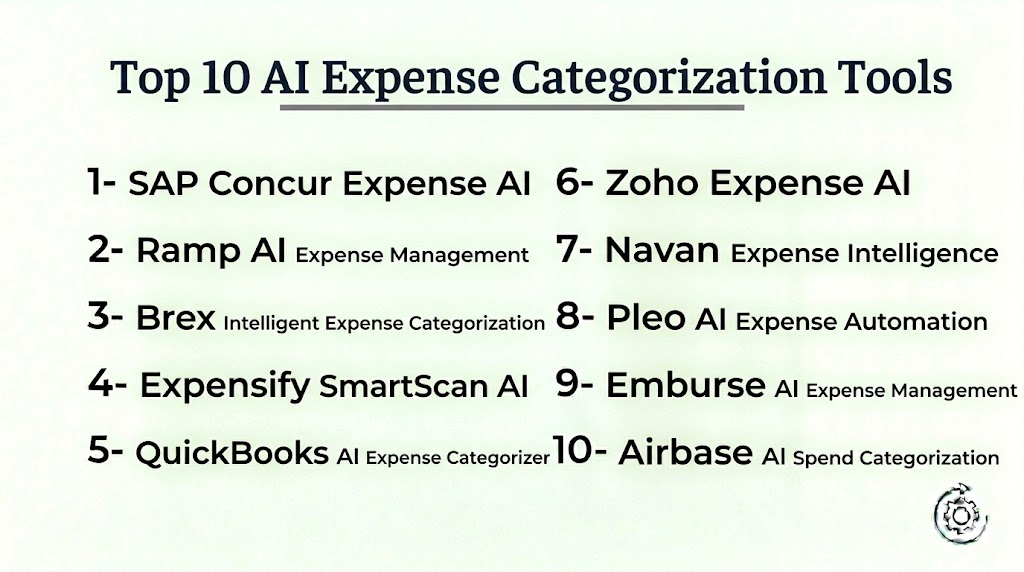
Top 10 AI Expense Categorization Tools
1- SAP Concur Expense AI
2- Ramp AI Expense Management
3- Brex Intelligent Expense Categorization
4- Expensify SmartScan AI
5- QuickBooks AI Expense Categorizer
6- Zoho Expense AI
7- Navan Expense Intelligence
8- Pleo AI Expense Automation
9- Emburse AI Expense Management
10- Airbase AI Spend Categorization
1- SAP Concur Expense AI
One-line Verdict
Best for enterprise-grade global expense categorization and compliance automation.
Short Description
SAP Concur uses AI-driven expense categorization and policy enforcement to automate corporate spending workflows at enterprise scale.
Standout Capabilities
- AI expense categorization
- Receipt OCR scanning
- Policy compliance automation
- Fraud detection alerts
- Multi-currency handling
- ERP integration
- Audit-ready reporting
AI-Specific Depth
Uses machine learning to classify expenses based on vendor history, transaction patterns, and corporate policy rules.
Pros
- Strong enterprise adoption
- Reliable compliance engine
- Global scalability
- Deep ERP integration
Cons
- Complex setup
- Expensive for SMBs
- Enterprise-focused
Security & Compliance
Enterprise-grade financial compliance
Deployment & Platforms
- Cloud enterprise finance platform
Integrations & Ecosystem
- SAP ERP
- HR systems
- Finance tools
- Banking systems
Pricing Model
Enterprise subscription
Best-Fit Scenarios
- Large enterprises
- Global finance teams
- Compliance-heavy industries
- ERP-driven organizations
2- Ramp AI Expense Management
One-line Verdict
Best for automated real-time expense categorization and spend control.
Short Description
Ramp uses AI to automatically categorize expenses, detect anomalies, and enforce company spending policies in real time.
Standout Capabilities
- Real-time AI categorization
- Spend policy enforcement
- Receipt automation
- Vendor intelligence
- Budget tracking
- Fraud detection
- Corporate card integration
AI-Specific Depth
Uses predictive models to classify transactions and flag unusual spending patterns instantly.
Pros
- Very fast automation
- Strong UX design
- Real-time insights
- Easy integration
Cons
- Limited global coverage
- US-centric ecosystem
- Less customization for complex enterprises
Security & Compliance
Not publicly stated
Deployment & Platforms
- Cloud finance platform
Integrations & Ecosystem
- Accounting tools
- ERP systems
- Banking APIs
- HR systems
Pricing Model
Subscription-based
Best-Fit Scenarios
- Mid-market companies
- Fast-growing startups
- Spend management teams
3- Brex Intelligent Expense Categorization
One-line Verdict
Best for startups and tech companies.
Short Description
Brex provides intelligent expense categorization with corporate card integration and real-time financial insights.
Standout Capabilities
- AI expense categorization
- Smart receipt capture
- Corporate card integration
- Spend analytics
- Budget tracking
- Policy automation
AI-Specific Depth
Uses ML classification models trained on merchant and transaction behavior patterns.
Pros
- Great startup focus
- Strong automation
- Fast onboarding
- Good analytics
Cons
- Limited enterprise flexibility
- US-focused banking system
Security & Compliance
Not publicly stated
Deployment & Platforms
- Cloud financial platform
Integrations & Ecosystem
- Accounting systems
- HR tools
- Banking APIs
- ERP tools
Pricing Model
Subscription + financial services bundle
Best-Fit Scenarios
- Startups
- Tech companies
- Finance automation teams
4- Expensify SmartScan AI
One-line Verdict
Best for receipt scanning and expense automation.
Short Description
Expensify uses SmartScan AI to extract data from receipts and automatically categorize expenses.
Standout Capabilities
- Receipt OCR scanning
- AI expense categorization
- Expense reporting automation
- Travel expense tracking
- Policy enforcement
- Mobile capture
AI-Specific Depth
Uses OCR + NLP models to extract structured receipt data.
Pros
- Very easy to use
- Strong mobile app
- Good SMB fit
- Fast scanning
Cons
- Limited enterprise analytics
- Basic automation rules
Security & Compliance
Not publicly stated
Deployment & Platforms
- Cloud + mobile platform
Integrations & Ecosystem
- Accounting tools
- ERP systems
- Banking systems
- HR tools
Pricing Model
Freemium + subscription
Best-Fit Scenarios
- Freelancers
- SMBs
- Travel-heavy users
5- QuickBooks AI Expense Categorizer
One-line Verdict
Best for small business accounting automation.
Short Description
QuickBooks uses AI to automatically categorize expenses and reconcile transactions.
Standout Capabilities
- AI expense categorization
- Bank reconciliation
- Automated bookkeeping
- Invoice management
- Tax tracking
AI-Specific Depth
Uses pattern recognition models based on historical accounting behavior.
Pros
- Strong SMB adoption
- Easy accounting integration
- Reliable categorization
Cons
- Limited enterprise scalability
- Requires accounting setup
Security & Compliance
Not publicly stated
Deployment & Platforms
- Cloud accounting platform
Integrations & Ecosystem
- Banking systems
- Payroll tools
- ERP systems
Pricing Model
Subscription-based
Best-Fit Scenarios
- Small businesses
- Freelancers
- Accounting teams
6- Zoho Expense AI
One-line Verdict
Best affordable SMB expense automation tool.
Short Description
Zoho Expense automates expense tracking, categorization, and reimbursement workflows.
Standout Capabilities
- AI categorization
- Receipt scanning
- Expense reports
- Budget tracking
- Policy enforcement
AI-Specific Depth
Uses ML models for expense classification and policy validation.
Pros
- Affordable
- Easy setup
- Good SMB fit
Cons
- Limited enterprise depth
Security & Compliance
Not publicly stated
Deployment & Platforms
- Cloud SaaS
Integrations & Ecosystem
- Zoho suite
- ERP systems
- Accounting tools
Pricing Model
Freemium + subscription
Best-Fit Scenarios
- SMB finance teams
- Zoho ecosystem users
7- Navan Expense Intelligence
One-line Verdict
Best for travel + expense automation.
Short Description
Navan combines travel and expense management with AI categorization.
Standout Capabilities
- AI expense categorization
- Travel integration
- Policy enforcement
- Real-time tracking
- Automated approvals
AI-Specific Depth
Uses AI to enforce policies at transaction level.
Pros
- Strong travel integration
- Real-time control
Cons
- Travel-focused
- Complex onboarding
Security & Compliance
Not publicly stated
Deployment & Platforms
- Cloud platform
Integrations & Ecosystem
- ERP systems
- HR tools
- Banking APIs
Pricing Model
Enterprise subscription
Best-Fit Scenarios
- Travel-heavy companies
- Enterprises
8- Pleo AI Expense Automation
One-line Verdict
Best for European SMBs.
Short Description
Pleo provides smart cards with AI-based expense categorization.
Standout Capabilities
- AI categorization
- Smart cards
- Receipt capture
- Budget tracking
AI-Specific Depth
Uses ML models to match receipts with transactions.
Pros
- Great UX
- Easy adoption
- SMB-friendly
Cons
- Limited enterprise scale
Security & Compliance
Not publicly stated
Deployment & Platforms
- Cloud platform
Integrations & Ecosystem
- Accounting tools
- ERP systems
Pricing Model
Subscription-based
Best-Fit Scenarios
- SMBs in Europe
9- Emburse AI Expense Management
One-line Verdict
Best for enterprise expense compliance.
Short Description
Emburse automates expense categorization, reporting, and compliance workflows.
Standout Capabilities
- AI categorization
- OCR scanning
- Policy enforcement
- Audit reporting
AI-Specific Depth
Uses ML for classification and fraud detection.
Pros
- Strong enterprise focus
- Good compliance
Cons
- Complex setup
Security & Compliance
Enterprise-grade compliance
Deployment & Platforms
- Cloud platform
Integrations & Ecosystem
- ERP systems
- HR systems
Pricing Model
Enterprise subscription
Best-Fit Scenarios
- Large enterprises
10- Airbase AI Spend Categorization
One-line Verdict
Best for spend + AP automation.
Short Description
Airbase combines AI expense categorization with accounts payable automation.
Standout Capabilities
- AI categorization
- AP automation
- Spend management
- Approval workflows
AI-Specific Depth
Uses AI to classify expenses and detect anomalies.
Pros
- Strong finance automation
- Good AP integration
Cons
- Enterprise-focused
Security & Compliance
Not publicly stated
Deployment & Platforms
- Cloud platform
Integrations & Ecosystem
- ERP systems
- Accounting tools
Pricing Model
Enterprise subscription
Best-Fit Scenarios
- Finance operations teams
- Enterprises
Comparison Table
| Tool | Best For | AI Accuracy | OCR Strength | Enterprise Fit |
|---|---|---|---|---|
| SAP Concur | Global enterprises | High | Strong | Excellent |
| Ramp | Real-time spend | High | Strong | Strong |
| Brex | Startups | High | Strong | Medium |
| Expensify | Receipts | High | Excellent | Medium |
| QuickBooks | SMB accounting | Medium | Medium | Medium |
| Zoho Expense | SMBs | Medium | Strong | Medium |
| Navan | Travel expense | High | Strong | High |
| Pleo | SMB Europe | Medium | Strong | Medium |
| Emburse | Enterprise | High | Strong | High |
| Airbase | AP + spend | High | Strong | High |
Evaluation & Scoring Table
| Tool | Core | Ease | Integration | Security | Performance | Support | Value | Total |
|---|---|---|---|---|---|---|---|---|
| SAP Concur | 9.5 | 7.5 | 9.4 | 9.2 | 9.3 | 8.8 | 7.8 | 8.8 |
| Ramp | 9.1 | 9.0 | 9.0 | 8.8 | 9.1 | 8.7 | 9.0 | 8.9 |
| Brex | 9.0 | 9.1 | 9.0 | 8.8 | 9.0 | 8.6 | 8.9 | 8.8 |
| Expensify | 8.8 | 9.3 | 8.7 | 8.6 | 8.8 | 8.5 | 9.2 | 8.7 |
| QuickBooks | 9.0 | 8.8 | 9.1 | 9.0 | 9.0 | 8.7 | 8.8 | 8.8 |
| Zoho Expense | 8.7 | 9.0 | 8.8 | 8.6 | 8.7 | 8.5 | 9.1 | 8.7 |
| Navan | 9.2 | 8.3 | 9.2 | 9.0 | 9.2 | 8.7 | 8.0 | 8.8 |
| Pleo | 8.8 | 9.1 | 8.8 | 8.6 | 8.7 | 8.4 | 9.0 | 8.7 |
| Emburse | 9.3 | 7.8 | 9.2 | 9.1 | 9.2 | 8.7 | 7.9 | 8.8 |
| Airbase | 9.2 | 7.8 | 9.3 | 9.1 | 9.2 | 8.7 | 7.8 | 8.8 |
Top 3 Recommendations
Enterprise Expense Automation
- SAP Concur
- Emburse
- Airbase
Real-Time Spend Control
- Ramp
- Brex
- Navan
SMB-Friendly Tools
- QuickBooks
- Zoho Expense
- Expensify
Which Tool Is Right for You
Choose SAP Concur if you need global enterprise compliance.
Choose Ramp if you want real-time AI expense control.
Choose Brex if you are a startup.
Choose Expensify if you want simple receipt tracking.
Choose QuickBooks if you want accounting automation.
Choose Zoho Expense if you want affordable SMB automation.
Choose Navan if you manage travel-heavy expenses.
Choose Pleo if you are a European SMB.
Choose Emburse if you need enterprise compliance.
Choose Airbase if you want spend + AP automation.
30 60 90 Days Implementation Playbook
First 30 Days
- Connect bank feeds
- Define categories
- Set policies
- Enable OCR
- Pilot departments
Next 60 Days
- Enable AI categorization
- Validate accuracy
- Integrate ERP
- Train finance teams
Final 90 Days
- Scale organization-wide
- Automate workflows
- Improve compliance reporting
- Optimize financial insights
Common Mistakes
- Poor category structure
- Weak policy setup
- Ignoring integrations
- Over-reliance on manual overrides
- Not validating AI outputs
- No employee training
- Fragmented finance systems
Frequently Asked Questions
1. What is AI expense categorization?
Automatic classification of expenses using AI.
2. How does it work?
Uses OCR, ML, and transaction patterns.
3. Is it accurate?
Yes, improves over time.
4. Does it replace accountants?
No, it automates repetitive tasks.
5. Can it detect fraud?
Yes, many tools support anomaly detection.
6. Does it support receipts?
Yes, via OCR.
7. Is it useful for SMBs?
Yes, many tools are SMB-friendly.
8. Can it integrate with ERP?
Yes.
9. Does it support global currencies?
Yes, most tools do.
10. Biggest benefit?
Time saving + accuracy + compliance.
Conclusion
AI Expense Categorization Tools are transforming finance operations by eliminating manual bookkeeping and enabling real-time, intelligent classification of expenses. These platforms improve financial accuracy, reduce operational overhead, and strengthen compliance across organizations. Enterprise leaders like SAP Concur, Emburse, and Airbase dominate large-scale deployments, while Ramp, Brex, and Navan focus on real-time spend intelligence. SMB-focused tools like QuickBooks, Zoho Expense, and Expensify make automation accessible for smaller teams. As finance becomes increasingly automated, AI-powered expense categorization is becoming a foundational capability for modern financial operations.

Find Trusted Cardiac Hospitals
Compare heart hospitals by city and services — all in one place.
Explore Hospitals
This guide made comparing expense categorization tools much easier.