
Introduction
AI Cash Flow Forecasting Platforms are advanced financial intelligence systems that use artificial intelligence, machine learning, and predictive analytics to estimate future cash inflows and outflows with high accuracy. These platforms analyze historical transactions, invoices, accounts receivable, accounts payable, customer behavior, and macroeconomic signals to generate real-time and forward-looking cash flow predictions.
Unlike traditional spreadsheets or static financial models, AI-driven cash flow forecasting tools continuously learn from new financial data and adjust predictions dynamically. This enables finance teams and CFOs to identify liquidity risks early, optimize working capital, and make faster strategic decisions.
These platforms are becoming a core part of modern financial planning and analysis, especially in enterprises that require real-time visibility into liquidity and operational cash positions.
Why It Matters
Cash flow is the foundation of business survival and growth. Poor forecasting leads to liquidity gaps, delayed payments, and financial instability.
Key challenges organizations face:
- Inaccurate manual forecasting
- Delayed visibility into cash positions
- Poor alignment between AR and AP cycles
- Unexpected liquidity shortages
- Inefficient working capital utilization
AI cash flow forecasting platforms solve these issues by:
- Predicting future cash inflows and outflows
- Identifying liquidity risks in advance
- Improving forecasting accuracy with machine learning
- Automating financial planning workflows
- Enhancing decision-making for CFOs and finance teams
These systems enable organizations to move from reactive finance management to predictive financial intelligence.
Real World Use Cases
- Short-term and long-term cash flow forecasting
- CFO dashboard liquidity planning
- Accounts receivable and payable prediction
- Working capital optimization
- Scenario-based financial modeling
- Subscription revenue forecasting
- Expense trend prediction
- Credit risk and collection timing analysis
- Budget planning and variance analysis
- Treasury management optimization
Evaluation Criteria for Buyers
- Accuracy of AI forecasting models
- Real-time data processing capability
- Integration with ERP and accounting systems
- Multi-entity and multi-currency support
- Predictive analytics depth
- Scenario planning capabilities
- Automation of financial workflows
- Data visualization and dashboards
- Security and compliance standards
- Scalability for enterprise finance operations
What’s Changed in AI Cash Flow Forecasting
Modern platforms have evolved significantly:
- From spreadsheet forecasting → AI-driven predictive models
- From static monthly reports → real-time cash intelligence
- From manual assumptions → machine learning predictions
- From siloed finance data → unified financial intelligence systems
- From reactive planning → proactive liquidity optimization
AI systems now continuously update forecasts based on live transaction data, improving accuracy over time.
Quick Buyer Checklist
| Requirement | Why It Matters |
|---|---|
| AI-driven forecasting | Improves accuracy of predictions |
| Real-time data sync | Enables live cash visibility |
| ERP integration | Connects financial systems |
| Scenario planning | Supports strategic decisions |
| AR/AP modeling | Improves liquidity forecasting |
| Multi-currency support | Enables global operations |
| Dashboard analytics | Simplifies decision-making |
| Predictive alerts | Identifies cash risks early |
| Automation features | Reduces manual effort |
| Scalability | Supports enterprise growth |
Best For
- CFOs and finance leaders
- Treasury management teams
- Enterprise finance departments
- SaaS and subscription businesses
- Global organizations with complex cash flows
- FP&A teams
- High-growth startups managing liquidity
Not Ideal For
- Very small businesses with simple cash flows
- Offline accounting environments
- Organizations without structured financial data
- Non-digital finance operations
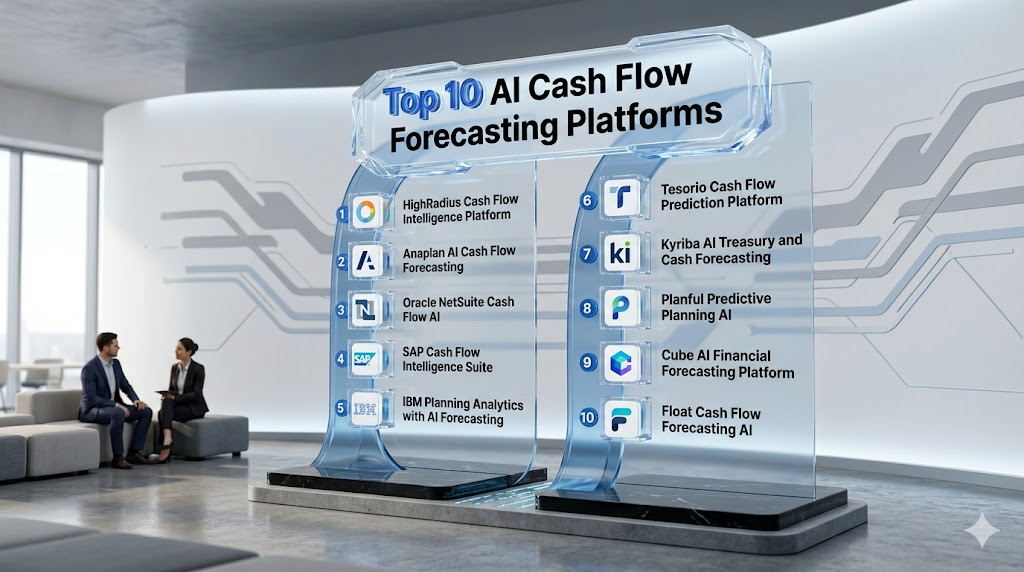
Top 10 AI Cash Flow Forecasting Platforms
1- HighRadius Cash Flow Intelligence Platform
2- Anaplan AI Cash Flow Forecasting
3- Oracle NetSuite Cash Flow AI
4- SAP Cash Flow Intelligence Suite
5- IBM Planning Analytics with AI Forecasting
6- Tesorio Cash Flow Prediction Platform
7- Kyriba AI Treasury and Cash Forecasting
8- Planful Predictive Planning AI
9- Cube AI Financial Forecasting Platform
10- Float Cash Flow Forecasting AI
1- HighRadius Cash Flow Intelligence Platform
One-line Verdict
Best for enterprise-level AI cash flow forecasting and working capital optimization.
Short Description
HighRadius uses AI-powered models to predict cash inflows, optimize liquidity, and automate cash forecasting across enterprise finance systems.
Standout Capabilities
- AI-based cash flow forecasting
- AR and AP predictive modeling
- Working capital optimization
- Liquidity risk detection
- Automated financial planning
- Real-time dashboards
- ERP integration
AI-Specific Depth
Uses machine learning models trained on enterprise financial data to predict cash flow trends and liquidity gaps with high accuracy.
Pros
- Strong enterprise adoption
- High forecasting accuracy
- Deep ERP integration
- Advanced financial intelligence
Cons
- Complex implementation
- High enterprise cost
- Requires structured financial data
Security & Compliance
Enterprise-grade financial security
Deployment & Platforms
Cloud-based financial intelligence platform
Integrations & Ecosystem
- SAP
- Oracle
- NetSuite
- Banking systems
Pricing Model
Enterprise subscription
Best-Fit Scenarios
- Large enterprises
- CFO-level forecasting
- Treasury teams
- Global finance operations
2- Anaplan AI Cash Flow Forecasting
One-line Verdict
Best for enterprise scenario-based financial planning and forecasting.
Short Description
Anaplan provides connected planning powered by AI for cash flow forecasting, budgeting, and scenario modeling.
Standout Capabilities
- AI cash flow forecasting
- Scenario modeling engine
- Financial planning automation
- Real-time forecasting updates
- Multi-department planning
- Risk analysis
- Data consolidation
AI-Specific Depth
Uses predictive analytics and machine learning models to connect financial and operational data for accurate forecasting.
Pros
- Strong enterprise planning capabilities
- Excellent scenario modeling
- Highly scalable platform
- Flexible forecasting engine
Cons
- Complex setup
- Requires training
- High cost
Security & Compliance
Enterprise compliance standards
Deployment & Platforms
Cloud planning platform
Integrations & Ecosystem
- ERP systems
- CRM systems
- Data warehouses
- Finance tools
Pricing Model
Enterprise subscription
Best-Fit Scenarios
- Enterprise FP&A teams
- Strategic finance planning
- Global organizations
3- Oracle NetSuite Cash Flow AI
One-line Verdict
Best for ERP-native cash flow forecasting and financial automation.
Short Description
Oracle NetSuite uses AI-driven analytics to forecast cash flow and optimize financial planning within ERP systems.
Standout Capabilities
- AI cash flow forecasting
- ERP-native financial modeling
- Revenue and expense prediction
- Budget tracking
- Automated reporting
- Multi-entity forecasting
- Real-time dashboards
AI-Specific Depth
Uses machine learning models integrated with ERP data to generate predictive cash flow insights.
Pros
- Strong ERP integration
- Reliable forecasting
- Enterprise scalability
- Unified financial system
Cons
- Oracle dependency
- Complex implementation
- Less flexible outside ERP
Security & Compliance
Enterprise-grade Oracle security
Deployment & Platforms
Oracle cloud ERP ecosystem
Integrations & Ecosystem
- Oracle ERP
- Finance systems
- CRM tools
- Banking APIs
Pricing Model
Enterprise subscription
Best-Fit Scenarios
- Oracle ERP users
- Large enterprises
- Finance operations teams
4- SAP Cash Flow Intelligence Suite
One-line Verdict
Best for SAP-native enterprise cash flow forecasting.
Short Description
SAP provides AI-driven cash flow forecasting integrated directly into its ERP ecosystem for enterprise financial intelligence.
Standout Capabilities
- AI cash flow prediction
- Liquidity forecasting
- AR/AP integration
- Financial dashboards
- Risk analysis
- ERP-native insights
- Scenario planning
AI-Specific Depth
Uses SAP AI core models to analyze enterprise financial data and generate predictive liquidity insights.
Pros
- Deep SAP integration
- High reliability
- Strong enterprise scalability
- Secure architecture
Cons
- SAP ecosystem dependency
- Complex configuration
- Limited external flexibility
Security & Compliance
Enterprise SAP security standards
Deployment & Platforms
SAP cloud ecosystem
Integrations & Ecosystem
- SAP ERP
- Finance modules
- Analytics tools
- Banking systems
Pricing Model
Enterprise subscription
Best-Fit Scenarios
- SAP enterprises
- Global finance teams
- ERP-driven organizations
5- IBM Planning Analytics with AI Forecasting
One-line Verdict
Best for AI-powered enterprise financial planning and forecasting.
Short Description
IBM Planning Analytics uses AI and machine learning to improve cash flow forecasting and financial planning accuracy.
Standout Capabilities
- AI forecasting engine
- Cash flow prediction
- Scenario modeling
- Budget planning automation
- Financial consolidation
- Predictive analytics
- Real-time dashboards
AI-Specific Depth
Uses machine learning models combined with OLAP-based analytics for advanced financial forecasting.
Pros
- Strong analytics engine
- Enterprise scalability
- Advanced forecasting tools
- Flexible modeling
Cons
- Complex setup
- Requires expertise
- High enterprise cost
Security & Compliance
Enterprise IBM security framework
Deployment & Platforms
Cloud and hybrid deployment
Integrations & Ecosystem
- ERP systems
- Data warehouses
- Finance tools
- APIs
Pricing Model
Enterprise subscription
Best-Fit Scenarios
- Large enterprises
- FP&A teams
- Data-driven finance organizations
6- Tesorio Cash Flow Prediction Platform
One-line Verdict
Best for AI-driven cash flow forecasting for mid-market companies.
Short Description
Tesorio uses predictive AI to forecast cash flow, optimize AR collections, and improve liquidity planning.
Standout Capabilities
- Cash flow forecasting AI
- AR prediction models
- Liquidity tracking
- Collections optimization
- Risk scoring
- Scenario modeling
- Finance dashboards
AI-Specific Depth
Uses predictive models trained on AR/AP behavior to forecast liquidity and cash inflows.
Pros
- Strong forecasting accuracy
- Easy integration
- Good UX design
- Mid-market friendly
Cons
- Limited enterprise depth
- Smaller ecosystem
- Requires clean data
Security & Compliance
Not publicly stated
Deployment & Platforms
Cloud SaaS platform
Integrations & Ecosystem
- ERP systems
- Accounting tools
- CRM platforms
- APIs
Pricing Model
Subscription-based
Best-Fit Scenarios
- Mid-market companies
- Finance planning teams
- Cash flow optimization
7- Kyriba AI Treasury Forecasting
One-line Verdict
Best for treasury-level cash flow and liquidity forecasting.
Short Description
Kyriba provides AI-powered treasury management and cash forecasting for global enterprises.
Standout Capabilities
- Treasury cash forecasting
- Liquidity management
- Risk analysis
- Payment prediction
- FX exposure modeling
- Real-time dashboards
- Bank connectivity
AI-Specific Depth
Uses AI models to optimize liquidity forecasting and treasury decision-making.
Pros
- Strong treasury focus
- High enterprise reliability
- Global banking integration
- Advanced liquidity tools
Cons
- Complex implementation
- Enterprise-only focus
- High cost
Security & Compliance
Bank-grade compliance
Deployment & Platforms
Cloud treasury platform
Integrations & Ecosystem
- Banks
- ERP systems
- Finance tools
- Payment networks
Pricing Model
Enterprise subscription
Best-Fit Scenarios
- Treasury departments
- Global enterprises
- Liquidity management teams
8- Planful Predictive Planning AI
One-line Verdict
Best for AI-driven financial planning and cash forecasting.
Short Description
Planful uses AI to improve budgeting, forecasting, and cash flow planning for finance teams.
Standout Capabilities
- AI cash flow forecasting
- Budget planning
- Scenario modeling
- Financial reporting
- Variance analysis
- Data consolidation
- Forecast automation
AI-Specific Depth
Uses machine learning models to improve forecasting accuracy based on historical financial behavior.
Pros
- Easy to use
- Strong planning features
- Good collaboration tools
- Mid-market friendly
Cons
- Limited enterprise depth
- Requires structured data
- Basic AI sophistication
Security & Compliance
Not publicly stated
Deployment & Platforms
Cloud financial planning platform
Integrations & Ecosystem
- ERP systems
- Finance tools
- Data platforms
- APIs
Pricing Model
Subscription-based
Best-Fit Scenarios
- Mid-market companies
- FP&A teams
- Budgeting and forecasting
9- Cube AI Financial Forecasting Platform
One-line Verdict
Best for spreadsheet-native AI cash flow forecasting.
Short Description
Cube integrates AI forecasting with spreadsheets for flexible financial planning.
Standout Capabilities
- Spreadsheet-based forecasting
- AI cash flow prediction
- Real-time data sync
- Budget modeling
- Scenario analysis
- ERP integration
- Financial dashboards
AI-Specific Depth
Uses machine learning to enhance spreadsheet-based forecasting accuracy.
Pros
- Easy adoption
- Spreadsheet familiarity
- Flexible modeling
- Fast setup
Cons
- Limited enterprise depth
- Spreadsheet dependency
- Basic AI capabilities
Security & Compliance
Not publicly stated
Deployment & Platforms
Cloud financial platform
Integrations & Ecosystem
- Excel
- Google Sheets
- ERP systems
- APIs
Pricing Model
Subscription-based
Best-Fit Scenarios
- SMBs
- Finance analysts
- Spreadsheet-heavy workflows
10- Float Cash Flow Forecasting AI
One-line Verdict
Best for simple and visual cash flow forecasting for SMBs.
Short Description
Float provides intuitive AI-based cash flow forecasting integrated with accounting systems.
Standout Capabilities
- Cash flow forecasting AI
- Visual dashboards
- Scenario planning
- Bank synchronization
- Budget tracking
- Forecast automation
- Financial reporting
AI-Specific Depth
Uses predictive models to forecast cash flow based on accounting and transaction data.
Pros
- Very easy to use
- Strong visualization
- Fast setup
- SMB-friendly
Cons
- Limited enterprise features
- Basic AI depth
- Small ecosystem
Security & Compliance
Not publicly stated
Deployment & Platforms
Cloud SaaS platform
Integrations & Ecosystem
- Accounting tools
- ERP systems
- Banking APIs
- Finance apps
Pricing Model
Subscription-based
Best-Fit Scenarios
- SMBs
- Freelancers
- Small finance teams
- Simple forecasting needs
Comparison Table
| Tool | Best For | Forecast Accuracy | ERP Integration | AI Depth | Enterprise Fit |
|---|---|---|---|---|---|
| HighRadius | Enterprise forecasting | Very High | Strong | High | Excellent |
| Anaplan | Scenario planning | High | Strong | High | Excellent |
| NetSuite | ERP-native forecasting | High | Very Strong | High | Excellent |
| SAP | ERP cash flow AI | High | Very Strong | High | Excellent |
| IBM | Advanced analytics | High | Strong | High | Excellent |
| Tesorio | Mid-market cash flow | High | Medium | High | Medium |
| Kyriba | Treasury forecasting | Very High | Strong | High | Excellent |
| Planful | FP&A planning | Medium | Strong | Medium | Medium |
| Cube | Spreadsheet forecasting | Medium | Medium | Medium | Medium |
| Float | SMB forecasting | Medium | Medium | Medium | Medium |
Evaluation & Scoring Table
| Tool | Core | Ease | Integration | Security | Performance | Support | Value | Total |
|---|---|---|---|---|---|---|---|---|
| HighRadius | 9.6 | 7.5 | 9.4 | 9.3 | 9.5 | 8.8 | 7.6 | 8.8 |
| Anaplan | 9.3 | 8.0 | 9.2 | 9.1 | 9.2 | 8.6 | 7.9 | 8.7 |
| NetSuite | 9.2 | 7.8 | 9.4 | 9.2 | 9.3 | 8.7 | 7.8 | 8.7 |
| SAP | 9.4 | 7.6 | 9.5 | 9.3 | 9.4 | 8.8 | 7.7 | 8.8 |
| IBM | 9.3 | 7.5 | 9.3 | 9.2 | 9.3 | 8.6 | 7.6 | 8.7 |
| Tesorio | 8.9 | 8.8 | 8.8 | 8.7 | 9.0 | 8.5 | 8.8 | 8.7 |
| Kyriba | 9.4 | 7.6 | 9.3 | 9.4 | 9.5 | 8.8 | 7.6 | 8.8 |
| Planful | 8.8 | 9.0 | 8.8 | 8.6 | 8.8 | 8.5 | 9.0 | 8.7 |
| Cube | 8.7 | 9.2 | 8.6 | 8.5 | 8.7 | 8.4 | 9.1 | 8.6 |
| Float | 8.6 | 9.3 | 8.5 | 8.5 | 8.6 | 8.4 | 9.2 | 8.6 |
Top 3 Recommendations
Enterprise Cash Flow Forecasting
- HighRadius
- SAP
- Kyriba
Financial Planning & Scenario Modeling
- Anaplan
- IBM
- NetSuite
SMB & Mid-Market Forecasting
- Tesorio
- Planful
- Float
Which Tool Is Right for You
Choose HighRadius if you need enterprise-grade cash forecasting.
Choose Anaplan if you want scenario-based planning.
Choose NetSuite if you use Oracle ERP.
Choose SAP if you are SAP ecosystem-based.
Choose IBM if you need advanced analytics.
Choose Kyriba if you manage treasury operations.
Choose Tesorio if you are mid-market focused.
Choose Planful if you need FP&A planning tools.
Choose Cube if you prefer spreadsheet workflows.
Choose Float if you want simple SMB forecasting.
30 60 90 Days Implementation Playbook
First 30 Days
- Connect financial data sources
- Configure forecasting models
- Define KPIs (cash flow, liquidity)
- Integrate ERP systems
- Run pilot forecasts
Next 60 Days
- Validate forecast accuracy
- Train finance teams
- Enable scenario modeling
- Optimize data pipelines
- Improve reporting
Final 90 Days
- Scale enterprise deployment
- Automate forecasting workflows
- Improve prediction accuracy
- Enable real-time dashboards
- Standardize financial planning
Common Mistakes
- Poor data quality
- Ignoring ERP integration
- Over-reliance on manual adjustments
- Not validating AI models
- Weak scenario planning setup
- Fragmented financial systems
- Lack of finance team adoption
Frequently Asked Questions
1. What is AI cash flow forecasting?
It uses AI to predict future cash inflows and outflows.
2. How accurate is it?
Accuracy improves with historical data.
3. Does it replace spreadsheets?
It enhances and automates them, not fully replaces.
4. Can it integrate with ERP systems?
Yes, most tools support ERP integration.
5. Is it useful for SMBs?
Yes, especially Cube and Float.
6. Does it help CFOs?
Yes, it improves liquidity planning.
7. Can it predict risks?
Yes, it identifies cash shortages early.
8. Does it support scenario planning?
Yes, many tools do.
9. Is it secure?
Yes, enterprise platforms use strong compliance.
10. Biggest benefit?
Better financial visibility and decision-making.
Conclusion
AI Cash Flow Forecasting Platforms are transforming financial planning by enabling organizations to predict liquidity, optimize working capital, and improve decision-making with real-time intelligence. These systems replace static forecasting methods with dynamic, AI-driven models that continuously learn from financial data. Enterprise leaders like HighRadius, SAP, and Kyriba dominate large-scale forecasting, while Anaplan, IBM, and NetSuite focus on advanced planning and scenario modeling. SMB-friendly platforms like Cube and Float make forecasting accessible for smaller teams. As finance becomes increasingly predictive, AI-powered cash flow forecasting is becoming a critical foundation for modern financial strategy.

Find Trusted Cardiac Hospitals
Compare heart hospitals by city and services — all in one place.
Explore Hospitals
Well explained and really useful for comparing the right forecasting platforms!