
Introduction
Sovereign AI Cloud Platforms enable organizations to deploy and operate AI workloads with strong control over data residency, jurisdiction, infrastructure, and governance. These platforms ensure sensitive data stays within approved regions, while offering cloud-scale AI capabilities such as model training, inference, RAG pipelines, and generative AI workflows. They are essential for enterprises and public sector organizations that must comply with strict regulatory, legal, or national requirements.
Use cases include government AI applications, financial risk modeling, healthcare data analysis, telecom AI services, internal RAG systems, AI research labs, and defense or critical infrastructure applications. Key evaluation criteria for buyers include data residency, operational autonomy, GPU availability, model support, RAG and retrieval capabilities, governance and compliance features, identity and access control, audit logging, latency and cost optimization, integration support, deployment flexibility, and exit or portability options.
Best for: governments, public sector agencies, large enterprises in regulated industries, banks, healthcare groups, telecom providers, and research institutions.
Not ideal for: small businesses, startups with simple AI needs, or teams that can rely on standard public cloud AI services.
What’s Changed in Sovereign AI Cloud Platforms
- Enterprises now require full operational control, not just regional data residency.
- GPU-enabled AI workloads are increasingly included in sovereign clouds.
- Governments are adopting sovereign platforms for national AI infrastructure.
- Enterprise AI governance is now embedded in platform offerings.
- Hybrid deployment models allow integration between private and public cloud AI.
- Open-source AI model support is becoming standard for flexibility and portability.
- Platforms now include RAG and retrieval integrations for private knowledge bases.
- Observability is critical: tracing, token metrics, latency, and usage dashboards.
- Compliance tools for GDPR, HIPAA, or local regulations are integrated or supported.
- Operational autonomy ensures local staff, key management, and audit control.
- Vendors provide portability and exit options to reduce lock-in risk.
- Cost and performance optimization are offered through infrastructure tuning and model routing.
Quick Buyer Checklist
- Data residency and jurisdictional compliance
- Operational sovereignty and administrative control
- GPU availability for model training and inference
- RAG integration and knowledge management support
- Model flexibility: hosted, BYO, or open-source
- Governance, audit, and compliance tools
- Deployment flexibility: private, hybrid, or regional cloud
- Observability: tracing, usage, latency, and cost metrics
- Identity and access management
- Vendor lock-in risk and portability options
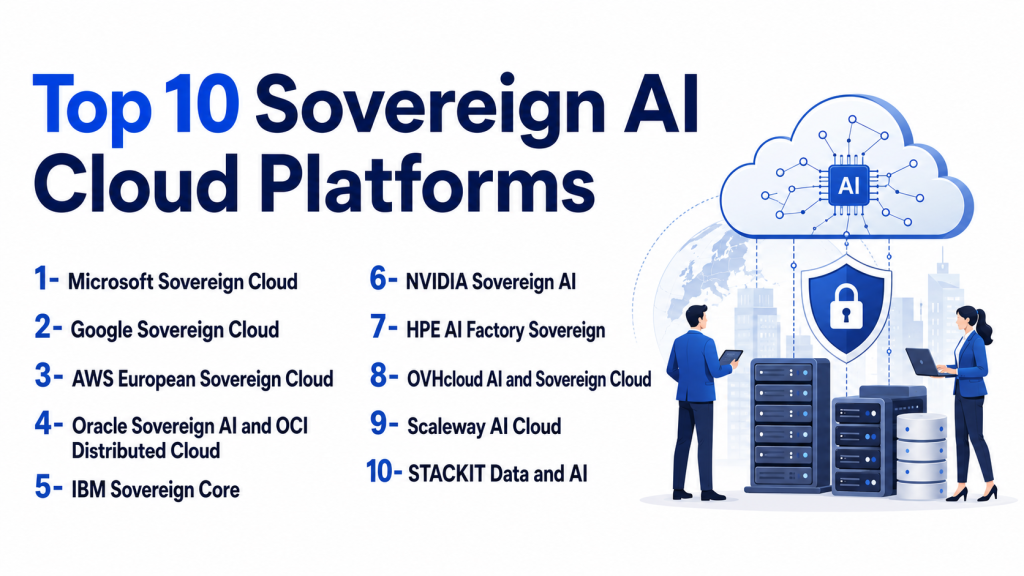
Top 10 Sovereign AI Cloud Platforms
1- Microsoft Sovereign Cloud
One-line verdict: Broad enterprise cloud and AI services with strong sovereignty and compliance features.
Short description:
Microsoft’s Sovereign Cloud provides regional and enterprise AI services that enforce data residency, operational control, and governance. It is widely adopted by governments and regulated enterprises that require cloud-scale AI without losing control over sensitive workloads.
Key Features
- Sovereign data residency and access control
- AI and ML services for enterprise workflows
- Integration with Microsoft identity and productivity tools
- Compliance and governance capabilities
- Hybrid and multi-region deployment options
- GPU-enabled AI workloads
- Suitable for public sector and regulated environments
Pros
- Broad enterprise adoption
- Deep AI, cloud, and productivity ecosystem
- Strong governance and compliance tools
Cons
- Sovereignty details vary by region
- Higher dependency on Microsoft ecosystem
- Premium pricing for enterprise features
Deployment & Platforms
Cloud, hybrid; Web, Windows, Linux
2- Google Sovereign Cloud
One-line verdict: Hyperscale AI cloud with regional sovereignty and data control.
Short description:
Google Sovereign Cloud provides AI, ML, and analytics services while keeping data within controlled regions. It supports enterprise AI workloads with operational autonomy and security.
Key Features
- Data residency and administrative control
- AI and ML services with GPU support
- Hybrid cloud and partner-managed regions
- Governance and audit capabilities
- RAG integration for private knowledge sources
- Enterprise-grade monitoring and observability
- Flexible deployment for regulated industries
Pros
- Strong AI and data platform
- Flexible regional deployment
- High performance and scalability
Cons
- Regional availability may vary
- Operational autonomy depends on partner configuration
- Enterprise support may require premium contracts
Deployment & Platforms
Cloud, hybrid; Web, Linux, Windows
3- AWS European Sovereign Cloud
One-line verdict: Independent AWS cloud for European AI workloads with operational autonomy.
Short description:
AWS European Sovereign Cloud ensures data residency and operational control for European customers. It is suitable for public sector and regulated enterprise workloads.
Key Features
- Regional cloud for EU data sovereignty
- AI, ML, and compute services
- Compliance-focused infrastructure
- Enterprise monitoring and security
- Hybrid deployment and partner integrations
- GPU-enabled AI services
- Production-ready AI workloads
Pros
- Strong cloud infrastructure
- Good fit for EU enterprises
- Comprehensive AI services
Cons
- Limited regions for full sovereignty
- AI service availability must be validated
- Higher setup complexity
Deployment & Platforms
Cloud; Web, Linux, Windows
4- Oracle Sovereign AI and OCI Distributed Cloud
One-line verdict: Distributed cloud for enterprises requiring data control and AI infrastructure.
Short description:
Oracle’s Sovereign AI platform supports distributed AI workloads with control over data location, GPU compute, and enterprise governance.
Key Features
- Distributed cloud deployment
- Data residency and access control
- GPU and AI workload support
- Enterprise integration and governance
- RAG support for private knowledge
- Hybrid deployment flexibility
- AI infrastructure for regulated sectors
Pros
- Strong enterprise integration
- Flexible deployment options
- Suitable for regulated workloads
Cons
- Best suited to Oracle-aligned enterprises
- Deployment complexity
- Higher cost for full sovereignty
Deployment & Platforms
Private cloud, hybrid; Web, Linux, Windows
5- IBM Sovereign Core
One-line verdict: AI-ready software foundation for enterprises and governments with sovereignty controls.
Short description:
IBM Sovereign Core provides a foundation to deploy AI workloads with data, operational, and governance controls, suitable for public sector and enterprise AI.
Key Features
- Sovereign software foundation
- Data and operational governance
- Supports AI workload deployment
- GPU compute for model training and inference
- Enterprise integration and hybrid deployment
- RAG and AI application support
- Regulatory compliance focus
Pros
- Strong governance
- Supports public sector and enterprise AI
- Integrates with enterprise infrastructure
Cons
- Deployment depends on existing IBM stack
- AI stack features may vary
- Complexity for smaller teams
Deployment & Platforms
Private cloud, hybrid; Web, Linux
6- NVIDIA Sovereign AI
One-line verdict: Accelerated AI infrastructure for national AI factories and enterprise workloads.
Short description:
NVIDIA Sovereign AI provides GPU-accelerated infrastructure for enterprises, governments, and telecoms aiming to build domestic AI capabilities and model training pipelines.
Key Features
- GPU-based AI infrastructure
- Accelerated model training and inference
- Partner-led sovereign cloud support
- Enterprise AI services
- Supports AI factories and national initiatives
- RAG and generative AI support
- Observability and performance monitoring
Pros
- Strong AI hardware ecosystem
- Scalable AI workloads
- Ideal for large enterprises and governments
Cons
- Not a standalone cloud provider
- Infrastructure-dependent
- High planning complexity
Deployment & Platforms
Private cloud, hybrid; Linux, Web
7- HPE AI Factory Sovereign
One-line verdict: Private sovereign AI infrastructure for enterprises and governments.
Short description:
HPE AI Factory Sovereign provides enterprise and government clients with AI-ready infrastructure for secure deployment, governance, and GPU workloads.
Key Features
- Private AI infrastructure
- Sovereign and regulatory alignment
- GPU-enabled AI workloads
- Hybrid deployment
- RAG support and workflow orchestration
- Enterprise monitoring and observability
- Compliance-focused
Pros
- Strong infrastructure positioning
- Suitable for regulated workloads
- Supports AI factory models
Cons
- Infrastructure-heavy
- Deployment complexity
- May require engineering expertise
Deployment & Platforms
Private cloud, hybrid; Linux, Web
8- OVHcloud AI and Sovereign Cloud
One-line verdict: European sovereign AI cloud with open, reversible infrastructure.
Short description:
OVHcloud provides European AI workloads with sovereignty principles, data portability, and compliance. It is suitable for regulated European organizations.
Key Features
- Data sovereignty and GDPR alignment
- AI and ML services
- Open and reversible cloud
- Regional European deployment
- GPU-enabled AI workloads
- Enterprise monitoring
- Cloud-native AI applications
Pros
- European sovereignty focus
- Open and reversible
- GDPR-aligned AI workloads
Cons
- Limited global ecosystem
- Advanced governance may require additional tools
- Smaller enterprise features
Deployment & Platforms
Cloud; Linux, Web
9- Scaleway AI Cloud
One-line verdict: European GPU cloud for AI workloads with sovereign positioning.
Short description:
Scaleway AI Cloud offers regional AI infrastructure with GPU support, generative AI, and RAG pipelines for European organizations.
Key Features
- Sovereign cloud with European data centers
- GPU-enabled AI workloads
- Managed AI services
- RAG support
- Cloud-native AI applications
- Data residency compliance
- Open-source model support
Pros
- Practical for SMEs and startups
- GPU and AI support
- European data sovereignty
Cons
- Smaller enterprise ecosystem
- Governance may require custom work
- Limited region coverage
Deployment & Platforms
Cloud; Linux, Web
10- STACKIT Data and AI
One-line verdict: GDPR-aligned European AI cloud for AI, data, and ML workloads.
Short description:
STACKIT Data and AI provides European data centers, GPU compute, and AI services compliant with GDPR and regional sovereignty.
Key Features
- GenAI and ML support
- European data residency
- GPU-enabled workloads
- AI platform with cloud-native services
- RAG integration
- Compliance-focused
- Managed and self-service options
Pros
- GDPR-aligned
- European data sovereignty
- Managed AI services
Cons
- Limited global presence
- Enterprise ecosystem smaller than hyperscalers
- Some features require custom setup
Deployment & Platforms
Cloud; Linux, Web
Comparison Table
| Tool | Best For | Deployment | Model Flexibility | Strength | Watch-Out | Public Rating |
|---|---|---|---|---|---|---|
| Microsoft Sovereign Cloud | Enterprise & government | Cloud / Hybrid | Hosted / BYO | Broad ecosystem | Region varies | N/A |
| Google Sovereign Cloud | AI & data-heavy workloads | Cloud / Partner | Hosted / BYO | Hyperscale AI | Partner config varies | N/A |
| AWS European Sovereign Cloud | European enterprises | Sovereign Cloud | Hosted / BYO | Independent AWS region | Limited availability | N/A |
| Oracle Sovereign AI | Distributed enterprise AI | Cloud / Hybrid | Hosted / BYO | Distributed control | Oracle ecosystem | N/A |
| IBM Sovereign Core | Public sector AI | Private / Hybrid | BYO / Platform | Governance-first | Availability varies | N/A |
| NVIDIA Sovereign AI | National AI factories | Private / Hybrid | BYO / Open-source | Accelerated infrastructure | Not standalone cloud | N/A |
| HPE AI Factory Sovereign | Private AI factories | Private / Hybrid | BYO / Open-source | Infrastructure-ready | Heavy infrastructure | N/A |
| OVHcloud AI | European AI workloads | Cloud | BYO / Open-source | GDPR & reversible | Smaller ecosystem | N/A |
| Scaleway AI Cloud | European SMEs | Cloud | Hosted / BYO | GPU & AI | Limited enterprise | N/A |
| STACKIT Data & AI | GDPR-aligned AI | Cloud | GenAI / BYO | European data & AI | Region focus | N/A |
Scoring & Evaluation
| Tool | Core | Reliability | Guardrails | Integrations | Ease | Perf/Cost | Security/Admin | Support | Weighted Total |
|---|---|---|---|---|---|---|---|---|---|
| Microsoft | 9 | 8 | 8 | 10 | 8 | 8 | 9 | 9 | 8.6 |
| 9 | 8 | 8 | 9 | 8 | 8 | 9 | 9 | 8.5 | |
| AWS EU | 8 | 7 | 8 | 9 | 8 | 8 | 9 | 9 | 8.1 |
| Oracle | 8 | 7 | 7 | 8 | 7 | 8 | 8 | 8 | 7.7 |
| IBM | 8 | 7 | 8 | 8 | 7 | 7 | 9 | 8 | 7.8 |
| NVIDIA | 9 | 7 | 7 | 9 | 6 | 9 | 8 | 8 | 8.0 |
| HPE | 8 | 7 | 7 | 8 | 7 | 8 | 8 | 8 | 7.7 |
| OVHcloud | 7 | 6 | 6 | 7 | 7 | 8 | 8 | 7 | 7.0 |
| Scaleway | 7 | 6 | 6 | 7 | 8 | 8 | 7 | 7 | 7.0 |
| STACKIT | 7 | 6 | 6 | 7 | 7 | 7 | 8 | 7 | 6.9 |
Top 3 for Enterprise: Microsoft, Google, AWS European Sovereign Cloud
Top 3 for SMB: Scaleway, OVHcloud, STACKIT
Top 3 for Developers: Scaleway, NVIDIA, Google
Which Platform Is Right for You
Solo / Freelancer
Low scale: Scaleway or OVHcloud for European data control without enterprise complexity.
SMB
Focus on cost and simplicity: STACKIT, Scaleway, or OVHcloud.
Mid-Market
Hybrid governance + production AI: IBM, Oracle, AWS EU.
Enterprise
Full enterprise + hyperscale AI: Microsoft, Google, AWS EU.
Regulated Industries
Public sector, banks, telecom: Microsoft, AWS EU, Oracle, IBM.
Budget vs Premium
Budget: Scaleway, OVHcloud, STACKIT.
Premium: Microsoft, Google, AWS, Oracle.
Build vs Buy
Build if strong internal infrastructure exists; buy if compliance, support, and operational reliability matter more.
Implementation Playbook 30 / 60 / 90 Days
30 days: Pilot AI workload, validate residency, GPU availability, and latency.
60 days: Configure identity, RBAC, audit logs, RAG, and evaluation harness.
90 days: Optimize cost, latency, model routing, governance, observability, and scale production AI.
Common Mistakes
- Assuming residency equals sovereignty
- Ignoring GPU and AI infrastructure needs
- Skipping RAG and retrieval access permissions
- Not testing latency or cost at scale
- Not verifying compliance and governance controls
- No incident response plan for AI failures
- Over-relying on hyperscalers without validating operational control
- Neglecting hybrid cloud integration
- Underestimating training and inference requirements
- Not documenting exit and portability strategy
FAQs
1. What is a sovereign AI cloud platform?
A platform ensuring AI workloads run with control over data residency, jurisdiction, and operational governance.
2. How is it different from regular cloud?
It provides legal, operational, and geographical sovereignty, not just standard cloud hosting.
3. Who needs it?
Governments, public sector, banks, healthcare, telecoms, and enterprises with strict compliance needs.
4. Can sovereign clouds host generative AI?
Yes, most support AI model training, inference, RAG pipelines, and generative AI.
5. Are hyperscalers suitable?
Yes, if their sovereign offerings meet residency, operational, and legal requirements.
6. Are regional providers better?
They often offer stronger local control but may have smaller AI service ecosystems.
7. Can I use open-source models?
Yes, but infrastructure, monitoring, governance, and GPU access must be managed internally.
8. How do I evaluate a provider?
Check data residency, GPU support, RAG capability, compliance, audit logs, access control, latency, and cost.
9. Is operational autonomy guaranteed?
Not automatically. It depends on infrastructure, admin control, and legal arrangements.
10. How do I scale securely?
Pilot workloads first, validate compliance and security, optimize infrastructure, then expand gradually.
Conclusion
Sovereign AI Cloud Platforms provide enterprises and governments with AI scale while keeping data, operations, and compliance under control. Microsoft, Google, and AWS offer hyperscale enterprise options, while OVHcloud, Scaleway, and STACKIT serve SMEs with European sovereignty focus. IBM, Oracle, HPE, and NVIDIA provide enterprise-grade AI factories and GPU infrastructure for sensitive workloads. Choosing the right platform requires balancing residency, governance, GPU and AI services, regulatory requirements, and budget.

Find Trusted Cardiac Hospitals
Compare heart hospitals by city and services — all in one place.
Explore Hospitals
Informative article! The comparison of sovereign AI cloud platforms is clear, practical, and helpful for understanding data privacy, compliance, and secure AI infrastructure options.