
Introduction
Agent Safety Guardrail Layers are mechanisms and modules designed to ensure AI agents operate safely, reliably, and in compliance with organizational policies. They act as protective layers that monitor agent behavior, enforce rules, prevent unsafe or unintended actions, and mitigate risks such as prompt injection, data leakage, hallucinations, or unauthorized tool usage.
These guardrails are critical in as AI agents are increasingly integrated into enterprise workflows, financial and healthcare systems, RAG pipelines, multi-agent coordination, automation, and customer support workflows. Buyers should evaluate policy enforcement, prompt validation, tool access controls, RAG safety, human-in-the-loop integration, observability, auditability, multi-agent support, memory and state governance, cost and latency impact, compliance standards, and deployment flexibility.
Best for: AI platform teams, enterprise AI engineers, research labs, and regulated industries needing robust safety enforcement.
Not ideal for: lightweight agents, single-turn chatbots, or projects without sensitive data or compliance requirements.
What’s Changed in Agent Safety Guardrail Layers
- Prompt injection defenses are now standard.
- Multi-agent safety and coordination controls are integrated.
- RAG pipelines include retrieval and tool access policies.
- Human-in-the-loop mechanisms ensure oversight in sensitive workflows.
- Observability dashboards track unsafe actions, latency, and token usage.
- Memory and state access is governed to prevent data leakage.
- Model-agnostic support allows guardrails across BYO, proprietary, and open-source LLMs.
- Low-code and API-based enforcement simplifies integration.
- Versioning and rollback improve safety in iterative deployments.
- Evaluation frameworks test hallucinations, tool safety, and workflow correctness.
- Compliance logging supports regulatory audits.
- Cost and latency impact is optimized to minimize workflow disruption.
Quick Buyer Checklist
- Prompt injection protection
- Tool and API access enforcement
- RAG and memory access guardrails
- Human-in-the-loop supervision
- Observability and logging dashboards
- Multi-agent safety policies
- Deployment flexibility: cloud, hybrid, on-prem
- Model-agnostic support (BYO, multi-model)
- Evaluation metrics and regression tests
- Policy enforcement and compliance logging
- Latency and cost considerations
- Vendor lock-in and integration support
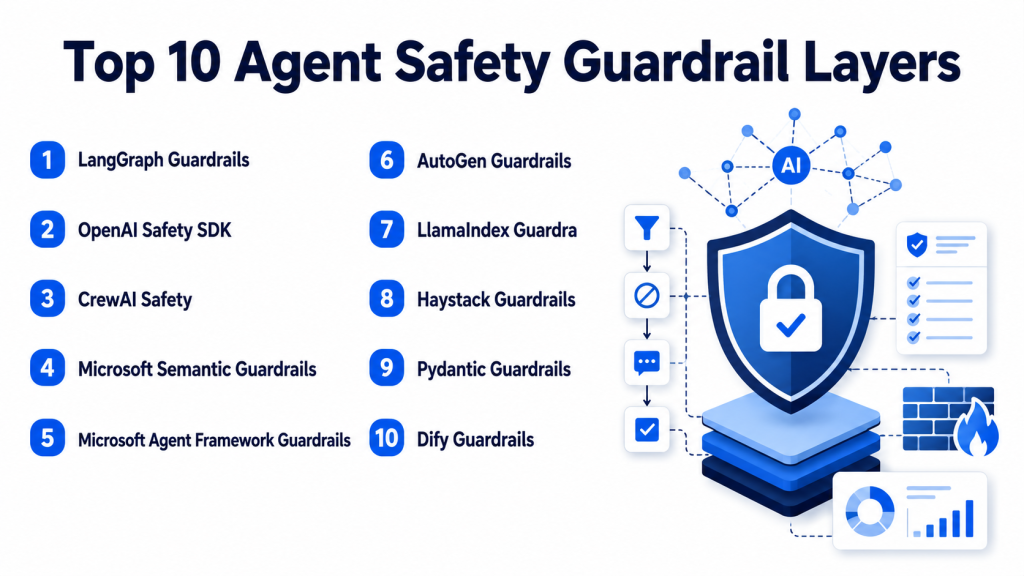
Top 10 Agent Safety Guardrail Layers
1- LangGraph Guardrails
One-line verdict: Enterprise-grade safety guardrails for multi-agent workflows with prompt and tool protection.
Short description:
LangGraph Guardrails enforce safety in multi-agent workflows, monitor prompt usage, control tool access, and integrate with RAG and memory stores.
Standout Capabilities
- Prompt validation and injection prevention
- Tool and API access control
- Human-in-the-loop safety checks
- Observability dashboards for unsafe actions
- RAG knowledge safety policies
- Multi-agent enforcement
- Versioned safety rules
AI-Specific Depth
- Model support: proprietary / BYO / multi-model
- RAG / knowledge integration: vector DB safety policies
- Evaluation: workflow testing, regression
- Guardrails: policy enforcement and prompt checks
- Observability: token usage, latency, unsafe action logs
Pros
- Enterprise-ready safety
- Multi-agent compliance support
- RAG and tool protection
Cons
- Requires engineering expertise
- Complex configuration
- Learning curve
Deployment & Platforms
Cloud / hybrid; Python-based
Integrations & Ecosystem
APIs, RAG connectors, LangChain ecosystem
Pricing Model
Open-source; enterprise support available
Best-Fit Scenarios
- Production multi-agent workflows
- Knowledge-driven RAG systems
- Human-in-the-loop compliance
2- OpenAI Safety SDK
One-line verdict: Safety middleware for OpenAI agents with prompt and tool enforcement.
Short description:
OpenAI Safety SDK provides guardrails for OpenAI agents, validating prompts, controlling tool usage, and monitoring unsafe outputs.
Standout Capabilities
- Prompt injection prevention
- Tool and API access policies
- Observability for unsafe actions
- Human-in-the-loop supervision
- Workflow branching safety
AI-Specific Depth
- Model support: OpenAI / BYO / multi-model
- RAG / knowledge integration: API safety connectors
- Evaluation: workflow and regression tests
- Guardrails: policy enforcement
- Observability: unsafe action logs, latency
Pros
- Developer-friendly
- Strong OpenAI integration
- Multi-agent prompt protection
Cons
- Limited outside OpenAI ecosystem
- Enterprise governance requires setup
- Premium deployment may be needed
Deployment & Platforms
Cloud; Python-based
Integrations & Ecosystem
OpenAI APIs, workflow tools, RAG pipelines
Pricing Model
Usage-based tiers
Best-Fit Scenarios
- Rapid prototyping
- Tool-driven workflows
- Multi-agent experimentation
3- CrewAI Safety
One-line verdict: Role-based guardrails for multi-agent task and tool safety.
Short description:
CrewAI Safety enforces role-based safety policies, controls tool access, and monitors multi-agent workflows for unsafe behavior.
Standout Capabilities
- Role-based enforcement
- Tool and API safety checks
- Multi-agent supervision
- Observability dashboards
- Human-in-the-loop approval
AI-Specific Depth
- Model support: BYO / multi-model
- RAG / knowledge integration: connectors
- Evaluation: workflow safety testing
- Guardrails: access policies
- Observability: unsafe action metrics
Pros
- Intuitive role-based safety
- Multi-agent enforcement
- Flexible configuration
Cons
- Complexity grows with number of agents
- Less code-first control
- Learning curve
Deployment & Platforms
Cloud / self-hosted; Python-based
Integrations & Ecosystem
APIs, RAG connectors, workflow tools
Pricing Model
Open-source with enterprise support
Best-Fit Scenarios
- Task-driven multi-agent safety
- Enterprise compliance workflows
- Knowledge-intensive processes
4- Microsoft Semantic Guardrails
One-line verdict: Enterprise safety module for multi-agent workflows with RAG and tool policy enforcement.
Short description:
Semantic Guardrails allow agents to safely interact with tools, memory, and RAG pipelines, ensuring compliance and controlled execution across enterprise workflows.
Standout Capabilities
- Multi-agent safety enforcement
- Tool and API access policies
- Human-in-the-loop supervision
- RAG and memory access controls
- Observability dashboards
AI-Specific Depth
- Model support: BYO / multi-model
- RAG / knowledge integration: safety connectors
- Evaluation: workflow safety regression tests
- Guardrails: prompt and tool policy enforcement
- Observability: unsafe action logs, latency, token usage
Pros
- Enterprise-ready safety
- Multi-agent compliance
- RAG and tool protection
Cons
- Microsoft ecosystem required
- Low-code support limited
- Enterprise deployment may require premium setup
Deployment & Platforms
Cloud / hybrid; Windows, Linux
Integrations & Ecosystem
Microsoft apps, RAG connectors, workflow APIs
Pricing Model
Open-source SDK with enterprise support
Best-Fit Scenarios
- Production multi-agent workflows
- Enterprise compliance enforcement
- RAG-enabled AI systems
5- Microsoft Agent Framework Guardrails
One-line verdict: Unified enterprise guardrail layer for multi-agent planning and tool execution.
Short description:
Agent Framework Guardrails enforce safety policies, control tool usage, and monitor multi-agent reasoning across production workflows.
Standout Capabilities
- Multi-agent safety enforcement
- Tool and API control
- State and memory protection
- Human-in-the-loop validation
- Observability dashboards
AI-Specific Depth
- Model support: BYO / multi-model
- RAG / knowledge integration: connectors
- Evaluation: regression and workflow safety tests
- Guardrails: policy enforcement
- Observability: execution logs, latency
Pros
- Enterprise-grade safety
- Unified multi-agent enforcement
- Observability and monitoring
Cons
- Microsoft ecosystem required
- Complexity for small teams
- Limited open-source examples
Deployment & Platforms
Cloud / hybrid; Web, Windows, Linux
Integrations & Ecosystem
Microsoft apps, APIs, RAG pipelines
Pricing Model
Enterprise license
Best-Fit Scenarios
- Regulated multi-agent workflows
- Enterprise AI deployment
- Production tool orchestration
6- AutoGen Guardrails
One-line verdict: Open-source safety layer for research and experimental multi-agent workflows.
Short description:
AutoGen Guardrails enforce tool, prompt, and memory safety in multi-agent workflows, suitable for research, experimentation, and prototyping.
Standout Capabilities
- Multi-agent safety enforcement
- Prompt injection detection
- Tool access controls
- Human-in-the-loop supervision
- Observability dashboards
AI-Specific Depth
- Model support: BYO / multi-model
- RAG / knowledge integration: connectors
- Evaluation: workflow and safety testing
- Guardrails: sandboxing
- Observability: unsafe action metrics, latency
Pros
- Open-source and flexible
- Research-friendly safety
- Multi-agent guardrails
Cons
- Production readiness limited
- Engineering expertise required
- Governance is minimal
Deployment & Platforms
Python, cloud / local
Integrations & Ecosystem
Tool connectors, APIs, RAG pipelines
Pricing Model
Open-source
Best-Fit Scenarios
- Research workflows
- Multi-agent experimentation
- Prototype AI workflows
7- LlamaIndex Guardrails
One-line verdict: RAG-focused guardrail module for safe multi-agent knowledge workflows.
Short description:
LlamaIndex Guardrails enforce safety policies in RAG pipelines, controlling retrieval, tool usage, and multi-agent interactions for enterprise AI.
Standout Capabilities
- Multi-agent safety enforcement
- Tool and API safety checks
- RAG pipeline safety
- Human-in-the-loop supervision
- Observability dashboards
AI-Specific Depth
- Model support: BYO / multi-model
- RAG / knowledge integration: vector DB connectors
- Evaluation: retrieval accuracy and workflow safety
- Guardrails: prompt, tool, and RAG policies
- Observability: latency, token metrics
Pros
- Knowledge-driven safety
- Multi-agent RAG enforcement
- Enterprise-ready
Cons
- Requires technical expertise
- Less low-code support
- Custom governance outside RAG may be needed
Deployment & Platforms
Python, cloud / hybrid
Integrations & Ecosystem
Vector DBs, APIs, RAG pipelines
Pricing Model
Open-source
Best-Fit Scenarios
- Knowledge assistants
- Multi-agent RAG workflows
- Enterprise document safety
8- Haystack Guardrails
One-line verdict: Modular safety module for RAG and multi-agent tool workflows.
Short description:
Haystack Guardrails enforce memory, prompt, and tool safety across modular multi-agent workflows, ideal for RAG-driven pipelines.
Standout Capabilities
- Modular guardrail components
- Tool and API safety enforcement
- Multi-agent supervision
- Observability dashboards
- RAG safety policies
AI-Specific Depth
- Model support: BYO / multi-model
- RAG / knowledge integration: connectors
- Evaluation: workflow and safety tests
- Guardrails: policy enforcement
- Observability: latency, token usage
Pros
- Flexible modular safety
- RAG and multi-agent ready
- Open-source
Cons
- Multi-agent collaboration limited
- Complex pipelines require engineering
- Guardrails may need customization
Deployment & Platforms
Python, cloud / hybrid
Integrations & Ecosystem
Vector DBs, APIs, RAG pipelines
Pricing Model
Open-source
Best-Fit Scenarios
- Knowledge-based workflows
- Multi-agent RAG pipelines
- Enterprise reasoning tasks
9- Pydantic Guardrails
One-line verdict: Python-first guardrail module for structured multi-agent reasoning.
Short description:
Pydantic Guardrails validate agent outputs, control tool and memory access, and enforce policy across multi-agent workflows.
Standout Capabilities
- Structured output validation
- Tool and memory access enforcement
- Multi-agent supervision
- Observability dashboards
- Human-in-the-loop checks
AI-Specific Depth
- Model support: BYO / multi-model
- RAG / knowledge integration: connectors
- Evaluation: workflow and reasoning tests
- Guardrails: schema validation, policy enforcement
- Observability: token usage, latency
Pros
- Type-safe safety enforcement
- Python developer-friendly
- Production-ready guardrails
Cons
- Python expertise required
- Less visual/low-code support
- Multi-agent orchestration may need custom design
Deployment & Platforms
Python, cloud / hybrid
Integrations & Ecosystem
Python apps, RAG pipelines, APIs
Pricing Model
Open-source
Best-Fit Scenarios
- Structured reasoning workflows
- Python-first multi-agent tasks
- Enterprise safety enforcement
10- Dify Guardrails
One-line verdict: Low-code safety layer for multi-agent planning, tool, and RAG workflows.
Short description:
Dify Guardrails provides visual safety enforcement for agents, ensuring prompt, memory, and tool access policies are followed in multi-agent workflows.
Standout Capabilities
- Visual safety workflow builder
- Tool and memory access policies
- Multi-agent supervision
- RAG and prompt safety
- Observability dashboards
AI-Specific Depth
- Model support: Hosted / BYO
- RAG / knowledge integration: connectors
- Evaluation: workflow safety testing
- Guardrails: policy enforcement
- Observability: token usage, latency
Pros
- Low-code rapid deployment
- Multi-agent RAG safety
- Visual enforcement of guardrails
Cons
- Less low-level control
- Governance depends on setup
- Complex workflows may require engineering
Deployment & Platforms
Web, cloud / self-hosted
Integrations & Ecosystem
LLMs, APIs, RAG pipelines, workflow tools
Pricing Model
Open-source / tiered
Best-Fit Scenarios
- Rapid prototyping with guardrails
- RAG-based multi-agent workflows
- Internal enterprise safety
Comparison Table
| Tool | Best For | Deployment | Model Flexibility | Strength | Watch-Out | Public Rating |
|---|---|---|---|---|---|---|
| LangGraph Guardrails | Enterprise workflows | Cloud / Hybrid | Multi-model / BYO | Durable multi-agent safety | Complexity | N/A |
| OpenAI Safety SDK | OpenAI agents | Cloud | OpenAI / BYO | Prompt & tool enforcement | Limited outside OpenAI | N/A |
| CrewAI Safety | Role-based workflows | Cloud / Self-hosted | BYO / Multi-model | Role-based enforcement | Complexity | N/A |
| Microsoft Semantic Guardrails | Enterprise AI | Cloud / Hybrid | Multi-model / BYO | Enterprise safety | Microsoft ecosystem | N/A |
| Microsoft Agent Framework Guardrails | Enterprise orchestration | Cloud / Hybrid | Multi-model | Unified guardrails | Microsoft-centric | N/A |
| AutoGen Guardrails | Research workflows | Cloud / Local | BYO / Multi-model | Flexible experimentation | Production readiness | N/A |
| LlamaIndex Guardrails | Knowledge-heavy workflows | Cloud / Hybrid | BYO / Multi-model | RAG safety | Engineering skill | N/A |
| Haystack Guardrails | Modular workflows | Cloud / Hybrid | BYO / Multi-model | Modular enforcement | Multi-agent collaboration | N/A |
| Pydantic Guardrails | Structured outputs | Cloud / Hybrid | BYO / Multi-model | Type-safe enforcement | Python-dependent | N/A |
| Dify Guardrails | Low-code workflows | Cloud / Self-hosted | Hosted / BYO | Rapid visual guardrails | Governance setup | N/A |
Scoring & Evaluation
| Tool | Core | Reliability | Guardrails | Integrations | Ease | Perf/Cost | Security/Admin | Support | Weighted Total |
|---|---|---|---|---|---|---|---|---|---|
| LangGraph Guardrails | 9 | 8 | 9 | 9 | 7 | 8 | 8 | 8 | 8.4 |
| OpenAI Safety SDK | 8 | 8 | 8 | 8 | 8 | 7 | 7 | 8 | 7.8 |
| CrewAI Safety | 8 | 7 | 8 | 8 | 8 | 7 | 7 | 8 | 7.7 |
| Microsoft Semantic Guardrails | 8 | 8 | 8 | 8 | 7 | 7 | 8 | 8 | 7.8 |
| Microsoft Agent Framework Guardrails | 8 | 8 | 8 | 8 | 7 | 7 | 8 | 8 | 7.8 |
| AutoGen Guardrails | 7 | 6 | 6 | 7 | 7 | 7 | 6 | 7 | 6.6 |
| LlamaIndex Guardrails | 8 | 7 | 8 | 9 | 7 | 7 | 7 | 8 | 7.7 |
| Haystack Guardrails | 8 | 7 | 7 | 8 | 7 | 7 | 7 | 8 | 7.4 |
| Pydantic Guardrails | 7 | 8 | 8 | 7 | 8 | 7 | 7 | 7 | 7.4 |
| Dify Guardrails | 7 | 6 | 7 | 8 | 9 | 7 | 7 | 7 | 7.2 |
Top 3 for Enterprise: LangGraph Guardrails, Microsoft Semantic Guardrails, Microsoft Agent Framework Guardrails
Top 3 for SMB: Dify Guardrails, CrewAI Safety, OpenAI Safety SDK
Top 3 for Developers: LangGraph Guardrails, Pydantic Guardrails, LlamaIndex Guardrails
Which Agent Safety Guardrail Layer Is Right for You
Solo / Freelancer
Dify Guardrails and Pydantic Guardrails are practical choices for solo developers who need lightweight safety controls without building a heavy enterprise governance stack. Dify works well when a visual workflow is preferred, while Pydantic Guardrails is useful for Python-first projects that need structured validation and safer outputs.
SMB
SMBs should focus on guardrails that are easy to deploy, flexible, and not too expensive to maintain. CrewAI Safety is useful for role-based multi-agent workflows, Dify Guardrails is helpful for low-code teams, and OpenAI Safety SDK fits teams already using OpenAI-based agent systems.
Mid-Market
Mid-market teams usually need stronger workflow governance, auditability, and RAG safety. LangGraph Guardrails, LlamaIndex Guardrails, and Haystack Guardrails are strong options when workflows involve tools, memory, documents, and internal knowledge systems. These teams should prioritize observability and human-in-the-loop review.
Enterprise
Enterprises should choose guardrail layers that support production control, approval workflows, identity integration, audit logs, and policy enforcement. LangGraph Guardrails is strong for complex agent workflows, while Microsoft Semantic Guardrails and Microsoft Agent Framework Guardrails fit organizations already aligned with Microsoft enterprise architecture.
Regulated Industries
Regulated industries such as healthcare, finance, insurance, public sector, and legal services should prioritize strict policy enforcement, access-aware retrieval, human approvals, and detailed audit logs. LangGraph Guardrails and Microsoft guardrail layers are better suited for governance-heavy workflows where unsafe actions, data leakage, or policy violations can create serious risk.
Budget vs Premium
Budget-conscious teams can start with open-source or low-code options such as AutoGen Guardrails, Pydantic Guardrails, Dify Guardrails, or CrewAI Safety. Premium or enterprise teams should invest in stronger guardrail architecture around LangGraph, Microsoft frameworks, or enterprise-grade RAG safety layers to reduce compliance and operational risk.
Build vs Buy
Build your own guardrail layer when your workflows are highly custom, your tool permissions are complex, or your industry has strict internal policy rules. Buy or adopt a platform-based guardrail layer when speed, governance, ease of rollout, and support are more important than deep customization. Many mature teams use a hybrid model: framework-level guardrails plus internal policy services.
Implementation Playbook 30 / 60 / 90 Days
30 Days
- Identify your highest-risk agent workflows, such as tool execution, customer communication, financial review, document retrieval, or internal system access.
- Define safety policies for prompts, outputs, tools, memory, RAG sources, and human approvals.
- Start with a limited pilot and apply guardrails to one real workflow.
- Add basic logging for prompts, tool calls, retrieved documents, blocked actions, and unsafe outputs.
- Create a small safety test set with prompt injection attempts, sensitive data requests, and risky tool actions.
- Decide which actions require human approval before execution.
- Document allowed tools, restricted actions, escalation paths, and ownership.
60 Days
- Add regression testing for prompt injection, hallucination risk, unsafe tool usage, and unauthorized retrieval.
- Implement RBAC, audit logs, environment separation, and access-aware retrieval.
- Add human-in-the-loop checkpoints for high-risk actions.
- Connect guardrails with RAG pipelines, memory stores, and tool-calling middleware.
- Build observability dashboards for blocked actions, false positives, latency, cost, and unsafe outputs.
- Create version control for guardrail policies, system prompts, tool permissions, and workflow rules.
- Run red-team testing with security, compliance, and business reviewers.
90 Days
- Optimize guardrail performance to reduce latency and false positives.
- Expand guardrails across more agent workflows and business teams.
- Create governance processes for changing policies, adding tools, updating prompts, and onboarding new data sources.
- Build incident response workflows for data leakage, unsafe outputs, unauthorized actions, and model failures.
- Review cost, latency, user feedback, blocked-action trends, and policy effectiveness.
- Standardize reusable guardrail templates for common workflows.
- Scale only after guardrails, evaluation, observability, and human review processes are stable.
Common Mistakes
- Ignoring prompt injection risk in RAG and tool-using workflows
- Allowing agents to call sensitive tools without approval
- Treating guardrails as a one-time setup instead of a continuous process
- Skipping evaluation and regression testing after prompt or model changes
- Not logging blocked actions, unsafe outputs, and tool failures
- Giving every agent the same permissions instead of role-based access
- Allowing memory stores to retain sensitive data without policy controls
- Forgetting that retrieved documents can contain malicious instructions
- Over-blocking harmless responses and reducing user trust
- Underestimating latency added by safety checks
- Not involving security, legal, compliance, and business owners early
- Using generic guardrails without adapting them to workflow risk
- Failing to test guardrails against real user behavior
- Scaling agent workflows before safety monitoring is mature
FAQs
1. What are agent safety guardrail layers?
Agent safety guardrail layers are controls that monitor and restrict AI agent behavior. They help prevent unsafe outputs, unauthorized tool calls, prompt injection, data leakage, and policy violations across agent workflows.
2. Why do AI agents need guardrails?
AI agents can retrieve data, call tools, trigger workflows, and interact with business systems. Without guardrails, they may expose sensitive data, take unsafe actions, follow malicious prompts, or produce unreliable decisions.
3. Are guardrails only needed for regulated industries?
No, guardrails are useful for any team deploying AI agents in real workflows. Regulated industries need stricter controls, but even internal assistants, customer support bots, and developer agents need safety checks.
4. Can guardrails stop prompt injection completely?
No guardrail can guarantee complete protection, but strong layers can reduce risk. Teams should combine input filtering, retrieval safety, tool permissions, human review, logging, and regular red-team testing.
5. How do guardrails work with RAG systems?
Guardrails can control what documents are retrieved, what instructions are trusted, and what outputs are allowed. They also help prevent agents from following malicious instructions hidden inside retrieved content.
6. Do guardrails increase latency?
Yes, some safety checks can add latency, especially if they inspect prompts, outputs, tools, and retrieved content. Teams should test performance and optimize policies to balance safety with user experience.
7. What is human-in-the-loop safety?
Human-in-the-loop safety means a person reviews or approves risky agent actions before they are executed. It is especially important for legal, financial, medical, security, and customer-facing workflows.
8. Can guardrails work with multiple LLMs?
Yes, many guardrail approaches can work across multiple models, but implementation varies. Buyers should check whether the guardrail layer supports BYO models, open-source models, hosted models, and multi-model routing.
9. How should I evaluate guardrail quality?
Evaluate blocked unsafe actions, false positives, prompt injection resistance, retrieval safety, policy accuracy, latency, and audit completeness. Use test cases that reflect real workflows, not only simple demo prompts.
10. Are open-source guardrails enough for enterprise use?
Open-source guardrails can be a strong starting point, but enterprise use often needs additional controls. These include identity integration, RBAC, audit logs, policy versioning, incident response, and compliance review.
Conclusion
Agent Safety Guardrail Layers are essential for any organization building AI agents that retrieve data, use tools, call APIs, store memory, or make workflow decisions. LangGraph Guardrails, Microsoft Semantic Guardrails, and Microsoft Agent Framework Guardrails are strong choices for enterprise and regulated environments, while Dify Guardrails, CrewAI Safety, and Pydantic Guardrails are practical for smaller teams and developer-led projects. The best guardrail layer depends on workflow risk, deployment model, tool access, RAG complexity, and compliance needs

Find Trusted Cardiac Hospitals
Compare heart hospitals by city and services — all in one place.
Explore Hospitals
Nice article! The comparison of agent simulation and sandboxing tools is clear, practical, and helpful for understanding secure AI testing environments.