
Introduction
Agent Simulation & Sandboxing Tools provide isolated environments where AI agents can be tested, evaluated, and trained safely before production deployment. They allow developers and enterprises to simulate multi-agent workflows, evaluate reasoning, test tool-calling and RAG integration, and prevent unsafe behaviors or unintended actions. Sandboxing ensures that agents operate in controlled environments, protecting sensitive systems, data, and workflows from accidental or malicious outcomes.
In , these tools are critical for enterprise AI, multi-agent orchestration, RAG pipelines, financial modeling, autonomous research, customer support automation, and regulated industry deployment. Buyers should evaluate isolation fidelity, multi-agent support, tool and API emulation, memory and state management, RAG integration, observability, human-in-the-loop supervision, policy enforcement, latency and cost impact, model-agnostic support, and red-teaming/testing capabilities.
Best for: AI engineers, enterprise AI teams, research labs, and regulated industries needing safe agent evaluation before deployment.
Not ideal for: small-scale chatbots, single-step agents, or systems without multi-step reasoning or tool interactions.
What’s Changed in Agent Simulation & Sandboxing Tools
- Multi-agent workflows can be fully simulated before production.
- Human-in-the-loop checkpoints are embedded for sensitive workflows.
- RAG pipelines can be tested safely in isolation.
- Observability dashboards track agent actions, tool calls, memory usage, and unsafe behaviors.
- Model-agnostic support allows BYO, proprietary, and open-source LLMs.
- Guardrails and policy enforcement are integrated into sandboxed environments.
- Memory and state management can be safely evaluated.
- Low-code visual simulation interfaces complement code-first frameworks.
- Versioning and rollback enable safe iterative testing.
- Synthetic environments and tool emulation allow stress-testing agent behavior.
- Cost and latency metrics can be measured before production.
- Red-teaming frameworks identify hallucinations or unsafe agent actions.
Quick Buyer Checklist
- Isolation fidelity for safe testing
- Multi-agent workflow simulation
- Tool-calling and API execution testing
- RAG and memory integration
- Human-in-the-loop workflow checkpoints
- Guardrails and policy enforcement
- Observability dashboards for action logs, latency, and token usage
- Model-agnostic support for BYO, proprietary, or open-source LLMs
- Cost and latency measurement
- Synthetic data and tool emulation support
- Versioning and rollback for iterative testing
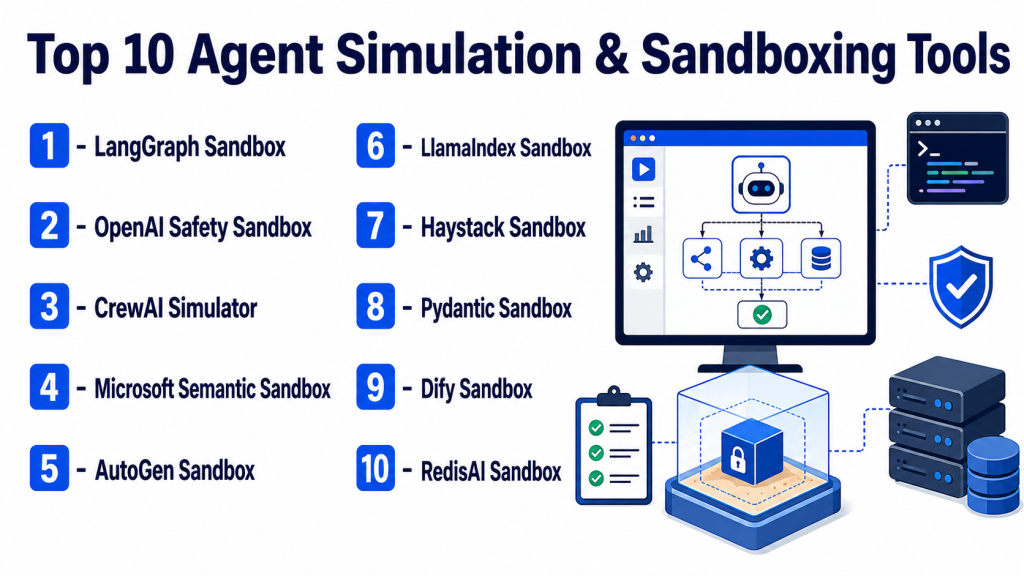
Top 10 Agent Simulation & Sandboxing Tools
1- LangGraph Sandbox
One-line verdict: Enterprise-grade simulation for multi-agent workflows with tool and memory testing.
Short description:
LangGraph Sandbox provides isolated environments to simulate multi-agent workflows, test tool interactions, memory usage, and RAG pipelines safely.
Standout Capabilities
- Graph-based multi-agent simulation
- Tool and API emulation
- Memory and RAG testing
- Human-in-the-loop checkpoints
- Observability dashboards
- Versioned workflow testing
- Fault injection and error testing
AI-Specific Depth
- Model support: proprietary / BYO / multi-model
- RAG / knowledge integration: vector DB emulation
- Evaluation: regression and reasoning tests
- Guardrails: policy enforcement, prompt injection detection
- Observability: token usage, latency, blocked action logs
Pros
- High control for enterprise workflows
- Supports multi-agent testing
- Safe RAG and tool evaluation
Cons
- Complex setup
- Requires engineering expertise
- Learning curve
Deployment & Platforms
Cloud / hybrid; Python-based
Integrations & Ecosystem
APIs, RAG connectors, LangChain ecosystem
Pricing Model
Open-source; enterprise support available
Best-Fit Scenarios
- Production multi-agent workflow testing
- Knowledge-driven RAG systems
- Human-in-the-loop policy validation
2- OpenAI Safety Sandbox
One-line verdict: Middleware for isolated OpenAI agent testing with prompt and tool simulation.
Short description:
OpenAI Safety Sandbox enables developers to simulate OpenAI agent workflows, validate tool usage, and test reasoning and safety policies.
Standout Capabilities
- Prompt and tool injection testing
- Multi-agent behavior simulation
- Observability dashboards
- Human-in-the-loop evaluation
- Regression testing
AI-Specific Depth
- Model support: OpenAI / BYO / multi-model
- RAG / knowledge integration: API connectors
- Evaluation: workflow regression tests
- Guardrails: safety policy enforcement
- Observability: latency, token, and unsafe action logs
Pros
- Developer-friendly
- Strong OpenAI ecosystem integration
- Supports multi-agent testing
Cons
- Limited outside OpenAI ecosystem
- Enterprise governance may require setup
- Premium features may be required
Deployment & Platforms
Cloud; Python-based
Integrations & Ecosystem
OpenAI APIs, workflow connectors, RAG pipelines
Pricing Model
Usage-based tiers
Best-Fit Scenarios
- Rapid prototyping
- Tool-driven workflow evaluation
- Multi-agent testing
3- CrewAI Simulator
One-line verdict: Role-based simulation for multi-agent workflow, tool, and memory evaluation.
Short description:
CrewAI Simulator enables role-based agent testing, simulating multi-agent interactions, tool access, and memory usage for enterprise workflows.
Standout Capabilities
- Role-based agent simulation
- Multi-agent coordination testing
- Tool and API execution validation
- Human-in-the-loop checkpoints
- Observability dashboards
AI-Specific Depth
- Model support: BYO / multi-model
- RAG / knowledge integration: connectors
- Evaluation: workflow correctness and regression
- Guardrails: access control policies
- Observability: unsafe actions, latency, token usage
Pros
- Intuitive role-based simulation
- Multi-agent workflow support
- Flexible for enterprise testing
Cons
- Complexity grows with workflow size
- Less code-first control
- Learning curve
Deployment & Platforms
Cloud / self-hosted; Python-based
Integrations & Ecosystem
APIs, RAG connectors, workflow tools
Pricing Model
Open-source with enterprise support
Best-Fit Scenarios
- Task-driven agent simulation
- Enterprise multi-agent coordination
- Knowledge-intensive processes
4- Microsoft Semantic Sandbox
One-line verdict: Enterprise simulation layer for multi-agent reasoning and tool safety.
Short description:
Semantic Sandbox allows agents to simulate multi-step reasoning, tool execution, and RAG pipeline interactions in a fully isolated environment.
Standout Capabilities
- Multi-agent workflow simulation
- Tool and API safety testing
- RAG pipeline testing
- Human-in-the-loop checkpoints
- Observability dashboards
AI-Specific Depth
- Model support: BYO / multi-model
- RAG / knowledge integration: connectors
- Evaluation: workflow regression, reasoning tests
- Guardrails: policy enforcement, prompt validation
- Observability: unsafe actions, latency, token metrics
Pros
- Enterprise-ready simulation
- Supports multi-agent RAG workflows
- Observability and monitoring
Cons
- Microsoft ecosystem required
- Limited low-code support
- Some features require premium deployment
Deployment & Platforms
Cloud / hybrid; Windows, Linux
Integrations & Ecosystem
Microsoft apps, RAG connectors, workflow APIs
Pricing Model
Open-source SDK with enterprise support
Best-Fit Scenarios
- Production multi-agent simulation
- Enterprise RAG testing
- Compliance-focused evaluation
5- AutoGen Sandbox
One-line verdict: Open-source sandbox for multi-agent experimentation with tool and memory simulation.
Short description:
AutoGen Sandbox provides an isolated environment to test multi-agent interactions, memory usage, and tool calls safely for research and prototyping.
Standout Capabilities
- Multi-agent workflow simulation
- Tool and API emulation
- Memory testing and RAG evaluation
- Human-in-the-loop checkpoints
- Observability dashboards
AI-Specific Depth
- Model support: BYO / multi-model
- RAG / knowledge integration: connectors
- Evaluation: reasoning correctness and regression tests
- Guardrails: sandboxed safety policies
- Observability: token usage, latency, unsafe actions
Pros
- Flexible for research
- Open-source and extensible
- Multi-agent sandboxing
Cons
- Limited production readiness
- Requires technical expertise
- Minimal enterprise governance
Deployment & Platforms
Python, cloud / local
Integrations & Ecosystem
APIs, RAG pipelines, memory stores
Pricing Model
Open-source
Best-Fit Scenarios
- Research workflows
- Multi-agent prototyping
- Experimental AI systems
6- LlamaIndex Sandbox
One-line verdict: RAG-focused sandbox for safe multi-agent knowledge workflows.
Short description:
LlamaIndex Sandbox simulates agent workflows in RAG-heavy environments, testing retrieval, reasoning, and tool-calling safely.
Standout Capabilities
- Multi-agent RAG simulation
- Tool and API access control
- Memory and context evaluation
- Observability dashboards
- Human-in-the-loop checkpoints
AI-Specific Depth
- Model support: BYO / multi-model
- RAG / knowledge integration: vector DB connectors
- Evaluation: retrieval and reasoning tests
- Guardrails: policy enforcement, prompt safety
- Observability: latency, token metrics
Pros
- Knowledge-driven sandbox
- Multi-agent RAG evaluation
- Enterprise-ready
Cons
- Technical expertise required
- Less low-code support
- Governance outside RAG may require custom policies
Deployment & Platforms
Python, cloud / hybrid
Integrations & Ecosystem
Vector DBs, APIs, RAG pipelines
Pricing Model
Open-source
Best-Fit Scenarios
- Knowledge assistants
- RAG-heavy workflows
- Enterprise sandbox testing
7- Haystack Sandbox
One-line verdict: Modular sandbox for multi-agent RAG and tool workflows.
Short description:
Haystack Sandbox simulates multi-agent workflows with modular components, allowing safe evaluation of tool-calling, memory, and retrieval-augmented reasoning.
Standout Capabilities
- Modular workflow simulation
- Tool and API safety checks
- Multi-agent reasoning
- RAG evaluation
- Observability dashboards
AI-Specific Depth
- Model support: BYO / multi-model
- RAG / knowledge integration: connectors
- Evaluation: workflow and reasoning testing
- Guardrails: policy enforcement
- Observability: latency, token usage
Pros
- Flexible and modular
- Multi-agent RAG ready
- Open-source
Cons
- Complex pipelines require engineering
- Guardrails may need customization
- Multi-agent collaboration is limited
Deployment & Platforms
Python, cloud / hybrid
Integrations & Ecosystem
Vector DBs, APIs, RAG pipelines
Pricing Model
Open-source
Best-Fit Scenarios
- Knowledge-driven workflows
- Multi-agent RAG pipelines
- Enterprise sandbox testing
8- Pydantic Sandbox
One-line verdict: Python-first sandbox for structured multi-agent simulation and validation.
Short description:
Pydantic Sandbox validates agent outputs, simulates tool usage, and tests memory interactions in structured multi-agent workflows.
Standout Capabilities
- Structured output validation
- Multi-agent workflow simulation
- Tool and API emulation
- Observability dashboards
- Human-in-the-loop checkpoints
AI-Specific Depth
- Model support: BYO / multi-model
- RAG / knowledge integration: connectors
- Evaluation: regression and retrieval tests
- Guardrails: schema validation, policy enforcement
- Observability: latency, token usage
Pros
- Type-safe simulation
- Python developer-friendly
- Production-ready evaluation
Cons
- Python expertise required
- Less visual/low-code support
- Complex multi-agent orchestration may need custom design
Deployment & Platforms
Python, cloud / hybrid
Integrations & Ecosystem
Python apps, APIs, RAG pipelines
Pricing Model
Open-source
Best-Fit Scenarios
- Structured reasoning workflows
- Python-first multi-agent testing
- Enterprise sandbox validation
9- Dify Sandbox
One-line verdict: Low-code sandbox for multi-agent tool, memory, and RAG evaluation.
Short description:
Dify Sandbox provides a visual environment for simulating multi-agent workflows, testing tool-calling, RAG integration, and memory handling.
Standout Capabilities
- Visual workflow builder
- Tool and memory safety simulation
- Multi-agent reasoning
- RAG integration testing
- Observability dashboards
AI-Specific Depth
- Model support: Hosted / BYO
- RAG / knowledge integration: connectors
- Evaluation: workflow and tool safety tests
- Guardrails: policy enforcement
- Observability: latency, token usage
Pros
- Low-code and rapid deployment
- Multi-agent sandboxing
- Visual workflow inspection
Cons
- Less control for custom policies
- Governance depends on setup
- Complex workflows may require engineering
Deployment & Platforms
Web, cloud / self-hosted
Integrations & Ecosystem
LLMs, APIs, RAG pipelines, workflow tools
Pricing Model
Open-source / tiered
Best-Fit Scenarios
- Rapid prototyping
- RAG and multi-agent workflows
- Enterprise sandbox testing
10- RedisAI Sandbox
One-line verdict: High-performance sandbox for safe multi-agent testing with low-latency memory.
Short description:
RedisAI Sandbox offers in-memory simulation of agent workflows, testing multi-agent reasoning, tool execution, and RAG integration with ultra-low latency.
Standout Capabilities
- In-memory workflow simulation
- Multi-agent coordination
- Tool and API emulation
- Memory and RAG testing
- Observability dashboards
AI-Specific Depth
- Model support: BYO / multi-model
- RAG / knowledge integration: connectors
- Evaluation: retrieval, reasoning, and latency tests
- Guardrails: access policies and safety checks
- Observability: token usage, latency metrics
Pros
- Extremely fast simulation
- Multi-agent testing at scale
- RAG and tool-safe evaluation
Cons
- Requires infrastructure setup
- Limited low-code interfaces
- Enterprise governance may need custom layers
Deployment & Platforms
Cloud, on-prem; Python, Web
Integrations & Ecosystem
APIs, RAG pipelines, vector DBs, workflow connectors
Pricing Model
Open-source / enterprise support
Best-Fit Scenarios
- High-performance sandboxing
- Latency-sensitive workflows
- Multi-agent RAG simulations
Comparison Table
| Tool | Best For | Deployment | Model Flexibility | Strength | Watch-Out | Public Rating |
|---|---|---|---|---|---|---|
| LangGraph Sandbox | Enterprise workflows | Cloud / Hybrid | Multi-model / BYO | Durable multi-agent simulation | Complexity | N/A |
| OpenAI Safety Sandbox | OpenAI agents | Cloud | OpenAI / BYO | Prompt & tool testing | Limited outside OpenAI | N/A |
| CrewAI Simulator | Role-based workflows | Cloud / Self-hosted | BYO / Multi-model | Role-based simulation | Complexity | N/A |
| Microsoft Semantic Sandbox | Enterprise AI | Cloud / Hybrid | Multi-model / BYO | Enterprise sandbox | Microsoft ecosystem | N/A |
| Microsoft Agent Framework Sandbox | Enterprise orchestration | Cloud / Hybrid | Multi-model | Unified simulation | Microsoft-centric | N/A |
| AutoGen Sandbox | Research workflows | Cloud / Local | BYO / Multi-model | Multi-agent experimentation | Production readiness | N/A |
| LlamaIndex Sandbox | Knowledge-heavy workflows | Cloud / Hybrid | BYO / Multi-model | RAG-focused simulation | Engineering skill | N/A |
| Haystack Sandbox | Modular workflows | Cloud / Hybrid | BYO / Multi-model | Flexible sandbox | Multi-agent collaboration | N/A |
| Pydantic Sandbox | Structured outputs | Cloud / Hybrid | BYO / Multi-model | Type-safe simulation | Python-dependent | N/A |
| Dify Sandbox | Low-code workflows | Cloud / Self-hosted | Hosted / BYO | Rapid prototyping | Governance setup | N/A |
| RedisAI Sandbox | High-performance workflows | Cloud / On-prem | BYO / Multi-model | Ultra-low latency | Infrastructure setup | N/A |
Scoring & Evaluation
| Tool | Core | Reliability | Guardrails | Integrations | Ease | Perf/Cost | Security/Admin | Support | Weighted Total |
|---|---|---|---|---|---|---|---|---|---|
| LangGraph Sandbox | 9 | 8 | 9 | 9 | 7 | 8 | 8 | 8 | 8.4 |
| OpenAI Safety Sandbox | 8 | 8 | 8 | 8 | 8 | 7 | 7 | 8 | 7.8 |
| CrewAI Simulator | 8 | 7 | 8 | 8 | 8 | 7 | 7 | 8 | 7.7 |
| Microsoft Semantic Sandbox | 8 | 8 | 8 | 8 | 7 | 7 | 8 | 8 | 7.8 |
| Microsoft Agent Framework Sandbox | 8 | 8 | 8 | 8 | 7 | 7 | 8 | 8 | 7.8 |
| AutoGen Sandbox | 7 | 6 | 6 | 7 | 7 | 7 | 6 | 7 | 6.6 |
| LlamaIndex Sandbox | 8 | 7 | 8 | 9 | 7 | 7 | 7 | 8 | 7.7 |
| Haystack Sandbox | 8 | 7 | 7 | 8 | 7 | 7 | 7 | 8 | 7.4 |
| Pydantic Sandbox | 7 | 8 | 8 | 7 | 8 | 7 | 7 | 7 | 7.4 |
| Dify Sandbox | 7 | 6 | 7 | 8 | 9 | 7 | 7 | 7 | 7.2 |
| RedisAI Sandbox | 9 | 8 | 9 | 9 | 7 | 8 | 8 | 8 | 8.4 |
Top 3 for Enterprise: LangGraph Sandbox, Microsoft Semantic Sandbox, RedisAI Sandbox
Top 3 for SMB: Dify Sandbox, CrewAI Simulator, OpenAI Safety Sandbox
Top 3 for Developers: LangGraph Sandbox, Pydantic Sandbox, LlamaIndex Sandbox
Which Agent Simulation & Sandboxing Tool Is Right for You
Solo / Freelancer
Dify Sandbox or Pydantic Sandbox are ideal for prototyping and testing small-scale agent workflows safely.
SMB
CrewAI Simulator, Dify Sandbox, and OpenAI Safety Sandbox offer practical multi-agent and tool-testing environments for teams.
Mid-Market
LangGraph Sandbox, LlamaIndex Sandbox, and Haystack Sandbox provide advanced simulation for RAG workflows and multi-agent reasoning.
Enterprise
Microsoft Semantic Sandbox, Microsoft Agent Framework Sandbox, and LangGraph Sandbox support production-grade multi-agent simulations with full observability and governance.
Regulated Industries
Choose tools with strong policy enforcement, human-in-the-loop checks, and audit logging. Microsoft and LangGraph Sandboxes are best suited for finance, healthcare, and legal applications.
Budget vs Premium
Budget: Dify Sandbox, AutoGen Sandbox, Pydantic Sandbox
Premium: LangGraph Sandbox, Microsoft frameworks, RedisAI Sandbox
Build vs Buy
Build your own sandbox for highly customized agent workflows; buy or adopt existing platforms for low-code enterprise deployment with integrated safety and observability.
Implementation Playbook 30 / 60 / 90 Days
30 Days: Pilot simulation on one multi-agent workflow, define safety and policy rules, add human-in-the-loop checkpoints, and log all agent actions.
60 Days: Integrate RAG and memory stores, expand to more agents and workflows, add regression testing, observability dashboards, and automated guardrails.
90 Days: Optimize cost and latency, expand sandbox coverage across departments, enforce governance, and scale production-ready agent simulations.
Common Mistakes
- Skipping human-in-the-loop simulation
- Testing only single-agent workflows
- Ignoring prompt injection and tool access risks
- Lack of observability and logging
- Overcomplicating sandbox configuration prematurely
- Underestimating latency and cost
- Using production data instead of synthetic environments
- Not versioning sandbox policies or workflows
- Overlooking RAG or memory testing
- Scaling before validating safety
FAQs
1. What are agent simulation and sandboxing tools?
Platforms that allow AI agents to run in isolated environments for testing, safety, and evaluation before production deployment.
2. Why are they important?
They prevent unsafe actions, tool misuse, prompt injection, and data leaks while validating reasoning and multi-agent interactions.
3. Can multiple agents be tested together?
Yes, modern sandboxes support multi-agent orchestration, interaction, and coordination in safe environments.
4. Are these tools suitable for RAG workflows?
Yes, most tools allow safe testing of retrieval-augmented generation pipelines and tool integrations.
5. Can human-in-the-loop supervision be implemented?
Yes, these platforms often provide checkpoints where humans approve or monitor agent actions.
6. Do they support memory testing?
Yes, agents can simulate long-term, short-term, and ephemeral memory usage safely.
7. Can open-source models be tested?
Most platforms support BYO, open-source, proprietary, and multi-model agent simulations.
8. Do these tools add latency?
Some sandbox layers may introduce minimal latency, which should be measured during testing.
9. How do I evaluate agent safety?
Use regression testing, red-teaming, observability dashboards, and prompt/tool stress tests.
10. Are they production-ready?
Some are research-focused; enterprise platforms like LangGraph or Microsoft Sandboxes are suitable for production-level simulations.
Conclusion
Agent Simulation & Sandboxing Tools are essential for safely evaluating multi-agent workflows, RAG pipelines, tool-calling, and memory usage before production. LangGraph Sandbox, Microsoft Semantic Sandbox, and RedisAI Sandbox excel for enterprise and regulated environments, while Dify Sandbox, Pydantic Sandbox, and AutoGen Sandbox are ideal for prototyping and research. The right sandbox depends on workflow complexity, risk level, compliance requirements, and budget.

Find Trusted Cardiac Hospitals
Compare heart hospitals by city and services — all in one place.
Explore Hospitals
Nice article! The comparison of agent simulation and sandboxing tools is clear, practical, and helpful for understanding secure AI testing environments.