
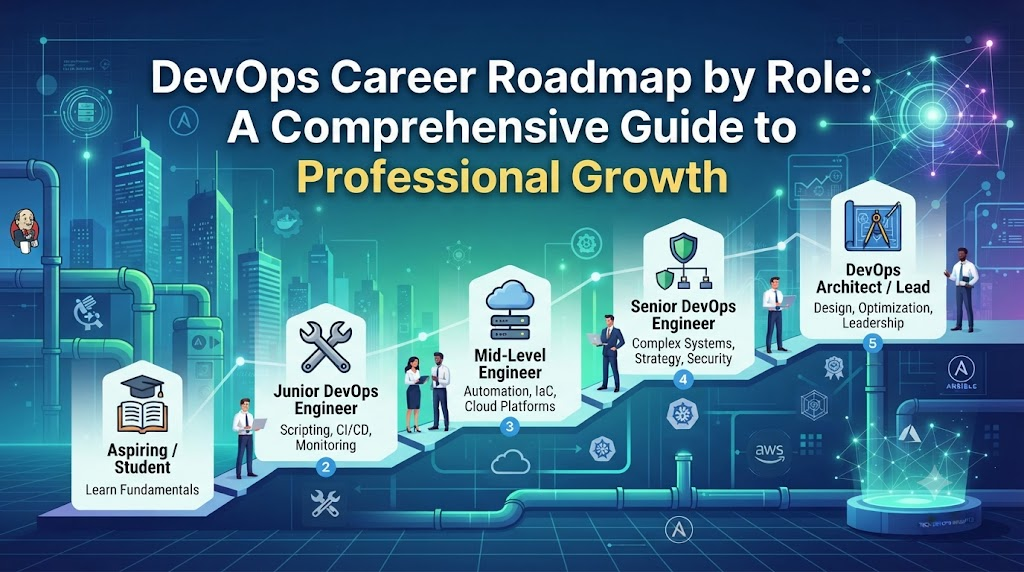
Introduction
Imagine sitting at your desk, opening a browser tab to figure out how to start a career in DevOps. Within minutes, you are staring at a massive, overwhelming list of technologies: Linux, Git, cloud platforms, containers, Kubernetes, continuous integration and continuous deployment pipelines, Terraform, monitoring tools, security scanners, shell scripting, and dozens of other frameworks.
For many beginners, this massive landscape leads directly to tool overload and confusion. The immediate questions that arise are simple yet frustrating: Which skills should I learn first? Do I need to master every single tool on the internet before applying for a job?
The reality is that DevOps is not a single tool or a narrow job description; it is a vast culture and engineering practice. Trying to learn everything simultaneously is a recipe for burnout. Instead, professionals need a role-based DevOps career roadmap that matches their specific target job, aligns with their background, and provides a structured path from fundamentals to advanced specialization.
What Is a DevOps Career Roadmap?
A DevOps career roadmap is a structured, step-by-step strategic guide that helps technical professionals navigate the journey from beginner to specialist or leader. Rather than serving as a random checklist of trendy tools, a well-designed roadmap identifies:
- Target professional role
- Required foundational knowledge
- Core technologies and scripting languages
- Practical hands-on projects
- Experience-building strategies
- Relevant certifications
- Interview preparation paths
- Long-term career progression milestones
Crucially, there is no single DevOps roadmap that fits everyone. A site reliability engineer requires a deep understanding of distributed systems and telemetry, whereas a cloud engineer focuses heavily on networking, identity management, and infrastructure provisioning. Choosing your destination role first changes how you approach your entire learning journey.
Why a Role-Based DevOps Roadmap Matters
Jumping into the job market without a target role often leads to superficial learning. You might know a little bit of Terraform, a bit of Docker, and a few basic Linux commands, but you lack the deep expertise required for any specific engineering position.
Adopting a role-based approach offers several clear advantages:
- Focused Learning: You concentrate only on the technologies and concepts relevant to your chosen career track.
- Less Tool Overload: Instead of trying to master five different CI/CD tools at once, you master one thoroughly.
- Better Project Selection: Your portfolio projects directly reflect the daily responsibilities of your target job.
- Faster Skill Development: Depth in a specific domain yields faster employability than shallow familiarity across twenty domains.
- Clear Career Goals: You understand the exact milestone requirements needed to move from a junior role to a mid-level or senior position.
- Targeted Interview Preparation: You can anticipate technical scenarios related directly to your daily operational scope.
Professionals should always learn transferable fundamentals first—such as operating systems, networking, and version control—and specialize in a specific role afterward.
Common DevOps Fundamentals Everyone Should Learn
Regardless of your final destination, every successful DevOps professional shares a common core foundation. Before specializing, you must become comfortable with:
- Linux: Process management, file permissions, log analysis, and system administration.
- Networking: IP addressing, DNS, TCP/IP, HTTP/HTTPS, load balancing, and firewalls.
- Git: Branching strategies, merging, pull requests, and repository management.
- Basic Scripting: Writing Bash or Python scripts to automate repetitive administrative tasks.
- Software Development Lifecycle (SDLC): Understanding how code moves from a developer’s local machine to production.
- DevOps Principles: Collaboration, automation, feedback loops, and continuous improvement.
- CI/CD Fundamentals: The basic mechanics of building, testing, and deploying code automatically.
- Cloud Fundamentals: Core compute, storage, and networking concepts offered by major cloud providers.
- Containers: Understanding how containerization isolates applications and dependencies.
- Monitoring & Troubleshooting: Reading system logs, tracking resource utilization, and debugging basic application failures.
Junior DevOps Engineer Career Roadmap
The junior stage is about proving your ability to handle foundational systems, support existing pipelines, and learn rapidly in a team environment.
Beginner Stage
- Master Linux administration, file systems, and user permissions.
- Learn Git workflows for collaborative code management.
- Understand networking basics, including ports, protocols, and DNS resolution.
- Learn shell scripting (Bash) for simple automation tasks.
Intermediate Stage
- Learn the basics of continuous integration and continuous deployment pipelines.
- Explore cloud fundamentals (compute instances, storage buckets, and security groups).
- Learn container basics using Docker and write simple Dockerfiles.
- Gain exposure to Infrastructure as Code tools like Terraform.
- Learn how to configure basic application and system monitoring.
Practical Stage
- Build automated build and test scripts.
- Containerize a multi-tier web application.
- Set up a basic CI/CD pipeline to deploy code to a cloud virtual machine.
- Troubleshoot simulated deployment failures in a personal lab.
Career Stage
- Prepare for Junior DevOps Engineer, DevOps Associate, or Cloud Support roles.
- Focus on demonstrating a strong grasp of fundamentals and a willingness to learn.
DevOps Engineer Career Roadmap
A standard DevOps Engineer bridges the gap between software development and IT operations, focusing heavily on delivery speed, environment consistency, and automation.
- Core Stack: Linux, Git, advanced scripting (Python/Bash), CI/CD platforms, cloud services, Docker, Kubernetes, Terraform, and monitoring solutions.
- Daily Responsibilities: Designing deployment automation, managing lower and upper environments, troubleshooting pipeline bottlenecks, maintaining infrastructure, and collaborating closely with developers.
- Recommended Learning Sequence: Master Linux and scripting $\rightarrow$ Learn advanced Git workflows $\rightarrow$ Build robust CI/CD pipelines $\rightarrow$ Provision cloud resources with Infrastructure as Code $\rightarrow$ Containerize and orchestrate applications $\rightarrow$ Implement comprehensive monitoring.
Cloud Engineer Career Roadmap
Cloud Engineers focus primarily on the architecture, provisioning, security, and optimization of cloud-native environments.
- Core Focus Areas: Cloud fundamentals, advanced virtual networking, identity and access management (IAM), compute scaling, managed databases, storage tiers, Infrastructure as Code, cost awareness, and high availability.
- Overlap with DevOps: While Cloud Engineers design and secure the core cloud foundation, DevOps Engineers build the delivery pipelines that run on top of that foundation. In many organizations, these roles overlap significantly.
Site Reliability Engineer Career Roadmap
Site Reliability Engineering (SRE) applies software engineering principles to infrastructure and operational problems, prioritizing system stability, scalability, and performance.
- Core Focus Areas: Linux systems internals, software engineering or advanced scripting, distributed systems fundamentals, observability (metrics, logs, traces), incident management, capacity planning, and reliability modeling.
- Key Concepts: Service Level Indicators (SLIs), Service Level Objectives (SLOs), error budgets, toil reduction, and structured post-mortem analysis. SREs treat operations as a software problem.
Platform Engineer Career Roadmap
Platform Engineering is focused on building internal developer platforms (IDPs) that enable self-service workflows for product development teams.
- Core Focus Areas: Kubernetes, cloud architecture, Infrastructure as Code, CI/CD orchestration, developer tooling, automation, self-service infrastructure APIs, internal developer experience, observability, and security guardrails.
- Mission: Platform engineers build paved roads that allow developers to ship code quickly and safely without needing to master every underlying infrastructure detail.
DevSecOps Engineer Career Roadmap
DevSecOps embeds security practices directly into every stage of the software delivery lifecycle rather than treating security as an afterthought.
- Core Focus Areas: DevOps fundamentals, security principles, secure coding concepts, CI/CD security, static and dynamic application security testing (SAST/DAST), dependency scanning, container vulnerability scanning, secrets management, and policy automation.
- Mission: Shift security left by automating checks inside pipelines to catch vulnerabilities before code reaches production.
Infrastructure Engineer Career Roadmap
Infrastructure Engineers focus on building, scaling, and maintaining the core hardware, virtualization, and cloud environments that support enterprise applications.
- Core Focus Areas: Linux administration, enterprise networking, server virtualization, cloud infrastructure, Infrastructure as Code, configuration management, automated backups, disaster recovery, and hardware security.
- Evolution: Modern infrastructure engineering relies heavily on code and automation, bringing it very close to traditional cloud and DevOps engineering.
CI/CD Engineer Career Roadmap
CI/CD Engineers specialize in designing, optimizing, and maintaining the software delivery pipelines that move code from source control to production.
- Core Focus Areas: Advanced Git branching strategies, build systems, automated testing integration, artifact management, pipeline security, release automation, and environment promotion.
- Deployment Strategies:
- Blue-Green Deployment: Maintaining two identical environments to instantly switch traffic between versions with zero downtime.
- Canary Deployment: Rolling out a new version to a small subset of users before expanding it to the entire user base.
- Rolling Deployment: Gradually replacing instances of the old version with the new version.
Automation Engineer Career Roadmap
Automation Engineers focus on eliminating manual toil across operations, testing, and deployment processes.
- Core Focus Areas: Advanced shell scripting, Python development, API integrations, infrastructure automation, configuration management, test automation frameworks, and cloud orchestration.
- Key Principle: Always understand and analyze the operational problem thoroughly before attempting to automate it. Automating a broken process only creates faster failures.
Kubernetes Engineer Career Roadmap
Kubernetes Engineers specialize in container orchestration, cluster operations, and cloud-native application delivery.
- Core Focus Areas: Container fundamentals, Kubernetes architecture, pods, deployments, services, configmaps, secrets, ingress controllers, persistent storage, role-based access control (RBAC), cluster networking, and advanced troubleshooting.
- Prerequisite Note: Kubernetes should never be learned in isolation. A strong understanding of Linux, networking, containers, and cloud architecture is mandatory before managing production clusters.
DevOps Architect Career Roadmap
DevOps Architects operate at a strategic level, designing scalable, secure, and cost-effective delivery ecosystems for large organizations.
- Core Focus Areas: Advanced cloud architecture, distributed systems design, cross-region disaster recovery, enterprise security frameworks, CI/CD architecture at scale, observability standards, cost optimization, and technical governance.
- Key Attribute: Architects excel at evaluating technical trade-offs rather than simply accumulating knowledge of new tools.
DevOps Lead / Engineering Manager Roadmap
Moving into leadership requires shifting focus from individual technical execution to team performance, delivery management, and strategic alignment.
- Core Focus Areas: Technical decision-making, team collaboration, project planning, risk management, incident leadership, mentoring engineers, stakeholder communication, and delivery governance.
- Core Truth: Leadership requires a strong balance of technical empathy and exceptional human communication skills.
Role-Based DevOps Skills Comparison
| Role | Core Skills | Advanced Skills | Typical Focus |
| Junior DevOps Engineer | Linux, Git, CI/CD basics | Cloud, Infrastructure as Code | Learning automation fundamentals |
| DevOps Engineer | CI/CD, cloud, containers | Kubernetes, advanced IaC | Software delivery and operations |
| Cloud Engineer | Cloud services, networking, IAM | IaC, multi-cloud architecture | Cloud infrastructure management |
| Site Reliability Engineer | Linux, automation, monitoring | Distributed systems, observability | System availability and reliability |
| Platform Engineer | Cloud, Kubernetes, automation | Developer platforms, self-service | Developer productivity |
| DevSecOps Engineer | DevOps core, security basics | Security automation, compliance | Secure software delivery |
| Infrastructure Engineer | Linux, networking, servers | IaC, disaster recovery | Core infrastructure stability |
| CI/CD Engineer | Git, pipeline building | Release automation, deployment strategies | Software delivery pipelines |
| Automation Engineer | Scripting, APIs | Advanced workflow automation | Operational efficiency |
| Kubernetes Engineer | Containers, Kubernetes | Cluster operations, service mesh | Cloud-native orchestration |
| DevOps Architect | DevOps stack, cloud systems | Enterprise architecture, cost governance | System design and strategy |
| DevOps Lead / Manager | Technical execution | Team leadership, delivery management | Team growth and project success |
Common Skills Across All DevOps Roles
Regardless of which specialized path you choose, certain skills remain universally valuable:
- Linux command-line proficiency
- Version control with Git
- Fundamental networking concepts
- Scripting for automation
- Cloud environment literacy
- Systematic troubleshooting methodology
- Monitoring and log analysis
- Basic security awareness
- Clear technical communication and documentation
Role-Specific Skill Matrix
| Skill Area | Junior DevOps | DevOps Engineer | SRE | Platform Engineer | Cloud Engineer |
| Linux | Beginner | Intermediate | Advanced | Intermediate | Intermediate |
| Networking | Beginner | Intermediate | Intermediate | Intermediate | Advanced |
| Cloud | Beginner | Intermediate | Intermediate | Advanced | Advanced |
| CI/CD | Beginner | Advanced | Intermediate | Advanced | Intermediate |
| Containers | Beginner | Intermediate | Intermediate | Advanced | Intermediate |
| Kubernetes | Basic | Intermediate | Intermediate | Advanced | Intermediate |
| IaC | Basic | Intermediate | Intermediate | Advanced | Advanced |
| Monitoring | Basic | Intermediate | Advanced | Intermediate | Intermediate |
| Security | Basic | Intermediate | Intermediate | Intermediate | Advanced |
| Scripting | Beginner | Intermediate | Advanced | Advanced | Intermediate |
| Troubleshooting | Basic | Intermediate | Advanced | Intermediate | Intermediate |
How to Choose the Right DevOps Role
Choosing your path comes down to honest self-assessment. Ask yourself these guiding questions:
- Do I enjoy building and scaling infrastructure? (Consider Cloud or Infrastructure Engineering)
- Do I love writing code that eliminates repetitive tasks? (Consider Automation Engineering)
- Am I fascinated by software delivery pipelines and zero-downtime releases? (Consider CI/CD Engineering)
- Do I care deeply about security guardrails and vulnerability scanning? (Consider DevSecOps)
- Do I enjoy analyzing system failures, performance metrics, and uptime? (Consider SRE)
- Do I like building internal developer portals and self-service tools? (Consider Platform Engineering)
- Do I enjoy orchestrating container clusters? (Consider Kubernetes Engineering)
- Do I like guiding technical strategy, mentoring engineers, and managing teams? (Consider Leadership or Architecture)
DevOps Roadmap for Developers
Developers transitioning into DevOps already understand software development lifecycles, coding principles, and version control.
- Leverage Existing Skills: Code comprehension, Git workflows, and debugging.
- Focus Areas to Add: Linux administration, networking, CI/CD pipelines, containerization, cloud services, and Infrastructure as Code.
DevOps Roadmap for System Administrators
System administrators possess strong operational foundations, making them natural candidates for DevOps, cloud, or SRE roles.
- Leverage Existing Skills: Linux systems, networking, server management, and troubleshooting.
- Focus Areas to Add: Git version control, Python or advanced Bash scripting, CI/CD pipelines, cloud platforms, containers, and Infrastructure as Code.
DevOps Roadmap for QA Engineers
Quality Assurance professionals bring a strong focus on testing, validation, and quality control.
- Leverage Existing Skills: Test automation, quality standards, and system validation.
- Focus Areas to Add: Git, CI/CD pipeline integration, containerization, cloud fundamentals, and security scanning tools.
DevOps Roadmap for Fresh Graduates
Fresh graduates should avoid the trap of trying to learn every available tool at once. Follow a gradual, structured progression:
- Stage 1: Linux, Networking, and Git.
- Stage 2: Shell Scripting and core DevOps principles.
- Stage 3: CI/CD fundamentals and Cloud basics.
- Stage 4: Containers (Docker) and Infrastructure as Code (Terraform).
- Stage 5: Monitoring, logging, and basic security practices.
- Stage 6: Capstone projects, portfolio building, and interview preparation.
Certifications in a DevOps Career Roadmap
Certifications can provide structured learning paths and validate your foundational knowledge to recruiters. However, certifications alone do not guarantee a job or a salary increase.
A balanced formula for career success is:
$$\text{Certification} + \text{Hands-On Projects} + \text{Practical Skills} + \text{Real Experience}$$
Choose certifications that directly support your target role rather than collecting badges indiscriminately.
DevOps Projects by Role
Practical projects prove your competence far better than any resume bullet point. Tailor your projects to your target role:
- DevOps Engineer: Build a complete automated CI/CD pipeline that tests, builds, and deploys a web application to the cloud.
- Cloud Engineer: Provision a multi-tier cloud environment using Terraform with automated networking, security groups, and database replication.
- SRE: Build a monitoring stack with Prometheus and Grafana, set up alerting rules, and run a simulated load test to observe system recovery.
- Platform Engineer: Create a self-service deployment workflow that allows users to spin up pre-configured environments with a single command.
- DevSecOps Engineer: Integrate static code analysis and container vulnerability scanning into an existing CI/CD pipeline.
- Kubernetes Engineer: Deploy, secure, and monitor a microservices application inside a multi-node Kubernetes cluster.
- Infrastructure Engineer: Automate server configuration and patch management across multiple virtual machines.
- Automation Engineer: Write robust Python scripts that interact with cloud APIs to automate routine backup and cleanup tasks.
- CI/CD Engineer: Design a multi-stage delivery pipeline supporting blue-green and canary deployment strategies.
How to Build a DevOps Portfolio by Role
When showcasing your projects on GitHub or a personal portfolio, document them thoroughly:
- Problem Statement: What challenge did you solve?
- Architecture: Include a clear diagram of your setup.
- Tools Used: List the specific technologies and versions.
- Implementation: Provide clean, well-commented code and configuration files.
- Automation & Security: Highlight how you automated workflows and secured secrets.
- Monitoring & Troubleshooting: Explain how you monitored the system and handled errors.
- Results & Lessons Learned: Discuss what worked, what failed, and how you improved it.
How to Gain Real-World DevOps Experience
Gaining practical experience without a formal title can be achieved through several avenues:
- Contributing to open-source infrastructure and tooling projects.
- Building and maintaining personal lab environments in the cloud.
- Taking on internal automation projects within your current non-DevOps job.
- Participating in hackathons and collaborative technical projects.
- Volunteering technical assistance for non-profit organizations.
DevOps Interview Preparation by Role
Interview preparation should match the specific responsibilities of your target role:
- DevOps Engineer Interviews: Expect questions on pipeline design, cloud services, container troubleshooting, and Infrastructure as Code state management.
- SRE Interviews: Focus on incident management scenarios, SLI/SLO definitions, system debugging, and distributed systems reliability.
- Cloud Engineer Interviews: Prepare for networking deep dives, IAM policies, cloud architecture patterns, and cost optimization strategies.
- DevSecOps Interviews: Review security scanning integration, vulnerability remediation, secrets management, and container hardening.
- Platform Engineer Interviews: Be ready to discuss Kubernetes architecture, developer experience, self-service tooling, and cluster management.
Common Mistakes When Following a DevOps Roadmap
- Learning Too Many Tools: Trying to learn every tool on the market instead of mastering core concepts.
- Ignoring Linux and Networking: Skipping the fundamentals and struggling when advanced systems fail.
- Skipping Hands-On Practice: Watching tutorials without writing configuration files or running pipelines yourself.
- Chasing Certificates Excessively: Accumulating certifications without building a corresponding project portfolio.
- Ignoring Troubleshooting: Relying only on success paths and never learning how to debug failures.
- Focusing on Titles over Skills: Worrying about job titles rather than actual engineering competence.
How Long It Takes to Learn DevOps
There is no fixed timeline or guarantee that you can become job-ready in a specific number of days or months. Timelines vary based on your prior technical background, daily study hours, target role complexity, and hands-on exposure.
Skills That Become More Important at Senior Levels
As you progress into senior and leadership roles, the nature of your work shifts away from simple tool execution:
- Systems architecture and long-term design
- Evaluating technical trade-offs objectively
- Designing for reliability, security, and cost efficiency
- Strategic automation and scaling
- Incident leadership and crisis management
- Mentoring junior engineers and fostering team growth
- Bridging technical execution with business objectives
Role of DevOpsSchool
Building a structured career in modern engineering requires guidance, practical exposure, and comprehensive training. For professionals seeking to master these domains, structured learning programs can help solidify foundations and develop hands-on expertise.
Platforms such as DevOpsSchool offer targeted training and professional development across cloud computing, continuous delivery, automation, container orchestration, monitoring, and site reliability engineering, helping practitioners align their skills with industry demands.
Future of DevOps Careers
The DevOps landscape continues to evolve alongside modern software development. Emerging trends point toward deeper integration of platform engineering, AI-assisted operations, advanced observability, GitOps workflows, and secure cloud-native infrastructure.
Future professionals will increasingly need to understand holistic system design, intelligent automation, security guardrails, and measurable business outcomes. DevOps is not shrinking; it is maturing into specialized disciplines that require deep engineering competence.
Frequently Asked Questions
What is the best DevOps career path for beginners?
Beginners should start with foundational IT skills—specifically Linux, networking, Git, and basic scripting—before moving into a Junior DevOps or Cloud Support role.
Which skills are common to all DevOps roles?
Linux administration, networking fundamentals, version control with Git, basic automation scripting, troubleshooting methodology, and collaboration skills are essential across every role.
How do I choose between DevOps, SRE, and Cloud Engineering?
Choose based on your daily interests: DevOps focuses on delivery pipelines and automation, SRE focuses on system reliability and observability, and Cloud Engineering focuses on infrastructure provisioning and architecture.
Can developers transition into DevOps?
Yes. Developers already understand software lifecycles and coding, making it straightforward for them to learn infrastructure, CI/CD pipelines, and cloud services.
Can system administrators become DevOps engineers?
Yes. System administrators possess strong operational foundations in Linux and networking, which makes learning automation, cloud platforms, and Infrastructure as Code a natural extension of their skills.
Do I need certifications for a DevOps career?
Certifications are helpful for structured learning and resume screening, but hands-on projects and practical problem-solving experience carry much more weight in technical interviews.
How can I build a DevOps portfolio?
Build complete end-to-end projects—such as automated CI/CD pipelines or cloud infrastructure deployments—and document your architecture, code, security practices, and troubleshooting steps on GitHub.
How long does it take to learn DevOps?
Learning timelines vary based on your background and daily commitment. Focus on steady progression through fundamentals, hands-on practice, and project building rather than chasing arbitrary timelines.
Final Thoughts
DevOps is a broad career field rather than a single job title. Different roles require different levels of technical depth, but foundational knowledge in Linux, networking, Git, automation, and troubleshooting remains valuable everywhere.
Choose a target role before building an advanced learning path, practice through real projects, develop role-specific expertise, and gradually expand your skills as your career grows. Senior success comes from combining technical depth with architecture, communication, leadership, and problem-solving ability.

Find Trusted Cardiac Hospitals
Compare heart hospitals by city and services — all in one place.
Explore Hospitals