
Introduction
In traditional software development lifecycles, testing and security evaluations were historically relegated to the final phases of the delivery pipeline, an approach that introduces unsustainable friction, prolonged remediation times, and severe financial penalties when critical defects escape into production. As enterprise demands shift toward rapid, reliable software delivery, organizations must establish an absolute equilibrium between deployment velocity, architectural stability, and comprehensive compliance by shifting validation mechanisms closer to the initiation of the development pipeline. This imperative for early validation gave rise to the philosophy of moving processes upstream, a core principle engineered to embed verification mechanisms directly into the foundational stages of the software lifecycle to eliminate systemic handoff delays. Organizations looking to master these modern methodologies and operationalize continuous testing, automation pipelines, and robust security protocols frequently engage with specialized educational platforms like DevOpsSchool, ensuring that code quality and system safety are verified programmatically the moment code is composed.
What Is Shift-Left in DevOps?
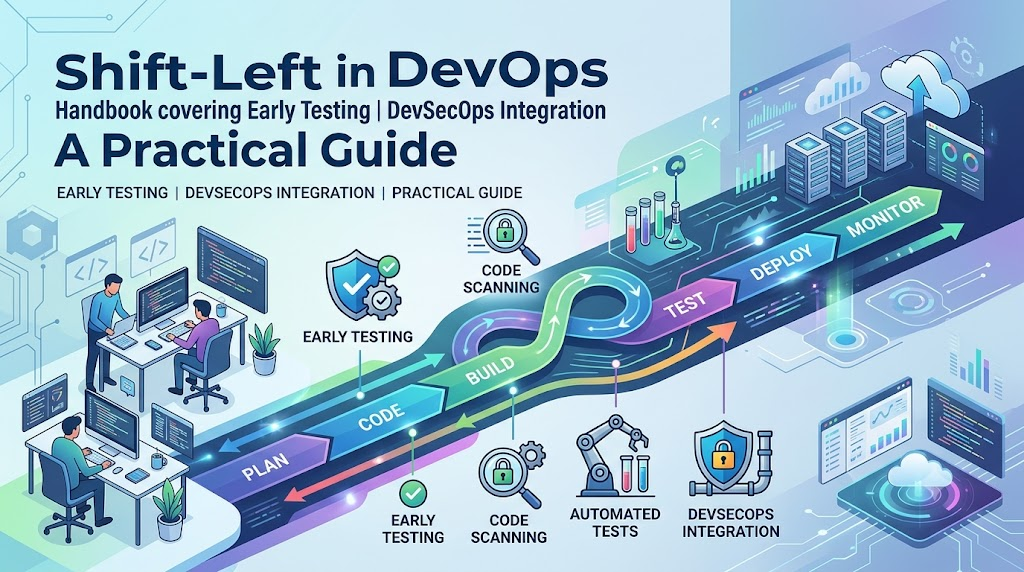
The concept of moving processes upstream represents an architectural philosophy that shifts critical validation tasks—specifically software testing, vulnerability scanning, compliance checks, and configuration audits—to the earliest attainable phases of the software development lifecycle. Instead of treating quality control and security evaluation as discrete phases executed after code compilation, this approach treats validation as an active, continuous component of the daily engineering workflow. The term itself refers to moving these verification practices to the left on a linear project timeline that proceeds from requirements gathering to production operations.
Early Testing
Early testing involves executing validation protocols during the initial phases of the delivery cycle. Developers run localized, automated test suites before committing code to shared repositories. By validating individual components, functions, and API contracts immediately after creation, teams catch algorithmic errors and behavioral regressions before they contaminate the primary code branches.
Early Security Validation
Early security validation integrates security assessments directly into the developer workflow. Rather than waiting for comprehensive seasonal penetration tests or pre-production vulnerability scans, code undergoes automated structural analysis, dependency checking, and secret detection during the compilation phase. This ensures that security flaws are highlighted while the codebase is still active in the developer’s local environment.
Continuous Feedback
Continuous feedback mechanisms form the operational communication backbone of an upstream validation model. When automated testing suites, code linters, and architectural policy checkers run on every code commit, developers receive objective reports within minutes. This rapid feedback loop ensures that engineering teams maintain a precise, real-time understanding of system stability, removing ambiguity regarding which code modification introduced a failure.
Risk Reduction
Proactively moving validation upstream systematically minimizes architectural risks. By identifying structural defects, interface mismatches, and configuration drifts during the design and early implementation phases, engineering teams prevent complex, multi-layered system failures that are difficult to diagnose in distributed pre-production or production environments.
Quality Improvement
Overall software quality shifts from a reactive metric to a proactive engineering standard. When code validation is treated as an ongoing requirement throughout the entire lifecycle, the foundational codebase remains clean, well-documented, and verifiable. This ongoing emphasis on code health yields highly maintainable applications characterized by modular design patterns and reliable runtime behavior.
Why Shift-Left Matters
Transitioning validation mechanisms to the earliest phases of development directly impacts an enterprise’s technical efficiency and fiscal performance. The business and technical justification for adopting an upstream validation strategy revolves around concrete metrics: cost optimization, compressed feedback cycles, robust security, and elevated deployment reliability.
Reduced Defect Costs
The financial argument for moving validation upstream is illustrated by the escalating cost curve of software defects. A structural bug identified during the requirements or initial coding phase requires minimal effort to resolve, often requiring just a simple code refactoring. The same defect discovered in a staging environment requires extensive log analysis, developer reassignment, build replication, and full regression cycles. If that same defect escapes into a production environment, the resolution cost escalates significantly due to emergency patching, service disruptions, potential SLA penalties, and brand erosion.
Faster Feedback Loops
Traditional development models suffer from long feedback loops where weeks separate code composition from QA evaluation. This latency forces developers to switch contexts, trying to recall design decisions made weeks prior to fix a newly reported bug. Upstream validation delivers near-instant feedback. When an engineer receives test results within minutes of a code push, context switching is eliminated, allowing for rapid remediation.
Better Software Quality
When testability is prioritized from day one, software architecture naturally improves. Developers must write modular, decoupled code to ensure it can be validated by automated unit and integration tests. This prevents the accumulation of technical debt and stops spaghetti code from degrading long-term maintainability.
Improved Security Posture
Integrating security checks early ensures that applications are built on verified foundations. Rather than attempting to patch complex architectural vulnerabilities right before a production launch, teams address insecure dependencies, hardcoded credentials, and cross-site scripting risks during daily development. This changes security from a final bureaucratic approval gate into a continuous design element.
Higher Deployment Confidence
When a software build successfully passes through a series of automated quality gates, linting checks, security scans, and unit tests, the deployment risk drops substantially. Operations and release engineering teams can promote builds across staging, canary, and production environments with high confidence, knowing the artifact has already undergone extensive verification.
Traditional Approach vs Shift-Left Approach
To understand how moving validation upstream alters software delivery, it is helpful to contrast it with traditional, sequential engineering models.
| Area | Traditional Approach | Shift-Left Approach |
| Testing Timing | Executed at the end of the development cycle, after code freeze. | Executed continuously, starting from requirements and local development. |
| Security Reviews | Performed as a final gate prior to production deployment. | Embedded directly into local workflows and automated build pipelines. |
| Feedback Cycle | Linear and delayed; takes weeks or months for results. | Automated and instantaneous; takes minutes or hours for results. |
| Defect Detection | Identified late, leading to expensive and complex bug fixes. | Identified early, allowing for immediate and low-cost remediation. |
| Deployment Readiness | Unpredictable; subject to sudden discoveries during QA phases. | Predictable; validated by automated quality gates at every step. |
Practical Explanations
Testing Timing
In traditional setups, testing is treated as a distinct phase that can only begin once developers complete all feature implementation. The upstream model treats testing as a concurrent activity. Test scripts, mocks, and execution strategies are designed alongside the application code, enabling testing to happen alongside development.
Security Reviews
Traditional security reviews rely on manual audits and periodic scanning tools operated by an isolated security team. The upstream model uses automated security scanning tools integrated directly into the developer’s integrated development environment (IDE) and the continuous integration pipeline, providing immediate visibility into potential risks.
Feedback Cycle
The traditional approach creates communication silos where developers hand off builds to QA teams, only to receive a batch of defect reports days or weeks later. Upstream validation leverages automated continuous integration infrastructure to provide developers with immediate reports on code quality, style violations, and test failures.
Defect Detection
Because traditional models test integrated software late in the delivery pipeline, isolating the root cause of an error is highly complex. In an upstream approach, because components are tested individually and continuously, pinpointing a failure is straightforward since it is typically isolated to the most recent code changes.
Deployment Readiness
Traditional deployment readiness depends on manual sign-offs and subjective evaluations right before release. Upstream methodologies use objective, automated quality gates within the deployment pipeline. A build is declared deployable only when it programmatically meets pre-defined standards for test coverage, security compliance, and architectural style guidelines.
Shift-Left Implementation Framework
Adopting an upstream validation strategy requires a structured framework that guides software from concept through implementation to operational monitoring.
Requirements Analysis
       ↓
Threat Modeling
       ↓
Code Development
       ↓
Automated Testing
       ↓
Security Validation
       ↓
CI/CD Integration
       ↓
Continuous Monitoring
       ↓
Continuous Improvement
1. Requirements Analysis
The framework begins during the initial planning phase. Business analysts, product managers, developers, and QA engineers collaborate to define unambiguous acceptance criteria. By defining clear behavioral expectations before writing code, teams prevent misunderstandings that later manifest as functional defects.
2. Threat Modeling
Before starting development, security engineers and system architects collaborate to model potential threats. This practice maps out the application’s attack surface, identifies high-risk data pathways, and establishes design requirements to counter potential security threats from the start.
3. Code Development
During the active writing phase, engineers use local testing tools, code formatters, and linting systems directly inside their development environments. This ensures that syntax compliance, standard formatting rules, and basic algorithmic validation occur before the code ever leaves the developer’s local machine.
4. Automated Testing
As code is committed, automated frameworks execute unit test suites, mock external service integrations, and validate core business logic. This phase validates that the newly introduced code functions properly in isolation and adheres to established design patterns.
5. Security Validation
The committed code runs through automated security pipelines. Static Application Security Testing (SAST) tools inspect the raw code for vulnerabilities, Software Composition Analysis (SCA) scanners audit open-source dependencies for known exploits, and secret scanners verify that no sensitive credentials have been committed.
6. CI/CD Integration
Once individual code checks pass, the build artifact passes through the Continuous Integration and Continuous Deployment (CI/CD) pipeline. Here, the system runs broader integration and contract tests, ensuring the component interacts correctly with peripheral systems, microservices, and databases.
7. Continuous Monitoring
Upstream validation extends directly into live operations. Continuous monitoring platforms track application health, error rates, resource utilization, and system anomalies in production. This operational data feeds back into the development loop to inform future design decisions.
8. Continuous Improvement
The framework concludes with regular reviews of pipeline performance, escape defects, and automation efficiency. Teams analyze any production incidents to determine how the pipeline missed the issue, updating test suites and security policies to catch similar bugs earlier next time.
Shift-Left Testing
To move testing upstream effectively, teams must transition from manual verification to an automated execution model that validates code across multiple structural layers.
Unit Testing
Unit testing forms the foundation of the testing strategy. These tests isolate and validate individual software functions, classes, and methods, completely detached from external dependencies like databases or network resources. Developers use mocking frameworks to simulate external inputs, ensuring that unit tests execute in milliseconds. The primary goal is to verify that the internal logic of a component behaves exactly as expected under a wide range of inputs.
Integration Testing
Once individual components are verified, integration testing validates the interactions between combined modules, database connections, cache layers, and external APIs. This layer ensures that data flows correctly across internal boundaries and that architectural assumptions regarding network protocols, serialization formats, and state changes remain valid.
Automated Testing
Automated testing converts manual verification steps into repeatable, programmable scripts. Instead of relying on human operators to click through user interfaces or manually invoke endpoints, automation frameworks handle these tasks deterministically. Automated testing ensures that test suites can run repeatedly, at scale, without human intervention.
Test Automation Frameworks
Selecting the right test automation framework is critical for long-term project maintainability. Modern engineering teams select frameworks based on their specific application stack:
- JUnit / TestNG: Ideal for backend services written in Java.
- PyTest: Highly efficient for Python applications and data engineering pipelines.
- Playwright / Cypress: Modern, fast tools for comprehensive end-to-end and frontend component testing.
- Selenium: A mature, versatile choice for broad cross-browser automation needs.
Continuous Testing
Continuous testing embeds automated test suites directly into the CI/CD execution pipeline. Every time an engineer pushes code, changes a configuration variable, or updates a dependency, the continuous testing system automatically runs the appropriate test suite. This turns testing into a constant background utility that validates system health with every change.
Shift-Left Security and DevSecOps
Integrating security validation early in the development process changes security from an adversarial final audit into a collaborative engineering practice. This methodology forms the technical core of DevSecOps.
Secure Coding Practices
Security begins at the keyboard. Engineers follow secure coding practices to eliminate common structural weaknesses, such as input validation failures, insecure deserialization, and improper memory management. By using secure code templates and modern development frameworks that offer built-in protections against common exploits, developers build security straight into the core architecture.
Static Application Security Testing (SAST)
SAST tools programmatically analyze application source code, binaries, or byte code without executing the software. These scanners look for patterns that match known vulnerabilities, such as SQL injection vectors, hardcoded cryptographic keys, and improper cross-origin resource sharing policies. SAST tools flag these structural risks directly inside the code repository, allowing developers to fix them before compilation.
Dependency Scanning
Modern software relies heavily on open-source libraries and external third-party packages. Dependency scanning—driven by Software Composition Analysis (SCA) technologies—audits the project’s manifest files against global vulnerability databases. If an application pulls in an outdated library with a known security flaw, the SCA tool alerts the developer and recommends a patched version.
Policy Validation
Policy validation uses automated rules to enforce corporate compliance, licensing restrictions, and operational governance standards. For example, policy engines can automatically block pull requests that introduce dependencies with restrictive open-source licenses or reject configurations that violate corporate access control models.
Security Automation Examples
To illustrate how security automation works in practice, consider the following real-world workflows:
- Pre-Commit Secret Scanning: An engineer inadvertently includes an active AWS access key within a local configuration file. Upon attempting to commit the change, a pre-commit hook runs a scanner locally, identifies the high-entropy string, blocks the commit, and prompts the engineer to remove the credential before the code ever leaves their machine.
- Automated Pull Request SAST Gate: A developer introduces a new data input form but omits proper input sanitization rules. When the developer opens a pull request, the CI pipeline triggers a SAST scanner. The tool flags the potential SQL injection risk, marks the build as failed, adds a comment directly on the lines of code responsible, and prevents the branch from being merged into production.
Integrating Shift-Left Into CI/CD Pipelines
The continuous integration and continuous delivery pipeline acts as the programmatic engine that enforces quality and security standards. By configuring precise quality gates, teams automate code promotion and keep defective builds out of production.
Automated Quality Gates
Quality gates are automated validation rules within the CI/CD pipeline that evaluate a build artifact against strict criteria. If a build fails to meet these metrics, the pipeline stops immediately and blocks the artifact from moving forward.
[ Developer Push ]
       │
       ▼
┌─────────────────────────────────┐
│     Build & Compilation         │
└──────────────┬──────────────────┘
               │ Pass
               ▼
┌─────────────────────────────────┐
│     Quality Gate 1: Testing     │──▶ [ Fail ] ──▶ Notify Team & Block Build
│     • Unit Tests > 80%          │
│     • Integration Tests Pass    │
└──────────────┬──────────────────┘
               │ Pass
               ▼
┌─────────────────────────────────┐
│    Quality Gate 2: Security     │──▶ [ Fail ] ──▶ Notify Team & Block Build
│     • Zero High/Critical SAST   │
│     • No Insecure Dependencies  │
└──────────────┬──────────────────┘
               │ Pass
               ▼
┌─────────────────────────────────┐
│   Quality Gate 3: Compliance    │──▶ [ Fail ] ──▶ Notify Team & Block Build
│     • Valid Component Licenses  │
└──────────────┬──────────────────┘
               │ Pass
               ▼
[ Artifact Approved for Deployment ]
Security Gates
Security gates apply the same automated enforcement to security metrics. Pipelines are configured to automatically fail builds if a vulnerability scanner uncovers a critical flaw or if an infrastructure-as-code configuration exposes public access storage buckets. This mechanism guarantees that security vulnerabilities never slip into deployment staging environments.
Build Validation
Build validation ensures that the software compiles properly, manages dependencies cleanly, and generates consistent, repeatable artifacts. This phase leverages sandboxed execution environments, like ephemeral Docker containers, to isolate the compilation process from external host environmental variations.
Operational Benefits
Automating these verification gates delivers clear operational advantages:
- Eliminates Manual Oversight: Releases don’t stall waiting for manual verification checklists or scheduling availability.
- Maintains Objective Standards: Code quality is judged by clear, programmatic rules rather than subjective manual code reviews.
- Accelerates Triage: Because the pipeline stops the moment a specific gate fails, engineers can immediately identify exactly what broke (e.g., a unit test regression versus a licensing violation).
Core Tools and Technologies
Successfully executing an upstream validation model requires a cohesive ecosystem of specialized tools integrated across the delivery lifecycle.
| Category | Purpose | Example Usage |
| Source Control | Manages codebase history, collaboration, and branch management. | Git, GitHub, GitLab, Bitbucket: Act as the central repositories where pre-commit hooks run local validation scripts. |
| CI/CD Tools | Automates the building, testing, and deployment pipeline. | Jenkins, GitHub Actions, GitLab CI, Tekton: Orchestrate the sequence of quality gates, vulnerability scans, and test suites. |
| Testing Tools | Automates functional, unit, integration, and interface verification. | JUnit, PyTest, Playwright, SonarQube: Execute structural code validation and track code health metrics. |
| Security Scanners | Automates vulnerability detection and compliance audits. | Snyk, Checkmarx, Aqua Security, Trivy: Scan code bases, third-party libraries, and container images for security flaws. |
| Monitoring Tools | Tracks runtime system metrics and application logs. | Prometheus, Grafana, Datadog, New Relic: Monitor production performance and route operational data back to developers. |
| Artifact Repositories | Secures and manages built software components. | JFrog Artifactory, Sonatype Nexus: Store verified, signed binaries that have successfully passed all pipeline gates. |
Measuring Shift-Left Success
To confirm that an upstream validation strategy is working, organizations must track key engineering and operational metrics. Evaluating these key performance indicators (KPIs) helps teams measure pipeline efficiency and quantify business value.
| Metric | Why It Matters | Business Value |
| Defect Escape Rate | Tracks the percentage of bugs discovered in production versus those caught during development. | Low rates mean fewer customer disruptions, protecting brand reputation and saving engineering time. |
| Vulnerability Detection Rate | Measures the volume of security vulnerabilities caught during development compared to production audits. | High early detection minimizes security exposure and avoids emergency patch deployments. |
| Lead Time for Changes | Measures the total time elapsed from code commit to successful production deployment. | Short lead times indicate a fast, friction-free pipeline that delivers features to market quickly. |
| Deployment Frequency | Measures how often the team successfully deploys code changes to production. | High frequency demonstrates strong automation confidence and excellent operational agility. |
| Test Automation Coverage | Tracks the percentage of the codebase validated by automated testing tools. | High coverage provides a safety net that lets developers refactor code safely without breaking existing features. |
| Change Failure Rate | Measures the percentage of production deployments that cause service degradation or require rollbacks. | Low failure rates point to reliable quality gates and high overall software stability. |
Common Shift-Left Challenges
Transitioning to an upstream validation model involves navigating organizational inertia, cultural alignment, and technical complexity.
| Challenge | Impact | Recommended Solution |
| Cultural Resistance | Developers view testing and security as extra administrative overhead that slows down feature delivery. | Foster shared ownership models; treat test suite health as a core engineering deliverable and reward proactive bug prevention. |
| Skills Shortages | Software developers may lack deep training in application security modeling or advanced test automation design. | Provide structured training programs and embed dedicated security and QA experts directly into development squads. |
| Tool Integration Complexity | Disjointed testing and scanning tools can flood developers with noisy alerts and false positives. | Invest time in tuning scanning tools, deduplicating alerts, and embedding results directly into everyday developer tools. |
| Legacy Systems | Monolithic codebases built without modular testing in mind are difficult to split into fast unit tests. | Use the Strangler Fig pattern to decouple components over time, building modern automated pipelines around the new microservices. |
| Security Ownership Confusion | Ambiguity over who fixes flagged vulnerabilities creates friction between developers and security teams. | Define clear operational rules: security teams act as policy advisors, while engineering squads own their code fixes. |
| Automation Gaps | Relying on manual regression testing patterns creates a major bottleneck right before release. | Systematically prioritize automating repetitive test scenarios, starting with core business transactions. |
Best Practices for Successful Shift-Left Adoption
Adopting an upstream validation strategy requires a deliberate roadmap focused on team collaboration, automation engineering, and iterative workflow improvements.
- Start Early in the Lifecycle: Involve QA engineers and security analysts right from the initial requirements definition and architectural design sessions to catch potential design flaws early.
- Automate Testing Methodically: Prioritize building out robust unit and integration test suites over end-to-end UI tests to ensure developers get fast, reliable feedback loops.
- Integrate Security into Daily Workflows: Embed light, fast SAST and dependency scanners directly into developer IDEs and pre-commit hooks to identify risks long before code hits the main repository.
- Foster Cross-Functional Collaboration: Break down traditional organizational silos by building cross-functional engineering teams where developers, QA engineers, and security specialists share ownership of production stability.
- Track and Adjust Pipeline Metrics: Monitor performance metrics like Defect Escape Rates and pipeline execution times to continuously tune scanners, eliminate flaky tests, and reduce false positives.
- Continuously Refine Engineering Processes: Conduct regular retrospectives following pipeline failures or production incidents to constantly update test suites, policy definitions, and operational playbooks.
Real-World Example: Financial Technology Transformation
Initial Quality Challenges
A global financial technology enterprise handling high-volume transaction processing was struggling with significant deployment delays. The organization relied on a traditional development model where developers wrote features over a six-week sprint, followed by a two-week manual QA freeze and a final security audit.
This approach led to high Defect Escape Rates, with critical regression bugs and security flaws routinely discovered right before production releases. Resolving these late-stage issues required frantic emergency patching, frequent release rollbacks, and costly context switching that damaged team morale and slowed down feature delivery.
Shift-Left Implementation Roadmap
The engineering leadership launched a multi-phase transformation strategy to modernize their delivery pipeline over a twelve-month horizon:
- Months 1–3: Transitioned monolithic repositories to modular structures, introduced localized unit testing requirements, and deployed Git-based workflows with mandatory pre-commit hooks.
- Months 4–6: Integrated automated SAST and dependency scanning tools directly into the continuous integration pipelines, setting up strict quality gates on all shared repository branches.
- Months 7–9: Replaced manual pre-release QA validation with continuous integration testing frameworks running concurrent API contract and functional regression test suites.
- Months 10–12: Optimized pipeline performance by tuning scanning rules to minimize false positives, creating automated compliance dashboards, and embedding security teams directly into daily engineering squads.
Testing Automation Improvements
The enterprise replaced manual verification checklists with a comprehensive automated testing matrix. Developers were provided with localized mocking frameworks to simulate core banking databases and external payment gateways, allowing them to run full integration suites on local machines. The CI pipeline was configured to run these fast unit and integration tests automatically on every pull request, preventing unverified code from being merged into main branches.
Security Integration
Security checking was completely integrated into the automated delivery pipeline. Lightweight dependency scanners ran on every code commit, instantly flagging vulnerable libraries. At the same time, central policy engines checked container images for configuration issues before deployment. These automated checks ensured that builds containing critical vulnerabilities were programmatically blocked at the gate.
KPI Improvements
Following the implementation of the upstream validation framework, the enterprise realized substantial performance gains across their core metrics:
- The Defect Escape Rate dropped by 78%, drastically reducing the need for emergency production hotfixes.
- The average Lead Time for Changes fell from 8 weeks down to less than 2 hours.
- Deployment Frequency increased from bi-monthly releases to multiple successful production deployments per day.
- The Change Failure Rate dropped from 24% to under 2%.
Lessons Learned
The transformation highlighted several key operational insights:
- Developer enablement is essential: Simply adding scanning tools without training developers on how to read the alerts creates friction and slows down adoption.
- Automation requires ongoing maintenance: Test suites must be regularly reviewed to prune slow or flaky tests, keeping build feedback loops fast and reliable.
- Start small and iterate: Attempting to automate an entire monolithic stack all at once risks overwhelming the organization; focusing on core, high-impact pipelines first builds momentum and delivers clear early wins.
Common Misconceptions
As organizations look to move validation upstream, they often run into common misunderstandings that can derail adoption if not properly addressed.
Misconception 1: Shift-Left replaces QA teams
A common misunderstanding is that moving testing upstream means eliminating dedicated QA professionals. In reality, this shift elevates the role of QA engineers. Instead of spending their time manually clicking through repetitive test cases at the end of a cycle, QA specialists transition into quality engineers who design advanced automation frameworks, set up robust validation gates, and guide development teams on modern testing strategies.
Misconception 2: More testing always means slower delivery
Engineering teams often worry that adding security scans and test suites early in the process will slow down daily development. However, running small, targeted automated tests continuously prevents the massive, unpredictable deployment blockers caused by late-stage bug discoveries. Investing a few minutes in automated checks during development saves days of troubleshooting and patching down the line.
Misconception 3: Security is only a security team responsibility
Adopting a DevSecOps approach does not mean developers must suddenly become expert penetration testers. It means security teams transition from acting as isolated gatekeepers to enabling engineering squads—providing developers with the automated tools, pre-configured libraries, and actionable guardrails they need to own code security safely and independently.
Misconception 4: Automation solves everything
While automation is a core pillar of modern DevOps, it cannot replace human critical thinking. Complex exploratory testing, threat modeling, and high-level architectural reviews still require experienced engineering judgment. Automation excels at handling repetitive verification tasks, freeing up human practitioners to focus on high-value system design and analysis.
Misconception 5: Shift-Left is only for large organizations
Small startups often assume that early testing and automated security gates introduce unnecessary overhead for small, fast-moving teams. In reality, establishing automated testing foundations early protects young companies from accumulating crushing technical debt, ensuring their codebase remains maintainable as the business grows.
Shift-Left Maturity Model
Adopting an upstream validation strategy is an iterative journey. Organizations can assess their current operational standing and plan future improvements using this five-level maturity model.
Level 1: Reactive Testing
       ↓
Level 2: Basic Automation
       ↓
Level 3: Continuous Testing
       ↓
Level 4: Integrated Security
       ↓
Level 5: Proactive Quality Engineering
Level 1 – Reactive Testing
Testing is entirely manual, disconnected from development, and executed only after code completion. Security evaluations are treated as an annual bureaucratic compliance audit, resulting in high defect escape rates and lengthy, unpredictable release cycles.
Level 2 – Basic Automation
Teams introduce basic automated unit testing, though executions remain inconsistent and localized to individual developer machines. Code repositories lack automated quality gates, meaning broken builds still regularly slip into shared testing environments.
Level 3 – Continuous Testing
Automated unit and integration test suites run automatically inside centralized CI pipelines on every code commit. Builds must pass clear test coverage standards to move forward, drastically reducing regression issues in pre-production staging areas.
Level 4 – Integrated Security
Security checks are deeply embedded alongside automated testing pipelines. SAST, dependency scanning, and license compliance verification run automatically on every pull request, transforming security from a final manual sign-off into a shared daily engineering practice.
Level 5 – Proactive Quality Engineering
Quality and security are driven by advanced predictive analytics, proactive threat modeling, and continuous feedback loops spanning development and live production operations. The delivery infrastructure features self-healing automation gates, real-time compliance tracking, and highly optimized engineering workflows.
Future of Shift-Left Practices
As software architectures grow more complex, the strategies and tools used to move validation upstream continue to evolve.
AI-Assisted Testing
Artificial intelligence is changing how teams design and maintain test suites. Modern testing platforms leverage machine learning models to analyze codebase changes, automatically generate relevant unit tests, and self-heal broken UI test scripts when component properties change. This dramatically lowers the manual maintenance overhead that traditionally plagues large automation suites.
Intelligent Security Validation
Future application security tools will go beyond static pattern matching to contextually analyze data flows across distributed microservices. By combining structural code analysis with active runtime intelligence, these smart scanning systems can pinpoint exploitable vulnerabilities while filtering out noisy false positives, allowing developers to focus on real security risks.
Platform Engineering Integration
As organizations adopt Platform Engineering models, upstream validation tools are being embedded directly into internal developer platforms (IDPs). Developers can provision pre-configured environments that come with built-in security guardrails, logging infrastructure, and automated testing frameworks out of the box, ensuring compliance by design.
Predictive Quality Analytics
By applying predictive analytics to historical development data, deployment logs, and incident reports, machine learning models can flag high-risk code changes before they are even compiled. This allows teams to dynamically scale up automated testing focus on error-prone modules, preventing regressions before they happen.
Continuous Compliance
Compliance is shifting from a periodic auditing hurdle to an automated, real-time feature of the delivery pipeline. Modern governance tools continuously evaluate infrastructure configurations against regulatory standards like SOC 2, ISO 27001, and HIPAA, providing live compliance tracking across both development and production environments.
Certifications & Learning Paths
Building a highly skilled team is essential for successfully modernizing an enterprise delivery pipeline. Structured training programs help engineers develop the core competencies needed to operationalize continuous testing and secure devops practices.
| Certification Area | Best For | Skill Level | Shift-Left Relevance |
| DevOps Engineering | Systems Engineers, Site Reliability Engineers, Release Leads. | Intermediate to Advanced | Teaches teams how to build robust CI/CD infrastructure, orchestrate quality gates, and manage automated delivery systems. |
| DevSecOps Specialist | Security Analysts, Platform Engineers, Cloud Architects. | Advanced | Focuses on embedding automated SAST tools, dependency scanners, and real-time compliance checks straight into the pipeline. |
| Automated Quality Engineering | QA Professionals, Test Automation Architects, Developers. | Intermediate | Covers modern automation frameworks, contract verification strategies, and end-to-end continuous testing integration. |
| Cloud Infrastructure Architecture | Cloud Engineers, Systems Architects, Operations Leads. | Advanced | Teaches how to manage infrastructure-as-code securely, validate configurations early, and maintain immutable environments. |
| Kubernetes & Container Security | Platform Specialists, System Administrators, DevOps Engineers. | Advanced | Focuses on securing container build chains, scanning images, and enforcing runtime security policies across cloud-native platforms. |
To help teams master these disciplines, the DevOpsSchool learning ecosystem offers comprehensive training tracks. These programs provide deep, practical exposure to container orchestration platforms, automated security tooling, and enterprise continuous integration design, equipping engineers with the hands-on skills required to drive modern organizational transformations.
Shift-Left Readiness Checklist
Teams can evaluate their current pipeline readiness and plan their transition using this operational checklist.
- Review Current Testing Workflows: Document all manual testing steps and measure the average time elapsed between writing code and discovering functional bugs.
- Establish Local Quality Checks: Provide developers with local linting tools, formatting rules, and pre-commit hooks to catch syntax errors before code is pushed.
- Build a Continuous Integration Baseline: Set up a central CI server that automatically compiles code and runs basic unit test suites on every pull request.
- Define Programmatic Quality Gates: Enforce clear rules within the repository pipeline, blocking merges that fail to meet baseline test coverage metrics.
- Introduce Automated Security Scanning: Integrate lightweight dependency scanners and basic SAST tools into the development workflow to flag vulnerabilities early.
- Foster Cross-Functional Collaboration: Bring developers, QA engineers, and security specialists together during initial design and sprint planning sessions.
- Monitor and Tune Pipeline Performance: Track metrics like build execution times and false positive rates to keep feedback loops fast and reliable.
FAQs
1. What does Shift-Left mean?
It describes an architectural philosophy that shifts critical validation tasks—such as testing, vulnerability scanning, and configuration audits—to the earliest attainable phases of the software development lifecycle, rather than treating them as final steps before release.
2. Why is Shift-Left important?
It helps organizations discover software bugs, configuration issues, and security vulnerabilities early when they are significantly faster and cheaper to fix, preventing expensive production downtime and release delays.
3. How does Shift-Left improve quality?
By running automated unit, integration, and style checks continuously during development, it prevents code regression and technical debt from accumulating, resulting in modular and highly maintainable systems.
4. What role does automation play?
Automation serves as the practical engine of the approach. Manual processes cannot scale to provide the near-instant feedback developers need, making automated quality gates and testing frameworks essential for continuous verification.
5. How does Shift-Left support DevSecOps?
It embeds automated security checks—like vulnerability scanning, dependency analysis, and compliance validation—directly into daily development workflows, changing security from an adversarial final hurdle into a shared, continuous engineering responsibility.
6. What metrics should teams track?
Teams should focus on actionable metrics like Defect Escape Rates, Vulnerability Detection Rates, Lead Time for Changes, Deployment Frequency, and Change Failure Rates to measure pipeline health and quality.
7. Can small teams adopt Shift-Left?
Yes. Setting up basic automated testing and security gates early helps small, fast-moving teams avoid accumulating massive technical debt, ensuring their codebase remains maintainable as the business grows.
8. How should organizations get started?
Start by analyzing your current release bottlenecks, automating basic unit tests within a central CI pipeline, and bringing QA and security specialists into early feature planning sessions.
9. Does Shift-Left replace QA teams?
No. It elevates the role of QA professionals, transitioning them from manual testers at the end of a cycle to quality engineers who design automation frameworks and guide teams on testing strategy.
10. Can Shift-Left prevent all production issues?
No engineering framework can completely eliminate production defects. The goal is to catch the vast majority of architectural flaws and regressions early, allowing teams to respond to remaining edge cases using robust production monitoring.
11. How do you handle legacy systems?
Break down large, monolithic codebases slowly over time using patterns like the Strangler Fig approach, building modern automated testing pipelines around the newly decoupled services as you write them.
12. What are the most common adoption hurdles?
Cultural resistance from teams who view new checks as bureaucratic overhead, initial tool integration complexity, and a lack of early training in secure coding and automation design.
13. How do you prevent pipeline tool fatigue?
Carefully tune your security scanners and testing frameworks to minimize false positives, and ensure all alerts provide developers with clear, actionable context for how to fix the issue.
14. What is the difference between Shift-Left and Shift-Right?
Shift-Left focuses on preventing bugs early in development through testing and security gates, while Shift-Right involves testing in production using tools like canary deployments, feature flags, and real-time observability to manage live systems.
15. How does Platform Engineering support Shift-Left?
Platform teams build internal developer portals that come pre-packaged with automated testing tools, security guardrails, and compliance templates, making it easy for developers to write secure, compliant code by default.
Final Thoughts
Transitioning to an upstream validation model represents a fundamental evolution in how modern software is built, secured, and delivered. By moving code verification, security scanning, and policy enforcement into the daily engineering workflow, organizations replace slow, reactive release processes with a predictable, automated delivery pipeline. This transformation requires more than just installing new automation tools; it demands a cultural shift toward shared ownership of software quality and security across development, QA, and operations teams. Focusing on early defect prevention over late-stage remediation allows enterprises to achieve a sustainable balance between rapid feature delivery and architectural stability.

Find Trusted Cardiac Hospitals
Compare heart hospitals by city and services — all in one place.
Explore Hospitals
