
Introduction
DevOps represents a paradigm shift that promises faster delivery, improved collaboration, and higher software reliability. By breaking down the traditional walls between development and operations, organizations can iterate rapidly and meet customer needs with unprecedented speed. However, the path to a high-performing DevOps model is rarely straightforward. Many organizations encounter significant friction, leading to stalled initiatives and frustration.
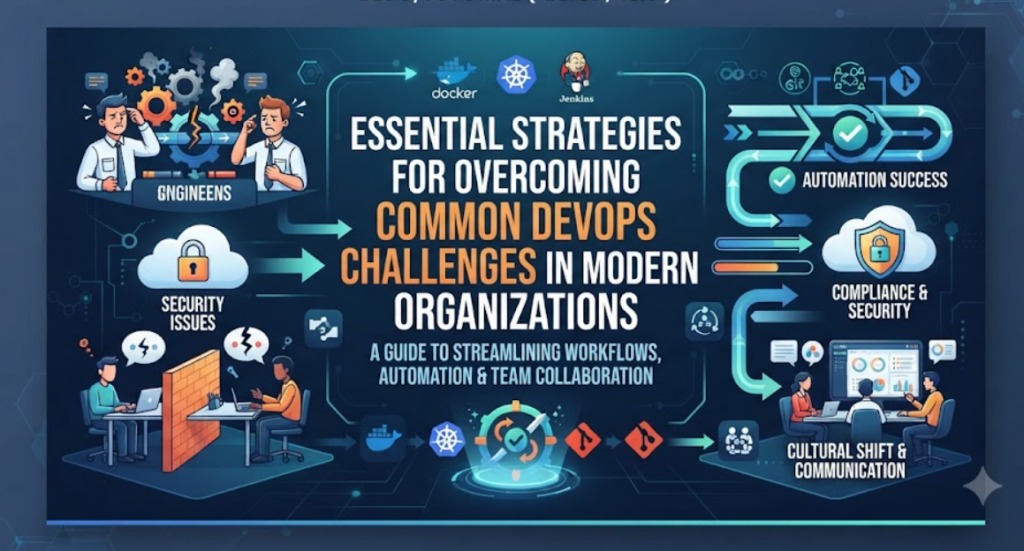
Understanding that DevOps is fundamentally about culture and process—not just tooling—is critical. Most failures in this space stem from an over-emphasis on technology while neglecting the human and structural elements of the organization. At DevOpsSchool, we have observed that identifying these barriers early is the most effective way to ensure a smooth transition. Whether you are leading a digital transformation or refining existing workflows, approaching these hurdles with a structured strategy is essential. This guide explores the realities of modern delivery, providing insights for leaders and engineers to navigate their unique DevOps journeys.
Understanding DevOps Transformation Challenges
DevOps transformation is an exercise in organizational change management. It requires moving from rigid, hierarchical structures to fluid, cross-functional teams. This shift demands a redesign of processes to favor automation over manual intervention and requires a mindset of continuous improvement where failure is treated as a learning opportunity rather than a liability.
For executives and managers, this means moving away from vanity metrics—like individual developer velocity—toward system-wide outcomes, such as lead time to changes and service restoration speed. The challenge lies in sustaining this momentum when legacy habits inevitably conflict with new, agile objectives.
Why DevOps Initiatives Often Struggle
The most common point of failure for DevOps initiatives is the “Tool-First Mindset.” Many organizations believe that purchasing an expensive suite of tools will automatically create a DevOps environment. This leads to several systemic issues:
- Unrealistic Expectations: Assuming that DevOps will yield overnight results without re-engineering internal workflows.
- Lack of Alignment: Development teams focusing on speed while operations teams prioritize stability, without a shared definition of success.
- Insufficient Training: Expecting teams to adopt new methodologies without providing the necessary upskilling.
- Poor Communication: Attempting to force collaboration through tools like Slack or Jira without changing the underlying power dynamics or reporting structures.
DevOps Challenge-Solution Framework
To address these hurdles, we recommend a standardized framework for problem-solving:
- Identify Challenge: Pinpoint the specific bottleneck (e.g., long deployment cycles).
- Assess Root Cause: Determine if the issue is technical, cultural, or process-related.
- Align Stakeholders: Ensure leadership, dev, and ops teams agree on the impact.
- Design Solution: Create a plan that addresses the root cause, not the symptom.
- Implement Incrementally: Avoid “Big Bang” changes; start with small, manageable pilots.
- Measure Results: Compare current performance against baseline metrics.
- Improve Continuously: Use feedback loops to refine the approach.
- Scale Successfully: Roll out successful patterns to other teams.
Common DevOps Challenges and Solutions
| Challenge | Impact | Recommended Solution |
| Cultural Resistance | Low team morale, sabotage | Emphasize empathy, leadership buy-in |
| Skills Gaps | Slow adoption, technical debt | Implement continuous learning programs |
| Siloed Teams | Finger-pointing, slow handoffs | Build cross-functional product squads |
| Tool Complexity | “Tool sprawl,” high maintenance | Standardize on a unified platform |
| Manual Processes | Human error, inconsistency | Prioritize automation of testing/deploy |
| Legacy Systems | Rigid architecture, slow releases | Use strangler fig pattern for migration |
| Security Integration | Delayed releases, vulnerabilities | Shift-left security (DevSecOps) |
| Governance | Compliance blockers | Automate compliance as code |
Cultural Resistance to Change
Resistance is a natural human reaction to change. In traditional IT environments, employees are often measured by their ability to maintain the status quo. When asked to pivot to DevOps, fear of job displacement or increased workload is common.
Solutions:
- Transparent Communication: Clearly explain the “why” behind the shift.
- Leadership Involvement: Leaders must model the behaviors they want to see, such as admitting mistakes and encouraging collaboration.
- Change Management: Address fatigue by celebrating small wins and acknowledging the effort required to shift mental models.
Skills and Knowledge Gaps
The transition to DevOps requires a “T-shaped” skill set, where individuals have deep expertise in one area but a broad understanding of the entire software delivery life cycle.
Solutions:
- Training Programs: Provide structured paths for learning cloud architecture, CI/CD pipelines, and infrastructure as code.
- Mentorship: Encourage internal knowledge sharing and peer-to-peer coaching.
- Workshops: Utilize practical sessions to ensure the team can apply theory in real-world scenarios.
Team Collaboration Challenges
When developers and operations teams operate in silos, they naturally form adversarial relationships. Development wants to ship code; operations wants to protect the production environment.
Solutions:
- Shared Ownership: Make teams responsible for their services in production.
- Collaboration Frameworks: Adopt regular standups or blameless post-mortems to align objectives.
- Unified Tooling: Ensure both teams use the same dashboard for tracking deployments and issues.
Automation Challenges
Automation is not a one-time project; it is a discipline. Many teams fail by trying to automate inefficient or broken processes.
Solutions:
- Standardization: Clean up processes before automating them.
- Infrastructure as Code (IaC): Treat infrastructure updates with the same rigor as application code.
- Incremental Automation: Focus on the highest-impact bottlenecks first, such as automated testing suites or deployment gates.
Legacy Systems and Technical Debt
Legacy systems are often brittle and lack the APIs needed for modern automation. Attempting to force these into a modern CI/CD pipeline without preparation usually leads to failure.
Solutions:
- Incremental Modernization: Use the Strangler Fig pattern to replace legacy functionality piece by piece.
- Containerization: Wrapping legacy apps in containers can provide consistent environments even when the core application logic is aged.
- Dedicated Refactoring Time: Allocate a percentage of every sprint to addressing technical debt.
Security and Compliance Integration
Security is often viewed as a final gate, which creates massive delays. DevSecOps aims to make security a shared responsibility throughout the SDLC.
Solutions:
- Security Automation: Integrate static and dynamic analysis (SAST/DAST) into the pipeline.
- Compliance as Code: Document regulatory requirements in code so they can be audited automatically.
- Early Involvement: Include security teams in architectural design discussions, not just at the end of the release.
Measuring DevOps Success
| Metric | Why It Matters | Business Value |
| Deployment Frequency | Shows ability to deliver value | Faster time-to-market |
| Lead Time for Changes | Tracks pipeline efficiency | Faster response to feedback |
| MTTR | Measures reliability/resilience | Minimal customer disruption |
| Change Failure Rate | Indicates code quality | Reduced rework costs |
| Automation Coverage | Measures maturity | Predictable, repeatable results |
Scaling DevOps Across the Organization
Scaling DevOps is not about replicating the same team structure everywhere. It is about creating a “Platform Engineering” model where a central team builds a “Golden Path”—a self-service internal developer platform (IDP) that provides standard tools and workflows. This allows product teams to move fast without having to reinvent the wheel, while the platform team ensures governance and compliance are baked in by default.
Best Practices for Overcoming DevOps Challenges
- Focus on Culture First: Prioritize people before tools.
- Invest in Training: Knowledge is the best barrier against technical stagnation.
- Automate Gradually: Start small to prove value, then scale.
- Improve Collaboration: Break down departmental silos.
- Integrate Security Early: Make security everyone’s business.
- Measure Outcomes Consistently: Use data to drive decisions, not anecdotes.
Real-World Example
A global financial services firm faced “deployment paralysis” where releases occurred only quarterly due to manual security reviews and fragile infrastructure.
- Initial Challenges: Siloed teams, manual gatekeeping, and massive technical debt.
- DevOps Roadmap: The organization initiated a “Platform Engineering” shift.
- Team Alignment: Created cross-functional teams with embedded security engineers.
- Automation Improvements: Automated security compliance checks within the CI pipeline.
- Business Outcomes: Reduced release cycle from 90 days to 2 weeks, with a 40% reduction in production outages.
- Lessons Learned: Culture change takes longer than technical implementation; executive support is non-negotiable.
Common Misconceptions
- “DevOps is only about tools”: Tools are merely enablers of culture and process.
- “Automation solves everything”: Automating a bad process just gets you to a bad result faster.
- “DevOps eliminates operations”: Operations roles evolve into Site Reliability Engineering (SRE), focusing on platform stability and automation.
- “DevOps is a one-time project”: DevOps is a continuous journey of improvement.
Future of DevOps Problem Solving
The future of DevOps lies in the intersection of AI and platform engineering. AI-assisted operations (AIOps) are beginning to help teams predict failures before they happen and automatically remediate minor incidents. Furthermore, platform engineering is maturing into a standardized approach, moving away from “DIY” custom scripts toward robust, product-managed internal platforms that abstract complexity for developers.
Certifications & Learning Paths
| Certification Area | Best For | Skill Level | Problem-Solving Relevance |
| DevOps Fundamentals | Beginners | Entry | Understands core principles |
| Cloud Architecture | Architects | Advanced | Design scalable infrastructure |
| Kubernetes | Platform Engineers | Expert | Container orchestration |
| Infrastructure as Code | DevOps Engineers | Intermediate | Eliminates manual config |
| DevSecOps | Security/Ops Teams | Intermediate | Integrates safety early |
DevOpsSchool provides comprehensive learning ecosystems tailored to these specific domains, ensuring professionals gain hands-on experience in solving real-world challenges.
DevOps Improvement Checklist
- Perform a maturity assessment to identify current gaps.
- Map out the current value stream to find bottlenecks.
- Establish a blameless culture by encouraging retrospectives.
- Standardize tool adoption to reduce cognitive load.
- Implement automated testing as part of every commit.
- Define and track the four key DORA metrics.
- Allocate time for continuous training and skill development.
FAQs
- What is the biggest DevOps challenge?Cultural resistance remains the primary challenge, as it requires changing long-standing human behaviors and organizational habits.
- How can organizations overcome cultural resistance?By fostering transparency, securing executive sponsorship, and incentivizing collaboration over competition.
- Why do DevOps initiatives fail?They often fail due to a “tool-first” approach that ignores the necessity of process redesign and cultural shifts.
- How should teams measure success?Focus on outcome-based metrics like lead time, deployment frequency, MTTR, and change failure rate.
- What role does automation play?Automation removes human error and creates consistency, but it must be applied to refined, effective processes.
- How can organizations modernize legacy systems?By using incremental strategies like the Strangler Fig pattern and containerization.
- How important is training?Crucial. Without upskilling, teams lack the technical proficiency to manage modern cloud-native environments.
- What should leaders prioritize first?Alignment of stakeholders and setting a clear vision for the desired business outcomes.
- Can DevOps exist without SRE?Yes, but SRE provides the operational rigor and focus on reliability that helps scale DevOps effectively.
- How does DevSecOps differ from DevOps?DevSecOps specifically integrates security practices into the DevOps pipeline, rather than treating security as an external gate.
- Is DevOps only for large enterprises?No, DevOps principles are scalable and beneficial for teams of any size, from startups to global corporations.
- What is an Internal Developer Platform (IDP)?An IDP is a set of tools and services that abstract complexity, allowing developers to self-serve infrastructure and services.
- Why is the “shift-left” approach important?It catches bugs, security flaws, and configuration errors earlier in the cycle when they are cheaper and easier to fix.
- How do we handle change fatigue?By celebrating small, incremental wins and clearly communicating the long-term value of the transformation.
- How does a platform team help?They build the foundation, allowing developers to focus on features instead of infrastructure management.
Final Thoughts
True DevOps transformation is not a finish line; it is a commitment to continuous improvement. By focusing on people, refining your processes, and choosing technology that supports your specific business goals, you can navigate the inevitable challenges of the journey. Measure your progress, learn from failures, and keep collaboration at the heart of your engineering culture. Success is found in the incremental gains you make every single day.

Find Trusted Cardiac Hospitals
Compare heart hospitals by city and services — all in one place.
Explore Hospitals
An area worth expanding is organizational resilience after the initial DevOps transformation. Many teams successfully remove technical bottlenecks but later struggle with growing platform complexity, undocumented operational knowledge, and dependency management across multiple services. Regular resilience reviews, platform lifecycle planning, and engineering practices such as game days or controlled failure simulations help ensure that DevOps capabilities continue to mature instead of gradually becoming difficult to operate and maintain at scale.