
Introduction
Nonprofit CRM (Customer Relationship Management) systems are purpose-built platforms that help mission-driven organizations manage relationships with donors, volunteers, members, beneficiaries, and partners. Unlike traditional sales CRMs, nonprofit CRMs focus on fundraising, donor stewardship, grant tracking, program management, and community engagement—all while ensuring transparency and accountability.
As nonprofits scale their impact, data complexity grows. Spreadsheets and disconnected tools quickly become barriers to growth. A nonprofit CRM centralizes data, automates repetitive tasks, improves donor retention, and enables data-driven decisions. From tracking recurring donations to managing campaigns and volunteers, these systems form the operational backbone of modern nonprofits.
When evaluating nonprofit CRM systems, organizations should look for donor management depth, fundraising tools, reporting and analytics, integrations, ease of use, scalability, security, and total cost of ownership. The right platform aligns technology with mission—supporting growth without adding operational burden.
Best for:
Nonprofit CRM systems are ideal for charities, foundations, NGOs, educational institutions, healthcare nonprofits, religious organizations, and social enterprises—from small teams to large global organizations.
Not ideal for:
Very small groups with minimal donor activity, one-time fundraising needs, or organizations that only require basic accounting tools may find a full CRM excessive.
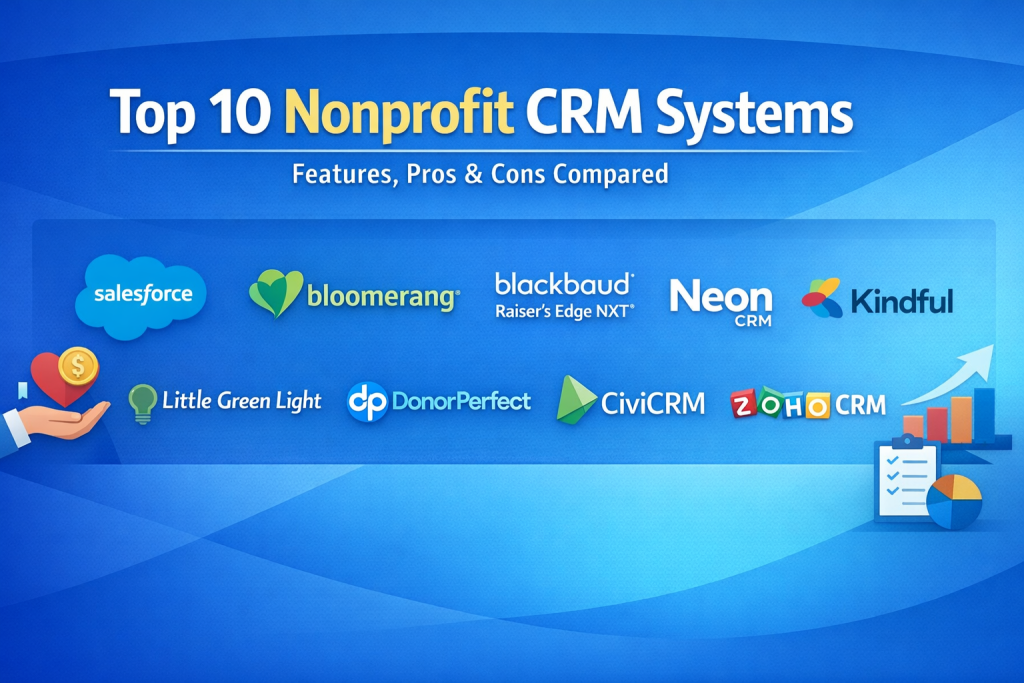
Top 10 Nonprofit CRM Systems Tools
1 — Salesforce Nonprofit Cloud
Short description:
An enterprise-grade nonprofit CRM built on the Salesforce platform, designed for large nonprofits requiring advanced customization and scalability.
Key features:
- Donor and constituent management
- Fundraising and grant tracking
- Custom workflows and automation
- Advanced analytics and dashboards
- Extensive third-party integrations
- Program and case management
Pros:
- Extremely powerful and flexible
- Strong ecosystem and partner network
Cons:
- Steep learning curve
- Higher implementation costs
Security & compliance:
SOC 2, GDPR support, encryption at rest/in transit, SSO, audit logs.
Support & community:
Extensive documentation, global partner ecosystem, strong community forums, enterprise support.
2 — Bloomerang
Short description:
A donor-centric CRM focused on donor retention, engagement tracking, and relationship building for growing nonprofits.
Key features:
- Donor engagement scoring
- Fundraising and campaign tracking
- Email and communication tools
- Reporting and dashboards
- Volunteer management
- Data health monitoring
Pros:
- Very intuitive interface
- Strong donor retention focus
Cons:
- Limited deep customization
- Less suited for very large enterprises
Security & compliance:
Encryption, GDPR readiness, role-based access controls.
Support & community:
Responsive customer support, onboarding resources, active nonprofit user community.
3 — Blackbaud Raiser’s Edge NXT
Short description:
A well-established fundraising CRM designed for mid-to-large nonprofits with sophisticated development operations.
Key features:
- Donor and gift management
- Prospect research tools
- Advanced fundraising analytics
- Campaign and appeal tracking
- Mobile-friendly dashboards
Pros:
- Strong fundraising capabilities
- Trusted by large institutions
Cons:
- Interface can feel dated
- Premium pricing
Security & compliance:
SOC 2, GDPR support, strong data governance controls.
Support & community:
Professional support plans, training programs, large nonprofit user base.
4 — Neon CRM
Short description:
An all-in-one CRM for small to mid-sized nonprofits combining fundraising, membership, and event management.
Key features:
- Donation and membership management
- Event registration and ticketing
- Email marketing tools
- Customizable reports
- Volunteer tracking
Pros:
- Affordable and feature-rich
- Easy to deploy
Cons:
- Limited enterprise scalability
- Reporting depth could improve
Security & compliance:
Encryption, GDPR tools, access controls.
Support & community:
Good documentation, responsive support, onboarding assistance.
5 — Kindful
Short description:
A modern donor management CRM focused on simplicity, clean data, and integrations with fundraising tools.
Key features:
- Centralized donor database
- Donation and campaign tracking
- Data hygiene tools
- Integrations with fundraising platforms
- Reporting and insights
Pros:
- Clean and modern UI
- Easy data management
Cons:
- Limited native email marketing
- Fewer advanced workflows
Security & compliance:
Encryption, GDPR-aligned practices.
Support & community:
Helpful support team, clear documentation, smaller but engaged community.
6 — Little Green Light
Short description:
A budget-friendly CRM designed for small nonprofits needing strong donor tracking without complexity.
Key features:
- Donor and gift management
- Pledge and grant tracking
- Custom reports
- Email integration
- Data import/export tools
Pros:
- Very affordable
- Simple and effective
Cons:
- Basic UI
- Limited automation
Security & compliance:
Standard encryption, access controls.
Support & community:
Responsive email support, clear user guides.
7 — DonorPerfect
Short description:
A long-standing nonprofit CRM focused on fundraising, donor engagement, and reporting.
Key features:
- Donor and donation tracking
- Online fundraising tools
- Email and communication features
- Custom reporting
- Event management
Pros:
- Comprehensive fundraising features
- Reliable and proven platform
Cons:
- Interface less modern
- Customization limitations
Security & compliance:
SOC 2, encryption, GDPR tools.
Support & community:
Strong customer support, training webinars, large user community.
8 — CiviCRM
Short description:
An open-source CRM designed for nonprofits seeking flexibility and control over their data and systems.
Key features:
- Donor and member management
- Event and campaign tools
- Email marketing
- Grant tracking
- Open-source customization
Pros:
- No licensing fees
- Highly customizable
Cons:
- Requires technical expertise
- Support depends on partners
Security & compliance:
Varies by hosting and configuration.
Support & community:
Strong open-source community, documentation, partner-based support.
9 — Zoho CRM for Nonprofits
Short description:
A cost-effective CRM adapted from Zoho’s business CRM for nonprofit relationship and donor management.
Key features:
- Contact and donor management
- Workflow automation
- Email and communication tools
- Reporting and analytics
- Broad Zoho ecosystem integrations
Pros:
- Affordable pricing
- Flexible automation
Cons:
- Not nonprofit-specific by default
- Requires configuration
Security & compliance:
ISO standards, GDPR support, encryption, SSO.
Support & community:
Extensive documentation, global support network.
10 — HubSpot CRM for Nonprofits
Short description:
A popular CRM platform offering nonprofit discounts, suitable for engagement tracking and communications.
Key features:
- Contact and engagement tracking
- Email marketing tools
- Workflow automation
- Reporting dashboards
- Integration marketplace
Pros:
- Very easy to use
- Strong marketing capabilities
Cons:
- Limited nonprofit-specific features
- Advanced features cost more
Security & compliance:
SOC 2, GDPR tools, SSO, encryption.
Support & community:
Excellent documentation, large global community, tiered support.
Comparison Table
| Tool Name | Best For | Platform(s) Supported | Standout Feature | Rating |
|---|---|---|---|---|
| Salesforce Nonprofit Cloud | Large enterprises | Web, Cloud | Extreme customization | N/A |
| Bloomerang | Growing nonprofits | Web | Donor engagement scoring | N/A |
| Blackbaud Raiser’s Edge NXT | Large fundraising teams | Web, Mobile | Prospect research | N/A |
| Neon CRM | Small–mid nonprofits | Web | All-in-one toolkit | N/A |
| Kindful | Data-focused teams | Web | Data cleanliness | N/A |
| Little Green Light | Small nonprofits | Web | Affordability | N/A |
| DonorPerfect | Fundraising-heavy orgs | Web | Robust fundraising | N/A |
| CiviCRM | Tech-savvy nonprofits | Web | Open-source flexibility | N/A |
| Zoho CRM for Nonprofits | Budget teams | Web, Mobile | Automation ecosystem | N/A |
| HubSpot CRM for Nonprofits | Outreach-focused teams | Web, Mobile | Ease of use | N/A |
Evaluation & Scoring of Nonprofit CRM Systems
| Criteria | Weight | Salesforce | Bloomerang | Neon CRM | CiviCRM |
|---|---|---|---|---|---|
| Core features | 25% | High | High | Medium | Medium |
| Ease of use | 15% | Medium | High | High | Low |
| Integrations & ecosystem | 15% | High | Medium | Medium | Medium |
| Security & compliance | 10% | High | Medium | Medium | Varies |
| Performance & reliability | 10% | High | High | Medium | Varies |
| Support & community | 10% | High | High | Medium | High |
| Price / value | 15% | Medium | Medium | High | High |
Which Nonprofit CRM Systems Tool Is Right for You?
- Solo users / small nonprofits: Choose simplicity and affordability (Little Green Light, Neon CRM).
- SMBs and growing organizations: Balance usability and donor insights (Bloomerang, Kindful).
- Mid-market nonprofits: Look for reporting depth and integrations (DonorPerfect, Zoho CRM).
- Enterprise organizations: Prioritize scalability, customization, and compliance (Salesforce, Blackbaud).
Budget-conscious teams should favor platforms with transparent pricing, while premium solutions suit organizations with dedicated IT and operations teams. Integration needs, data volume, and compliance requirements should guide final selection.
Frequently Asked Questions (FAQs)
1. What is a nonprofit CRM?
A system designed to manage donors, volunteers, members, and fundraising activities in one place.
2. How is a nonprofit CRM different from a sales CRM?
It focuses on relationships, donations, and programs rather than sales pipelines.
3. Are nonprofit CRMs expensive?
Costs vary widely—from free open-source tools to enterprise platforms.
4. Can small nonprofits use CRM software?
Yes, many tools are designed specifically for small teams and budgets.
5. Do nonprofit CRMs support online donations?
Most include donation tracking and online fundraising integrations.
6. How long does implementation take?
From a few days for simple tools to several months for enterprise systems.
7. Are nonprofit CRMs secure?
Reputable platforms offer encryption and compliance features.
8. Can these tools handle volunteers?
Many include volunteer and membership management modules.
9. What are common mistakes when choosing a CRM?
Over-buying features, underestimating training, and ignoring integrations.
10. Can I migrate data from spreadsheets?
Yes, most CRMs support CSV imports and migration tools.
Conclusion
Nonprofit CRM systems play a vital role in helping organizations build stronger relationships, improve fundraising outcomes, and operate efficiently. The right CRM empowers teams with clarity, automation, and insights—freeing them to focus on impact rather than administration.
There is no single “best” nonprofit CRM for everyone. The ideal choice depends on organizational size, budget, technical capacity, and long-term goals. By carefully evaluating features, usability, security, and value, nonprofits can select a platform that truly supports their mission and growth.

Find Trusted Cardiac Hospitals
Compare heart hospitals by city and services — all in one place.
Explore Hospitals