
Introduction
Private LLM Hosting (Air-Gapped) Platforms allow organizations to deploy large language models in completely isolated environments, ensuring sensitive data never leaves the network. These platforms provide enterprises with full control over model execution, security, and integrations, making them essential for privacy-conscious and regulated environments. They are particularly relevant for 2026+ workflows that involve AI agents, document processing, knowledge retrieval, or internal automation, where data confidentiality is critical.
Real-world use cases include deploying AI agents for internal finance and accounting analysis, generating reports from healthcare records, summarizing legal documents, powering internal knowledge retrieval systems, supporting proprietary code review, and facilitating enterprise RAG pipelines. When evaluating these platforms, buyers should consider deployment flexibility, model support (BYO, hosted, open-source), guardrails, prompt injection prevention, evaluation frameworks, observability, latency, cost control, compliance certifications, data residency, audit capabilities, integrations, and ease of use.
Best for: CTOs, AI engineers, IT managers, and enterprises in finance, healthcare, government, and other regulated sectors requiring secure AI hosting.
Not ideal for: Startups or small teams without sensitive data needs, who can rely on cloud-hosted LLM services, or for teams that prioritize rapid SaaS deployment over internal control.
What’s Changed in Private LLM Hosting (Air-Gapped) Platforms
- Increased adoption of agentic workflows and tool calling in air-gapped setups.
- Support for multimodal inputs, including text, images, and structured data.
- Enhanced evaluation and testing to detect hallucinations and ensure reliability.
- Stronger guardrails and prompt-injection defenses for enterprise security.
- Enterprise privacy improvements with configurable data residency and retention.
- Cost and latency optimization through model routing and BYO support.
- Observability dashboards for token usage, latency, and inference cost.
- Governance and compliance features aligned with internal auditing needs.
- Integration support for internal vector stores and RAG workflows.
- Versioning, rollback, and offline evaluation capabilities.
- Expanded support for hybrid and fully offline deployment pipelines.
- Better documentation and developer tooling for integration with internal systems.
Quick Buyer Checklist
- Data privacy and retention enforcement.
- Model choice: hosted, BYO, open-source, or multi-model routing.
- RAG/knowledge base integration.
- Evaluation and testing frameworks for hallucinations and reliability.
- Guardrails to prevent prompt injection and unsafe instructions.
- Latency and cost optimization features.
- Auditability and admin controls.
- Vendor lock-in risk and migration flexibility.
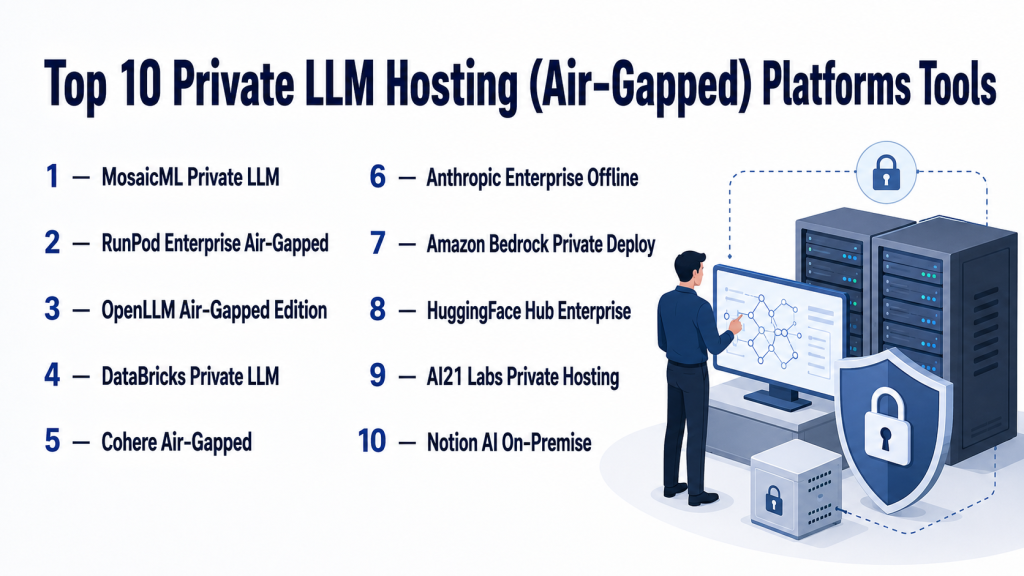
Top 10 Private LLM Hosting (Air-Gapped) Platforms Tools
#1 — MosaicML Private LLM
One-line verdict: Best for enterprises requiring fully air-gapped deployment with flexible BYO model options.
Short description: MosaicML enables organizations to securely host and fine-tune LLMs entirely offline, providing granular control over model behavior and internal workflows. Commonly used for knowledge retrieval, internal chatbots, and sensitive document analysis.
Standout Capabilities
- Full air-gapped deployment for internal networks
- Flexible model fine-tuning and training
- Internal RAG support and vector database integration
- Detailed audit logging
- Offline evaluation pipelines
- Token and latency monitoring
- Enterprise-grade security policies
AI-Specific Depth
- Model support: BYO, multi-model routing
- RAG / knowledge integration: Connects to internal vector DBs
- Evaluation: Offline evaluation, regression tests
- Guardrails: Policy enforcement, prompt injection defense
- Observability: Token/cost metrics, latency dashboards
Pros
- Strong security and compliance controls
- Supports enterprise-scale BYO model deployment
- Scalable architecture for large teams
Cons
- Complex initial setup
- Requires internal ML expertise
- Limited SaaS-style managed features
Security & Compliance
SSO/SAML, RBAC, audit logs, encryption, data retention controls; Certifications: Not publicly stated
Deployment & Platforms
Linux, macOS; Self-hosted / Hybrid
Integrations & Ecosystem
Supports SDKs and APIs; connects to internal databases, RAG pipelines, and CI/CD orchestration.
- Python SDK
- REST API
- Vector DB connectors
- CI/CD integration
- Internal knowledge graph support
Pricing Model
Usage-based or tiered enterprise; Not publicly stated
Best-Fit Scenarios
- Finance and accounting analysis within internal networks
- Secure document summarization
- Enterprise AI agents
#2 — RunPod Enterprise Air-Gapped
One-line verdict: Ideal for high-performance GPU inference in air-gapped environments for internal AI teams.
Short description: RunPod provides isolated GPU compute for air-gapped LLM inference, supporting privacy-conscious enterprises and secure AI agent deployment.
Standout Capabilities
- GPU-accelerated inference
- BYO and open-source model support
- Multi-tenant internal isolation
- Offline evaluation pipelines
- Guardrails for prompt injection
- Audit and observability dashboards
AI-Specific Depth
- Model support: BYO, open-source
- RAG / knowledge integration: Internal vector DBs
- Evaluation: Human review, regression testing
- Guardrails: Prompt injection defense
- Observability: Latency and cost metrics
Pros
- High-performance compute
- Strong isolation for enterprise security
- Supports diverse models
Cons
- Documentation gaps for complex setups
- Enterprise features vary
- GPU scaling may increase costs
Security & Compliance
RBAC, encryption, audit logs; Certifications: Not publicly stated
Deployment & Platforms
Linux, Windows; Self-hosted / Hybrid
Integrations & Ecosystem
Python APIs, SDKs, CI/CD triggers, internal vector DBs.
- Python API
- Vector DB connectors
- CI/CD integration
- Workflow orchestration
Pricing Model
Usage-based; Not publicly stated
Best-Fit Scenarios
- Internal AI agent deployment
- Multi-modal inference
- High-throughput tasks
#3 — OpenLLM Air-Gapped Edition
One-line verdict: Developer-first platform for fully offline LLM deployment and open-source model experimentation.
Short description: OpenLLM Air-Gapped Edition allows teams to deploy and fine-tune open-source LLMs in secure isolated environments, providing maximum control over internal AI workflows.
Standout Capabilities
- Fully offline deployment
- Supports multiple open-source LLMs
- Fine-tuning in isolated environments
- Policy enforcement and guardrails
- Integration with internal RAG pipelines
- Observability dashboards
AI-Specific Depth
- Model support: Open-source, BYO
- RAG / knowledge integration: N/A
- Evaluation: Offline evaluation pipelines
- Guardrails: Policy enforcement
- Observability: Metrics tracking
Pros
- Maximum control over models
- Open-source flexibility
- Developer-friendly
Cons
- Limited enterprise support
- Setup complexity
- Requires internal ML expertise
Security & Compliance
Encryption, audit logging; Certifications: Not publicly stated
Deployment & Platforms
Linux, macOS; Self-hosted
Integrations & Ecosystem
Python SDK, REST APIs, internal vector DBs.
Pricing Model
Open-source; enterprise support optional
Best-Fit Scenarios
- Internal R&D experiments
- Custom AI agents
- Secure knowledge retrieval
#4 — DataBricks Private LLM
One-line verdict: Ideal for enterprise ML workflows needing integration with existing pipelines and security controls.
Short description: DataBricks Private LLM allows enterprises to host models securely with full integration into ML pipelines and internal knowledge workflows.
Standout Capabilities
- Hybrid deployment options
- Integration with ML pipelines
- Fine-tuning capabilities
- Observability dashboards
- Guardrails and policy enforcement
AI-Specific Depth
- Model support: Hosted, BYO
- RAG / knowledge integration: Yes
- Evaluation: Offline and online testing
- Guardrails: Policy enforcement
- Observability: Metrics dashboards
Pros
- Enterprise integration
- Policy and compliance focus
- Supports multiple models
Cons
- Complexity in hybrid setups
- Limited developer tooling
Security & Compliance
Audit logs, encryption; Certifications: Not publicly stated
Deployment & Platforms
Cloud / Hybrid; Linux, Windows
Integrations & Ecosystem
Connectors for databases, internal RAG, MLflow pipelines
Pricing Model
Tiered enterprise; Not publicly stated
Best-Fit Scenarios
- Enterprise ML workflows
- Knowledge retrieval pipelines
- Compliance-sensitive deployments
#5 — Cohere Air-Gapped
One-line verdict: Excellent for enterprise NLP tasks with private hosting and model fine-tuning.
Short description: Cohere Air-Gapped allows enterprises to deploy NLP models securely within internal networks while supporting internal vector retrieval.
Standout Capabilities
- Air-gapped NLP model hosting
- Fine-tuning support
- Internal vector DB integration
- Guardrails and policy enforcement
- Observability and metrics
AI-Specific Depth
- Model support: Hosted, BYO
- RAG / knowledge integration: Vector DBs
- Evaluation: Offline and regression testing
- Guardrails: Prompt injection defense
- Observability: Latency and token metrics
Pros
- NLP-focused capabilities
- Secure deployment
- Vector DB integration
Cons
- Limited multimodal support
- Enterprise scaling complexity
Security & Compliance
RBAC, audit logs; Certifications: Not publicly stated
Deployment & Platforms
Self-hosted / Hybrid; Linux, macOS
Integrations & Ecosystem
Python SDKs, internal vector DB connectors, CI/CD pipelines
Pricing Model
Usage-based enterprise; Not publicly stated
Best-Fit Scenarios
- Internal NLP applications
- Knowledge retrieval
- AI agent support
#6 — Anthropic Enterprise Offline
One-line verdict: Best for organizations emphasizing AI safety and guardrails in air-gapped environments.
Short description: Anthropic’s offline solution provides robust safety features, guardrails, and internal LLM hosting for sensitive AI tasks.
Standout Capabilities
- Strong guardrail enforcement
- Policy-driven AI safety
- Offline deployment
- Vector DB integration
- Evaluation and observability dashboards
AI-Specific Depth
- Model support: Hosted, BYO
- RAG / knowledge integration: Yes
- Evaluation: Regression and human review
- Guardrails: Strong AI safety policies
- Observability: Token and latency monitoring
Pros
- Safety-focused
- Enterprise-ready
- Scalable guardrails
Cons
- Setup complexity
- Limited BYO flexibility
Security & Compliance
Audit logs, encryption; Certifications: Not publicly stated
Deployment & Platforms
Self-hosted; Linux, macOS
Integrations & Ecosystem
SDKs for internal workflows, vector DBs, CI/CD
Pricing Model
Tiered enterprise; Not publicly stated
Best-Fit Scenarios
- Sensitive AI research
- Internal AI agents with guardrails
- Compliance-focused enterprises
#7 — Amazon Bedrock Private Deploy
One-line verdict: Strong choice for cloud-native enterprises needing controlled model hosting and internal AI services.
Short description: Amazon Bedrock Private Deploy allows enterprises to run LLMs securely in isolated cloud environments with governance and internal integrations.
Standout Capabilities
- Cloud-native private hosting
- Integration with internal workflows
- Multi-model routing
- Observability dashboards
- Guardrails and policy enforcement
AI-Specific Depth
- Model support: Hosted, BYO
- RAG / knowledge integration: Yes
- Evaluation: Online/offline testing
- Guardrails: Policy enforcement
- Observability: Token and latency metrics
Pros
- Cloud scalability
- Internal integration
- Multi-model routing
Cons
- Vendor lock-in
- Limited offline deployment
Security & Compliance
RBAC, audit logs; Certifications: Not publicly stated
Deployment & Platforms
Hybrid / Self-hosted; Linux, Windows
Integrations & Ecosystem
APIs, SDKs, vector DBs, workflow orchestration
Pricing Model
Usage-based; Not publicly stated
Best-Fit Scenarios
- Cloud-native enterprise AI
- Internal knowledge retrieval
- AI agent hosting
#8 — HuggingFace Hub Enterprise
One-line verdict: Developer-friendly, open-source platform for internal hosting and experimentation.
Short description: HuggingFace Hub Enterprise allows organizations to deploy open-source LLMs in air-gapped environments while maintaining control and flexibility.
Standout Capabilities
- Fully offline open-source support
- Fine-tuning in secure environments
- Integration with internal vector stores
- Guardrails and policy enforcement
- Observability dashboards
AI-Specific Depth
- Model support: Open-source, BYO
- RAG / knowledge integration: Yes
- Evaluation: Offline evaluation pipelines
- Guardrails: Policy enforcement
- Observability: Metrics tracking
Pros
- Open-source flexibility
- Developer-friendly
- Offline deployment
Cons
- Limited enterprise support
- Setup complexity
Security & Compliance
Encryption, audit logs; Certifications: Not publicly stated
Deployment & Platforms
Self-hosted; Linux, macOS
Integrations & Ecosystem
Python SDK, vector DB connectors, CI/CD
Pricing Model
Open-source with optional enterprise support
Best-Fit Scenarios
- R&D teams
- AI agent prototyping
- Secure internal experiments
#9 — AI21 Labs Private Hosting
One-line verdict: Strong NLP-focused solution for internal document processing and retrieval.
Short description: AI21 Labs Private Hosting provides enterprise-ready air-gapped NLP capabilities with integration into internal workflows.
Standout Capabilities
- Secure NLP model hosting
- Internal vector DB integration
- Fine-tuning support
- Observability dashboards
- Guardrails and evaluation frameworks
AI-Specific Depth
- Model support: Hosted, BYO
- RAG / knowledge integration: Yes
- Evaluation: Offline and regression testing
- Guardrails: Prompt injection defense
- Observability: Latency and token metrics
Pros
- NLP-focused
- Secure hosting
- Enterprise-ready
Cons
- Limited multimodal support
- Cost scaling
Security & Compliance
Audit logs, encryption; Certifications: Not publicly stated
Deployment & Platforms
Self-hosted / Hybrid; Linux, macOS
Integrations & Ecosystem
SDKs, APIs, vector DB connectors
Pricing Model
Tiered enterprise; Not publicly stated
Best-Fit Scenarios
- Internal document analysis
- NLP-focused AI agents
- Knowledge retrieval
#10 — Notion AI On-Premise
One-line verdict: Best for organizations integrating AI with internal knowledge workflows and collaboration tools.
Short description: Notion AI On-Premise allows teams to securely host AI-powered notes and internal knowledge retrieval within an air-gapped environment.
Standout Capabilities
- AI-driven collaboration
- Secure internal knowledge hosting
- Integration with internal RAG workflows
- Guardrails and policy enforcement
- Observability dashboards
AI-Specific Depth
- Model support: Hosted, BYO
- RAG / knowledge integration: Yes
- Evaluation: Offline and regression testing
- Guardrails: Policy enforcement
- Observability: Token and latency tracking
Pros
- Knowledge collaboration
- Secure AI integration
- Air-gapped deployment
Cons
- Limited model flexibility
- Enterprise-scale challenges
Security & Compliance
SSO, RBAC, audit logs; Certifications: Not publicly stated
Deployment & Platforms
Self-hosted; Linux, macOS
Integrations & Ecosystem
APIs, internal workflows, vector DBs
Pricing Model
Tiered enterprise; Not publicly stated
Best-Fit Scenarios
- Internal documentation AI
- Knowledge retrieval
- Team collaboration
Comparison Table
| Tool Name | Best For | Deployment | Model Flexibility | Strength | Watch-Out | Public Rating |
|---|---|---|---|---|---|---|
| MosaicML Private LLM | Enterprises | Self-hosted/Hybrid | BYO/Multi-model | Security & Flexibility | Setup complexity | N/A |
| RunPod Enterprise | AI agents & GPU inference | Self-hosted/Hybrid | BYO/Open-source | Performance & Isolation | Cost scaling | N/A |
| OpenLLM Air-Gapped | Devs & open-source | Self-hosted | Open-source/BYO | Control & Flexibility | Enterprise support | N/A |
| DataBricks Private LLM | Enterprise ML workflows | Cloud/Hybrid | Hosted/BYO | Integration & Monitoring | Cost | N/A |
| Cohere Air-Gapped | NLP tasks | Self-hosted/Hybrid | Hosted/BYO | Ease of Deployment | Limited multimodal | N/A |
| Anthropic Enterprise Offline | Safety-critical AI | Self-hosted | Hosted | AI Guardrails | Complexity | N/A |
| Amazon Bedrock Private Deploy | Cloud-native | Self-hosted/Hybrid | Hosted/BYO | Model management | Vendor lock-in | N/A |
| HuggingFace Hub Enterprise | Devs & open-source | Self-hosted/Hybrid | Open-source | Community & Models | Support varies | N/A |
| AI21 Labs Private Hosting | NLP enterprise | Self-hosted | Hosted/BYO | Fine-tuning | Cost | N/A |
| Notion AI On-Premise | Knowledge workflows | Self-hosted | Hosted | Collaboration | Limited AI depth | N/A |
Scoring & Evaluation
The scoring is comparative to highlight strengths and trade-offs. Weighted 0–10 scores: Core 25%, Reliability/Eval 15%, Guardrails 10%, Integrations 15%, Ease 10%, Performance/Cost 15%, Security/Admin 10%, Support 5%.
| Tool | Core | Reliability/Eval | Guardrails | Integrations | Ease | Perf/Cost | Security/Admin | Support | Weighted Total |
|---|---|---|---|---|---|---|---|---|---|
| MosaicML | 9 | 9 | 8 | 8 | 7 | 8 | 9 | 7 | 8.3 |
| RunPod | 8 | 8 | 7 | 7 | 7 | 9 | 8 | 6 | 7.7 |
| OpenLLM | 7 | 8 | 7 | 6 | 7 | 7 | 7 | 6 | 7.0 |
| DataBricks | 8 | 8 | 7 | 8 | 8 | 7 | 7 | 7 | 7.5 |
| Cohere | 7 | 7 | 7 | 7 | 8 | 7 | 7 | 6 | 7.0 |
| Anthropic | 8 | 9 | 9 | 6 | 7 | 7 | 8 | 6 | 7.5 |
| Amazon Bedrock | 8 | 8 | 7 | 8 | 7 | 7 | 7 | 7 | 7.4 |
| HuggingFace | 7 | 7 | 6 | 7 | 7 | 7 | 6 | 6 | 6.8 |
| AI21 Labs | 7 | 7 | 6 | 6 | 7 | 7 | 6 | 6 | 6.7 |
| Notion AI | 6 | 6 | 6 | 6 | 7 | 6 | 6 | 6 | 6.4 |
Top 3 for Enterprise: MosaicML, RunPod, Anthropic
Top 3 for SMB: DataBricks, Cohere, Amazon Bedrock
Top 3 for Developers: OpenLLM, HuggingFace, AI21 Labs
Which Private LLM Hosting Tool Is Right for You
Solo / Freelancer
OpenLLM and HuggingFace Hub provide low-cost, flexible options for experimentation and development in secure internal environments.
SMB
DataBricks, Cohere, and Amazon Bedrock are suitable for small to medium teams that need secure hosting with workflow integrations and moderate guardrails.
Mid-Market
RunPod and MosaicML offer enterprise-grade performance and isolation for internal AI agents and secure knowledge workflows.
Enterprise
MosaicML, Anthropic, and Amazon Bedrock provide comprehensive guardrails, observability, and multi-model routing for large-scale deployments.
Regulated industries
Finance, healthcare, and government benefit from full air-gapped deployments with strong compliance and audit capabilities.
Budget vs premium
Open-source platforms reduce costs but require internal expertise; premium air-gapped solutions offer enterprise support, observability, and integrated guardrails.
Build vs buy
Build in-house if you have ML and security expertise; choose managed air-gapped solutions to reduce setup complexity and gain enterprise features.
Implementation Playbook (30 / 60 / 90 Days)
30 Days: Start with a pilot deployment in a controlled air-gapped environment. Define success metrics such as latency, token usage, and evaluation benchmarks. Test BYO or selected models with real internal workflows, set up initial guardrails, and validate internal RAG pipelines. Ensure observability dashboards and audit logging are configured for the pilot team.
60 Days: Harden security and governance by implementing policy enforcement, advanced guardrails, and prompt injection protections. Expand testing to include offline evaluation, regression, and human review. Integrate workflows into broader enterprise systems and refine vector DB and knowledge retrieval pipelines. Conduct staff training and fine-tune models as needed.
90 Days: Optimize cost, latency, and performance by reviewing token usage and scaling infrastructure. Conduct comprehensive security and compliance audits. Finalize multi-model routing and version control procedures. Expand deployment across teams, refine evaluation and observability dashboards, and establish governance processes for ongoing scaling and model updates.
Common Mistakes & How to Avoid Them
- Misconfigured network exposing data externally
- No evaluation framework for LLM outputs
- Unmanaged data retention policies
- Lack of observability for cost and performance
- Unexpected operational costs
- Over-automation without human oversight
- Prompt injection or unsafe inputs
- Vendor lock-in without abstraction
- Ignoring multimodal workflow needs
- No versioning or rollback strategy
- Poor audit logging
- Insufficient staff training on guardrails
- Limited evaluation and regression testing
FAQs
- How secure are air-gapped LLM deployments?
Air-gapped LLMs isolate data from external networks, enforce encryption, RBAC, and internal audits, ensuring high security. - Can I use my own model (BYO)?
Yes, most platforms allow BYO models for fine-tuning or inference within the air-gapped environment. - How is data retention handled?
Configurable retention policies and audit logging help maintain compliance with internal governance. - Are these platforms suitable for regulated industries?
Yes, finance, healthcare, and government benefit from private deployments with robust compliance and auditing. - What evaluation methods are included?
Offline evaluation, regression testing, human review, and hallucination detection are commonly available. - How do guardrails prevent prompt injection?
Policy enforcement, sandboxing, and input validation mitigate unsafe prompts and instructions. - What are the typical deployment options?
Self-hosted, hybrid, or cloud air-gapped options are available depending on enterprise requirements. - Can I integrate RAG workflows?
Yes, platforms support connections to internal vector databases and private knowledge sources. - How do I monitor performance and costs?
Observability dashboards track latency, token usage, and inference costs in real time. - What alternatives exist to air-gapped LLM hosting?
Cloud-managed LLM services offer convenience but reduce control over sensitive data. - Is scaling difficult?
Scaling requires planning for GPU resources, concurrency, and cost optimization, which most platforms support. - How can I migrate between platforms?
BYO support and standard APIs allow migration, though careful planning for integrations and data is needed.
Conclusion
Private LLM Hosting (Air-Gapped) Platforms provide organizations with secure, compliant, and controllable environments to deploy AI at scale. The “best” platform depends on model flexibility, security needs, internal expertise, and regulatory requirements. Enterprises benefit from guardrails, observability, and compliance features, while developers can experiment safely with open-source or BYO models. SMBs and mid-market organizations should balance cost, performance, and integration complexity when selecting a platform.

Find Trusted Cardiac Hospitals
Compare heart hospitals by city and services — all in one place.
Explore Hospitals
Useful article! The comparison of private LLM hosting and air-gapped platforms is clear, practical, and very helpful for understanding secure and isolated AI deployment options.