
Introduction
Invoice-to-Cash (I2C) platforms manage the entire financial lifecycle from issuing an invoice to receiving and reconciling payment. This includes billing, collections, dispute management, cash application, reporting, and analytics. In modern finance teams, I2C platforms are no longer just accounting tools—they are revenue acceleration engines that improve cash flow, reduce DSO (Days Sales Outstanding), and enhance customer experience.
As businesses scale, manual invoicing, fragmented payment systems, and disconnected ERPs create delays, errors, and revenue leakage. Invoice-to-Cash platforms solve this by automating workflows, enforcing controls, integrating payments, and providing real-time visibility into receivables.
Why Invoice-to-Cash Platforms Matter
- Faster cash collection and improved working capital
- Reduced billing errors and disputes
- Better customer payment experience
- Stronger compliance, audit readiness, and financial forecasting
Common Real-World Use Cases
- High-volume B2B invoicing and collections
- Subscription and usage-based billing
- Global invoicing with multi-currency and tax compliance
- Enterprise finance teams needing audit-grade controls
What to Look for When Choosing an Invoice-to-Cash Platform
Key evaluation criteria include:
- End-to-end automation (invoice → collections → cash application)
- ERP and payment gateway integrations
- Scalability and performance
- Security, compliance, and auditability
- Ease of use for finance and AR teams
Best for:
Mid-market and enterprise finance teams, shared service centers, SaaS companies, manufacturing firms, and global businesses handling high invoice volumes and complex collections.
Not ideal for:
Freelancers, very small businesses with low invoice volume, or teams that only need basic invoicing without collections automation or analytics.
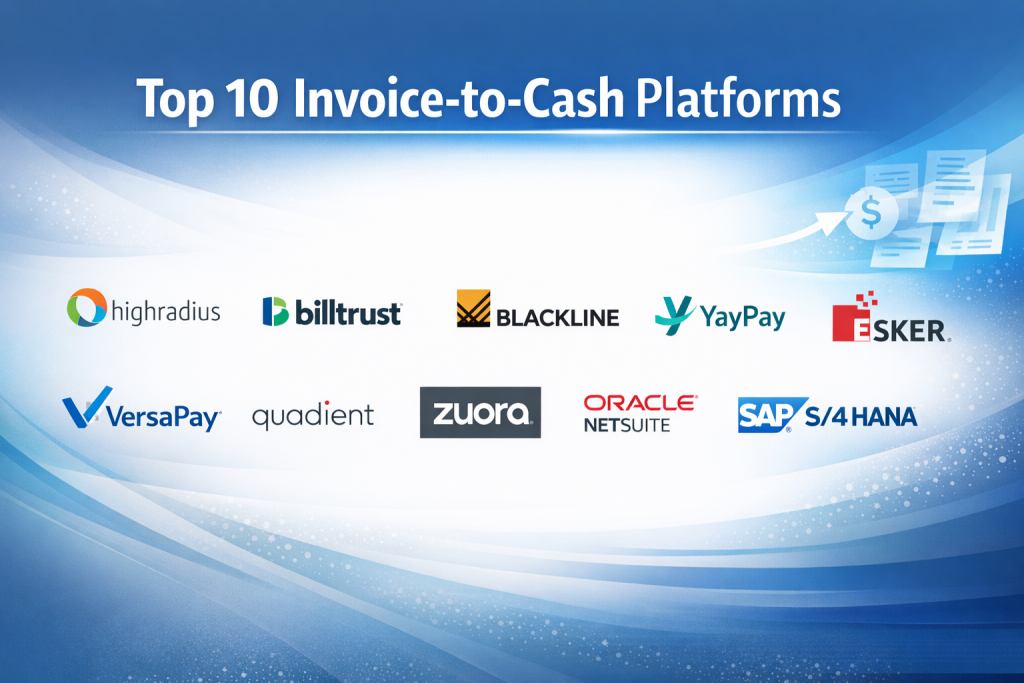
Top 10 Invoice-to-Cash Platforms Tools
1 — HighRadius
Short description:
An AI-driven enterprise Invoice-to-Cash platform designed for large global organizations managing complex receivables and collections.
Key Features
- AI-powered collections prioritization
- Automated cash application
- Credit risk and dispute management
- Advanced AR analytics and dashboards
- ERP-native integrations
- Predictive forecasting
Pros
- Strong AI and automation depth
- Enterprise-grade scalability
Cons
- High implementation cost
- Requires change management
Security & Compliance: SOC 2, GDPR, role-based access, audit logs
Support & Community: Dedicated enterprise support, structured onboarding
2 — Billtrust
Short description:
A B2B-focused Invoice-to-Cash platform emphasizing invoicing, payments, and collections automation.
Key Features
- Digital invoicing and delivery
- Integrated B2B payment options
- Automated collections workflows
- Cash application automation
- Customer payment portals
Pros
- Excellent B2B payment experience
- Strong invoice delivery capabilities
Cons
- Limited advanced analytics
- Less suitable for very large enterprises
Security & Compliance: SOC 2, PCI-DSS, GDPR
Support & Community: Good documentation, responsive customer support
3 — BlackLine
Short description:
A financial operations platform with strong focus on AR automation, reconciliation, and compliance.
Key Features
- AR automation and reconciliation
- Dispute and deduction management
- Journal automation
- Financial close integration
- Compliance reporting
Pros
- Excellent audit and compliance controls
- Strong ERP alignment
Cons
- Steeper learning curve
- Premium pricing
Security & Compliance: SOC 1 & 2, ISO 27001, GDPR
Support & Community: Enterprise onboarding, global support teams
4 — YayPay
Short description:
A modern collections automation tool focused on improving AR team productivity.
Key Features
- Automated collections workflows
- Customer communication tracking
- Dispute management
- Real-time AR visibility
- ERP integrations
Pros
- Easy to use
- Strong collections focus
Cons
- Limited invoicing features
- Not a full I2C suite
Security & Compliance: SOC 2, GDPR
Support & Community: Good onboarding, active customer support
5 — Esker
Short description:
An end-to-end source-to-pay and Invoice-to-Cash automation platform with strong global presence.
Key Features
- Invoice automation
- Collections and dispute management
- AI-based document capture
- Global tax and compliance support
- ERP integrations
Pros
- Global compliance strength
- Broad automation coverage
Cons
- UI can feel dated
- Longer implementation cycles
Security & Compliance: ISO 27001, SOC, GDPR
Support & Community: Strong global enterprise support
6 — Versapay
Short description:
A collaborative AR and Invoice-to-Cash platform focused on customer engagement and payments.
Key Features
- Customer AR portals
- Automated invoicing
- Integrated payments
- Collections collaboration
- ERP-native architecture
Pros
- Strong customer experience
- Easy ERP integration
Cons
- Limited advanced analytics
- Mid-market focus
Security & Compliance: SOC 2, PCI-DSS
Support & Community: Good onboarding, mid-market support focus
7 — Quadient
Short description:
An enterprise platform emphasizing digital customer communications and billing automation.
Key Features
- Digital invoice delivery
- Omnichannel communications
- Payment integration
- Compliance management
- Workflow automation
Pros
- Strong customer communications
- Multi-channel delivery
Cons
- Less AR intelligence
- Complex configuration
Security & Compliance: ISO 27001, GDPR
Support & Community: Enterprise support, detailed documentation
8 — Zuora
Short description:
A subscription-focused billing and revenue platform suitable for SaaS and recurring revenue businesses.
Key Features
- Subscription invoicing
- Usage-based billing
- Payment and collections automation
- Revenue recognition
- SaaS analytics
Pros
- Best-in-class subscription billing
- Highly scalable
Cons
- Not ideal for non-subscription models
- Complex setup
Security & Compliance: SOC 1 & 2, GDPR
Support & Community: Strong SaaS community, enterprise plans available
9 — Oracle NetSuite
Short description:
A cloud ERP with native Invoice-to-Cash capabilities for growing and global businesses.
Key Features
- Native invoicing and AR
- Integrated payments
- Revenue management
- Financial reporting
- Multi-currency support
Pros
- Unified ERP experience
- Strong financial reporting
Cons
- Less specialized I2C automation
- Customization requires expertise
Security & Compliance: SOC, ISO, GDPR
Support & Community: Large ecosystem, certified partners
10 — Nickel
Short description:
Short description: A unified platform that unifies A/R, A/P, and trade credit into a single interface, designed to automate the entire invoice-to-cash cycle for B2B businesses.
Key Features:
- Centralized A/R, A/P
- Unlimited free ACH transfers with no hidden costs
- Native, real-time synchronization with QuickBooks Online
- Live payment tracking and customizable approval workflows
Pros:
- Eliminates the complexity of managing multiple financial tools
- Accelerates deal flow by automating customer credit decisions
- Provides high-quality human support and dedicated onboarding assistance
Cons:
- System is currently optimized for US-based business operations
- Full access to advanced credit decisioning requires the Pro tier
Security & Compliance: SOC 2 compliant, PCI-DSS certified, and funds held in FDIC-insured accounts.
Support & Community: 24/7 human-led chat and email support with dedicated success management.For more information, visit nickel.com.
Comparison Table
| Tool Name | Best For | Platform(s) Supported | Standout Feature | Rating |
|---|---|---|---|---|
| HighRadius | Large enterprises | Web, ERP-native | AI-driven collections | N/A |
| Billtrust | B2B mid-market | Web, ERP | B2B payments | N/A |
| BlackLine | Compliance-heavy orgs | Web, ERP | Audit readiness | N/A |
| YayPay | AR teams | Web | Collections automation | N/A |
| Esker | Global businesses | Web, ERP | Global compliance | N/A |
| Versapay | Mid-market AR | Web, ERP | Customer portals | N/A |
| Quadient | Invoice delivery | Web | Omnichannel billing | N/A |
| Zuora | SaaS companies | Web | Subscription billing | N/A |
| Oracle NetSuite | Growing firms | Cloud ERP | Unified finance | N/A |
| SAP S/4HANA Finance | Enterprises | Enterprise ERP | Real-time finance | N/A |
Evaluation & Scoring of Invoice-to-Cash Platforms
| Tool | Core Features (25%) | Ease of Use (15%) | Integrations (15%) | Security (10%) | Performance (10%) | Support (10%) | Price/Value (15%) | Total |
|---|---|---|---|---|---|---|---|---|
| HighRadius | 23 | 12 | 14 | 9 | 9 | 9 | 11 | 87 |
| Billtrust | 20 | 13 | 12 | 8 | 8 | 8 | 12 | 81 |
| BlackLine | 22 | 11 | 13 | 10 | 9 | 9 | 10 | 84 |
| Zuora | 21 | 12 | 13 | 9 | 9 | 8 | 11 | 83 |
Which Invoice-to-Cash Platform Is Right for You?
- Solo users: Basic invoicing tools may suffice
- SMBs: Billtrust, Versapay
- Mid-market: BlackLine, Esker, Zuora
- Enterprise: HighRadius, SAP, Oracle
Budget-conscious: ERP-native solutions
Premium needs: AI-driven enterprise platforms
Ease of use: YayPay, Versapay
Deep integrations: SAP, Oracle, HighRadius
Compliance-heavy: BlackLine, Esker
Frequently Asked Questions (FAQs)
- What is Invoice-to-Cash?
It covers invoicing, collections, cash application, and reconciliation. - Do I need a full I2C platform?
Only if invoice volume and complexity justify automation. - How long does implementation take?
From weeks (mid-market) to several months (enterprise). - Are these tools secure?
Most support SOC 2, encryption, and audit controls. - Can they integrate with ERP systems?
Yes, ERP integration is a core requirement. - Are I2C tools suitable for SaaS?
Yes, especially subscription-focused platforms. - Do they support global invoicing?
Many support multi-currency and tax compliance. - Can they reduce DSO?
Yes, through automation and prioritization. - Are they customizable?
Most enterprise tools are highly configurable. - What is the biggest mistake buyers make?
Underestimating change management and integration needs.
Conclusion
Invoice-to-Cash platforms are critical for modern finance operations focused on cash flow, efficiency, and compliance. The right solution depends on invoice volume, business model, integration needs, and compliance requirements. There is no universal best tool—only the best fit for your organization’s size, complexity, and growth goals. Choosing wisely can turn receivables from a bottleneck into a strategic advantage.

Find Trusted Cardiac Hospitals
Compare heart hospitals by city and services — all in one place.
Explore Hospitals
Nice post! I like how you broke down the pros and cons of each platform — super helpful for deciding which one fits a business’s needs. 😊