
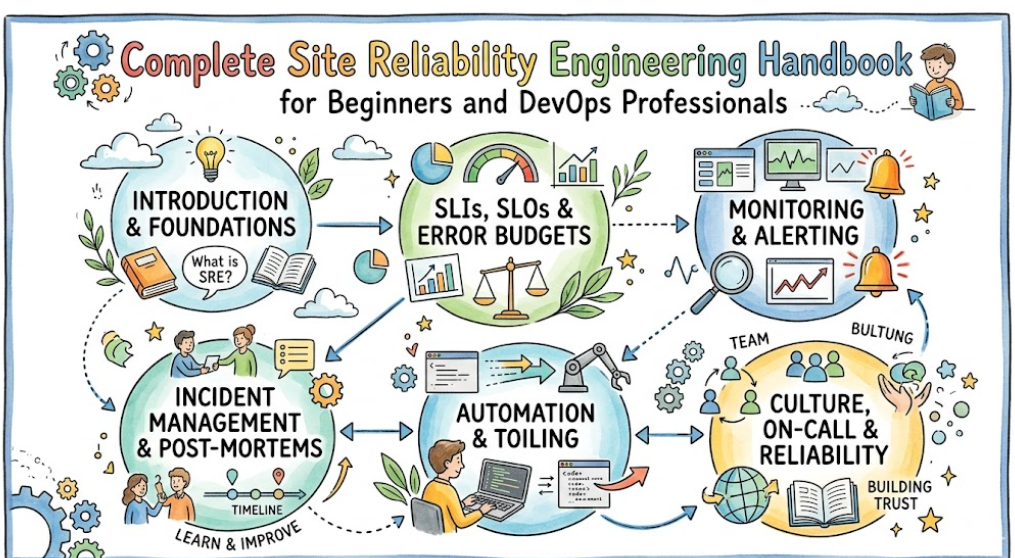
Introduction
Imagine a Friday afternoon during a major global retail sale. Millions of users are actively adding items to their shopping carts, processing payments, and browsing inventory. Suddenly, a subtle memory leak in a newly deployed microservice begins to saturate the underlying cloud infrastructure. Container orchestration nodes start failing, API response times spike from 200 milliseconds to over 15 seconds, and database connection pools become entirely exhausted. In a traditional IT framework, the software development team would blame the infrastructure operations team, while the operations team would point back to the developer’s code changes. Meanwhile, the business loses revenue and customer trust with every passing second.
This operational gridlock is precisely why modern organizations have transitioned away from isolated functional silos and embraced systematic reliability management. As software systems evolved from monolithic application architectures housed in on-premises datacenters to dynamic, highly distributed, cloud-native deployments running on ephemeral container platforms, traditional systems administration models broke down. Modern web-scale platforms require infrastructure that can heal itself, scale dynamically, and provide predictable performance under volatile workloads.
To bridge the gap between rapid feature delivery and ironclad system stability, organizations require a structured, engineering-driven approach to production operations. Aspiring professionals looking to master these concepts can explore the comprehensive training initiatives provided by DevOpsSchool, which offers structured learning tracks designed to cultivate real-world production engineering competencies. By treating operational challenges as software engineering problems, companies can maintain rapid feature velocity without sacrificing the baseline stability that customers expect. Understanding Site Reliability Engineering (SRE) has transformed from an innovative experimental philosophy used by elite hyper-scale tech firms into an essential operational standard for any business running services on modern cloud infrastructure.
What Is Site Reliability Engineering (SRE)?
Site Reliability Engineering is an engineering discipline that applies software engineering principles, methodologies, and mindsets directly to IT infrastructure and production operations tasks. The discipline originates from the early 2000s at Google, conceptualized by Ben Treynor Sloss, who famously defined SRE as “what happens when you ask a software engineer to design an operations function.” Instead of relying on manual interventions, ticket-driven queues, and repetitive human tasks to keep systems running, SRE treats production environments as a software problem where scalability, reliability, and efficiency are achieved through code, automation, and architectural design.
Traditionally, software engineering and IT operations operated with conflicting motivations. Software developers were incentivized to write new features and push changes to production as quickly as possible to drive business value. On the other hand, IT operations teams were incentivized to keep systems completely stable, which naturally led them to resist frequent code changes, since changes introduce operational risk. SRE redefines this dynamic by introducing a shared, quantitative framework that balances the need for rapid feature deployment with the absolute necessity of system availability.
The core philosophy of reliability engineering rests on the premise that 100% availability is a flawed and unrealistic target for virtually any software service. Striving for absolute perfection is economically unviable, slows feature velocity to a crawl, and offers diminishing returns because the user’s end-to-end reliability is already limited by the availability of the internet, local cellular networks, and consumer devices. SRE establishes an engineering framework where a defined, acceptable level of failure is formally acknowledged, budgeted, and managed. This allows teams to take calculated risks, deploy code rapidly, and systematically engineer away system fragility through architectural resilience, proactive capacity management, and comprehensive automation.
Why SRE Matters in Modern Infrastructure
Modern digital infrastructure is defined by its scale, distribution, and inherent complexity. The transition from monolithic application designs to distributed microservices architectures means that a single user action might touch dozens of independent services, API gateways, external databases, and third-party caching layers across multiple cloud regions. In such environments, failures are no longer rare anomalies; they are statistical regularities. Hardware nodes degrade, networks experience intermittent packet loss, and third-party APIs suffer from latency spikes. Without a dedicated reliability framework, managing these complex systems becomes an unsustainable game of reactive firefighting.
High availability requirements are no longer exclusive to financial institutions or critical infrastructure providers. In the modern digital economy, even a few minutes of unexpected downtime can result in massive financial losses, severe reputational damage, and rapid customer churn. Users expect instant, seamless access to applications regardless of global location or concurrent platform traffic. SRE introduces structural patterns—such as automated failovers, circuit breakers, rate limiting, and graceful degradation—ensuring that when a sub-component fails, the wider application degrades elegantly rather than suffering a catastrophic, systemic outage.
Furthermore, cloud-native environments introduce a layer of operational complexity that traditional systems monitoring cannot adequately handle. Ephemeral cloud instances, auto-scaling container groups, and serverless runtimes appear and disappear in a matter of minutes or seconds. SRE provides the paradigms necessary to observe these highly dynamic environments effectively. By implementing deep observability, rigorous capacity planning, and data-driven incident management, SRE enables organizations to accelerate deployment speeds while simultaneously reducing the frequency, blast radius, and duration of production incidents.
Core Principles of SRE
Service Level Indicators (SLIs)
A Service Level Indicator is a carefully chosen quantitative measure of the technical performance of a service, evaluated in real time. SLIs form the bedrock of data-driven reliability decisions. Rather than relying on vague statements like “the database feels slow,” an SRE defines precise SLIs that map directly to user experience. Common examples include the latency of successful HTTP GET requests measured at the API gateway, or the ratio of HTTP 500 error responses to total requests.
A standard latency SLI might be calculated as follows:
$$\text{SLI}_{\text{latency}} = \frac{\text{Count of HTTP requests where latency} \le 200\text{ms}}{\text{Total valid HTTP requests}} \times 100$$
Service Level Objectives (SLOs)
A Service Level Objective is a target metric or range of values for a service reliability level, bounded by a specific target percentage and a defined time window. SLOs are built directly from SLIs and represent the formal agreement within an organization regarding how reliable a service actually needs to be. For instance, an engineering team might establish an SLO stating that the latency SLI must remain above 99% over any rolling 30-day window. Choosing an SLO requires balancing technical feasibility with business viability; over-engineering a system for 99.999% uptime when the business only requires 99.9% creates unnecessary architectural complexity and diverts engineering resources away from core product innovation.
Service Level Agreements (SLAs)
A Service Level Agreement is a formal, legally binding contract between a service provider and its end users or customers. The SLA defines the expected reliability performance of the service and outlines the explicit financial, legal, or material consequences if the provider fails to meet that standard, such as service credits, refunds, or contractual penalties. While SREs do not typically write the legal text of an SLA, their engineering efforts directly defend it. To ensure a safe operational margin, an organization’s internal SLO is always set to a significantly higher standard than the external SLA.
Error Budgets
An Error Budget is the exact mathematical inverse of a service’s SLO, representing the allowable amount of downtime or system underperformance that a service can accumulate over a given time frame. If an application has a defined availability SLO of 99.9% over a 30-day period, its error budget is exactly 0.1%.
$$\text{Error Budget} = 100\% – \text{SLO}\%$$
This budget acts as a financial ledger for operational risk. When the system runs smoothly, the accumulated error budget can be “spent” on risky activities, such as deploying major feature updates, performing complex database migrations, or executing structural architectural changes. However, if production incidents occur and the error budget is entirely consumed or breached, the SRE framework mandates a shift in organizational priorities. Feature deployments are automatically halted, and engineering resources are redirected exclusively to stability improvements, bug fixes, and reliability automation until the service recovers its budget safety margin.
Automation
Automation is the primary mechanism through which SRE teams scale their impact without linearly increasing headcount. When an operational process is executed manually, it introduces human error, creates operational bottlenecks, and consumes valuable engineering time. SREs actively write software to automate infrastructure provisioning, configuration management, code deployments, certificate renewals, and self-healing failure recoveries. If an infrastructure task must be performed more than twice, it becomes a prime candidate for programmatic automation.
Observability
Traditional monitoring simply tells an operations team whether a system is failing by checking static thresholds or pinging endpoints. Observability, conversely, is the property of a system that allows engineers to infer its internal states based entirely on its external outputs. SRE teams design, instrument, and deploy deep observability frameworks that collect, correlate, and analyze high-cardinality data from across the entire infrastructure stack. This comprehensive telemetry allows engineers to diagnose complex, novel failures and understand why an application is behaving abnormally in production.
Incident Response
When critical production failures inevitably manifest, SRE provides an organized, repeatable framework for incident response designed to minimize the Mean Time to Resolution (MTTR). Rather than relying on chaotic chat threads or ad-hoc debugging sessions, SRE introduces formal incident command structures. Roles are explicitly allocated, including an Incident Commander to direct the overall mitigation strategy, an Operations Lead to execute technical changes, and a Communications Lead to keep internal and external stakeholders updated. This systematic approach reduces organizational panic and keeps engineering minds focused entirely on rapid service restoration.
Toil Reduction
Toil is defined as the administrative or operational work tied to running a production service that tends to be manual, repetitive, automatable, tactical, devoid of enduring value, and scaling linearly with the growth of the service. Examples include manually provisioning user accounts, restarting stuck processes, or manually copying data logs across servers. SRE targets toil aggressively, enforcing strict organizational rules—such as the standard mandate that an SRE engineer must spend at least 50% of their time on genuine software engineering and project work, leaving no more than 50% for pure operational tasks like on-call duties and ticket resolution.
SRE Lifecycle & Workflow
The operational lifecycle of a service managed by an SRE team follows a continuous, data-driven cycle designed to systematically mature infrastructure resilience. This workflow begins long before an application is deployed to production, extending through continuous observation, active incident mitigation, and structural, iterative optimizations.
| Stage | Purpose | Common Tools | Real-World Outcome |
| Monitoring & Alerting | Capture runtime anomalies before they affect users | Prometheus, Grafana, Datadog | Automated pages dispatch to the precise on-call engineer with full diagnostic context |
| Incident Management | Rapidly mitigate active production degradations | PagerDuty, Opsgenie, Slack | Structured mitigation minimizing system blast radius and downtime duration |
| Postmortem Analysis | Uncover root causes and build permanent system defenses | Confluence, Google Docs, Jira | Blameless documentation resulting in tangible engineering tasks to prevent recurrence |
| Capacity Planning | Ensure resources match future demand curves | Prometheus, CloudWatch, Custom Scripts | Infrastructure scales efficiently ahead of traffic spikes, eliminating resource exhaustion |
| Reliability Testing | Proactively inject system faults to find hidden dependencies | Gremlin, Chaos Mesh | Discovered failure modes are fixed prior to hitting live customer traffic environments |
| Performance Optimization | Reduce runtime latencies and compute overhead | eBPF, OpenTelemetry, Profilers | Lowered cloud infrastructure spend alongside highly responsive user applications |
SRE vs DevOps
The relationship between Site Reliability Engineering and DevOps is frequently misunderstood, with many organizations mistakenly treating them as interchangeable terms or opposing methodologies. In reality, they are deeply complementary frameworks that target the exact same organizational goal: breaking down functional silos to deliver high-quality software quickly and reliably.
The most accurate industry mental model states that DevOps is a broad cultural philosophy, while SRE is a highly specific, concrete implementation of that philosophy. DevOps provides the high-level cultural guidelines and core principles—such as encouraging shared ownership, embracing automation, accepting failure as a learning vector, and measuring everything. SRE takes these abstract DevOps ideals and defines the explicit architectural mechanisms, mathematical metrics, and operational rules required to execute them on the production floor.
| Feature | Site Reliability Engineering (SRE) | DevOps |
| Primary Focus | System availability, operational scaling, performance, and infrastructure resilience | Cultural alignment, delivery speed, end-to-end automation, and organizational agility |
| Core Team Composition | Software engineers with heavy systems, networking, and operations expertise | Cross-functional mix of product developers, QA engineers, and systems operators |
| Approach to Failure | Managed mathematically using formal SLIs, SLOs, and Error Budgets | Culturally accepted as an inevitable learning opportunity for continuous improvement |
| Automation Strategy | Focused on system scaling, automatic self-healing, and structural toil eradication | Focused on CI/CD pipelines, automated testing, and automated infrastructure delivery |
| Monitoring Philosophy | Deep observability into complex internal states via telemetry data | End-to-end telemetry across code quality, pipeline speed, and environment health |
| Operational Mandate | Explicitly capped operational time to safeguard engineering project cycles | Shared accountability across teams without explicit operational time ceilings |
Popular SRE Tools
The SRE tooling ecosystem is vast and highly specialized. SRE teams select tools not merely for their raw features, but for how effectively they integrate into programmatic workflows, support scale, and provide high-fidelity telemetry data.
Monitoring & Observability Tools
Monitoring and observability platforms form the eyes and ears of the SRE team, continuously tracking metrics, logs, and trace events from production instances.
| Tool Name | Purpose | Enterprise Usage | Difficulty Level |
| Prometheus | Time-series metrics collection | Core metrics engine for Kubernetes and cloud-native systems | Intermediate |
| Grafana | Unified data visualization | Designing real-time operational dashboards for engineering teams | Beginner |
| Datadog | Full-stack observability SaaS | Single-pane-of-glass tracing, metrics, and application performance monitoring | Beginner |
| OpenTelemetry | Vendor-neutral telemetry framework | Instrumenting custom code to export traces, metrics, and application logs | Advanced |
Logging & Tracing Tools
As transactions move across multiple independent distributed microservices, logging and tracing platforms allow engineers to track individual requests seamlessly.
| Tool Name | Purpose | Enterprise Usage | Difficulty Level |
| Elasticsearch / ELK | Centralized log aggregation and analysis | Storing, indexing, and querying terabytes of multi-component system logs | Intermediate |
| Jaeger | Distributed request tracing | Visualizing transaction paths across highly complex microservice graphs | Advanced |
| Loki | Cost-effective log aggregation | Multi-tenant log storage deeply integrated into the Grafana ecosystem | Intermediate |
Incident Management & Automation Tools
When production systems degrade, automated scheduling and collaboration software orchestrate the response.
| Tool Name | Purpose | Enterprise Usage | Difficulty Level |
| PagerDuty | Intelligent on-call routing | Dispatching high-priority alerts to engineers based on rotation schedules | Beginner |
| Ansible | Agentless configuration automation | Programmatic patching, provisioning, and server orchestration | Beginner |
| Terraform | Declarative Infrastructure as Code | Defining cloud networks, clusters, and computing environments as code | Intermediate |
Observability in SRE
To maintain reliability in highly complex environments, SRE teams rely on the comprehensive implementation of the three pillars of observability: Metrics, Logs, and Traces.
Metrics
Metrics are numeric values measured over intervals of time, optimized for fast querying, long-term storage, and real-time mathematical aggregation. Because metrics have very little data overhead, they are ideal for driving real-time alerting systems and high-level operational dashboards. SREs classify metrics using established frameworks such as the Four Golden Signals:
- Latency: The time taken to service a request, carefully differentiating the latency of successful requests from failed ones.
- Traffic: A measure of how much demand is being placed on the system, such as HTTP requests per second or concurrent database connections.
- Errors: The rate of requests that fail, either explicitly (e.g., HTTP 500 errors) or implicitly (e.g., an HTTP 200 response that returns incorrect payload data).
- Saturation: A measure of how full a service’s constrained resources are, tracking elements like memory utilization, CPU limits, or disk I/O channels.
Logs
Logs are timestamped text strings generated by application runtimes or system daemons in response to specific code executions. While metrics indicate that a system is experiencing anomalous behavior, logs provide the explicit, granular context required to understand exactly what went wrong inside a specific process. SRE teams mandate structured logging formats—such as JSON payloads—allowing automated logging aggregators to parse, index, and query log data quickly during an active debugging session.
Traces and Distributed Tracing
A trace represents the entire lifecycle of a discrete request as it moves through a multi-tiered, distributed system. In a microservices architecture, a single user click might initiate an auth check, call an inventory service, write to a payment database, and trigger a shipping notification. Distributed tracing assigns a unique tracking identifier to the initial request at the edge gateway. This identifier is injected into the metadata header of every subsequent internal network call. Distributed tracing systems parse these headers to construct an end-to-end visual timeline, allowing SREs to pinpoint the exact microservice causing latency or throwing unhandled exceptions.
Incident Management in SRE
The ultimate metric of an effective SRE team is not the complete absence of production incidents, but how efficiently the team organizes, mitigates, and learns from those incidents. The incident lifecycle consists of distinct phases engineered to minimize chaos and protect engineers from burnout.
[Detection/Alert] ──> [Triage & Command] ──> [Mitigation] ──> [Postmortem Analysis] ──> [Remediation Action Items]
Code language: CSS (css)
When an automated alert trips an on-call notification, the primary objective is rapid mitigation, not permanent root cause analysis. SREs prioritize stabilizing the platform—whether by rolling back the latest deployment, shifting traffic to an alternate cloud region, or dynamically increasing auto-scaling limits. Deep debugging happens only after the live production environment is completely healthy and stable.
Once an incident is resolved, the SRE methodology mandates the creation of a comprehensive Blameless Postmortem. The baseline premise of a blameless culture is that human errors are symptoms of systemic architectural flaws, not the root causes themselves. If an engineer executes an incorrect command that drops a production database, the SRE perspective states that the system shouldn’t have allowed an interactive shell to perform such a destructive action without guardrails.
A high-quality postmortem details the exact chronological timeline of the event, evaluates the effectiveness of the monitoring system, isolates the underlying systemic vulnerabilities, and establishes concrete, tracked engineering tasks to ensure that identical failure modes can never occur again.
Reliability Engineering Best Practices
Executing an SRE model requires moving beyond pure theory and instilling systematic operational habits across the engineering organization:
- Automation-First Operations: Eliminate interactive manual configurations on servers. Every infrastructure state change must be version-controlled, reviewed via pull requests, and deployed through automated continuous integration pipelines.
- Rigorous Error Budget Management: Establish a clear corporate policy where error budget depletion binds product engineering focus directly to reliability remediation. Uptime goals must drive software delivery velocity.
- Pervasive Monitoring Coverage: Treat monitoring code as a core application feature. A software feature is incomplete until its associated SLIs are instrumented, dashboards are built, and alerting thresholds are configured.
- Chaos Engineering Implementation: Do not wait for production failures to happen naturally. Use chaos engineering practices to deliberately inject controlled faults—such as shutting down server nodes or introducing artificial latency—into staging or production environments to validate system resilience.
- Proactive Capacity Planning: Analyze historical utilization trends alongside business growth projections to model future resource demands. Automate horizontal auto-scaling parameters to absorb unexpected demand spikes safely.
SRE Roles and Responsibilities
As the discipline has matured, specialized operational roles have emerged within larger enterprise infrastructure teams:
- Site Reliability Engineer: The core practitioner who balances operational on-call support with writing software code to automate infrastructure, optimize performance, and build internal tools.
- Reliability Architect: A senior individual contributor who designs large-scale system patterns, reviews software architectures for structural flaws, and ensures cross-service dependencies are resilient.
- Production Engineer: A closely related variant focus dedicated to embedded application-level reliability, optimizing runtime configurations, and ensuring application code handles infrastructure failure gracefully.
- Observability Engineer: A specialized engineer focused entirely on building, scaling, and maintaining the enterprise monitoring fabric, data collectors, and logging pipelines.
- Incident Commander: A critical runtime role assumed during major system outages, responsible for orchestrating technical teams, making high-stakes mitigation choices, and decoupling operational debugging from stakeholder management.
SRE Engineer Roadmap for Beginners
Transitioning into Site Reliability Engineering requires building a solid foundation across several foundational technical domains. The roadmap below outlines an effective sequence for developing these competencies.
1. Operating Systems & Linux Systems Administration
Before managing thousands of servers via container tools, an engineer must thoroughly understand how a single operating system operates. Focus deeply on the Linux kernel ecosystem:
- Master the Linux filesystem structure, permissions models, and shell scripting (Bash).
- Understand process management states, signals, threads, and memory allocations.
- Learn to diagnose runtime performance issues using basic CLI utilities like
top,htop,strace,lsof, andvmstat.
2. Networking Fundamentals
Distributed systems communicate continuously across complex physical and virtual networks. You must understand the data paths thoroughly:
- Master the OSI Model, specifically focusing on the transport (TCP/UDP) and network (IP) layers.
- Understand core internet routing protocols, including DNS resolution, HTTP/HTTPS lifecycle, TLS handshake, and load-balancing algorithms.
- Learn basic network debugging tools such as
curl,dig,traceroute,tcpdump, andnetstat.
3. Programming and Scripting Proficiency
An SRE is first and foremost a software engineer who writes code to run systems. Pure systems administrators without programming skills face severe scaling limitations:
- Develop a professional operational mastery of at least one major language, preferably Python or Go (Golang).
- Understand data structures, basic algorithms, API interaction patterns, and error-handling architectures.
- Learn Git-based version control workflows thoroughly, including branching, merging, and pull-request code reviews.
4. Cloud Infrastructure Platforms & Infrastructure as Code (IaC)
Modern organizations rely on abstracting computing resources using APIs provided by public or private cloud vendors:
- Master core infrastructure constructs on a major cloud provider (such as AWS, Google Cloud, or Microsoft Azure), including virtual networks, compute instances, object storage, and IAM permission policies.
- Learn declarative Infrastructure as Code using tools like Terraform or OpenTofu to define your infrastructure state cleanly as code.
5. Containerization & Orchestration (Kubernetes)
Containers provide application portability, while orchestrators manage container lifecycles at scale:
- Understand container fundamentals by writing Dockerfiles, building container images, and managing local container storage and runtimes.
- Deeply study Kubernetes architecture, focusing on Pod lifecycles, Deployments, Services, Ingress control, ConfigMaps, and structural resource limits.
6. Suggested Practice Projects for Mastery
- Project 1: Write a Python script that polls a public API, extracts telemetry data, and writes a structured JSON log file to a specific folder. Rotate the log file automatically when it exceeds 10MB.
- Project 2: Use Terraform to provision a low-cost virtual instance on a cloud provider. Write an automation script that configures Nginx, secures it with a TLS certificate, and opens up restricted firewall rules.
- Project 3: Deploy a local Kubernetes cluster (using Minikube or Kind). Deploy a basic application along with a Prometheus and Grafana instance. Configure a custom Grafana dashboard displaying live CPU and memory utilization.
SRE Certifications
While hands-on project work is the primary indicator of technical capability, professional certifications can help validate your expertise, structure your learning journey, and ensure your alignment with established industry frameworks.
The structured training tracks provided across the DevOpsSchool educational portfolio offer direct, hands-on prep designed to align with these globally recognized standard industry certifications.
| Certification | Level | Best For | Skills Covered |
| SRE Foundation (DevOps Institute) | Beginner | Entry-level professionals, Systems Admins, Product Managers | Core SRE tenets, vocabulary, SLI/SLO formulation, error budgets |
| Certified Kubernetes Administrator (CKA) | Intermediate | SREs, Cloud Engineers, Systems Administrators | Kubernetes cluster management, troubleshooting, storage, networking |
| AWS Certified DevOps Engineer – Professional | Advanced | Senior Cloud Architects, Advanced SRE Practitioners | Multi-account provisioning, automated scale, complex CI/CD, healing automation |
| Google Cloud Certified Professional Cloud DevOps Engineer | Advanced | Cloud Engineers specializing in Google-native SRE patterns | Managing service performance, implementing SRE practices, monitoring systems |
Real-World SRE Use Cases
SRE principles apply directly across multiple industry verticals, with each sector adapting the framework to meet its unique operational constraints:
- E-Commerce Platforms: During major holiday shopping traffic surges, e-commerce SRE teams configure aggressive horizontal auto-scaling rules and active cache invalidation routines. They build structural “graceful degradation” pathways—ensuring that if the underlying inventory prediction service becomes saturated, the front-end user experience gracefully hides recommendation widgets while keeping the core checkout path functional.
- Fintech & Banking Systems: In banking infrastructure, transactional consistency and data security are absolute priorities. SREs in this space focus heavily on zero-trust network configurations, detailed security auditing logs, and active-active multi-region cloud databases configured for near-instant failovers with zero data loss ($RPO=0$).
- SaaS Platforms: Multi-tenant SaaS environments experience volatile, unpredictable workloads as corporate users connect. SREs build tenant-isolated resource throttling systems, strict rate-limiting policies at the API gateway layer, and tenant-specific SLO monitors ensuring a single noisy customer cannot degrade the performance of other users sharing the underlying computing cluster.
Benefits of SRE
Implementing a mature Site Reliability Engineering practice delivers transformative advantages to both engineering organizations and the wider business:
- Drastic Reduction in Downtime: Through programmatic self-healing automation, automated rollbacks, and high-fidelity alerting, organizations significantly minimize their Mean Time to Resolution (MTTR), keeping systems operational.
- Accelerated Feature Velocity: Rather than delaying releases due to fear of failure, the calculated risk framework provided by error budgets enables development teams to deploy new features quickly and confidently.
- Elimination of Engineering Silos: SRE shifts organizational perspective by introducing shared technical objectives and clear mathematical boundaries, ending the unproductive finger-pointing between software developers and operations teams.
- Optimized Infrastructure Expenditure: Through continuous profiling, performance tuning, and data-driven capacity modeling, SREs help companies scale down over-provisioned cloud instances, reducing overall infrastructure costs.
Common Challenges in SRE
Despite the undeniable benefits, building a sustainable SRE function presents several systemic challenges that leadership teams must manage proactively.
- Alert Fatigue: When monitoring systems route low-priority warnings or actionable but non-urgent issues directly to an engineer’s pager at midnight, it leads to sleep deprivation and severe burnout.
- Solution: Enforce strict alerting rules. Only page a human if the alert is urgent, indicates a direct threat to the user-facing SLO, and requires an immediate human decision. Route non-urgent issues to an administrative ticket queue.
- On-Call Burnout: Small engineering teams running complex systems can quickly wear down if they find themselves perpetually attached to an incident pager.
- Solution: Implement balanced on-call rotations across multiple geographic time zones (“Follow-the-Sun” model) or spread the pager responsibilities across both SREs and the original product developers who authored the features.
- Cultural Resistance to Error Budgets: Product managers and executive leadership teams occasionally push back when an SRE policy mandates a complete feature deployment freeze due to an exhausted error budget.
- Solution: Secure explicit executive buy-in before implementing the SRE model. Establish error budget policies as standard corporate governance rules, rather than optional guidelines that can be bypassed during deadlines.
Common Beginner Mistakes in SRE
If you are beginning your journey into Site Reliability Engineering, avoid these common tactical pitfalls:
- [ ] Skipping System Fundamentals: Attempting to learn advanced service meshes or distributed orchestrators before mastering basic Linux system concepts, core disk I/O diagnostics, and standard TCP/IP networking constructs.
- [ ] Over-Focusing on Tooling Splendors: Focusing excessively on specific technology tool suites, rather than mastering the foundational, language-agnostic concepts of telemetry collection, deep system profiling, and sound architectural design patterns.
- [ ] Building Overly Complex Alerting Rules: Creating thousands of distinct, micro-level threshold alerts for single servers rather than building high-level, macro alerts focused directly on user-facing symptoms.
- [ ] Neglecting Coding Competency Development: Treating the role as a traditional systems administration position and failing to invest the time required to build clean, modular, and maintainable software code.
Future of SRE
The landscape of modern systems infrastructure continues to evolve at a rapid pace, steering the SRE discipline toward several key architectural paradigms:
As machine learning utilities mature, observability platforms are integrating advanced mathematical analytics to ingest millions of telemetry data streams. This shift toward AIOps and Predictive Observability allows systems to detect subtle pattern deviations, predict impending disk failures, and automate cluster optimizations before any formal alert threshold is reached.
Additionally, many organizations are adopting Platform Engineering models, where dedicated SRE teams transition from manually fixing individual product clusters to building centralized Internal Developer Platforms (IDPs). These automated self-service portals encapsulate the company’s infrastructure security guardrails, deployment pipelines, and observability configurations within an intuitive interface. This empowers product developers to independently provision safe, highly resilient infrastructure environments without requiring custom intervention from the SRE team.
FAQs (15 Questions)
1. What is Site Reliability Engineering?
Site Reliability Engineering is a discipline that applies software engineering practices directly to production operations, infrastructure automation, and scalability management to build highly resilient systems.
2. Is SRE different from DevOps?
Yes. DevOps is a broad cultural philosophy focused on team collaboration and delivery speed, whereas SRE is a specific technical implementation of that philosophy that manages reliability mathematically using code.
3. Does SRE require coding?
Yes. A core defining tenet of SRE is treating operations as a software problem. Practitioners write code to build automation tooling, interact with infrastructure APIs, and develop self-healing systems.
4. Which programming language is best for SRE?
Python and Go (Golang) are the dominant languages within the SRE ecosystem. Go is widely used for building cloud-native tools, while Python is exceptional for advanced automation scripting and telemetry analytics.
5. Is Kubernetes necessary for SRE?
While SRE concepts apply universally to any infrastructure environment (including traditional bare-metal deployments), Kubernetes has become the industry standard container orchestrator for cloud-native applications.
6. What skills are needed for SRE?
A well-rounded SRE needs a solid grasp of Linux systems administration, TCP/IP networking, a major programming language, cloud infrastructure concepts, Infrastructure as Code tools, and observability frameworks.
7. How stressful is an SRE role?
The role can become stressful during major, unexpected system incidents. However, a mature SRE practice mitigates this stress through blameless cultures, structured incident command workflows, and strict rules against alert fatigue.
8. What salary can SRE engineers expect?
SREs are highly sought-after professionals due to their rare mix of development and operations skills. Salaries vary widely by location and experience, but they consistently rank among the highest-paid positions in tech, often commanding premium compensation packages compared to traditional systems administration roles.
9. What is an Error Budget?
An Error Budget is the exact mathematical inverse of a service’s SLO (e.g., a 99.9% SLO leaves a 0.1% error budget). It represents the acceptable amount of system downtime or degradation available for engineering experimentation and deployment risk.
10. What is the difference between a metric and a log?
A metric is a highly efficient numeric data value tracked over time, perfect for alerting systems. A log is a detailed, text-based string containing granular execution context generated by applications during active operations.
11. What is Toil in SRE?
Toil is operational work that is manual, repetitive, automatable, tactical, lacks long-term value, and scales linearly as your service footprint expands. SRE explicitly seeks to automate and eliminate toil.
12. What is Chaos Engineering?
Chaos Engineering is the practice of deliberately injecting controlled faults into systems (such as terminating an active node) to proactively test and verify that your infrastructure can adapt and heal itself gracefully.
13. What happens when an Error Budget is spent?
When an error budget is entirely consumed, standard deployment pipelines are paused. The engineering organization reallocates its focus toward fixing bugs, stabilizing architecture, and improving reliability automation.
14. What is a Blameless Postmortem?
A blameless postmortem is an analytical document written after an incident. It focuses objectively on identifying systemic infrastructure flaws and process gaps, rather than assigning blame or fault to individual engineers.
15. Can a system administrator transition directly into SRE?
Yes. Systems administrators possess deep operating system and networking knowledge. By developing structured programming proficiency and embracing a cloud-native automation mindset, they can make exceptional SREs.
Final Thoughts
The journey toward building highly reliable distributed systems is not defined by adopting a specific tool suite or rebranding an existing operations group overnight. True reliability is an ongoing technical commitment rooted in sound software engineering methodologies, data-driven decisions, and an organizational culture that views system failures as engineering opportunities rather than management crises.
As digital systems grow increasingly complex, the demand for engineers who can confidently navigate both application development and enterprise infrastructure operations continues to expand. For aspiring engineers and organizations alike, mastering the structured principles of Site Reliability Engineering is the single most reliable strategy for confidently navigating the unpredictable production realities of today’s digital world.

Find Trusted Cardiac Hospitals
Compare heart hospitals by city and services — all in one place.
Explore Hospitals