
Introduction
Foundation Model API Platforms are the infrastructure layer that lets developers and enterprises access powerful AI models—such as large language models, multimodal systems, and specialized reasoning engines—through APIs instead of managing complex machine learning infrastructure.
In practical terms, these platforms are the “AI brains on demand” behind modern applications like copilots, chat assistants, automated workflows, document intelligence systems, and autonomous agents. Instead of training or hosting models yourself, you plug into these platforms and build products on top of them.
Today, these platforms are no longer simple model endpoints. They have evolved into full AI operating systems that include tool calling, agent orchestration, evaluation frameworks, safety guardrails, observability tools, and cost optimization layers.
Common real-world use cases include:
- AI copilots for enterprise software
- Customer support automation systems
- Document summarization and extraction pipelines
- Autonomous agents that complete multi-step tasks
- Developer productivity tools (code generation, debugging, testing)
- Multimodal applications combining text, images, and audio
When evaluating these platforms, buyers typically consider:
- Model quality and consistency
- Latency and throughput performance
- Pricing and cost predictability
- Security and compliance controls
- Data privacy and retention policies
- Retrieval-Augmented Generation (RAG) support
- Tool/function calling capabilities
- Evaluation and testing frameworks
- Observability (logs, traces, metrics)
- Vendor lock-in risk and portability
Best for: CTOs, AI engineers, product teams, and startups building production-grade AI systems.
Not ideal for: Casual users or simple chatbot use cases that do not require scaling, governance, or infrastructure control.
What’s Changed in Foundation Model API Platforms
Modern Foundation Model API Platforms have significantly evolved. Key trends include:
- Shift from single prompts to agentic workflows
- Native support for tool calling and function execution
- Strong adoption of multimodal inputs (text, image, audio, video)
- Growing importance of evaluation frameworks and regression testing
- Built-in defenses against prompt injection and jailbreak attacks
- Enterprise demand for data privacy and retention control
- Rise of model routing systems for cost and performance optimization
- Support for multiple model providers in a single platform
- Expansion of open-source model hosting alongside proprietary models
- Increased focus on observability and trace-level debugging
- Integration of governance and auditability features
- Hybrid deployment models (cloud + private inference)
- Strong emphasis on latency optimization for real-time AI applications
Quick Buyer Checklist (Scan-Friendly)
Before choosing a Foundation Model API platform, evaluate:
- Data privacy and retention policies
- Support for BYO (Bring Your Own) models
- Availability of multiple model providers
- RAG and vector database integrations
- Built-in evaluation and testing tools
- Guardrails and safety mechanisms
- Latency and performance consistency
- Cost tracking, caching, and optimization features
- Observability (logs, traces, monitoring)
- Deployment flexibility (cloud, hybrid, self-hosted)
- API stability and versioning strategy
- Enterprise controls (RBAC, SSO, audit logs)
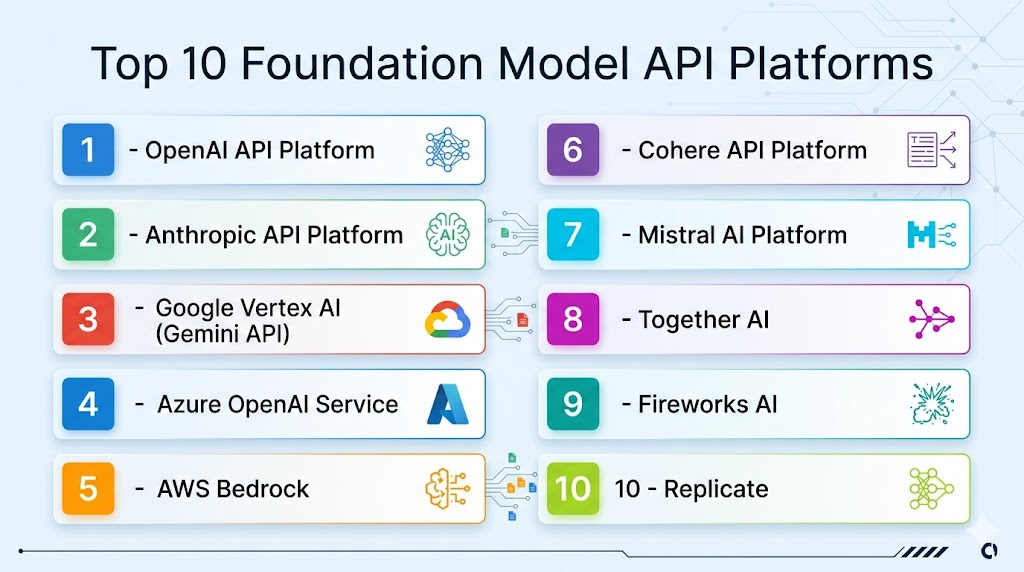
Top 10 Foundation Model API Platforms
#1 — OpenAI API Platform
One-line verdict: Best for high-quality general-purpose AI applications with strong ecosystem support.
Short description:
Provides access to advanced multimodal models widely used for chatbots, copilots, and agent-based systems.
Standout Capabilities
- High-quality reasoning and multimodal models
- Strong tool/function calling support
- Mature SDK ecosystem
- Fast model iteration cycle
- Broad industry adoption
AI-Specific Depth
- Model support: Proprietary multimodal models
- RAG / knowledge integration: External implementation required
- Evaluation: External tools needed
- Guardrails: Built-in moderation systems
- Observability: Token and usage metrics
Pros
- Strong model performance
- Excellent developer experience
- Large ecosystem support
Cons
- Limited portability
- Potential cost scaling at high usage
- Black-box model behavior
Security & Compliance
- Enterprise controls available (details vary by configuration)
Deployment & Platforms
- Cloud API only
Integrations & Ecosystem
- Works with major vector databases
- Broad SDK support
- Common in SaaS integrations
Pricing Model
Usage-based (token-driven)
Best-Fit Scenarios
- AI copilots
- Chat-based assistants
- Multimodal applications
#2 — Anthropic API Platform
One-line verdict: Best for safe, reliable long-context reasoning and enterprise document workflows.
Short description:
Focuses on safety-aligned models optimized for reasoning and handling long documents.
Standout Capabilities
- Long context processing
- Stable reasoning behavior
- Strong safety alignment
- Document-heavy workflows
AI-Specific Depth
- Model support: Proprietary models
- RAG: External implementation required
- Evaluation: External tools required
- Guardrails: Strong built-in alignment
- Observability: Basic usage metrics
Pros
- Excellent long-context handling
- Consistent outputs
- Strong safety design
Cons
- Smaller ecosystem
- Limited multimodal coverage
- Less customization control
Security & Compliance
- Enterprise offerings available (varies)
Deployment & Platforms
- Cloud API only
Integrations & Ecosystem
- Works with orchestration frameworks
- Common in enterprise assistants
Pricing Model
Usage-based
Best-Fit Scenarios
- Legal/document analysis
- Enterprise knowledge systems
- Compliance-heavy applications
#3 — Google Vertex AI (Gemini API)
One-line verdict: Best for multimodal AI deeply integrated with cloud-native infrastructure.
Short description:
Provides Gemini models with strong multimodal capabilities and enterprise cloud integration.
Standout Capabilities
- Multimodal AI (text, image, audio, video)
- Cloud-native integration
- Enterprise-grade scalability
- Strong data pipeline support
AI-Specific Depth
- Model support: Gemini + ecosystem models
- RAG: Native tooling available
- Evaluation: Platform tools available (varies)
- Guardrails: Safety filters included
- Observability: Cloud monitoring tools
Pros
- Strong multimodal capabilities
- Deep cloud integration
- Enterprise scalability
Cons
- Complex setup
- Fragmented tooling across services
Security & Compliance
- Cloud enterprise compliance controls
Deployment & Platforms
- Cloud only
Integrations & Ecosystem
- BigQuery, Cloud Storage, ML pipelines
Pricing Model
Cloud usage-based
Best-Fit Scenarios
- Enterprise AI systems
- Multimodal pipelines
- Cloud-native applications
#4 — Azure OpenAI Service
One-line verdict: Best for enterprises needing secure OpenAI model access inside Microsoft ecosystem.
Short description:
Provides OpenAI models with enterprise-grade Azure security and governance.
Standout Capabilities
- Enterprise governance controls
- Private networking support
- Microsoft ecosystem integration
- Strong compliance alignment
AI-Specific Depth
- Model support: OpenAI models via Azure
- RAG: Azure AI Search integration
- Evaluation: External or Azure tools
- Guardrails: Content filtering systems
- Observability: Azure Monitor
Pros
- Strong enterprise security
- Deep Microsoft integration
- Compliance-ready infrastructure
Cons
- Slower feature updates
- Complex configuration
Security & Compliance
- Enterprise-grade Azure controls
Deployment & Platforms
- Cloud (Azure)
Integrations & Ecosystem
- Microsoft 365, Power Platform, Azure ML
Pricing Model
Usage-based via Azure billing
Best-Fit Scenarios
- Large enterprises
- Regulated industries
- Microsoft-centric organizations
#5 — AWS Bedrock
One-line verdict: Best multi-model enterprise platform with strong AWS integration.
Short description:
Unified access to multiple foundation model providers within AWS infrastructure.
Standout Capabilities
- Multi-model access
- AWS-native integration
- Guardrails framework
- Scalable infrastructure
AI-Specific Depth
- Model support: Multiple providers
- RAG: AWS ecosystem tools
- Evaluation: Emerging support
- Guardrails: Built-in AWS Guardrails
- Observability: CloudWatch
Pros
- Flexible model selection
- Strong AWS ecosystem
- Enterprise scalability
Cons
- Complex pricing
- Fragmented model experience
Security & Compliance
- AWS enterprise security
Deployment & Platforms
- Cloud (AWS)
Integrations & Ecosystem
- S3, Lambda, SageMaker
Pricing Model
Usage-based per model provider
Best-Fit Scenarios
- Enterprise AWS workloads
- Multi-model systems
- Scalable AI platforms
#6 — Cohere API Platform
One-line verdict: Best for enterprise search, embeddings, and RAG-heavy applications.
Short description:
Specializes in NLP models optimized for retrieval and enterprise search systems.
Standout Capabilities
- High-quality embeddings
- RAG-first architecture
- Enterprise search optimization
- Lightweight APIs
AI-Specific Depth
- Model support: Proprietary NLP models
- RAG: Strong native support
- Evaluation: External tools required
- Guardrails: Basic safety filters
- Observability: API metrics
Pros
- Excellent retrieval performance
- Strong embeddings
- Enterprise search focus
Cons
- Narrower model scope
- Smaller ecosystem
Security & Compliance
- Enterprise options available (varies)
Deployment & Platforms
- Cloud API
Integrations & Ecosystem
- Vector databases and search systems
Pricing Model
Usage-based
Best-Fit Scenarios
- Enterprise search
- Knowledge retrieval systems
- RAG-based apps
#7 — Mistral AI Platform
One-line verdict: Best for efficient, cost-effective, and open-weight model deployment.
Short description:
Offers high-performance models optimized for efficiency and flexibility.
Standout Capabilities
- Efficient model architecture
- Open-weight options
- Fast inference
- Flexible deployment
AI-Specific Depth
- Model support: Open + proprietary
- RAG: External integration required
- Evaluation: External tools
- Guardrails: Limited native support
- Observability: Basic metrics
Pros
- Cost-efficient
- High performance
- Flexible deployment
Cons
- Smaller ecosystem
- Limited governance tools
Security & Compliance
- Not fully publicly detailed
Deployment & Platforms
- Cloud + hybrid options
Integrations & Ecosystem
- Open-source compatible tools
Pricing Model
Usage-based
Best-Fit Scenarios
- Cost-sensitive applications
- Open-weight deployments
- Custom AI stacks
#8 — Together AI
One-line verdict: Best for hosting and fine-tuning open-source models at scale.
Short description:
Focused on serving and fine-tuning open-source models efficiently.
Standout Capabilities
- Open-source model hosting
- Fine-tuning support
- High-performance inference
- Developer-friendly APIs
AI-Specific Depth
- Model support: Open-source models
- RAG: External integration
- Evaluation: External tools
- Guardrails: Minimal
- Observability: Basic
Pros
- Strong open-source support
- Flexible model control
- Cost-effective scaling
Cons
- Limited enterprise governance
- Requires engineering effort
Security & Compliance
- Not publicly detailed
Deployment & Platforms
- Cloud API
Integrations & Ecosystem
- Hugging Face ecosystem compatibility
Pricing Model
Usage-based
Best-Fit Scenarios
- Open-source AI systems
- Research workflows
- Custom pipelines
#9 — Fireworks AI
One-line verdict: Best for ultra-fast inference and optimized model serving.
Short description:
Focuses on high-performance inference infrastructure for production AI apps.
Standout Capabilities
- Low-latency inference
- Optimized serving engine
- High throughput systems
- Scalable architecture
AI-Specific Depth
- Model support: Mixed models
- RAG: External
- Evaluation: Limited
- Guardrails: Basic
- Observability: Performance metrics
Pros
- Very fast inference
- Scalable infrastructure
- Developer-friendly APIs
Cons
- Limited enterprise tooling
- Smaller ecosystem
Security & Compliance
- Not fully publicly stated
Deployment & Platforms
- Cloud API
Integrations & Ecosystem
- LLM orchestration tools
Pricing Model
Usage-based
Best-Fit Scenarios
- Real-time AI applications
- High-throughput systems
- Low-latency agents
#10 — Replicate
One-line verdict: Best for experimenting with diverse AI models quickly.
Short description:
Provides simple API access to a wide range of AI models for experimentation and prototyping.
Standout Capabilities
- Large model variety
- Simple deployment interface
- Rapid prototyping
- Community model ecosystem
AI-Specific Depth
- Model support: Open-source + community models
- RAG: External
- Evaluation: Not built-in
- Guardrails: Minimal
- Observability: Basic logs
Pros
- Easy experimentation
- Wide model access
- Fast prototyping
Cons
- Not enterprise-focused
- Limited governance features
Security & Compliance
- Not publicly detailed
Deployment & Platforms
- Cloud API
Integrations & Ecosystem
- Developer experimentation tools
Pricing Model
Usage-based per model
Best-Fit Scenarios
- Prototyping
- Research experiments
- Model testing
Comparison Table
| Tool | Best For | Deployment | Model Flexibility | Strength | Watch-Out | Public Rating |
|---|---|---|---|---|---|---|
| OpenAI API | General AI apps | Cloud | Proprietary | Model quality | Lock-in risk | N/A |
| Anthropic | Safe reasoning | Cloud | Proprietary | Reliability | Narrow multimodal | N/A |
| Vertex AI | Multimodal cloud AI | Cloud | Multi-model | Cloud integration | Complexity | N/A |
| Azure OpenAI | Enterprise AI | Cloud | OpenAI models | Compliance | Slow updates | N/A |
| AWS Bedrock | Multi-model enterprise | Cloud | Multi-model | AWS ecosystem | Complexity | N/A |
| Cohere | RAG/search | Cloud | Proprietary | Retrieval | Narrow scope | N/A |
| Mistral AI | Efficient LLMs | Cloud/hybrid | Mixed | Cost efficiency | Smaller ecosystem | N/A |
| Together AI | Open-source hosting | Cloud | Open-source | Flexibility | Less governance | N/A |
| Fireworks AI | Fast inference | Cloud | Mixed | Speed | Limited enterprise tools | N/A |
| Replicate | Experimentation | Cloud | Community | Simplicity | Not enterprise-ready | N/A |
Scoring & Evaluation (Transparent Rubric)
Scoring is comparative and reflects production readiness across multiple dimensions.
| Tool | Core | Reliability | Guardrails | Integrations | Ease | Perf/Cost | Security | Support | Weighted Total |
|---|---|---|---|---|---|---|---|---|---|
| OpenAI API | 10 | 9 | 8 | 9 | 9 | 8 | 8 | 9 | 8.9 |
| Anthropic | 9 | 10 | 9 | 8 | 9 | 8 | 8 | 8 | 8.8 |
| Vertex AI | 9 | 8 | 8 | 10 | 7 | 8 | 9 | 9 | 8.5 |
| Azure OpenAI | 9 | 8 | 9 | 10 | 7 | 8 | 10 | 9 | 8.6 |
| AWS Bedrock | 9 | 8 | 8 | 10 | 7 | 8 | 9 | 9 | 8.5 |
| Cohere | 8 | 7 | 7 | 8 | 8 | 8 | 8 | 7 | 7.9 |
| Mistral AI | 8 | 7 | 6 | 7 | 8 | 9 | 7 | 7 | 7.7 |
| Together AI | 8 | 7 | 6 | 8 | 8 | 9 | 7 | 7 | 7.8 |
| Fireworks AI | 8 | 7 | 6 | 7 | 8 | 10 | 7 | 7 | 7.9 |
| Replicate | 7 | 6 | 5 | 7 | 10 | 8 | 6 | 6 | 7.1 |
Which Platform Is Right for You?
Solo / Freelancer
- OpenAI API
- Replicate
SMB
- OpenAI API
- Cohere
- Mistral AI
Mid-Market
- AWS Bedrock
- Vertex AI
- Anthropic
Enterprise
- Azure OpenAI
- AWS Bedrock
- Vertex AI
Regulated Industries
- Azure OpenAI
- AWS Bedrock
- Vertex AI
Budget vs Premium
- Budget: Mistral AI, Together AI
- Premium: OpenAI API, Anthropic, Azure OpenAI
Build vs Buy
- Use APIs for speed and reliability
- Use open-source stacks for control and cost optimization
Implementation Playbook (30 / 60 / 90 Days)
30 Days
- Define use case
- Run API experiments
- Build baseline evaluation set
- Track latency and cost
60 Days
- Add guardrails
- Implement evaluation pipelines
- Introduce logging and tracing
- Perform safety testing
90 Days
- Optimize cost and routing
- Scale production workloads
- Add governance controls
- Automate monitoring and alerts
Common Mistakes & How to Avoid Them
- No evaluation system before production
- Ignoring prompt injection risks
- Over-reliance on a single provider
- Lack of cost tracking
- Missing observability
- Poor prompt version control
- No fallback models
- Treating LLMs as deterministic systems
- Weak access control
- Skipping load testing
- No governance policies
- Over-automation without human oversight
- Ignoring data retention policies
- No incident response strategy
FAQs
1. What is a Foundation Model API Platform?
A service that provides access to large AI models via APIs for building applications without training models.
2. Do these platforms store user data?
It depends on the provider and configuration. Some offer zero-retention modes, but policies vary.
3. Can I use my own model?
Yes, several platforms support BYO models including AWS Bedrock, Vertex AI, and Together AI.
4. What is the difference between API platforms and open-source models?
APIs are hosted services, while open-source models require self-hosting or third-party infrastructure.
5. Which platform is cheapest?
Cost varies, but efficiency-focused platforms like Mistral AI and Fireworks AI are often more affordable.
6. Can I switch providers later?
Yes, but abstraction layers are recommended to avoid vendor lock-in.
7. Do these platforms support AI agents?
Yes, most support tool calling and agent workflows.
8. What is RAG?
Retrieval-Augmented Generation combines AI models with external knowledge sources.
9. Are these platforms secure?
Most enterprise platforms offer strong security controls, but configuration matters.
10. What is model routing?
Automatically selecting the best model for each task based on cost or performance.
11. Do I need evaluation tools?
Yes, evaluation is critical for production reliability.
12. Can I self-host foundation models?
Yes, using open-source ecosystems or hybrid platforms.
Conclusion
Foundation Model API Platforms are the backbone of modern AI systems, evolving into full-stack infrastructure layers that combine models, orchestration, evaluation, and governance. The best choice depends on your goals—whether it is intelligence quality, enterprise security, cost efficiency, or open-source flexibility—but long-term success depends less on the model itself and more on how well the platform supports reliability, observability, and scalable AI workflows.

Find Trusted Cardiac Hospitals
Compare heart hospitals by city and services — all in one place.
Explore Hospitals
Useful and well-structured article on foundation model API platforms. It breaks down key features and differences clearly, making it easier to compare options.