
Introduction
Multimodal Model Platforms are AI systems that allow models to understand and generate information across multiple types of data—such as text, images, audio, video, and documents—within a single unified workflow. Instead of treating each input type separately, these platforms combine them into one reasoning system, enabling more human-like understanding.
In practical terms, these platforms power applications like visual assistants, real-time voice agents, document intelligence systems, video analysis tools, and advanced AI copilots that can “see, hear, and read” at the same time. Modern multimodal platforms are no longer experimental—they are production-grade infrastructure used in enterprise AI systems.
Leading models now support combinations of text + image + audio + video in a single API call, enabling unified reasoning across formats instead of fragmented pipelines.
Common real-world use cases include:
- AI assistants that analyze screenshots and explain them
- Voice-based copilots with real-time responses
- Document + image + chart analysis systems
- Video summarization and understanding tools
- Customer support bots that process screenshots and voice messages
- Medical, legal, and enterprise document interpretation systems
When evaluating multimodal platforms, buyers typically focus on:
- Supported input types (text, image, audio, video)
- Cross-modal reasoning quality
- Latency across modalities
- Context window size
- Model accuracy for vision/audio tasks
- Integration with RAG systems
- Cost per multimodal request
- Tool calling and agent capabilities
- Safety and moderation systems
- Enterprise deployment flexibility
Best for: AI product teams, enterprise automation teams, developers building intelligent assistants, and startups building next-gen AI interfaces.
Not ideal for: simple text-only chatbot use cases or lightweight applications where multimodal input is not required.
What’s Changed in Multimodal Model Platforms
Multimodal platforms have rapidly evolved from simple “vision add-ons” into deeply integrated intelligence systems:
- Shift from text-only LLMs to native multimodal foundation models
- True text + image + audio + video fusion in single models
- Growth of real-time voice AI and conversational agents
- Expansion of video-native understanding models
- Large context windows enabling long document + video reasoning
- Strong improvements in cross-modal reasoning accuracy
- Integration of agentic workflows with multimodal inputs
- Rise of multimodal tool calling (vision + actions)
- Increased focus on latency optimization for real-time apps
- Better OCR + document + diagram understanding
- Enterprise adoption of multimodal RAG pipelines
- Improved evaluation benchmarks for vision/audio reasoning
- Stronger safety filters for visual and audio content
Modern frontier systems like Gemini and GPT-class models now support multimodal reasoning at scale with native architecture design rather than patchwork encoders.
Quick Buyer Checklist (Scan-Friendly)
Before choosing a multimodal platform, evaluate:
- Supported modalities (text, image, audio, video)
- Native vs. add-on multimodal architecture
- Vision reasoning accuracy (charts, diagrams, screenshots)
- Audio understanding and transcription quality
- Video processing capability
- Context window size for multimodal inputs
- Latency under mixed input workloads
- Cost per multimodal request
- RAG and external knowledge integration
- Tool calling and agent support
- Safety filters for image/audio content
- Deployment options (cloud, hybrid, self-hosted)
- API consistency across modalities
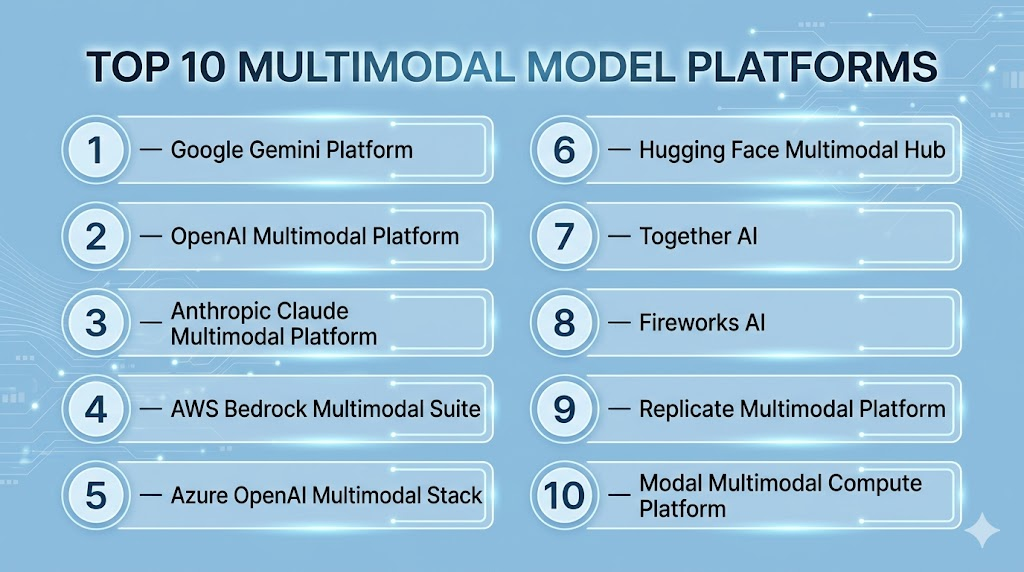
Top 10 Multimodal Model Platforms
#1 — Google Gemini Platform
One-line verdict: Best overall multimodal platform with native text, image, audio, and video understanding.
Short description:
Gemini is designed as a native multimodal system that processes multiple input types in a unified architecture, making it one of the most advanced platforms for cross-modal reasoning.
Standout Capabilities
- Native multimodal architecture (text, image, audio, video)
- Strong long-context reasoning
- Excellent video understanding
- High-quality document and diagram analysis
- Real-time multimodal interaction capabilities
AI-Specific Depth
- Model support: Native multimodal Gemini models
- Vision + audio + video: Fully supported
- RAG: Strong integration with cloud tools
- Evaluation: Built-in benchmarking tools
- Observability: Cloud-native monitoring
Pros
- True multimodal integration (not stitched)
- Strong performance on mixed inputs
- Excellent scalability
Cons
- Complex ecosystem
- Requires cloud dependency
Security & Compliance
- Enterprise-grade cloud security controls
Deployment & Platforms
- Cloud only
Integrations & Ecosystem
- Google Cloud, Vertex AI, BigQuery
Pricing Model
Usage-based cloud pricing
Best-Fit Scenarios
- Video intelligence systems
- Enterprise multimodal AI
- Real-time assistant applications
#2 — OpenAI Multimodal Platform
One-line verdict: Best for high-quality multimodal reasoning and developer-friendly AI APIs.
Short description:
OpenAI platforms support vision, text, and audio capabilities with strong reasoning and agent integration.
Standout Capabilities
- Strong vision reasoning (screenshots, diagrams)
- Audio-based interaction support
- Tool/function calling for agents
- High reasoning accuracy
- Strong ecosystem adoption
AI-Specific Depth
- Model support: Proprietary multimodal models
- Vision/audio: Supported
- Video: Limited/native support varies
- RAG: External integration required
- Observability: Token + request logs
Pros
- High reasoning quality
- Strong developer ecosystem
- Easy API integration
Cons
- Limited full video-native support
- Potential cost scaling
Security & Compliance
- Enterprise controls available
Deployment & Platforms
- Cloud API
Integrations & Ecosystem
- Broad SDK ecosystem and agent frameworks
Pricing Model
Usage-based
Best-Fit Scenarios
- AI copilots
- Vision-based assistants
- Multimodal chat applications
#3 — Anthropic Claude Multimodal Platform
One-line verdict: Best for document + image reasoning with strong safety alignment.
Short description:
Claude excels in analyzing documents, diagrams, and images with high reliability and structured reasoning.
Standout Capabilities
- Strong document + image interpretation
- High-context reasoning
- Safety-focused design
- Reliable structured outputs
AI-Specific Depth
- Model support: Proprietary multimodal models
- Vision: Strong
- Audio/video: Limited support
- RAG: External integration
- Guardrails: Strong built-in alignment
Pros
- Very reliable reasoning
- Excellent for enterprise documents
- Safe outputs
Cons
- Limited multimodal breadth
- No native video-first design
Security & Compliance
- Enterprise-grade offerings available
Deployment & Platforms
- Cloud API
Integrations & Ecosystem
- Enterprise workflow tools
Pricing Model
Usage-based
Best-Fit Scenarios
- Legal and compliance systems
- Document intelligence
- Enterprise assistants
#4 — AWS Bedrock Multimodal Suite
One-line verdict: Best enterprise multimodal platform inside AWS ecosystem.
Short description:
Provides access to multiple multimodal models with enterprise-grade infrastructure and governance.
Standout Capabilities
- Multi-model access
- Enterprise governance controls
- AWS-native integration
- Scalable inference infrastructure
AI-Specific Depth
- Model support: Multiple providers
- Vision/audio: Model-dependent
- RAG: AWS-native
- Observability: CloudWatch
- Guardrails: AWS Guardrails
Pros
- Enterprise-ready
- Flexible model selection
- Strong governance
Cons
- Complex configuration
- Fragmented model behavior
Security & Compliance
- AWS enterprise security stack
Deployment & Platforms
- Cloud (AWS)
Integrations & Ecosystem
- S3, Lambda, SageMaker
Pricing Model
Usage-based
Best-Fit Scenarios
- Enterprise AI systems
- Multi-model multimodal pipelines
- AWS-native applications
#5 — Azure OpenAI Multimodal Stack
One-line verdict: Best for secure enterprise multimodal AI in Microsoft ecosystem.
Short description:
Provides multimodal AI capabilities integrated with Azure’s enterprise infrastructure.
Standout Capabilities
- Vision + text reasoning
- Enterprise-grade governance
- Secure deployment options
- Microsoft ecosystem integration
AI-Specific Depth
- Model support: OpenAI models via Azure
- Vision/audio: Supported
- RAG: Azure AI Search
- Observability: Azure Monitor
Pros
- Strong compliance
- Enterprise security
- Deep integration with Microsoft tools
Cons
- Slower iteration
- Complex setup
Security & Compliance
- Azure enterprise security standards
Deployment & Platforms
- Cloud (Azure)
Integrations & Ecosystem
- Microsoft 365, Power Platform
Pricing Model
Usage-based
Best-Fit Scenarios
- Enterprise workflows
- Regulated industries
- Microsoft-heavy organizations
#6 — Hugging Face Multimodal Hub
One-line verdict: Best open-source multimodal ecosystem for experimentation and deployment.
Short description:
Provides access to a large collection of multimodal models and deployment tools.
Standout Capabilities
- Wide open-source model support
- Vision + language models
- Easy deployment endpoints
- Strong community ecosystem
AI-Specific Depth
- Model support: Open-source multimodal models
- Vision/audio/video: Varies by model
- RAG: External
- Evaluation: External tools
Pros
- Huge model ecosystem
- Flexible experimentation
- Easy prototyping
Cons
- Inconsistent performance
- Limited enterprise governance
Security & Compliance
- Varies by deployment setup
Deployment & Platforms
- Cloud + self-host
Integrations & Ecosystem
- Hugging Face ecosystem tools
Pricing Model
Usage-based or self-hosted
Best-Fit Scenarios
- Research
- Prototyping multimodal apps
- Open-source deployments
#7 — Together AI
One-line verdict: Best for scalable open-source multimodal model hosting.
Short description:
Focuses on hosting and scaling open multimodal models efficiently.
Standout Capabilities
- Open-source multimodal hosting
- Fine-tuning support
- Scalable inference
- API-first architecture
AI-Specific Depth
- Model support: Open-source models
- Vision/audio: Model-dependent
- RAG: External
- Observability: Basic metrics
Pros
- Flexible deployment
- Strong OSS support
- Cost-efficient scaling
Cons
- Limited enterprise tooling
- Requires engineering setup
Security & Compliance
- Not fully standardized publicly
Deployment & Platforms
- Cloud API
Integrations & Ecosystem
- Hugging Face compatible
Pricing Model
Usage-based
Best-Fit Scenarios
- Open-source multimodal systems
- Custom AI pipelines
- Research applications
#8 — Fireworks AI
One-line verdict: Best for fast multimodal inference optimization.
Short description:
Optimized for low-latency multimodal model serving.
Standout Capabilities
- High-speed inference
- Optimized GPU usage
- Real-time multimodal performance
- Scalable APIs
AI-Specific Depth
- Model support: Mixed models
- Vision/audio: Supported depending on model
- RAG: External
- Observability: Performance metrics
Pros
- Very fast inference
- Efficient infrastructure
- Developer-friendly
Cons
- Limited governance tools
- Smaller ecosystem
Security & Compliance
- Not fully publicly stated
Deployment & Platforms
- Cloud API
Integrations & Ecosystem
- LLM orchestration tools
Pricing Model
Usage-based
Best-Fit Scenarios
- Real-time multimodal apps
- Chat + vision systems
- High-throughput workloads
#9 — Replicate Multimodal Platform
One-line verdict: Best for rapid multimodal experimentation and prototyping.
Short description:
Provides API access to a wide variety of multimodal models.
Standout Capabilities
- Large model variety
- Simple API access
- Fast experimentation
- Community models
AI-Specific Depth
- Model support: Open-source + community
- Vision/audio/video: Varies
- RAG: External
- Observability: Basic logs
Pros
- Very easy to use
- Wide experimentation scope
- Fast prototyping
Cons
- Not enterprise-grade
- Limited control
Security & Compliance
- Not standardized
Deployment & Platforms
- Cloud API
Integrations & Ecosystem
- Developer experimentation ecosystem
Pricing Model
Usage-based
Best-Fit Scenarios
- Prototyping multimodal apps
- Research experiments
- Model testing
#10 — Modal Multimodal Compute Platform
One-line verdict: Best serverless GPU platform for multimodal workloads.
Short description:
Serverless GPU platform for running multimodal AI pipelines.
Standout Capabilities
- Serverless GPU execution
- Auto-scaling workloads
- Flexible multimodal pipelines
- Python-native deployment
AI-Specific Depth
- Model support: Custom/open-source
- Vision/audio/video: User-defined
- RAG: External
- Observability: Execution logs
Pros
- Flexible compute
- Easy scaling
- Developer-friendly
Cons
- Requires setup effort
- Not plug-and-play
Security & Compliance
- Not fully publicly detailed
Deployment & Platforms
- Serverless cloud
Integrations & Ecosystem
- Python ML ecosystem
Pricing Model
Compute-based
Best-Fit Scenarios
- Custom multimodal pipelines
- AI infrastructure workloads
- Dynamic workloads
Comparison Table
| Platform | Best For | Deployment | Modalities | Strength | Watch-Out | Public Rating |
|---|---|---|---|---|---|---|
| Gemini | Full multimodal AI | Cloud | Text/Image/Audio/Video | Native multimodal | Ecosystem complexity | N/A |
| OpenAI | General multimodal apps | Cloud | Text/Image/Audio | Reasoning quality | Limited video | N/A |
| Claude | Document + image reasoning | Cloud | Text/Image | Safety + accuracy | Limited modalities | N/A |
| AWS Bedrock | Enterprise multimodal | Cloud | Multi-model | Governance | Complexity | N/A |
| Azure OpenAI | Enterprise AI | Cloud | Text/Image/Audio | Security | Slower updates | N/A |
| Hugging Face | OSS multimodal | Cloud/self | Mixed | Flexibility | Inconsistency | N/A |
| Together AI | OSS scaling | Cloud | Mixed | Cost efficiency | Limited governance | N/A |
| Fireworks AI | Fast inference | Cloud | Mixed | Speed | Smaller ecosystem | N/A |
| Replicate | Experimentation | Cloud | Mixed | Simplicity | Not enterprise-ready | N/A |
| Modal | Serverless compute | Cloud | Custom | Flexibility | Setup complexity | N/A |
Scoring & Evaluation (Transparent Rubric)
| Platform | Core | Reliability | Guardrails | Integrations | Ease | Perf/Cost | Security | Support | Weighted Total |
|---|---|---|---|---|---|---|---|---|---|
| Gemini | 10 | 9 | 9 | 9 | 8 | 8 | 9 | 9 | 8.9 |
| OpenAI | 9 | 9 | 8 | 9 | 9 | 8 | 8 | 9 | 8.7 |
| Claude | 9 | 9 | 9 | 8 | 9 | 8 | 9 | 8 | 8.8 |
| AWS Bedrock | 9 | 8 | 8 | 10 | 7 | 8 | 10 | 9 | 8.6 |
| Azure OpenAI | 9 | 8 | 9 | 10 | 7 | 8 | 10 | 9 | 8.6 |
| Hugging Face | 8 | 7 | 7 | 9 | 9 | 8 | 7 | 8 | 8.0 |
| Together AI | 8 | 7 | 6 | 8 | 8 | 9 | 7 | 7 | 7.8 |
| Fireworks AI | 8 | 8 | 6 | 7 | 8 | 10 | 7 | 7 | 7.9 |
| Replicate | 7 | 6 | 5 | 7 | 10 | 8 | 6 | 6 | 7.0 |
| Modal | 8 | 7 | 6 | 8 | 8 | 9 | 7 | 7 | 7.7 |
Which Multimodal Platform Is Right for You
Solo / Developers
- Replicate
- Hugging Face
- OpenAI
Startups / SMBs
- Fireworks AI
- Together AI
- OpenAI
Mid-Market
- AWS Bedrock
- Gemini
- Modal
Enterprise
- Azure OpenAI
- AWS Bedrock
- Gemini
Regulated Industries
- Azure OpenAI
- AWS Bedrock
- Claude
Implementation Playbook (30 / 60 / 90 Days)
30 Days
- Test multimodal APIs (text + image first)
- Define use cases (vision, audio, video)
- Build baseline evaluation set
- Measure latency and cost
60 Days
- Add RAG pipelines
- Introduce observability and tracing
- Implement safety filters
- Run multimodal stress tests
90 Days
- Optimize routing and cost
- Deploy production workloads
- Add governance and RBAC
- Scale multimodal agents
Common Mistakes & How to Avoid Them
- Treating multimodal as “just vision + text”
- Ignoring video cost explosion
- No evaluation benchmarks for images/audio
- Poor latency planning for multimodal inputs
- Missing fallback models
- No safety filters for images/audio
- Overloading single model for all modalities
- Weak observability setup
- No RAG optimization
- Lack of agent orchestration design
- Ignoring token cost spikes in vision
- No production stress testing
- Skipping data governance
- Not separating modalities in pipelines
FAQs
1. What is a multimodal model platform?
A platform that supports multiple input types like text, images, audio, and video in one AI system.
2. Why are multimodal models important?
They enable AI to understand real-world data more like humans by combining different sensory inputs.
3. Which is the most advanced multimodal platform?
Platforms like Gemini and OpenAI currently lead in native multimodal reasoning.
4. Do all models support video?
No, only some platforms support native video understanding.
5. What is native multimodal AI?
It means the model is trained on multiple modalities together, not added later as separate systems.
6. Is multimodal AI expensive?
Yes, especially video and high-resolution image processing.
7. Can multimodal models do real-time voice?
Yes, many support real-time audio interaction.
8. What is multimodal RAG?
It combines retrieval systems with text, images, and other inputs.
9. Are multimodal platforms secure?
Enterprise platforms provide strong security, but configuration is critical.
10. Can I build agents with multimodal models?
Yes, most modern platforms support agent workflows.
11. What industries use multimodal AI?
Healthcare, finance, education, customer support, and media.
12. What is the biggest challenge in multimodal AI?
Cost, latency, and cross-modal reasoning consistency.
Conclusion
Multimodal Model Platforms represent the next evolution of AI systems, enabling unified reasoning across text, images, audio, and video. The most advanced platforms are now natively multimodal, meaning they are designed from the ground up to process multiple data types together rather than stitching them externally. The best platform depends on your use case—whether it is enterprise governance, developer flexibility, or real-time multimodal intelligence—but long-term success depends on balancing performance, cost, and true cross-modal understanding.

Find Trusted Cardiac Hospitals
Compare heart hospitals by city and services — all in one place.
Explore Hospitals
Nice overview of multimodal model platforms. It explains the key features and differences in a simple way, making it easier to compare options.