
Introduction
Open-Source Model Hub Platforms are centralized repositories where developers, researchers, and organizations can discover, share, host, and deploy machine learning models—especially large language models (LLMs), vision models, and multimodal systems. Think of them as the “GitHub for AI models,” enabling collaboration, reproducibility, and faster AI development.
These platforms go beyond simple storage—they provide versioning, datasets, demos, APIs, and increasingly, deployment and evaluation tools. The rise of open-source AI has made these hubs critical infrastructure for building modern AI systems.
Real-world use cases include:
- Discovering and downloading pretrained models for NLP, vision, and audio
- Sharing fine-tuned models within teams or communities
- Hosting private enterprise model registries
- Rapid prototyping with public datasets and demos
- Building RAG systems with open datasets
- Benchmarking and evaluating models across domains
When evaluating these platforms, buyers should consider:
- Model catalog size and diversity
- Open-source licensing transparency
- Dataset availability and integration
- Versioning and collaboration features
- Inference and deployment capabilities
- Evaluation and benchmarking tools
- Security, access control, and governance
- API and SDK support
- Community activity and ecosystem
- Vendor lock-in risk
Open-source model hubs are now foundational to AI development, with platforms like Hugging Face hosting hundreds of thousands of models and datasets across domains.
Best for: AI engineers, ML researchers, startups, and enterprises building AI with open-source models.
Not ideal for: teams needing fully managed proprietary AI solutions with strict SLAs and minimal customization.
What’s Changed in Open-Source Model Hub Platforms
- Explosion of community-contributed models and datasets
- Rise of multimodal model hubs (text, vision, audio, video)
- Growth of private model registries for enterprises
- Integration of inference APIs directly inside hubs
- Emergence of model versioning and lineage tracking
- Built-in evaluation and benchmarking pipelines
- Support for agent workflows and tool chaining
- Increasing focus on model governance and licensing clarity
- Expansion of fine-tuning and training pipelines
- Growth of regional hubs (e.g., Asia-focused platforms)
- Adoption of OpenAI-compatible APIs
- Integration with CI/CD pipelines for ML workflows
Quick Buyer Checklist (Scan-Friendly)
- Does it support your model types (LLM, vision, multimodal)?
- Are licensing and usage rights clearly defined?
- Can you host private models securely?
- Does it support datasets and RAG workflows?
- Are evaluation tools built-in?
- Can you deploy models directly from the hub?
- Does it integrate with your ML stack?
- Is there strong community support?
- What are the governance and access controls?
- How easy is model versioning and collaboration?
- Is there risk of vendor lock-in?
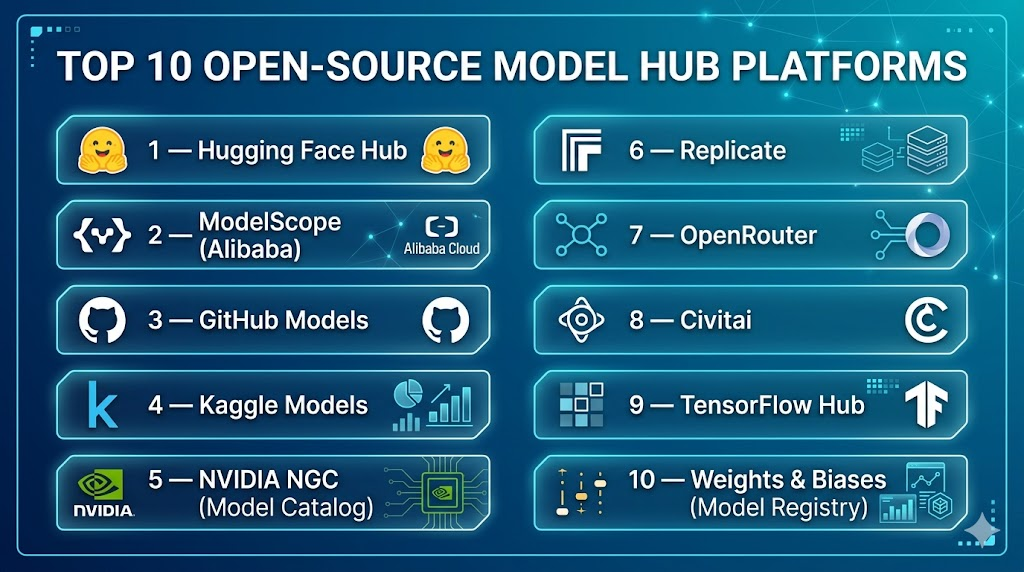
Top 10 Open-Source Model Hub Platforms
#1 — Hugging Face Hub
One-line verdict: Best overall open-source model hub with unmatched ecosystem and community adoption.
Short description:
The largest and most widely used platform for hosting, sharing, and deploying AI models, datasets, and applications.
Standout Capabilities
- Massive model and dataset library (hundreds of thousands)
- Supports NLP, vision, audio, and multimodal models
- Spaces for deploying demos and apps
- Integrated inference APIs
- Strong community and documentation
- Model versioning and collaboration tools
- Enterprise features (private hubs, governance)
AI-Specific Depth
- Model support: Open-source + some proprietary
- RAG / knowledge integration: Strong dataset hub
- Evaluation: Community benchmarks + tools
- Guardrails: Basic + external integrations
- Observability: API metrics
Pros
- Largest ecosystem
- Easy to use
- Strong community
Cons
- Can be overwhelming
- Some enterprise features paid
Security & Compliance
- SSO, private repos, enterprise controls (details vary)
Deployment & Platforms
- Web, APIs, cloud-hosted
Integrations & Ecosystem
- Transformers, Gradio, PyTorch, TensorFlow, APIs
Pricing Model
Freemium + enterprise
Best-Fit Scenarios
- Model discovery
- Open-source collaboration
- Rapid prototyping
#2 — ModelScope (Alibaba)
One-line verdict: Best for large-scale multilingual and Asia-focused model ecosystems.
Short description:
A comprehensive model hub offering diverse AI models across NLP, vision, and speech.
Standout Capabilities
- Strong multilingual model support
- Large model repository
- Integrated training and deployment tools
- Active developer ecosystem
AI-Specific Depth
- Model support: Open-source
- RAG: Dataset integration
- Evaluation: Platform tools
- Guardrails: Limited
- Observability: Basic
Pros
- Strong in Asian markets
- Diverse model support
- Growing ecosystem
Cons
- Smaller global adoption
- Documentation varies
Deployment & Platforms
- Web + APIs
Integrations & Ecosystem
- Alibaba Cloud ecosystem
Pricing Model
Not publicly stated
Best-Fit Scenarios
- Multilingual AI
- Asia-focused deployments
- Research
#3 — GitHub Models
One-line verdict: Best for developers wanting model access integrated with Git workflows.
Short description:
A model catalog integrated into GitHub with APIs and developer tooling.
Standout Capabilities
- Git-based versioning
- OpenAI-compatible APIs
- Integration with repositories
- Developer-first experience
AI-Specific Depth
- Model support: Open + hosted
- RAG: External
- Evaluation: Limited
- Guardrails: Basic
- Observability: Usage metrics
Pros
- Familiar workflow
- Strong developer ecosystem
- Easy collaboration
Cons
- Newer platform
- Limited advanced features
Deployment & Platforms
- Web + APIs
Integrations & Ecosystem
- GitHub ecosystem, CI/CD
Pricing Model
Not publicly stated
Best-Fit Scenarios
- Dev teams
- CI/CD workflows
- Model versioning
#4 — Kaggle Models
One-line verdict: Best for dataset discovery and experimentation-driven AI workflows.
Short description:
A platform for datasets, models, and notebooks with strong community engagement.
Standout Capabilities
- Massive dataset library
- Notebook-based experimentation
- Community competitions
- Easy prototyping
AI-Specific Depth
- Model support: Open-source
- RAG: Strong dataset integration
- Evaluation: Competition benchmarks
- Guardrails: N/A
- Observability: Limited
Pros
- Great for learning
- Strong community
- Easy experimentation
Cons
- Not production-focused
- Limited deployment features
Deployment & Platforms
- Web
Integrations & Ecosystem
- Google ecosystem
Pricing Model
Free
Best-Fit Scenarios
- Learning AI
- Prototyping
- Dataset exploration
#5 — NVIDIA NGC (Model Catalog)
One-line verdict: Best for GPU-optimized models and enterprise AI deployments.
Short description:
A curated catalog of models and containers optimized for NVIDIA hardware.
Standout Capabilities
- GPU-optimized models
- Containerized deployments
- Enterprise-ready
- Integration with NVIDIA stack
AI-Specific Depth
- Model support: Open + proprietary
- RAG: External
- Evaluation: Limited
- Guardrails: N/A
- Observability: Enterprise tools
Pros
- High performance
- Enterprise-ready
- Optimized for GPUs
Cons
- NVIDIA dependency
- Smaller community
Deployment & Platforms
- Cloud + on-prem
Integrations & Ecosystem
- CUDA, TensorRT
Pricing Model
Varies / N/A
Best-Fit Scenarios
- GPU-heavy workloads
- Enterprise AI
- Production systems
#6 — Replicate
One-line verdict: Best for simple API-based access to open models without infrastructure overhead.
Short description:
A platform for running open-source models via simple APIs.
Standout Capabilities
- One-call model execution
- Large model catalog
- Hosted inference
- Easy integration
AI-Specific Depth
- Model support: Open-source
- RAG: External
- Evaluation: Limited
- Guardrails: Basic
- Observability: Usage metrics
Pros
- Simple API
- No infrastructure needed
- Fast setup
Cons
- Less control
- Usage-based cost
Deployment & Platforms
- Cloud
Integrations & Ecosystem
- APIs, SDKs
Pricing Model
Usage-based
Best-Fit Scenarios
- Rapid prototyping
- API-based apps
- Startups
#7 — OpenRouter
One-line verdict: Best for unified access to multiple LLMs via a single API.
Short description:
A model routing and catalog platform that aggregates multiple LLM providers.
Standout Capabilities
- Multi-model routing
- Unified API
- Access to open + closed models
- Cost optimization
AI-Specific Depth
- Model support: Multi-model
- RAG: External
- Evaluation: Limited
- Guardrails: Basic
- Observability: Usage tracking
Pros
- Flexibility
- Easy switching
- Cost optimization
Cons
- Not a pure model hub
- Depends on providers
Deployment & Platforms
- Cloud
Integrations & Ecosystem
- APIs, developer tools
Pricing Model
Usage-based
Best-Fit Scenarios
- Multi-model apps
- Cost optimization
- API abstraction
#8 — Civitai
One-line verdict: Best for community-driven generative image and diffusion models.
Short description:
A platform focused on sharing and discovering diffusion models and fine-tuned variants.
Standout Capabilities
- Large diffusion model library
- Community contributions
- LoRA and embeddings support
- Visual model previews
AI-Specific Depth
- Model support: Open-source (image models)
- RAG: N/A
- Evaluation: Community-driven
- Guardrails: Minimal
- Observability: N/A
Pros
- Strong community
- Visual focus
- Easy discovery
Cons
- Limited to image models
- Less enterprise-ready
Deployment & Platforms
- Web
Integrations & Ecosystem
- Stable Diffusion ecosystem
Pricing Model
Free
Best-Fit Scenarios
- Generative art
- Diffusion workflows
- Creative AI
#9 — TensorFlow Hub
One-line verdict: Best for TensorFlow-native model discovery and integration.
Short description:
A repository of reusable machine learning models designed for TensorFlow workflows.
Standout Capabilities
- Pretrained TensorFlow models
- Easy integration into pipelines
- Google-backed ecosystem
- Reliable performance
AI-Specific Depth
- Model support: Open-source
- RAG: External
- Evaluation: Limited
- Guardrails: N/A
- Observability: Limited
Pros
- Stable ecosystem
- Easy integration
- Trusted platform
Cons
- Less flexible outside TensorFlow
- Smaller community vs Hugging Face
Deployment & Platforms
- Web + APIs
Integrations & Ecosystem
- TensorFlow ecosystem
Pricing Model
Free
Best-Fit Scenarios
- TensorFlow projects
- Production pipelines
- ML engineering
#10 — Weights & Biases (Model Registry)
One-line verdict: Best for experiment tracking combined with model registry capabilities.
Short description:
A platform focused on experiment tracking, evaluation, and model lifecycle management.
Standout Capabilities
- Experiment tracking
- Model registry
- Evaluation tools
- Collaboration features
AI-Specific Depth
- Model support: Custom + open
- RAG: External
- Evaluation: Strong
- Guardrails: N/A
- Observability: Advanced metrics
Pros
- Strong evaluation tools
- Great for teams
- Mature platform
Cons
- Not a pure model hub
- Requires setup
Deployment & Platforms
- Cloud
Integrations & Ecosystem
- ML frameworks, pipelines
Pricing Model
Freemium
Best-Fit Scenarios
- ML teams
- Experiment tracking
- Model lifecycle
Comparison Table
| Tool Name | Best For | Deployment | Model Flexibility | Strength | Watch-Out | Public Rating |
|---|---|---|---|---|---|---|
| Hugging Face | General use | Cloud | High | Largest ecosystem | Complexity | N/A |
| ModelScope | Multilingual AI | Cloud | High | Asia focus | Adoption | N/A |
| GitHub Models | Dev workflows | Cloud | Medium | Git integration | New platform | N/A |
| Kaggle | Learning | Cloud | Medium | Datasets | Not production | N/A |
| NVIDIA NGC | Enterprise AI | Hybrid | Medium | GPU optimization | Lock-in | N/A |
| Replicate | API access | Cloud | Medium | Simplicity | Cost | N/A |
| OpenRouter | Multi-model | Cloud | High | Flexibility | Dependency | N/A |
| Civitai | Image models | Web | Low | Community | Narrow focus | N/A |
| TensorFlow Hub | TF workflows | Cloud | Medium | Stability | Ecosystem limit | N/A |
| Weights & Biases | ML ops | Cloud | Medium | Evaluation | Not hub-first | N/A |
Scoring & Evaluation (Transparent Rubric)
| Tool | Core | Reliability/Eval | Guardrails | Integrations | Ease | Perf/Cost | Security/Admin | Support | Weighted Total |
|---|---|---|---|---|---|---|---|---|---|
| Hugging Face | 10 | 9 | 7 | 10 | 9 | 8 | 9 | 10 | 9.1 |
| ModelScope | 9 | 8 | 6 | 8 | 7 | 8 | 7 | 8 | 7.9 |
| GitHub Models | 8 | 7 | 6 | 9 | 9 | 8 | 8 | 9 | 8.2 |
| Kaggle | 8 | 7 | 5 | 8 | 10 | 9 | 7 | 9 | 8.1 |
| NVIDIA NGC | 9 | 8 | 6 | 8 | 7 | 9 | 9 | 8 | 8.3 |
| Replicate | 8 | 7 | 6 | 8 | 9 | 7 | 7 | 8 | 7.8 |
| OpenRouter | 8 | 7 | 6 | 9 | 8 | 8 | 7 | 8 | 7.9 |
| Civitai | 7 | 6 | 5 | 6 | 9 | 8 | 6 | 7 | 7.1 |
| TensorFlow Hub | 8 | 7 | 5 | 8 | 8 | 8 | 7 | 8 | 7.8 |
| Weights & Biases | 8 | 9 | 6 | 9 | 7 | 8 | 9 | 9 | 8.4 |
Top 3 for Enterprise
- Hugging Face
- NVIDIA NGC
- Weights & Biases
Top 3 for SMB
- Kaggle
- Replicate
- GitHub Models
Top 3 for Developers
- Hugging Face
- GitHub Models
- OpenRouter
Which Open-Source Model Hub Platform Is Right for You
Solo / Freelancer
- Kaggle
- Civitai
- Hugging Face
SMB
- Replicate
- GitHub Models
- Hugging Face
Mid-Market
- Weights & Biases
- ModelScope
- OpenRouter
Enterprise
- Hugging Face
- NVIDIA NGC
- Weights & Biases
Regulated industries (finance/healthcare/public sector)
- Hugging Face (private hubs)
- NVIDIA NGC
- Weights & Biases
Budget vs premium
- Budget: Kaggle, TensorFlow Hub
- Premium: Hugging Face Enterprise, NGC
Build vs buy (when to DIY)
- Build when full control is required
- Use hubs when speed and collaboration matter
Implementation Playbook (30 / 60 / 90 Days)
30 Days
- Select platform
- Identify use cases
- Test model discovery and downloads
- Define evaluation metrics
60 Days
- Integrate datasets (RAG)
- Implement model versioning
- Set up evaluation workflows
- Add access controls
90 Days
- Scale usage across teams
- Optimize deployment pipelines
- Implement governance policies
- Monitor usage and performance
Common Mistakes & How to Avoid Them
- Ignoring model licensing
- No evaluation pipeline
- Poor dataset integration
- Lack of version control
- Over-reliance on public models
- No governance controls
- Ignoring security risks
- No observability
- Poor documentation practices
- Vendor lock-in
- No collaboration workflows
- Skipping validation before deployment
FAQs
1. What is a model hub platform?
A platform for hosting, sharing, and discovering AI models and datasets.
2. Are all models open-source?
No, some hubs host mixed-license models.
3. Can I host private models?
Yes, many platforms support private repositories.
4. Do model hubs support deployment?
Some provide built-in inference APIs.
5. What is RAG in model hubs?
Using datasets to augment model responses.
6. Are these platforms free?
Most have free tiers with paid enterprise features.
7. Which is the most popular?
Hugging Face is the most widely used.
8. Can enterprises use open-source hubs?
Yes, with private and secure deployments.
9. Do they support multimodal models?
Yes, most modern hubs do.
10. What is the biggest risk?
Licensing and compliance issues.
11. Can I fine-tune models on these platforms?
Some platforms support it directly.
12. Are alternatives available?
Yes, several specialized hubs exist.
Conclusion
Open-source model hub platforms are the backbone of modern AI development, enabling rapid innovation, collaboration, and deployment. The right choice depends on your use case—whether it’s experimentation, production, or enterprise governance—but success comes from combining the right platform with strong evaluation, security, and integration practices.

Find Trusted Cardiac Hospitals
Compare heart hospitals by city and services — all in one place.
Explore Hospitals