
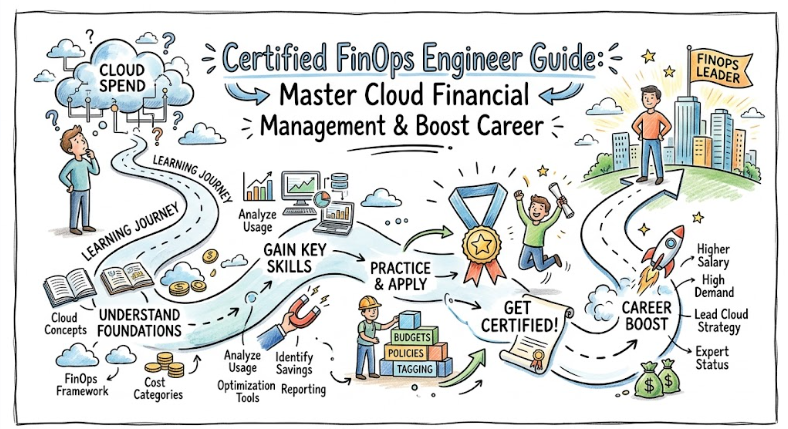
In the current landscape of cloud-native infrastructure, the ability to manage cloud costs is no longer just a finance problem; it is a fundamental engineering requirement. The Certified FinOps Engineer is a specialized credential designed for professionals who want to bridge the gap between cloud operations and financial accountability. This guide is crafted for DevOps, SRE, and Platform Engineers who need to master the art of cloud financial management to drive efficiency in their organizations. By following this roadmap, engineers and managers can navigate the complexities of cloud billing, optimization, and cultural change. As a primary resource for this domain, finopsschool provides the structured learning necessary to transition from a traditional engineer to a cost-aware architect.
What is the Certified FinOps Engineer?
The Certified FinOps Engineer represents a shift from reactive cost-cutting to proactive cloud financial health. Unlike traditional certifications that focus solely on cloud provider tools, this program emphasizes a production-focused approach to the FinOps lifecycle: Inform, Optimize, and Operate. It exists to provide a standardized framework for engineers to communicate with finance teams while maintaining the velocity of development. The curriculum is designed to align with modern engineering workflows, ensuring that cost optimization becomes a sprint-level consideration rather than a quarterly surprise.
Who Should Pursue Certified FinOps Engineer?
This certification is highly beneficial for Cloud Engineers, Site Reliability Engineers (SREs), and Platform Engineers who manage large-scale cloud environments. It is equally relevant for Engineering Managers and Technical Leaders who are responsible for departmental budgets and unit economics. In the Indian market, where global delivery centers are scaling rapidly, and in the global enterprise space, professionals who can prove they reduce “cloud waste” are in high demand. Beginners looking to enter the “Ops” spectrum will find it a powerful differentiator, while experienced veterans can use it to pivot into Cloud Financial Management roles.
Why Certified FinOps Engineer is Valuable and Beyond
The demand for FinOps expertise is surging as organizations realize that uncontrolled cloud spending can neutralize the benefits of digital transformation. This certification provides long-term career longevity because it focuses on principles—visibility, allocation, and optimization—that remain relevant even as cloud providers change their pricing models. It helps professionals stay relevant in a competitive market by proving they possess a “business-first” engineering mindset. The return on time investment is significant, as companies are actively seeking leaders who can implement automated cost-governance policies.
Certified FinOps Engineer Certification Overview
The program is delivered via the official curriculum and hosted on finopsschool.com. It utilizes a practical assessment approach that moves beyond multiple-choice questions to evaluate how an engineer handles real-world billing data and architectural inefficiencies. The certification levels are structured to take a candidate from foundational understanding to advanced strategic execution. It is owned and maintained by industry practitioners who ensure the content reflects current enterprise challenges in multi-cloud and hybrid environments.
Certified FinOps Engineer Certification Tracks & Levels
The certification is divided into Foundation, Professional, and Advanced levels to cater to different stages of a career. The Foundation level focuses on terminology and the FinOps framework, while the Professional level dives deep into technical implementation and automation. Advanced levels are aimed at architects who design cost-efficient systems from the ground up. These tracks allow professionals to specialize in areas like FinOps for Kubernetes or FinOps for Big Data, ensuring a clear path for career progression from an individual contributor to a strategic leader.
Complete Certified FinOps Engineer Certification Table
| Track | Level | Who it’s for | Prerequisites | Skills Covered | Recommended Order |
| Core FinOps | Foundation | Junior Engineers / Managers | Basic Cloud Knowledge | Lifecycle, Personas, Phases | 1st |
| Engineering | Professional | SRE / DevOps / Cloud Eng | 2+ Years Cloud Exp | Automation, Unit Metrics | 2nd |
| Architecture | Advanced | Solutions Architects | Professional Level | Multi-cloud, Governance | 3rd |
| Specialized | Kubernetes | Platform Engineers | CKA Knowledge | Container Cost Allocation | Optional |
Detailed Guide for Each Certified FinOps Engineer Certification
Certified FinOps Engineer – Foundation Level
What it is
This certification validates a professional’s understanding of the FinOps language and the core principles of the FinOps Foundation framework. It ensures the candidate can navigate the phases of cloud financial management.
Who should take it
It is ideal for beginners in the cloud space, finance professionals working with tech teams, and junior DevOps engineers who need to understand how cloud billing works.
Skills you’ll gain
- Understanding cloud variable spend models.
- Mastery of FinOps terminology and personas.
- Ability to identify the three phases: Inform, Optimize, and Operate.
- Knowledge of cost allocation and tagging strategies.
Real-world projects you should be able to do
- Create a basic tagging policy for a small development team.
- Generate a monthly cloud spend report categorized by department.
Preparation plan
- 7–14 days: Review the official handbook and practice core terminology.
- 30 days: Analyze a sample cloud bill and practice mapping costs to tags.
- 60 days: Implement a mock reporting dashboard using standard cloud tools.
Common mistakes
- Focusing only on cost-cutting instead of value realization.
- Ignoring the cultural aspect of FinOps and collaboration.
Best next certification after this
- Same-track: Certified FinOps Engineer – Professional
- Cross-track: CKA (Certified Kubernetes Administrator)
- Leadership: Engineering Management Professional
Certified FinOps Engineer – Professional Level
What it is
This level validates the technical ability to implement automation and advanced optimization strategies. It proves you can technically execute what the framework suggests.
Who should take it
Experienced SREs and DevOps engineers who are responsible for production environments and want to automate cost governance.
Skills you’ll gain
- Advanced rightsizing and instance selection.
- Implementing automated cleanup scripts and “shut-down” policies.
- Calculating unit economics and cost per transaction.
- Managing Reserved Instances and Savings Plans programmatically.
Real-world projects you should be able to do
- Build an automated workflow that alerts engineers when a resource exceeds its budget.
- Optimize a production cluster to reduce monthly spend by 20% without losing performance.
Preparation plan
- 7–14 days: Focus on cloud-native cost management APIs.
- 30 days: Build hands-on scripts for resource scheduling and rightsizing.
- 60 days: Conduct a deep-dive audit of a complex multi-cloud billing account.
Common mistakes
- Over-optimizing at the cost of system reliability.
- Failing to automate the reporting process.
Best next certification after this
- Same-track: Certified FinOps Engineer – Advanced
- Cross-track: DevSecOps Professional
- Leadership: FinOps Lead / Director
Choose Your Learning Path
DevOps Path
For DevOps professionals, the focus is on integrating cost metrics into the CI/CD pipeline. You will learn how to make cost a “non-functional requirement” similar to security or performance. This path emphasizes using Infrastructure as Code to enforce budget constraints and automated tagging. It ensures that every deployment is evaluated for its financial impact before it hits production.
DevSecOps Path
The DevSecOps path looks at cost management through the lens of compliance and risk. Unmanaged cloud resources are not just a financial drain but also a security vulnerability. You will learn to use FinOps data to identify “shadow IT” and orphaned resources that could be exploited. This path focuses on the intersection of resource governance, policy-as-code, and cost-efficient security tooling.
SRE Path
Site Reliability Engineers use FinOps to balance the “Error Budget” with the “Financial Budget.” This path focuses on architectural efficiency, ensuring that high availability does not lead to unnecessary spending. You will master the art of rightsizing and performance tuning to achieve the best possible cost-to-performance ratio. SREs learn to treat cost as a key performance indicator for system health.
AIOps Path
In the AIOps path, professionals learn to use machine learning models to predict future cloud spend and detect anomalies. This involves using data science to analyze historical billing patterns and automate complex forecasting. You will focus on building intelligent systems that can automatically adjust resource allocation based on predicted demand and price fluctuations.
MLOps Path
MLOps professionals focus on the unique cost challenges of machine learning workloads, such as GPU utilization and data egress fees. This path covers the financial management of training pipelines and model deployment at scale. You will learn how to optimize expensive compute resources and manage the lifecycle of large datasets without breaking the budget.
DataOps Path
The DataOps path addresses the massive costs associated with data storage, ETL processes, and big data querying. Professionals in this track learn how to optimize data architectures for cost-efficient processing. You will focus on tiered storage strategies and optimizing query performance to reduce the financial impact of data-driven decision-making in the enterprise.
FinOps Path
This is the core path for those dedicated to the Cloud Financial Management profession. It focuses on the bridge between finance, procurement, and engineering departments. You will learn how to lead a FinOps practice, manage organizational change, and drive a culture of accountability. This path is designed for those who want to become FinOps Practitioners or Directors.
Role → Recommended Certified FinOps Engineer Certifications
| Role | Recommended Certifications |
| DevOps Engineer | Foundation + Professional (Engineering Track) |
| SRE | Professional + Advanced Architecture |
| Platform Engineer | Foundation + Kubernetes Specialization |
| Cloud Engineer | Foundation + Professional |
| Security Engineer | Foundation + DevSecOps Integration |
| Data Engineer | Foundation + DataOps Specialization |
| FinOps Practitioner | All Levels (Foundation to Advanced) |
| Engineering Manager | Foundation + Leadership Module |
Next Certifications to Take After Certified FinOps Engineer
Same Track Progression
Once you have mastered the engineering side of FinOps, the logical next step is to move into FinOps Architecture or Strategy. This involves looking at enterprise-wide governance and multi-cloud optimization. You will move from managing individual accounts to designing global cost-control frameworks for massive organizations.
Cross-Track Expansion
To become a more versatile engineer, consider expanding into DevSecOps or SRE domains. Understanding how security and reliability interact with cost provides a holistic view of the cloud lifecycle. Broadening your skills ensures that you can lead multi-disciplinary teams that deliver efficient, secure, and resilient software.
Leadership & Management Track
For those aiming for executive roles, moving into technical leadership or MBA-style management programs is beneficial. You can transition into roles like “Head of Cloud Infrastructure” or “Director of Cloud Operations.” These roles require a combination of technical FinOps knowledge and strategic business acumen to manage large-scale budgets and teams.
Training & Certification Support Providers for Certified FinOps Engineer
DevOpsSchool
DevOpsSchool provides a robust ecosystem for technical professionals looking to master the integration of financial metrics into their delivery pipelines. They offer instructor-led training that focuses on the practical application of FinOps principles within a DevOps context. Their courses are designed to help engineers understand how to automate cost governance using popular tools like Terraform and Jenkins.
Cotocus
Cotocus is known for its deep dive into cloud-native technologies and provides specialized support for FinOps engineering. Their training modules are highly technical, focusing on the architectural changes required to optimize large-scale cloud environments. They provide hands-on labs that simulate real-world billing scenarios, allowing candidates to practice cost-allocation and optimization strategies in a safe environment.
Scmgalaxy
Scmgalaxy acts as a comprehensive knowledge hub for software configuration and operations management. They provide extensive resources and community support for professionals pursuing FinOps certifications. Their platform is excellent for those looking for community-driven insights, practice questions, and peer-to-peer learning to supplement their formal certification preparation.
BestDevOps
BestDevOps focuses on career-oriented training that prepares engineers for the evolving demands of the IT industry. Their FinOps curriculum is tailored to bridge the gap between technical execution and business requirements. They emphasize the “why” behind FinOps, ensuring that students can justify architectural decisions to stakeholders while maintaining technical excellence.
devsecopsschool.com
This provider specializes in the intersection of security, development, and operations. For FinOps, they offer unique insights into how resource governance and cost management contribute to a more secure cloud environment. Their training helps professionals identify how reducing “cloud sprawl” can simultaneously lower costs and minimize the attack surface of an organization.
sreschool.com
SRESchool focuses on the reliability aspect of engineering, where cost is treated as a critical system metric. Their FinOps training is designed for SREs who need to maintain high availability while adhering to strict financial constraints. They teach candidates how to use observability tools to track cloud spend and performance in real-time.
aiopsschool.com
AIOps School is the primary destination for learning how to apply artificial intelligence to IT operations. Their FinOps-related content covers the use of machine learning for predictive billing and anomaly detection. This is essential for engineers who want to build self-healing, cost-optimizing systems that act autonomously to stay within budget.
dataopsschool.com
DataOps School addresses the specific financial challenges of data-intensive organizations. Their training focuses on the cost of data at rest and data in motion. They provide specialized guidance on optimizing storage costs, managing egress fees, and ensuring that big data projects remain financially viable as they scale to petabytes of information.
finopsschool.com
FinOpsSchool is the dedicated authority for this certification, providing the core curriculum and assessment framework. They offer a comprehensive suite of resources, from foundational bootcamps to advanced architectural workshops. As the primary hosting site, they ensure all content is up-to-date with the latest cloud provider updates and industry best practices.
Frequently Asked Questions (General)
- How difficult is the Certified FinOps Engineer exam?
The difficulty is moderate to high, depending on your cloud experience. It requires a mix of theoretical knowledge of the framework and practical ability to read bills. - How much time is needed to prepare for the foundation level?
Most professionals with cloud experience can prepare in 2 to 4 weeks by dedicating an hour each day to the study material. - Are there any prerequisites for the professional level?
While not mandatory, having at least two years of experience in cloud operations or a previous cloud provider certification is highly recommended. - Is this certification recognized globally?
Yes, the principles taught are universal and applicable to any organization using AWS, Azure, Google Cloud, or hybrid environments. - Does this certification focus on a specific cloud provider?
No, it is cloud-agnostic. It teaches principles that apply across all major providers, focusing on the FinOps Foundation’s standardized framework. - What is the typical salary impact after getting certified?
Professionals often see a significant salary increase as “Cloud Financial Management” is currently a high-priority niche for large enterprises. - How often do I need to recertify?
Typically, the certification is valid for two to three years, after which you may need to pass an update exam to stay current with the framework. - Can a non-technical person take this exam?
The foundation level is suitable for non-technical roles like finance or procurement, but the professional level requires technical engineering skills. - What tools will I learn to use during the preparation?
You will learn to use cloud-native cost explorers, tagging APIs, and third-party optimization platforms like CloudHealth or Apptio. - Is there a hands-on lab component in the exam?
The professional and advanced levels often include scenario-based questions that simulate real-world architectural and billing challenges. - How does this differ from a standard Cloud Architect certification?
A Cloud Architect focuses on how to build, while a FinOps Engineer focuses on how to build efficiently and manage the ongoing costs of that architecture. - Is there a community for certified professionals?
Yes, there is a large global community of practitioners who share best practices, job opportunities, and case studies regularly.
FAQs on Certified FinOps Engineer
- What is the primary goal of a Certified FinOps Engineer?
The goal is to ensure that every dollar spent in the cloud drives maximum business value through visibility and optimization. - How does FinOps help in a multi-cloud environment?
It provides a single language and framework to manage costs consistently across different providers like AWS, Azure, and GCP. - Can FinOps be integrated into Scrum or Agile?
Absolutely. Cost should be treated as a story point or a non-functional requirement in every sprint planning session. - What is “Unit Economics” in the context of FinOps?
It is the practice of measuring cloud cost against a business metric, such as “cost per customer login” or “cost per transaction.” - Why is tagging so important for this certification?
Tagging is the foundation of cost allocation. Without accurate tags, you cannot hold specific teams or departments accountable for their spend. - How do I handle “Shared Costs” like support fees?
The certification teaches various models for proportionally allocating shared costs across the teams that benefit from them. - Is automated rightsizing safe for production?
The course teaches you how to implement guardrails and testing to ensure that automated changes do not impact system stability. - What is the “Inform” phase in the FinOps lifecycle?
It is the first phase where the focus is on achieving complete visibility into cloud spend and accurately allocating those costs.
Final Thoughts: Is Certified FinOps Engineer Worth It?
As a mentor who has seen the transition from on-premise servers to the “blank check” era of early cloud adoption, I can tell you that the era of unmonitored spending is over. Companies are no longer satisfied with just “being in the cloud”; they want to be in the cloud efficiently. The Certified FinOps Engineer is not just another badge; it is a signal to the market that you understand the business of engineering. If you enjoy solving complex puzzles and want to be the person who saves your company millions while keeping systems fast, this is the right path. It is a practical, high-impact investment in your career that will remain relevant for as long as companies use the cloud.

Find Trusted Cardiac Hospitals
Compare heart hospitals by city and services — all in one place.
Explore Hospitals
Good and easy-to-follow guide on the Certified FinOps Engineer path. It simplifies cloud cost management concepts and shows how the certification can support career growth.