
Introduction
Autonomous Task Automation Platforms are AI-driven systems that perform end-to-end workflows with minimal human intervention. They orchestrate tasks across applications, trigger automated decision-making, and integrate multiple AI models for complex workflows. These platforms are critical as businesses seek to streamline operations, reduce latency, and maintain compliance while leveraging AI.
Real-world use cases include:
- Automating repetitive IT and customer support tasks
- Coordinating multi-step data pipelines in analytics and ML ops
- Orchestrating cross-application business processes in finance or HR
- Managing agentic workflows in marketing campaigns or product operations
- Automating DevOps pipelines including testing, deployment, and monitoring
- Handling multimodal inputs like text, images, and voice for dynamic responses
When evaluating these platforms, buyers should consider:
- Model flexibility and routing options
- Integration ecosystem and API availability
- Evaluation and reliability metrics
- Guardrails and security features
- Observability and cost tracking
- Deployment options cloud, hybrid, or on-prem
- Data privacy, retention, and compliance controls
- Ease of use and performance optimization
- Support, training, and community
- Pricing and scalability
- BYO model compatibility
- Vendor lock-in risk
Best for: Enterprises, mid-market businesses, and developers needing robust AI automation and orchestration.
Not ideal for: Small teams with limited AI complexity or when lightweight task scheduling tools suffice.
What’s Changed in Autonomous Task Automation Platforms
- AI agentic workflows now support tool-calling and multi-step orchestration across applications
- Multi-modal inputs like text, image, and voice are increasingly standard
- Evaluation frameworks monitor hallucinations and reliability
- Guardrails mitigate prompt injection, policy violations, and unsafe outputs
- Enterprise privacy requirements enforce strict data residency and retention policies
- Cost and latency optimizations include intelligent model routing and resource allocation
- Observability dashboards provide token-level metrics, execution traces, and usage analytics
- Governance and compliance features are expected in regulated industries
- Open-source and BYO models reduce vendor lock-in
- Integration with RAG pipelines and vector stores supports knowledge-driven automation
- Advanced security includes RBAC, audit logs, and SSO/SAML support
- AI evaluation harnesses are built into production pipelines for ongoing quality control
Quick Buyer Checklist
- Data privacy & retention controls
- Model choice hosted, BYO, or open-source
- Knowledge integration or RAG support
- Evaluation and testing pipelines
- Guardrails and policy enforcement
- Latency & cost monitoring
- Observability and audit logs
- Vendor lock-in risk
- Deployment flexibility
- Support and community availability
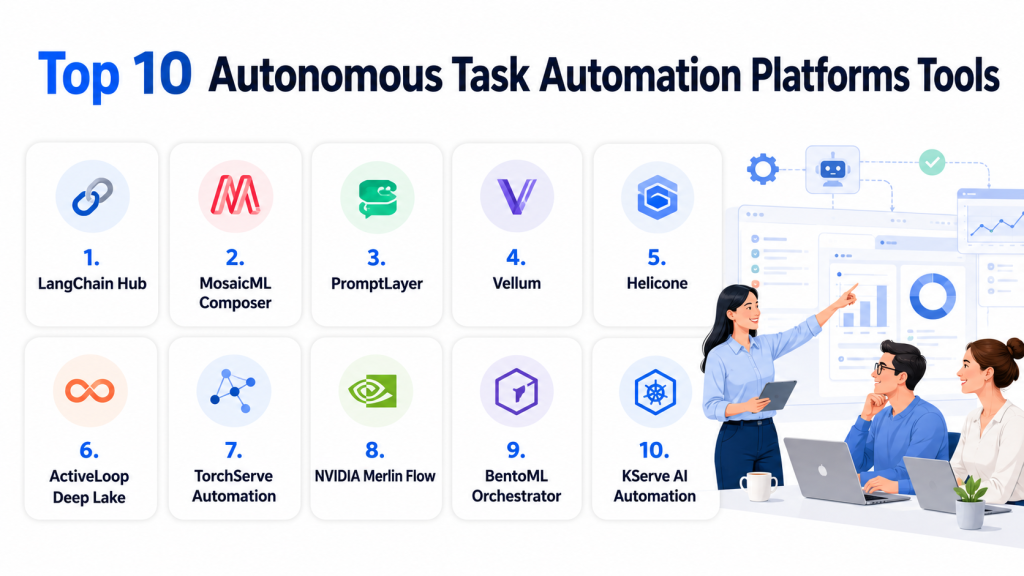
Top 10 Autonomous Task Automation Platforms Tools
1- LangChain Hub
One-line verdict: Ideal for developers building agentic AI workflows with customizable multi-model pipelines.
Short description: LangChain Hub simplifies orchestration for multi-step AI tasks across APIs, vector stores, and LLMs, suitable for developers and enterprises.
Standout Capabilities
- Pre-built chains and templates
- Multi-LLM orchestration
- Integrations with vector databases and cloud services
- Fine-grained debugging and monitoring
- Supports Python and JavaScript SDKs
- Agentic reasoning and planning
- Workflow version control
AI-Specific Depth
- Model support: Proprietary, open-source, BYO, multi-model
- RAG / knowledge integration: Connectors, vector DB
- Evaluation: Prompt testing, regression
- Guardrails: Policy checks, injection defense
- Observability: Traces, token usage, latency
Pros
- Flexible and modular
- Strong integrations
- Open architecture
Cons
- Requires coding knowledge
- Limited out-of-the-box enterprise UX
- Complex for small teams
Security & Compliance
Not publicly stated
Deployment & Platforms
Web, Cloud, Varies N/A
Integrations & Ecosystem
APIs, SDKs, plugin ecosystem, integration with databases, messaging tools, extensibility
Pricing Model
Not publicly stated
Best-Fit Scenarios
- Developer-first automation projects
- Multi-model AI pipelines
- Agentic task orchestration
2- MosaicML Composer
One-line verdict: Enterprise-grade platform for automated AI pipelines with cost-efficient model orchestration.
Short description: Composer handles automated training, fine-tuning, and execution of AI agents for scalable enterprise tasks.
Standout Capabilities
- Optimized for ML training
- Prebuilt orchestration workflows
- Model fine-tuning automation
- Integration with cloud compute resources
- Multi-agent task pipelines
- Cost and latency monitoring
- Observability dashboards
AI-Specific Depth
- Model support: Proprietary, open-source, BYO
- RAG / knowledge integration: N/A
- Evaluation: Offline evaluation, monitoring
- Guardrails: Policy checks, safety constraints
- Observability: Resource usage, token metrics
Pros
- High efficiency
- Strong enterprise support
- Optimized compute and cost
Cons
- Steep learning curve
- Not for small teams
- Limited non-ML task automation
Security & Compliance
Not publicly stated
Deployment & Platforms
Cloud, Web interface, Varies N/A
Integrations & Ecosystem
Cloud compute APIs, data connectors, SDKs, workflow integrations, monitoring dashboards
Pricing Model
Tiered enterprise
Best-Fit Scenarios
- Enterprise AI orchestration
- Training-heavy automation pipelines
- Multi-agent ML tasks
3- PromptLayer
One-line verdict: Perfect for tracking and versioning prompts in multi-agent AI workflows.
Short description: Tracks prompt history, evaluates effectiveness, and manages prompt lifecycle for AI teams.
Standout Capabilities
- Centralized prompt logging
- Supports multiple LLM providers
- Metrics tracking
- Workflow debugging
- Integration with CI/CD pipelines
AI-Specific Depth
- Model support: Hosted, BYO
- RAG / knowledge integration: N/A
- Evaluation: Regression testing, prompt benchmarking
- Guardrails: N/A
- Observability: Prompt traces, token usage
Pros
- Detailed observability
- Reduces prompt drift
- Integrates with workflows
Cons
- Limited standalone automation
- Developer-centric UI
- Requires integration setup
Security & Compliance
Not publicly stated
Deployment & Platforms
Web, Cloud
Integrations & Ecosystem
APIs, LLM integrations, CI/CD, agent orchestration
Pricing Model
Usage-based, tiered
Best-Fit Scenarios
- Prompt version control
- Multi-agent debugging
- Experimentation & evaluation
4- Vellum
One-line verdict: Enterprise operations platform for visual AI workflows and automated orchestration.
Short description: Vellum provides drag-and-drop interfaces for AI agents, workflow planning, and enterprise automation.
Standout Capabilities
- Visual workflow editor
- Drag-and-drop orchestration
- Integration with APIs
- Multi-agent execution tracking
- Evaluation dashboards
AI-Specific Depth
- Model support: BYO, multi-model
- RAG / knowledge integration: Connectors supported
- Evaluation: Offline, human review
- Guardrails: Safety checks, prompt injection defenses
- Observability: Execution tracing, token monitoring
Pros
- User-friendly visual interface
- Enterprise integrations
- Workflow tracking
Cons
- Less flexible for developers
- Enterprise licensing required
- Learning curve for complex workflows
Security & Compliance
Not publicly stated
Deployment & Platforms
Web, Cloud, Hybrid
Integrations & Ecosystem
Enterprise APIs, SDKs, plugin support, knowledge bases, vector DBs, cloud services
Pricing Model
Tiered enterprise
Best-Fit Scenarios
- Enterprise workflow automation
- Multi-agent orchestration
- Visual workflow monitoring
5- Helicone
One-line verdict: Optimized for cost observability and analytics in autonomous AI pipelines.
Short description: Helicone provides monitoring, caching, and cost analytics for AI models, aiding operational transparency.
Standout Capabilities
- Cost tracking and token analytics
- Intelligent caching
- Multi-agent monitoring
- Open-source and hosted
- Dashboard for observability
AI-Specific Depth
- Model support: Hosted, open-source, BYO
- RAG / knowledge integration: N/A
- Evaluation: Offline evaluation
- Guardrails: N/A
- Observability: Token-level metrics, caching performance
Pros
- Reduces operational cost
- Transparent model usage
- Easy workflow integration
Cons
- Focused on analytics, not orchestration
- Limited workflow features
- Less visual interface
Security & Compliance
Not publicly stated
Deployment & Platforms
Web, Cloud, Hybrid
Integrations & Ecosystem
API integration, dashboards, analytics connectors, workflow hooks
Pricing Model
Usage-based, tiered
Best-Fit Scenarios
- Cost-optimized workflows
- Multi-agent observability
- Model usage tracking
6- ActiveLoop Deep Lake
One-line verdict: Ideal for AI-native data lake integration and vector-based autonomous task workflows.
Short description: Provides storage, querying, and streaming for AI datasets, enabling efficient multi-agent operations.
Standout Capabilities
- Native vector storage
- Streaming support
- Multi-agent access controls
- ML pipeline integration
- Scalable data infrastructure
AI-Specific Depth
- Model support: Open-source, BYO
- RAG / knowledge integration: Vector DB compatible
- Evaluation: N/A
- Guardrails: N/A
- Observability: Usage metrics, query tracing
Pros
- High-performance data ops
- Supports multi-agent workflows
- Scalable and open-source
Cons
- Requires ML expertise
- Less UI/UX focus
- Limited orchestration features
Security & Compliance
Not publicly stated
Deployment & Platforms
Cloud, On-prem, Web
Integrations & Ecosystem
Python SDK, vector DB connectors, ML pipeline hooks, streaming API
Pricing Model
Tiered, open-source + enterprise
Best-Fit Scenarios
- AI-native data orchestration
- Vector search integration
- Multi-agent pipelines
7- TorchServe Automation
One-line verdict: Best for deploying and orchestrating PyTorch-based models in AI pipelines.
Short description: Automates model serving, monitoring, and scaling for PyTorch AI agents and workflows.
Standout Capabilities
- Model versioning and deployment
- Scalable serving infrastructure
- Multi-agent support
- Metrics collection and monitoring
- CI/CD integration
AI-Specific Depth
- Model support: BYO PyTorch
- RAG / knowledge integration: N/A
- Evaluation: Offline regression tests
- Guardrails: N/A
- Observability: Tracing, metrics, logs
Pros
- Seamless PyTorch integration
- Production-scale support
- Flexible deployment
Cons
- Limited non-PyTorch support
- Developer-centric
- Less end-to-end orchestration
Security & Compliance
Not publicly stated
Deployment & Platforms
Cloud, On-prem, Web, Linux
Integrations & Ecosystem
CI/CD, monitoring, Python SDK, model registry hooks
Pricing Model
Open-source, enterprise tiered
Best-Fit Scenarios
- PyTorch automation
- Multi-agent AI pipelines
- Production serving
8- NVIDIA Merlin Flow
One-line verdict: Suited for recommendation AI automation and multi-agent orchestration.
Short description: End-to-end AI workflow automation for recommendation engines, including multi-step orchestration.
Standout Capabilities
- GPU-optimized execution
- Multi-agent orchestration
- Model evaluation metrics
- ML ops pipeline integration
- Pre-built recommender templates
AI-Specific Depth
- Model support: Proprietary, open-source
- RAG / knowledge integration: N/A
- Evaluation: Offline evaluation
- Guardrails: Policy enforcement
- Observability: Metrics, traces
Pros
- GPU-optimized
- Strong ML integration
- Workflow templates
Cons
- Focused on recommendation systems
- Enterprise-oriented
- Learning curve
Security & Compliance
Not publicly stated
Deployment & Platforms
Cloud, Hybrid, Web
Integrations & Ecosystem
GPU APIs, ML pipelines, Python SDK, monitoring hooks
Pricing Model
Tiered enterprise
Best-Fit Scenarios
- Recommendation pipelines
- GPU-accelerated tasks
- Multi-agent orchestration
9- BentoML Orchestrator
One-line verdict: Developer-friendly platform for deploying, testing, and automating multi-model AI services.
Short description: Simplifies AI service deployment with multi-model routing, testing, and orchestration.
Standout Capabilities
- Multi-model routing
- Versioning and rollback
- Automated testing hooks
- CI/CD integration
- Python SDKs
AI-Specific Depth
- Model support: BYO, multi-model
- RAG / knowledge integration: N/A
- Evaluation: Regression, human review
- Guardrails: N/A
- Observability: Metrics, logs
Pros
- Developer-friendly
- Flexible deployment
- Multi-model orchestration
Cons
- Limited enterprise UX
- Python required
- Less visual tools
Security & Compliance
Not publicly stated
Deployment & Platforms
Cloud, On-prem, Web, Linux
Integrations & Ecosystem
Python SDK, CI/CD, monitoring tools, API hooks
Pricing Model
Open-source + enterprise tier
Best-Fit Scenarios
- Developer automation
- Multi-model services
- CI/CD pipelines
10- KServe AI Automation
One-line verdict: Ideal for Kubernetes-native AI pipelines and scalable multi-model serving.
Short description: Automates AI model serving, scaling, and monitoring in Kubernetes environments.
Standout Capabilities
- Kubernetes-native deployment
- Multi-model orchestration
- Autoscaling and monitoring
- Model version control
- CI/CD integration
AI-Specific Depth
- Model support: BYO, multi-model
- RAG / knowledge integration: N/A
- Evaluation: Offline tests
- Guardrails: N/A
- Observability: Metrics, traces, token usage
Pros
- Cloud-native and scalable
- Multi-model orchestration
- Kubernetes integration
Cons
- Requires Kubernetes expertise
- Less visual interface
- Developer-focused
Security & Compliance
Not publicly stated
Deployment & Platforms
Cloud, On-prem, Web, Linux, Kubernetes
Integrations & Ecosystem
K8s API, CI/CD, monitoring tools, Python SDKs
Pricing Model
Open-source, enterprise tier
Best-Fit Scenarios
- Kubernetes AI workflows
- Multi-model deployment
- Scalable production pipelines
Comparison Table
| Tool Name | Best For | Deployment | Model Flexibility | Strength | Watch-Out | Public Rating |
|---|---|---|---|---|---|---|
| LangChain Hub | Developers | Cloud | Multi-model / BYO | Flexible orchestration | Steep learning curve | N/A |
| MosaicML Composer | Enterprise ML | Cloud | BYO / Proprietary | High-performance ML | Learning curve | N/A |
| PromptLayer | Prompt management | Cloud | Hosted / BYO | Prompt observability | Developer-focused | N/A |
| Vellum | Enterprise workflow | Cloud/Hybrid | BYO / Multi-model | Visual orchestration | Enterprise cost | N/A |
| Helicone | Cost analytics | Cloud/Hybrid | Hosted / BYO | Cost transparency | Limited workflow | N/A |
| ActiveLoop Deep Lake | AI data ops | Cloud/On-prem | Open-source / BYO | Vector storage & streaming | ML expertise needed | N/A |
| TorchServe Automation | PyTorch serving | Cloud/On-prem | BYO | PyTorch integration | Developer-centric | N/A |
| NVIDIA Merlin Flow | Recommenders | Cloud/Hybrid | BYO / Proprietary | GPU-optimized | Niche use-case | N/A |
| BentoML Orchestrator | Developer pipelines | Cloud/On-prem | Multi-model / BYO | Developer-friendly | Limited enterprise UX | N/A |
| KServe AI Automation | Kubernetes-native | Cloud/On-prem | Multi-model / BYO | Scalable orchestration | Requires K8s expertise | N/A |
Scoring & Evaluation
Scoring is comparative, not absolute. Weighted Total 0–10 based on Core features, Reliability, Guardrails, Integrations, Ease, Performance & Cost, Security/Admin, Support.
| Tool | Core | Reliability | Guardrails | Integrations | Ease | Perf/Cost | Security/Admin | Support | Weighted Total |
|---|---|---|---|---|---|---|---|---|---|
| LangChain Hub | 9 | 8 | 7 | 9 | 7 | 8 | 7 | 8 | 8.2 |
| MosaicML Composer | 8 | 9 | 8 | 8 | 7 | 9 | 7 | 7 | 8.2 |
| PromptLayer | 7 | 8 | 6 | 7 | 8 | 7 | 6 | 8 | 7.2 |
| Vellum | 8 | 8 | 8 | 8 | 8 | 8 | 7 | 7 | 7.8 |
| Helicone | 7 | 7 | 6 | 7 | 8 | 8 | 6 | 7 | 7.0 |
| ActiveLoop Deep Lake | 8 | 7 | 6 | 8 | 7 | 8 | 6 | 7 | 7.2 |
| TorchServe Automation | 7 | 7 | 6 | 7 | 7 | 8 | 6 | 6 | 6.8 |
| NVIDIA Merlin Flow | 8 | 7 | 7 | 7 | 7 | 8 | 7 | 7 | 7.2 |
| BentoML Orchestrator | 7 | 7 | 6 | 7 | 8 | 7 | 6 | 7 | 6.9 |
| KServe AI Automation | 8 | 8 | 7 | 8 | 7 | 8 | 7 | 7 | 7.6 |
Top 3 for Enterprise: MosaicML Composer, LangChain Hub, Vellum
Top 3 for SMB: LangChain Hub, Vellum, Helicone
Top 3 for Developers: LangChain Hub, PromptLayer, BentoML Orchestrator
Which Tool Is Right for You
Solo / Freelancer
Use LangChain Hub or BentoML for lightweight prototypes and agent orchestration.
SMB
Vellum or Helicone provide visual workflow management and cost observability.
Mid-Market
LangChain Hub or Vellum enable multi-agent automation with moderate governance and scalability.
Enterprise
MosaicML Composer, KServe, or NVIDIA Merlin Flow for high-performance AI orchestration.
Regulated industries
Vellum, KServe, MosaicML with guardrails and auditability.
Budget vs premium
Open-source BYO solutions like LangChain Hub or BentoML for cost-efficiency; premium enterprise tools offer support and scalability.
Build vs buy
DIY with open-source for small teams; enterprises benefit from full-featured platforms.
Implementation Playbook
- 30 days: Pilot workflows, define metrics, integrate evaluation harness
- 60 days: Harden security, apply guardrails, red-teaming, prompt/version control
- 90 days: Optimize cost and latency, enforce governance, scale workflows, monitor observability dashboards
Common Mistakes
- Over-automation without review
- Ignoring prompt injection risks
- No evaluation or regression testing
- Unmanaged data retention
- Poor observability
- Unexpected operational costs
- Vendor lock-in
- Multi-agent conflicts
- Weak security
- Ignoring BYO compatibility
- Insufficient performance monitoring
- Skipping incremental rollout
- Not leveraging integrations
FAQs
1- What are Autonomous Task Automation Platforms?
They automate multi-step AI workflows, reducing human intervention and increasing efficiency.
2- How do they handle multi-agent workflows?
They orchestrate multiple AI agents, routing tasks, monitoring performance, and integrating outputs.
3- Can I bring my own model?
Most platforms support BYO models, integrating proprietary or open-source models.
4- Are these platforms secure for regulated industries?
Security depends on the vendor; many offer SSO, RBAC, audit logs, and guardrails.
5- How is cost managed?
Observability and analytics track token usage, compute costs, and workflow optimization.
6- Can small teams use these platforms?
Yes, developer-friendly or open-source tools like LangChain Hub and BentoML are better for small teams.
7- What evaluation mechanisms exist?
Evaluation includes regression testing, offline tests, human review, and observability metrics.
8- Are there guardrails to prevent AI errors?
Enterprise platforms implement policy checks, prompt injection prevention, and safety constraints.
9- What integrations are typically supported?
APIs, SDKs, cloud connectors, CI/CD hooks, vector DBs, messaging services, and enterprise connectors.
10- How quickly can workflows be implemented?
Small pilots in weeks; enterprise-scale workflows may take 30–90 days for full rollout.
11- Do these platforms support multimodal inputs?
Leading platforms handle text, image, voice, and structured data.
12- How do I switch vendors if needed?
Ensure workflows are modular, use open standards, and maintain export options to reduce lock-in.
Conclusion
Autonomous Task Automation Platforms transform operations by enabling multi-agent workflows, real-time orchestration, and robust observability. The “best” tool depends on company size, workflow complexity, regulatory requirements, and budget. Small teams can leverage open-source platforms for flexibility, while enterprises benefit from full-featured orchestration platforms with security and guardrails. Start with a pilot, evaluate reliability, and scale incrementally. Methodical implementation ensures efficiency, cost control, and governance. Following best practices allows organizations to maximize automation benefits, maintain compliance, and confidently scale AI-driven workflows

Find Trusted Cardiac Hospitals
Compare heart hospitals by city and services — all in one place.
Explore Hospitals
Great article with a clear comparison of Autonomous Task Automation platforms. Very helpful and easy to understand for anyone exploring AI automation tools.