
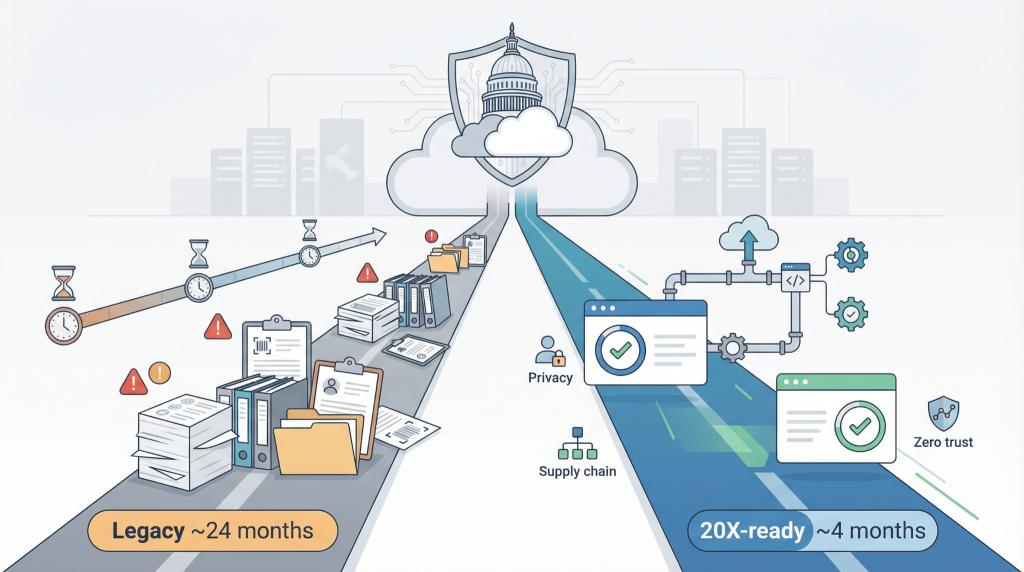
Winning a federal cloud deal still means wrestling with FedRAMP’s 12–24-month timeline. You’re juggling hundreds of NIST SP 800-53 Rev. 5 controls, monthly scans and impatient executives. Yet the FedRAMP Marketplace now lists 400-plus authorized services—proof that faster paths exist.
This guide shows you exactly which risk-assessment platforms cut that timeline and which keep you stuck in the past. We’ll break down the Rev. 5 rule changes, continuous-monitoring mandates and rank the five leading tools on evidence-backed criteria. Ready to pick a side? Let’s dive in.
FedRAMP today: why risk-assessment tools matter more than ever
FedRAMP is no longer a simple checkbox exercise. The Marketplace lists more than 400 authorized cloud services, and GSA’s “FedRAMP 20x” initiative adds dozens each quarter.
That growth brings both opportunity and pressure. Agencies now expect vendors to show up with a polished Authority to Operate, not an “in process” badge.
The bar is also higher. In May 2023, FedRAMP aligned its baselines to NIST SP 800-53 Revision 5, adding sharper privacy, supply-chain, and zero-trust controls. Every new package must clear the Rev 5 threshold.
Meanwhile, the timeline still averages 12–24 months from kickoff to ATO—longer if you pursue a Joint Authorization Board path. That’s a year or two of burn rate, engineering effort, and executive patience; one slip can restart the clock.
The right tooling is the only proven way to compress months of control mapping, document writing, and vulnerability triage into weeks of guided tasks and continuous scans. As you read on, keep one question in mind: does a platform help you outrun the 24-month drag and stay ahead of Rev 5, or will it trap you in a legacy workflow?
How we chose our Top 5: the criteria that separate 20X-ready from legacy
We didn’t rank tools on instinct. We lined them up against the same pain points you and every program manager feel the moment FedRAMP lands on the roadmap.
First, we looked at relevance. A platform had to map directly to FedRAMP Rev. 5 controls, not a dated Rev. 4 template or a vague “NIST-ish” library. Anything less triggers rework when your 3PAO asks for the new supply-chain, privacy, and zero-trust families.
Next came automation. Manual evidence collection keeps ATO timelines hovering around 12–24 months for most vendors. We scored higher when a tool pulls logs, configuration states, and scan results automatically, then drops them into an SSP or POA&M without extra copying.
Continuous monitoring was the third lens. FedRAMP’s job is not finished at signature; monthly vulnerability scans and annual assessments are baseline requirements. We favored platforms that stream scanner data into live dashboards and alert teams before the PMO notices a miss.
Trust mattered, too. When the tool stores your system data, we check its own FedRAMP status. Using an authorized service removes an extra vendor questionnaire and lets you inherit security controls, saving valuable time.
We rounded out the scorecard with usability and cost. A clear interface and guided tasks shorten the learning curve, while transparent, scale-friendly pricing protects your budget from swelling mid-project.
Those five lenses—Rev. 5 readiness, automation depth, continuous-monitoring reach, FedRAMP pedigree, and practical UX-plus-cost—drove every ranking decision that follows.
1. Vanta: evidence automation that turns FedRAMP into a living system, not a one-time scramble
FedRAMP programs slow down for two predictable reasons: teams spend months chasing evidence, then spend the rest of the year proving it stays current. Vanta’s risk management module is built to remove both bottlenecks by continuously pulling evidence from your stack and tying it directly to NIST SP 800-53 Rev. 5 controls.
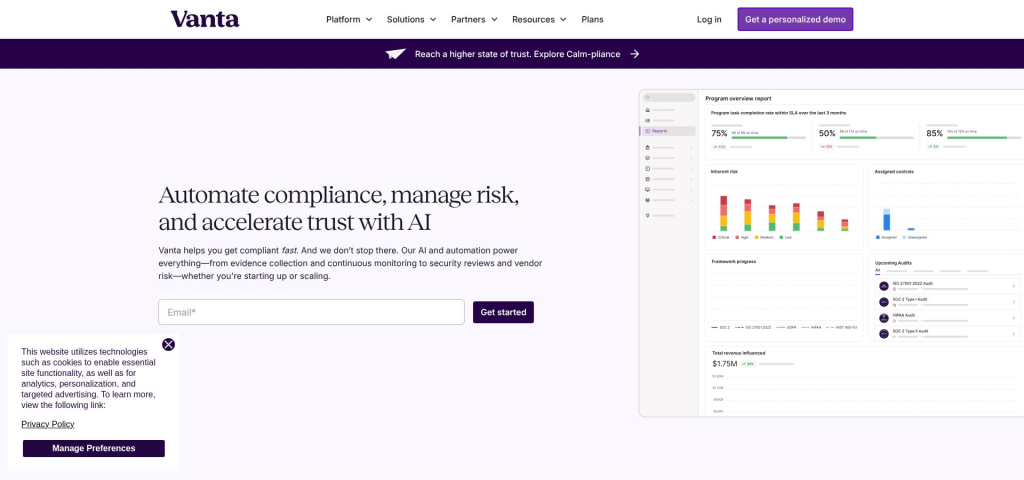
At a baseline level, Vanta is a strong fit for cloud-native teams because it connects to services like AWS, Azure, GitHub, Okta, and more, then collects configuration data, logs, and user activity on an ongoing cadence. Instead of building an SSP (System Security Plan) from screenshots and stale exports, you review the evidence Vanta gathers and use it to drive control narratives and readiness tracking in one place.
Where Vanta stands out is proof, not promises. In Vanta’s Vibrent Health case study, the company achieved FedRAMP Rev. 5 Moderate in four months with a three-person security team.
“Without Vanta, FedRAMP would have taken us six to nine months and a team of six people.”
— CISO, Vibrent Health
Rev. 5 coverage is not an add-on here. Vanta maps to NIST SP 800-53 Rev. 5, including the newer privacy, supply-chain, and zero-trust-aligned expectations that FedRAMP adopted in 2023. That matters because “we wrote it for Rev. 4 and we’ll update later” is exactly how timelines reset when a 3PAO review begins.
Vanta also brings leverage if you are not starting from zero. Its cross-framework mapping can reuse existing evidence; Vibrent Health reported 80–90 percent overlap from HIPAA and GDPR evidence into FedRAMP Rev. 5. That reuse can translate into less rework across audits, fewer duplicate policy cycles, and faster package iteration when priorities change midstream.
FedRAMP trust and operational fit
Vanta itself is FedRAMP Low authorized, which reduces friction when you want to store compliance artifacts in the tool and inherit controls instead of running a separate vendor security review.
Documentation and workflow
Vanta can generate SSP narrative content as evidence arrives. One customer example in the original draft shipped a first-draft SSP in six weeks. POA&M (Plan of Action and Milestones) workflows live alongside control status, so failures are tracked as remediation work instead of disappearing into spreadsheets.
Continuous monitoring
Vanta’s model is “always collecting.” That is the right posture for monthly vulnerability management and ongoing control health, especially when executive pressure is to keep authorization moving while engineering continues shipping.
What to verify for FedRAMP 20x and OSCAL
Vanta’s automation-first approach fits the direction of FedRAMP 20x, which is trending toward machine-readable evidence over narrative-heavy packages. If your program depends on OSCAL-native outputs for submission workflows, confirm Vanta’s current OSCAL export capabilities during evaluation.
Pricing
Vanta is sold as a tiered subscription, with FedRAMP offered as a module. Pricing typically scales with company size and the number of frameworks you run.
Best fit
- Mid-market SaaS teams pursuing FedRAMP Low or Moderate, especially if you already maintain SOC 2, HIPAA, or GDPR and want to reuse evidence instead of rewriting it.
- Lean security teams that need a system to keep evidence fresh without hiring multiple additional compliance-focused roles.
Key limitation
- Vanta’s own FedRAMP authorization is Low. If you are targeting FedRAMP High or operating in highly complex, hybrid boundaries, you may need to pair it with a deeper RMF platform and dedicated security tooling for that environment.
Bottom line: Vanta is “FedRAMP readiness at operational speed.” If your biggest risk is the manual grind of evidence, narratives, and recurring deliverables, it is one of the most direct ways to compress effort without lowering rigor.
2. Thoropass: audit-led FedRAMP execution that keeps software and assessors in one workflow
If your FedRAMP program keeps losing time to the handoff between the tool you use internally and the auditor who will actually sign off, Thoropass is built for that reality. It pairs evidence automation with an in-platform audit relationship, so the artifacts you collect day to day are the same ones your 3PAO reviews, without another round of repackaging.

Thoropass’s defining credibility signal for federal buyers is programmatic, not marketing-led. The platform is designed around a mapped control set that an auditor works inside directly, which aligns with where FedRAMP is heading: continuous, reviewable proof rather than narrative documentation assembled at the last minute. That alignment matters because the biggest FedRAMP schedule risk is rarely a missing control; it is a missing conversation between the team producing evidence and the team assessing it.
On the controls side, Thoropass supports NIST SP 800-53 Rev. 5 mappings, including the privacy, supply-chain, and zero-trust-oriented expectations that became part of the baseline after the 2023 update. For day-to-day execution, the platform focuses on keeping evidence organized by control, owner, and status, so you can respond to auditor questions with a live record instead of reconstructing a snapshot from screenshots.
POA&M and remediation workflow
When a control drifts or a test fails, Thoropass tracks the follow-up as structured remediation work rather than a loose to-do. Findings are tied back to controls and owners, which makes POA&M closure feel like routine operations work instead of a quarterly fire drill before a deliverable is due.
Integrations and environment support
Thoropass is frequently evaluated by teams running the mid-market SaaS stack that powers most federal-targeted products, with integrations spanning major cloud providers, identity platforms, ticketing systems, and common DevOps tools. The key question is not whether Thoropass integrates, but whether it integrates with the systems you use to generate FedRAMP evidence every day.
OSCAL and SSP output expectations
Thoropass’s strength is continuous evidence and audit-connected workflows. If your program requires OSCAL-native exports or fully automated SSP generation as a primary workflow, confirm current capabilities during evaluation, since these are not the most prominently positioned parts of the platform.
Pricing
Thoropass pricing is typically custom and often bundled with audit services, which can make total first-year spend more predictable than buying software and auditors separately.
Best fit
- Teams that want software and auditor workflows to live in the same system, especially for a first or second FedRAMP effort
- Security and compliance leaders prioritizing continuous evidence, auditor visibility, and clear remediation trails
Key limitation
- Thoropass’s differentiation is audit-connected compliance operations, not document-centric FedRAMP package generation. Teams that want end-to-end SSP and OSCAL submission workflows may need to validate fit or pair Thoropass with a more documentation-focused GRC approach.
Bottom line: Thoropass is a strong choice when your goal is to make FedRAMP compliance behave like a single connected program, where the work you do in the platform is the work your auditor sees, continuously and without translation.
3. TrustCloud: graph-based FedRAMP execution for teams that need structure without a blank template
TrustCloud is at its best when your biggest risk is not technical capability, but program drift. If you have a small team, limited federal experience, and a long list of Rev. 5 controls to translate into real work, TrustCloud turns FedRAMP into a structured program by connecting controls, evidence, and risks in one graph, so progress is visible rather than implied.
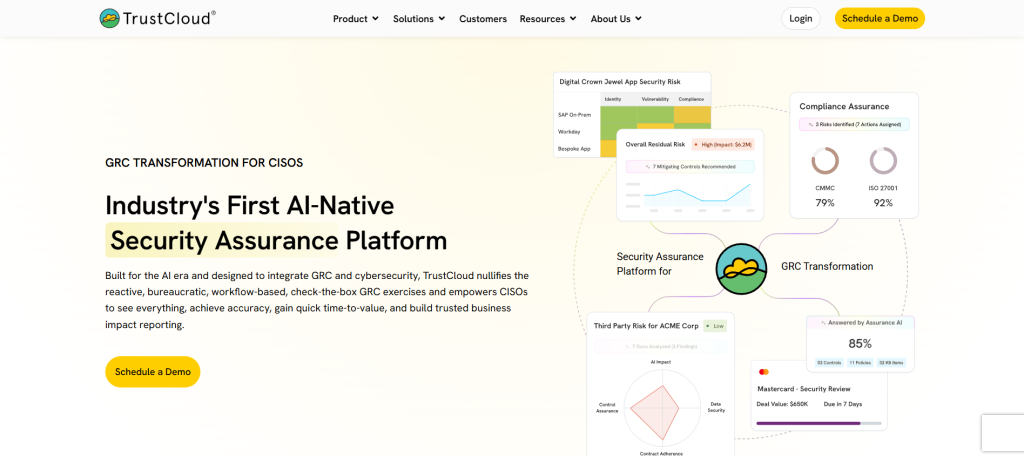
The strongest trust signal for TrustCloud is its focus on modeling compliance the way engineers think about systems: every control has mapped evidence, every risk has a control, and every gap has an owner. For buyers evaluating whether a vendor can keep up with the direction of FedRAMP, that graph-based posture is meaningful. It is not just “Rev. 5 mapped”; it is “controls, evidence, and risk linked by design.”
From there, the product story is about structure. TrustCloud breaks a FedRAMP baseline into actionable work and tracks progress as evidence lands against the graph. Engineers see concrete tasks tied to specific controls rather than abstract control IDs, and completing those tasks updates your documentation and evidence trail. That connection is what compresses the months that normally disappear into coordination.
Documentation and POA&M workflows
TrustCloud is built to keep documentation and remediation tracking aligned as the system changes. Because controls, evidence, and risks share a single data model, gaps surface as structured findings rather than as scattered spreadsheet rows, which makes POA&M closure easier to manage over time.
Environment support
TrustCloud supports integrations across cloud, identity, ticketing, and common DevOps tools, covering the stack most federal-targeted SaaS teams already run. Integration depth can vary by category, so the right approach during evaluation is to validate the specific tools that drive your evidence.
Framework coverage
TrustCloud supports FedRAMP and a broad set of adjacent frameworks, with cross-mapping across its graph so adding frameworks feels incremental rather than duplicative. That breadth is useful when you want one control library to serve FedRAMP plus programs like SOC 2, ISO 27001, HIPAA, GDPR, and PCI DSS.
Time-to-value
TrustCloud is commonly positioned as friendly for earlier-stage teams that want structure without a long services-led rollout. Treat specific timeline claims as directional indicators for what guided execution can unlock, not universal outcomes.
OSCAL diligence note
OSCAL support is not prominently positioned in TrustCloud’s available materials. If your agency sponsor or 3PAO expects OSCAL-native package workflows, confirm export formats during evaluation.
Best fit
- First-time FedRAMP teams that want a structured, opinionated path through Rev. 5 controls
- Organizations expanding into multiple frameworks that benefit from cross-mapping built into the data model rather than bolted on after the fact
Key limitation
- The same graph-based model that creates clarity for standard cloud-native builds can feel different if your team is used to checklist-style compliance UIs. Hybrid boundaries and high-impact systems can also outgrow the default workflow, and you may need deeper customization or a more RMF-heavy platform.
Bottom line: TrustCloud is a strong “get moving and stay moving” choice for FedRAMP, especially when execution discipline, documentation hygiene, and connected controls matter more than building a fully custom GRC system from scratch.
4. Telos Xacta: RMF-native governance for complex, high-impact missions
Xacta is built for the version of FedRAMP most teams try to avoid: large boundaries, multiple stakeholders, and High-impact data where “good enough” documentation does not survive first contact with assessment.
Telos positions Xacta as an end-to-end Risk Management Framework (RMF) platform, and its authorization story supports that enterprise posture. Xacta is FedRAMP High authorized across the full suite. Xacta 360 achieved FedRAMP High in July 2025, and Xacta.io and Xacta.ai received FedRAMP High authorization in April 2026, completing the platform’s FedRAMP High footprint.
That matters for two reasons:
- Trust: you can run the GRC workflow inside a FedRAMP High authorized service.
- Depth: Xacta is designed to manage the full lifecycle, not just collect artifacts.
What Xacta helps you do well
Run RMF with fewer gaps. Xacta ingests cloud asset inventories and supports control inheritance workflows, so your security plan stays connected to what is actually deployed. It tracks controls, assessments, and POA&M items with the kind of audit trail agencies and primes expect when many contributors touch the same package.
Support continuous monitoring as a program, not a calendar reminder. Xacta.io is designed to integrate multiple security tools for real-time risk visibility. With Xacta.ai, Telos adds AI-enhanced insights intended to make that monitoring output more actionable for operators and assessors.
Produce outputs in modern formats. Xacta produces artifacts in traditional document formats and in machine-readable formats including OSCAL. If your roadmap includes automation-heavy submissions and faster package reuse, that capability is increasingly hard to treat as optional.
Where it fits best
Xacta is a strong fit for:
- Federal agencies, prime contractors, and defense integrators managing FedRAMP High or RMF-heavy environments
- Teams juggling multiple regimes in one boundary, including FedRAMP, CMMC, and DoD impact level requirements
- Programs that need structured roles, workflow rigor, and cross-framework requirement libraries, not just a dashboard
Trade-offs to plan for
Xacta’s advantage is also its cost: it is not lightweight. The platform has a real learning curve, and smaller teams often need dedicated compliance analysts to get full value. If your primary goal is speed-to-first-ATO for a straightforward SaaS boundary, a lighter automation platform can feel faster. If your goal is defensible governance at scale, Xacta is built for that job.
Bottom line: Xacta is the enterprise workhorse in this list. It is designed to carry FedRAMP High complexity, multi-framework reporting, and OSCAL-ready outputs without losing control of the audit trail.
5. RegScale: ATO as code, built around OSCAL and FedRAMP 20x realities
RegScale is the most literal interpretation of “compliance automation” in this list. It treats FedRAMP artifacts as machine-readable assets you can version, review, and ship with the same rigor as application code.
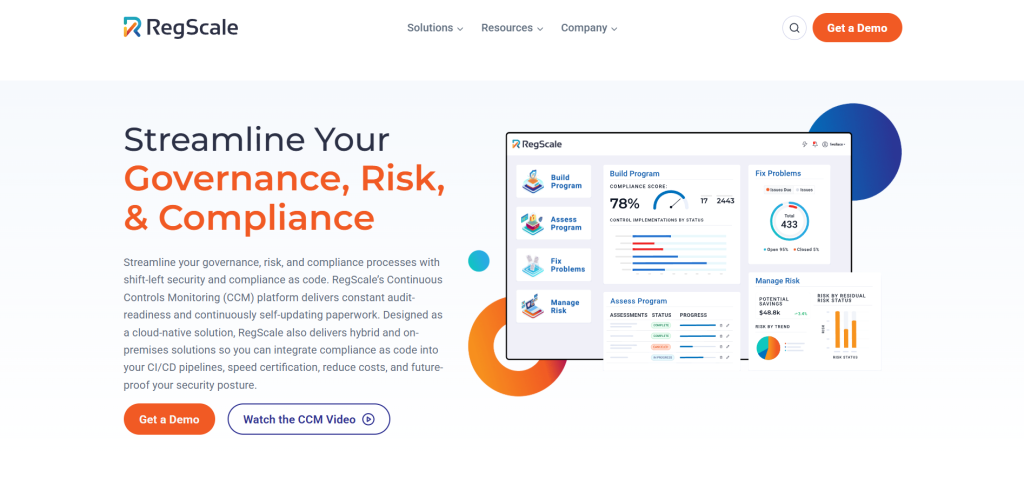
That stance is not theoretical. RegScale is FedRAMP High authorized, and it achieved its own authorization with DHS agency sponsorship in six months. For FedRAMP buyers, that is a meaningful signal that the platform can support High-impact rigor without defaulting to year-long documentation cycles.
OSCAL-native, not OSCAL-export-later
RegScale’s core workflow is built around OSCAL. Controls live as structured data, and teams update implementation details in formats engineers already use (JSON or YAML) and move changes through Git-based review. The platform then refreshes the live SSP and package outputs automatically.
RegScale also leans into where FedRAMP is going next:
- It is a founding member of the OSCAL Foundation
- It participates in FedRAMP 20x community working groups
- It supports FedRAMP 20x KSIs (Key Security Indicators)
- It built OSCAL Hub, an open-source project aimed at simplifying FedRAMP package submission and review
If your roadmap includes FedRAMP 20x-style, machine-readable proof and faster package reuse, this is the most direct alignment in the market.
What you automate with RegScale
SSP production at engineering speed. RegScale cites generating 410+ control implementation statements in two weeks, compared to typical timelines of 12 to 16 weeks. That matters because SSP writing is often the hidden schedule killer, especially when updates lag behind architecture changes.
Evidence pipelines, not evidence hunts. The platform is API-first and built to ingest evidence from infrastructure-as-code and security tooling, including Git workflows, Terraform outputs, Kubernetes configurations, and scanner outputs such as Nessus. Instead of manually curating artifacts, teams push technical proof into the compliance record as part of normal delivery.
Continuous monitoring and continuous ATO support. RegScale is designed for continuous controls monitoring and continuous ATO (cATO) approaches. The USMC-MCCS “Operation StormBreaker” example is positioned as an extreme case of what that can unlock, including a cited 99.97 percent faster ATO and $100 K saved per system per month.
Fit, pricing, and trade-offs
RegScale is best for teams that already think in code and pipelines:
- DevSecOps organizations pursuing continuous ATO pilots
- Enterprises and agencies that require OSCAL-native workflows for FedRAMP packages
- Engineering-forward security teams comfortable with APIs and integration work
Pricing is not publicly disclosed. RegScale positions its approach as reducing overall FedRAMP investment, citing 3–4× faster timelines at about 50 percent of the average cost, with ~$2 M referenced as a typical FedRAMP spend.
The trade-off is usability for non-technical teams. RegScale can require integration scripting, and its workflow assumes comfort with Git, structured data, and automation-first operations. If your program is driven primarily by document editors and manual control narratives, adoption can be slower without engineering buy-in.
Bottom line: RegScale is the strongest pick here when OSCAL, FedRAMP 20x alignment, and “ATO as code” are not slogans, they are requirements.
Conclusion: choosing your FedRAMP tool
Most teams do not “pick one FedRAMP tool.” They build a stack that covers three jobs:
- Package production: SSP content, control implementation statements, inheritance, POA&M workflow
- Evidence operations: continuous collection, freshness tracking, audit trails
- Security signal: vulnerability scanning and cloud-risk detection that produces defensible ConMon artifacts
Step 1: Choose for the authorization model you will be living in
FedRAMP is moving toward 20x, and tool roadmaps matter.
- FedRAMP 20x Phase 1 (Low) completed in September 2025, with 26 CSPs authorized.
- Phase 2 (Moderate) launched in November 2025 as a limited pilot.
- Phase 3 is planned for FY26 with broader eligibility.
- Over time, Rev. 5 agency authorizations will eventually sunset, which increases the value of tools that can support automation-first, machine-readable evidence workflows.
Practical takeaway: favor platforms that can keep evidence current continuously and support structured outputs and integrations, instead of relying on manual narrative updates.
Step 2: Match the tool to your bottleneck, not the vendor’s headline feature
Use these prompts to self-select:
- If documentation is the drag: prioritize SSP generation, control mapping to Rev. 5, and POA&M workflow that stays synced to system change.
- If ConMon is where you miss deadlines: prioritize scanners and monitoring feeds that produce repeatable monthly evidence, plus a workflow layer that turns findings into tracked POA&M closure.
- If your biggest risk is audit chaos: prioritize an evidence system that timestamps artifacts, maps them to controls, and flags staleness before deliverables are due.
Step 3: Decide how much flexibility you can afford
Every acceleration strategy trades something.
- Turnkey environments can compress early timelines by locking you into a reference design.
- Automation-first SaaS platforms reduce manual effort, but you need to confirm fit for your cloud environment and target baseline.
- Enterprise RMF suites handle complexity and multi-framework governance, but they require more process maturity and dedicated operators.
A simple rule of thumb
- Need to move fast with a small team: use a high-automation platform, and pair it with a proven scanner for ConMon.
- Managing FedRAMP High or multiple frameworks: prioritize an RMF-capable GRC platform with strong POA&M and reporting, then layer scanning and cloud-risk tools underneath.
- Budget-constrained but engineering-strong: use self-hosted scaffolding to draft documentation, but plan for additional tooling to cover continuous monitoring and evidence automation.
Whatever stack you choose, insist on three non-negotiables: Rev. 5 control coverage, continuous monitoring integrations, and a roadmap aligned to FedRAMP 20x. Tools that deliver those reliably are the ones that stay useful after the initial ATO, when the real work begins.

I’m Rajesh Kumar, a DevOps, SRE, DevSecOps, Cloud, and Platform Engineering expert passionate about sharing practical knowledge, real-world experiences, and industry best practices. I have worked at Cotocus and regularly write about technology, travel, investing, health, product reviews, and digital marketing through my various platforms.
I publish technical articles at DevOps School, travel stories at Holiday Landmark, stock market insights at Stocks Mantra, health and fitness guidance at My Medic Plus, product reviews at TrueReviewNow, and SEO and digital marketing strategies at Wizbrand.
Find Trusted Cardiac Hospitals
Compare heart hospitals by city and services — all in one place.
Explore Hospitals
Very informative article with a clear comparison of FedRAMP risk assessment tools. Easy to understand and helpful for teams working in government cloud security.